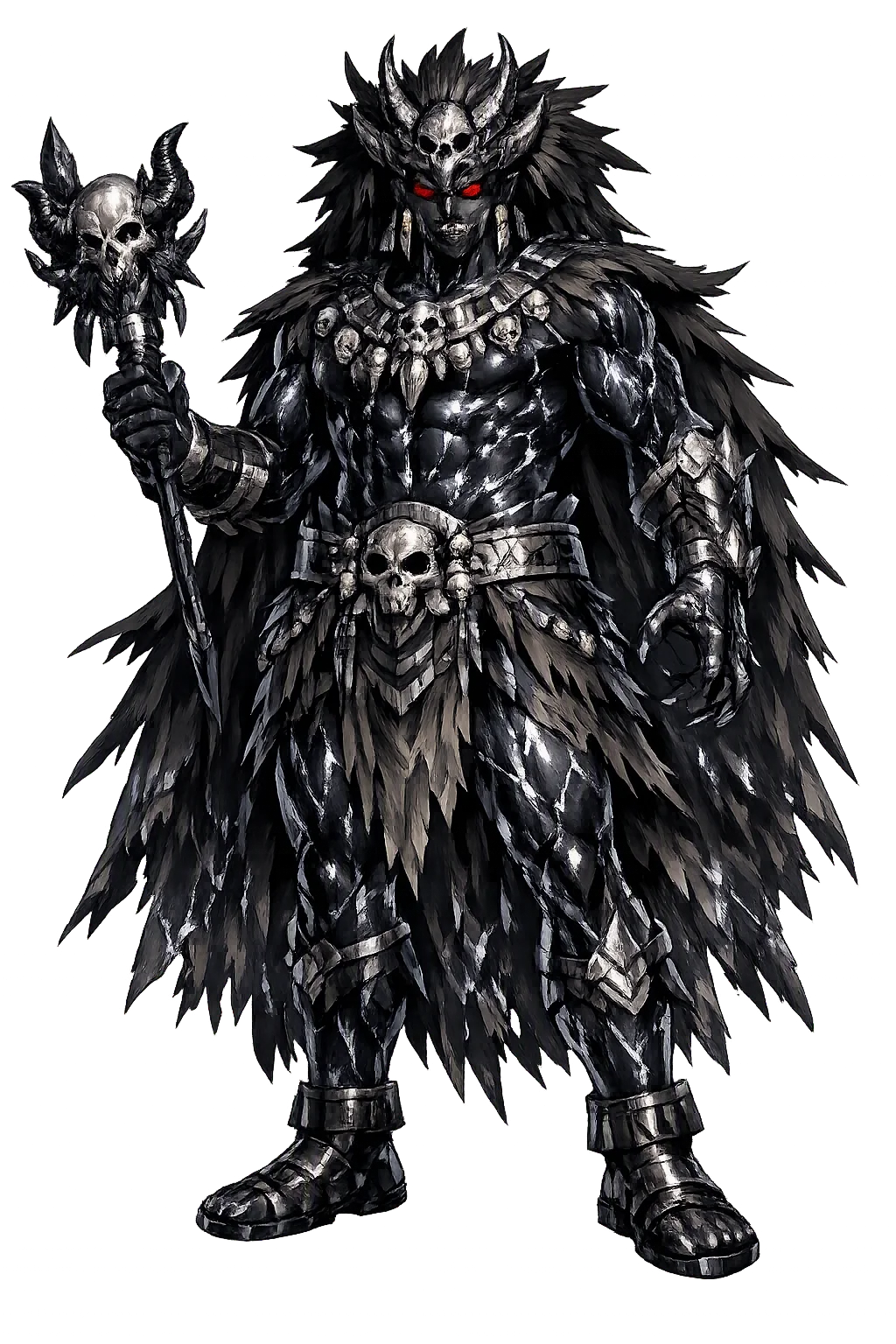
Stories of Supay
No Inca myth cycle of Supay survives on its own terms. Everything we know comes through colonial chroniclers, Quechua-language manuscripts, and the living memory of Andean communities — the record of a lord of the inner world who was propitiated, feared, demonized, and finally renamed, yet never quite dethroned.
The earliest European witness is the corregidor Polo de Ondegardo, whose 1571 report De los errores y supersticiones de los indios explains Inca cosmology as three stacked worlds: hanaq pacha, the upper world; kay pacha, this present world; and uku pacha, the inner world within the earth. The dead descended to uku pacha, Polo reports, and there remained in the power of the being they called Supay. Bernabé Cobo repeats the scheme a century later (Historia del Nuevo Mundo 13.10), adding that the dead were furnished with food, tools, and treasure for the journey down. Nowhere in these accounts is Supay a god of a temple or a priesthood: he is the one who holds the dead, and the offerings made at funerals are essentially payments that keep him from reaching further into the world of the living. The Inca underworld was not a place of punishment but of retention, and Supay was its jailer as much as its king. The belief encodes a sober arithmetic: every death adds to his household, so the living must forever feed the boundary between the worlds.
The Quechua-language Huarochirí manuscript, recorded by the extirpator Francisco de Ávila in the first years of the seventeenth century (trans. Salomon & Urioste, 1991), treats supay not as a single lord but as a class of dangerous beings — the supaykuna — who dwell in caves, springs, hills, and crossroads and send illness to those who offend them. The most famous haunt is the cavern of Tambillos, near San Pedro de Huarochirí, where the people made offerings of coca and maize beer so that the spirits of the rock would not take their children. Scholars have long debated whether the chroniclers' single 'Supay, lord of the inner world' is a Spanish simplification of this older, plural spirit-world, or whether the supaykuna were always understood as the lord's subjects. The manuscript itself does not resolve the question; it simply shows communities negotiating, offering, and appeasing. Whatever the hierarchy, the logic is constant: the earth's interior is populated, and it must be paid. Supay's power was never worshipped from a temple — it was managed at the cave mouth, one offering at a time.
The most consequential chapter of Supay's history was written not by his believers but by his enemies. To convert the Andes, the missionaries needed Satan to have a local name, and they chose Supay's. González Holguín's Quechua Vocabulario (1608) glosses supay plainly as 'devil', and Pablo José de Arriaga's manual for destroying idolatry, the Extirpación de la idolatría (1621), names Supay as the demon who still receives the offerings poured at the Indian shrines. The campaign worked as language policy: within a generation Quechua speakers used supay for the Christian devil, and the pre-conquest meaning — 'spirit' — survived only in scholarly memory. Every colonial confession, sermon, and catechism pressed the word deeper into its new meaning. The transformation is a case study in conversion by redefinition: the church did not first destroy the lord of the inner world; it renamed him, and let the new name do the slow work of displacement. That the word, not the being, was conquered is proven by the mines, where the lord returned under another alias.
In the silver mines of the colonial Andes, above all at Potosí, miners developed the cult of El Tío, 'the Uncle': an effigy seated at the deepest level of each mine, fed coca leaves, cane alcohol, and cigarettes on Tuesdays and Fridays, and honored with the ch'alla libation. Michael Taussig's The Devil and Commodity Fetishism in South America (1980) connected the Tío to the older Supay of uku pacha — the lord of the inner world now ruling a new and terrible wealth. The miners said it plainly: the metal belongs to the one below, and he will trade safety for tribute; fatal accidents were read as unpaid debts. Unlike the church's Supay, this underground lord was negotiated with, not merely feared — a business partner who could be generous and could be cheated, at one's peril. The tradition continues today at Cerro Rico and in the Diablada dances of Oruro. Supay's late history shows a power outliving its own demonization: renamed the Devil by the conquerors, he remained — under a new alias — the actual master of the underworld the miners worked in.
Underworld
Supay is the lord of uku pacha, the inner world beneath the Andes — the domain of the dead, of cave-dwelling spirits, and of the mineral wealth the earth conceals. No temple bore his name; he was propitiated, not praised. Under Spanish rule the name was reforged: supay became the Quechua word for 'devil', and the lord of the inner world survives today as the miners' Tío.
Master of the inner world beneath the earth where the dead dwell and the ore veins run (Polo de Ondegardo 1571; Cobo, Historia 13.10).
The dangerous spirits — the supaykuna — who send illness and haunt caves and crossroads; offerings kept them from taking the living.
Caverns near Huarochirí where the people said the supay dwelt; the Huarochirí manuscript records the rites paid there.
In the colonial mines, above all Potosí, miners fed the underground lord coca, alcohol, and cigarettes under the alias El Tío.
From the original script to the living URL
Supay
The name survives in scholarly transliteration. Supay is the standard Incan romanisation, documented in academic sources — “The spirit”. Because the spelling uses only Latin letters, the form is the same in both ASCII and Unicode.
No indigenous writing system is securely attested for individual incan names. The form shown is a modern scholarly transliteration.
supay
The plain supay form is identical to the Unicode restoration. Because this name is already written in Latin letters, no diacritics, stress, or script information were lost — only capitalization differs.
Supay
The Unicode restoration does not need to recover lost marks for Supay. Its value is canonical spelling and consistent cataloguing, not the reconstruction of erased orthography. The domain is readable as-is to both DNS and humanity.
Supay.com
This restoration is written entirely in ASCII letters — no Punycode encoding stands between Supay and the DNS. The domain reads identically to machines and to human eyes.
Owned, ideal, and ASCII forms of Supay
Supay
The full Unicode restoration. supay.com is not in the PuniCodex collection — it is watched for release; if it drops, this temple upgrades to an owned flagship.
How Supay was spoken
How Supay is preserved in writing
No indigenous writing system is securely attested for individual incan names. The form shown is a modern scholarly transliteration.
Contribute scholarly provenance →The lore you have read is the living myth. Extended Lore opens the scholarly vault beneath it: the cult and its material remains, a history of the image, the name after antiquity, a meditation on what the name still means, and the full scholarly apparatus — etymology, orthography, sources.
Enter Extended Lore