PuniCodex

Extended Lore

שְׁלֹמֹה Šəlōmōh

Etymology · Orthography · Cult · Iconography · Reception · Sources

Tier 1 Šəlōmōh.com
Šəlōmōh — King, Sage
01

Quick Facts

Essential information about Šəlōmōh, King, Sage

Original Scriptשְׁלֹמֹה
Unicode RestorationŠəlōmōh
Reconstructed Pronunciation/ʃəloːˈmoː(h)/
PantheonCanaanite
DomainKing, Sage
MeaningThird king of Israel, builder of the Temple
ClassificationTier 1
Primary DomainŠəlōmōh.com
Sacred SymbolsTemple, Seal / signet, Scales, Peacock and gold, Crown
02

Etymology & Word Family

From original script to Unicode restoration

Original Script שְׁלֹמֹה Šəlōmōh — "Third king of Israel, builder of the Temple"
Unicode Restoration Šəlōmōh Restored stress, length, and script
Modern ASCII solomon Plain-ASCII fallback

The name Šəlōmōh carries the orthographic signature of the canaanite tradition: שְׁלֹמֹה. Unicode restoration recovers what ASCII flattens.

03

Unicode Character Breakdown

Character-by-character philological analysis

CharacterUnicodeNameBlockPhonetic Role
ŠU+0160Latin Capital Letter S with CaronLatin Extended-ASame, capitalized and fricative
əU+0259Latin Small Letter SchwaIPA ExtensionsSchwa vowel
lU+006CLatin Small Letter LBasic LatinSame
ōU+014DLatin Small Letter O with MacronLatin Extended-AMacron: long vowel
mU+006DLatin Small Letter MBasic LatinSame
ōU+014DLatin Small Letter O with MacronLatin Extended-AMacron: long vowel
hU+0068Latin Small Letter HBasic LatinHeh h

The Tier 1 classification reflects how much of the original phonology this restoration preserves — stress and vowel length for Greek names, distinctive letters and diacritics for every other tradition.

04

Cult & Worship

How the sacred was kept — rites, sanctuaries, remains

The Cult

Solomon's cult was a building. The Temple on the threshing floor of Araunah became the fixed altar of Israelite religion — daily offerings morning and evening, incense, and the festivals of the year gathered to a single address, with the priesthood organized under Zadok and, as Chronicles details, twenty-four courses of priests, gatekeepers, and singers to staff the rounds. Its dedication was the feast of his reign: after seven years of building the ark entered the debir, fire fell, the cloud filled the house, and the celebration ran a doubled seven days (1 Kings 8:65) — a national festival unlike any before it. Destroyed in 586 BCE, the house became memory and longing: the fast of the Ninth of Av still laments it, and prayer has faced its platform, today's Haram al-Sharif, ever since. A cult that outlived its sanctuary — no other building on earth has generated so much worship, mourned or hoped for, across three thousand years.

In the Earth

The Temple Mount in Jerusalem, now the Haram al-Sharif, is the traditional site of Solomon's Temple, though no Iron Age remains have been excavated there for religious and political reasons. Monumental six-chambered gates at Megiddo, Hazor, and Gezer have been attributed by some to Solomon's building program, while others date them later to the Omride dynasty. The site of Khirbet Qeiyafa and the Stepped Stone Structure in the City of David are debated as evidence of an early Judahite state. Saba (Sheba) in modern Yemen, with its dam and inscriptions at Marib, confirms the existence of the South Arabian kingdom that the Queen of Sheba legend reflects.

05

Iconography

How Šəlōmōh was imaged across the ages

The Image

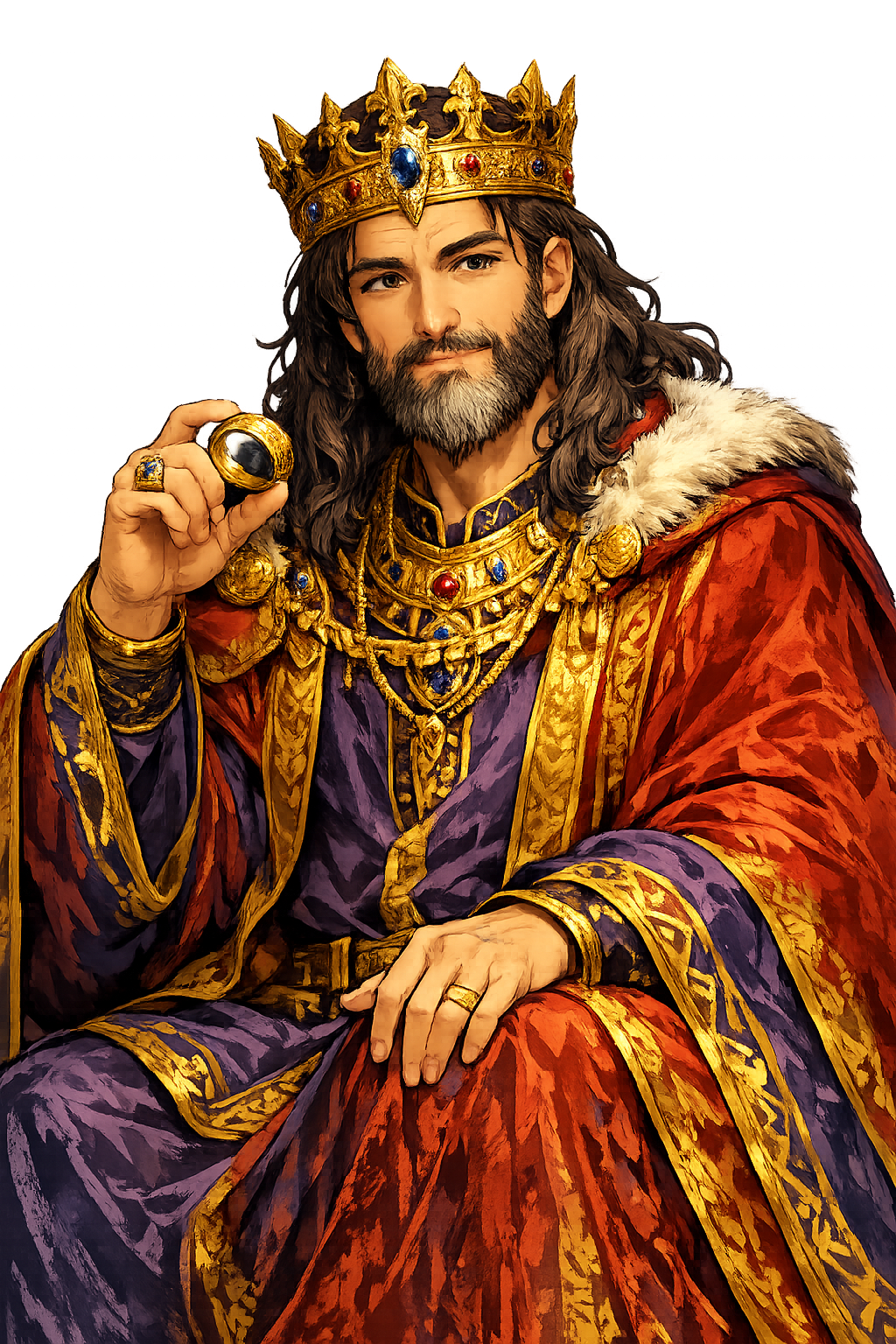
Solomon's image is late but rich. The earliest narrative cycles are Byzantine: the Octateuchs (Vaticanus graecus 747, twelfth century) paint the dream at Gibeon, the temple architecture, and the judgment of the two mothers. Medieval art chose two moments — the wise verdict and the Queen of Sheba's visit, the latter a whole iconography of queenship, gold, and far travel in Gothic portals and manuscript painting. Michelangelo hung him among Christ's ancestors in a Sistine lunette (1508–1512), pairing his kingship with the lineage it fed. Recognition runs through attributes rather than a fixed face: crown, the scales or sword of judgment, the model temple, the peacocks of his trade, and — as later folklore grew — the seal-ring that commands spirits. The judgment scene on a lion-flanked throne became Europe's standard image of justice itself, borrowed by courthouse art across the West. No beard, no stance, no single portrait ever fixed him, because his stories, not his person, are what the tradition kept repainting.

06

Reception & Transformation

The name after its own age — transmission, translation, survival

Afterlives

Solomon's transmission runs from temple archive to world literature. The Septuagint bound his history into the Basileiōn, the Books of Kingdoms, and Josephus retold his reign at length; the New Testament already invokes 'Solomon in all his glory' and the Queen of the South. A Greek demonology of the early centuries CE, the Testament of Solomon, put a seal-ring in his hand and circulated for a millennium in Byzantine manuscripts. Medieval Europe met him twice: in the Latin Colloquy of Solomon and Marcolf, the sage-and-peasant dialogue printed again and again in the fifteenth century, and in the Song of Songs, whose commentaries — Origen's surviving in Rufinus' Latin, Gregory of Nyssa's as homilies, Bernard of Clairvaux's eighty-six sermons left unfinished mid-sentence — made Solomon the unexpected patron of mystical marriage. Modern scholarship widened the lens: nineteenth-century explorers gave his name to Jerusalem's surviving stones — Robinson's Arch (1838), Warren's shafts (1867–70) — and the twentieth turned his authorship into a question, dating Proverbs, Ecclesiastes, and the Song to schools and centuries rather than one golden reign. Ecclesiastes is still read in synagogues each Sukkot. The kingdom split the day he died; the library holds.

Identifications Across Traditions

In Islam, Solomon is Sulaymān, a prophet who commands the wind, speaks with birds, and rules over jinn under God's permission (Qur'an 27). Jewish tradition expands him into a master of demons, a magician-king whose seal controls spirits. Christianity sees him as a type of Christ the wise king and builder of a spiritual temple. Ethiopian legend makes him the father of Menelik I through the Queen of Sheba, founding the Solomonic dynasty claimed by Ethiopian emperors into the twentieth century. The figure of Solomon thus drifts from history into legend, from king into archetype.

Modern Legacy

Šəlōmōh gave the world the idea of the wise king whose wealth is justified by understanding. The 'judgment of Solomon' has entered legal and popular language as a decision that exposes truth by risking loss. The Temple he built remains the imagined heart of Jerusalem, mourned in Jewish liturgy and yearned for in apocalyptic expectation. His attributed writings — Proverbs, Ecclesiastes, Song of Songs — are among the most read books of the Bible, while the Seal of Solomon became a protective amulet across Jewish, Christian, and Islamic magic. In modern archaeology, Solomon is also a battleground: the dating of Iron Age monumental gates at Megiddo, Hazor, and Gezer is central to debates about the historicity and scale of his kingdom.

07

The Meditation

What Šəlōmōh means — beyond the dictionary

Šəlōmōh is the king who gets exactly what he asks for and then loses himself in what he does not need. His wisdom is real — it cuts through lies and builds a temple — but it cannot protect him from his own appetites. In that, he is a mirror for every culture that confuses accumulation with meaning.

The Temple he builds is beautiful, yet its completion already contains the warning that no building can house the infinite. When the cloud fills the house, it is a sign not of possession but of presence that exceeds architecture. Solomon's legacy is therefore double: he is the builder of a house and the proof that houses, however splendid, cannot save the builder. To remember him is to ask what we are building, and whether our wisdom is strong enough to refuse what our power can take.

08

Frequently Asked Questions

Common questions about Šəlōmōh, King, Sage, and Unicode restoration

01How do you pronounce Šəlōmōh?

In reconstructed pronunciation, Šəlōmōh is /ʃəloːˈmoː(h)/ — approximately 'shuh-LOH-moh' — start with a quick 'shuh'; both later 'o' sounds are long and steady, like 'show'.

02What does Šəlōmōh mean?

Šəlōmōh means Third king of Israel, builder of the Temple in the canaanite tradition.

03What are the symbols of Šəlōmōh?

Šəlōmōh is associated with Temple (The fixed house of YHWH in Jerusalem, the center of Israelite cult and identity), Seal / signet (The legendary ring that commanded demons and animals in later Jewish and Islamic folklore), Scales (The instrument of his wise judgment and the balance of peace (šālôm)), Peacock and gold (The exotic wealth of his international trade and the opulence of his court), Crown (The throne of ivory overlaid with gold and the apex of Israelite royal power).

04Why restore Šəlōmōh in Unicode?

Plain ASCII solomon strips the stress, length, and script that make the name specific. Unicode restoration returns the name to its original written dignity.

05What is the most important myth about Šəlōmōh?

“The Dream at Gibeon” — the 1 Kings 3 story that anchors the mythology of Šəlōmōh, told in full on the lore page.

09

Scholarly Sources

The philological foundations of this restoration

Every claim on this page is grounded in established scholarship. The orthographic restorations follow disciplinary convention. The etymological chain follows the best available reference works. This is not invention — it is resurrection through scholarship.

◈

Lexicography & Philology

  • Abraham
◎

Primary Texts

  • The Ugaritic Baal Cycle; ritual texts from Ugarit and Phoenician inscriptions.
◉

Archaeology & Art History

  • Material evidence — iconography, inscriptions, and temple archaeology — for Šəlōmōh and related cults.
✦

Religious Studies

  • HALOT s.v. שְׁלֹמֹה
  • TDOT s.v. Solomon
  • 1 Kings 1–11; 2 Chronicles 1–9
  • Proverbs; Ecclesiastes; Song of Songs
  • Kitchen, On the Reliability of the Old Testament
  • Finkelstein & Silberman, The Bible Unearthed
  • Kebra Nagast (Ethiopian tradition)
Return

The Surface Awaits

You have traced the name from its earliest attestation to its Unicode restoration. Now return to the myth. The story is where the name lives.

Back to Lore
Šəlōmōh mascot