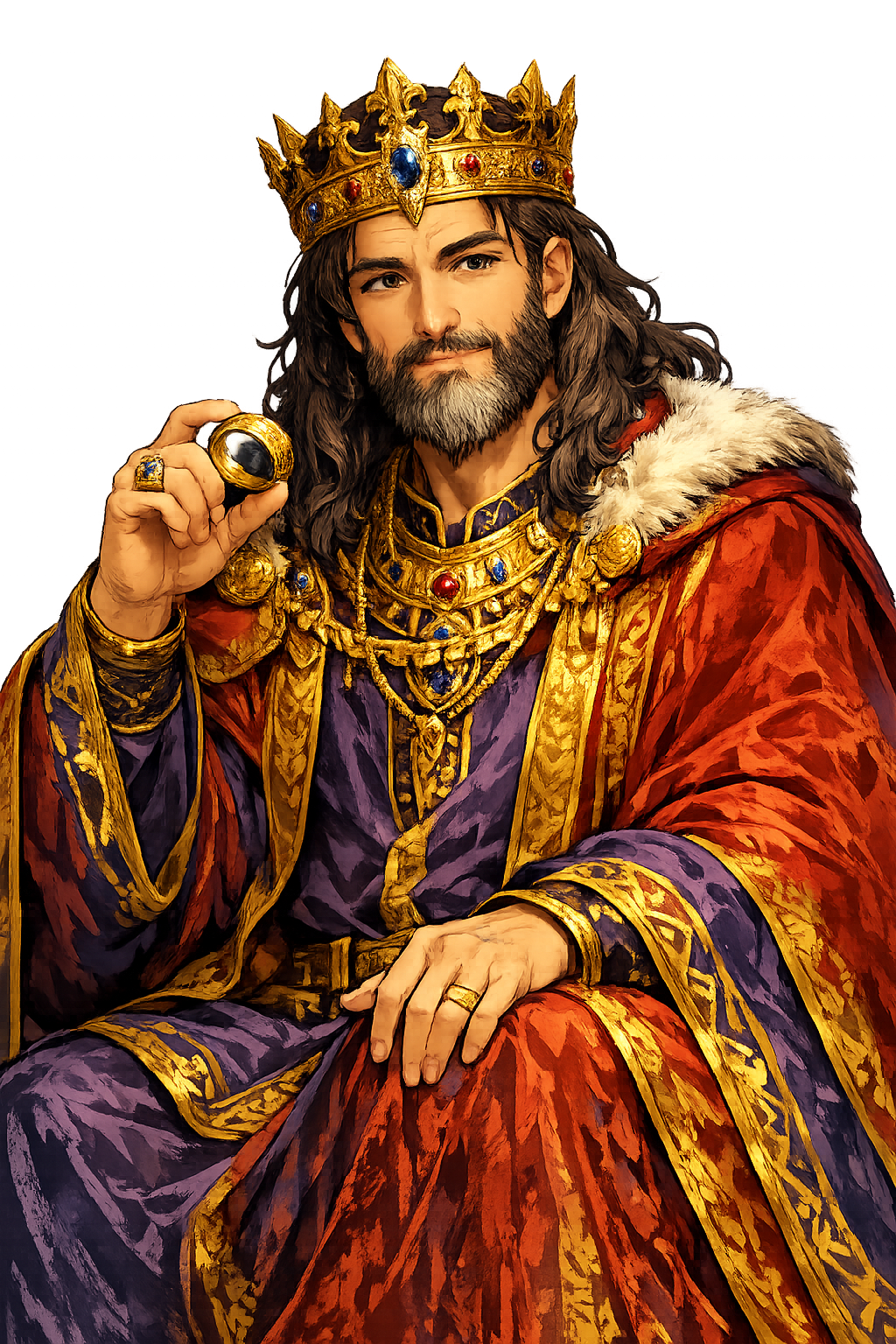
Stories of Šəlōmōh
Šəlōmōh's mythology is the story of wisdom tested by excess. He begins with a prayer for understanding and ends with idolatrous shrines built for his foreign wives. His reign is Israel's golden age and its cautionary tale at once.
When Solomon becomes king — after David's death and Adonijah's failed bid — God appears to him at Gibeon, at the great high place where the king has gone to sacrifice, and offers whatever he asks. Solomon does not ask for riches, long life, or the death of his enemies, but for 'an understanding mind, to discern between good and evil, to govern your people' (1 Kings 3:9; cf. 2 Chronicles 1). Pleased, God grants the wisdom and adds wealth and honor besides, on condition that the king walk in his ways. The story is quietly economic: God offers a blank check, and the king requests an instrument rather than a prize — a 'listening heart' rather than the things a listening heart can win. It became the template for every later legend in which Solomon's wisdom, and not his gold, is the true treasury of Israel, and it frames the whole account that follows: everything magnificent in chapters 3–10 is bonus, granted to a man who asked only to understand.
Two prostitutes of the same house come before the king, each claiming the living newborn, one child having died in the night. Solomon orders a sword: 'Divide the living child in two, and give half to the one and half to the other.' The first woman, whose heart breaks, pleads: 'Give her the living child, and by no means kill him.' The second: 'It shall be neither mine nor yours; divide it.' Solomon gives the child to the first — 'she is his mother' (1 Kings 3:16–27). The verdict works because it converts a dispute of claims into an experiment in love: the false mother proves herself by consenting to the division, the true mother by her willingness to lose. 'And all Israel heard of the judgment... and they perceived that the wisdom of God was in him' (3:28). The myth's enduring afterlife in law and proverb — a 'judgment of Solomon' now means any decision that exposes the truth by accepting the risk of loss — shows how completely the experiment succeeded.
Solomon contracts with Hiram of Tyre for cedar and cypress and for Huram-Abi, 'a craftsman endued with understanding,' and the house rises on the threshing floor of Araunah: an outer court, the hekhal with its cedar carvings of gourds and flowers, and the debir — the holy of holies, twenty cubits square — where two cherubim of olive wood, overlaid with gold, spread their wings over the ark (1 Kings 6–7). Seven years in the building. At the dedication, fire descends and the glory-cloud fills the house, so that the priests cannot stand to minister (8:10–11); Solomon kneels on a bronze platform and prays the longest prayer in the Bible (8:22–53), asking God to hear from heaven when Israel is defeated, drought-stricken, sick, or exiled — and even when 'a foreigner, who is not of your people Israel,' prays toward this house. The first temple is consecrated with its own failure already written into the liturgy, and the stranger's prayer written into its address list.
The queen of Sheba journeys to Jerusalem with a caravan of spices, gold, and precious stones — 'a very great retinue' — to test Solomon with hard questions, the chidôt that were the sport of ancient courts (1 Kings 10:1–13; 2 Chronicles 9). He answers all of them; 'nothing was hidden from the king that he could not explain.' She sees the house he built, the fare of his table, the burnt offerings at the Temple, the attendants in their linen, and his cupbearers, and she is left breathless: 'the half was not told me — your wisdom and prosperity surpass the report that I heard,' and blessed be his God. Her gifts and his counter-gifts of 'every desirable thing' mark the southern trade route as a channel of legend — and the chapter's famous inventory, 120 talents of gold a year (roughly four and a half tons), a throne of ivory overlaid with pure gold with twelve lions on its six steps, apes and peacocks arriving by the fleet-load, is the Old Testament's portrait of an economy of reputation: the whole known world audited Jerusalem and found it solvent.
In his old age the heart of the king was turned — 700 wives, princesses, and 300 concubines, from Moab, Ammon, Edom, Sidon, and the Hittite lands, 'and his wives turned away his heart after other gods' (1 Kings 11:1–8). On the Mount of Olives, east of the city, he built high places for Chemosh of Moab, for Milcom of the Ammonites, and for Astarte of the Sidonians — the builder of the house of YHWH raising shrines within sight of it. The prophet Ahijah of Shiloh tears his new cloak into twelve pieces: ten for Jeroboam the official, one left for David's line 'that my servant David may always have a lamp before me in Jerusalem' (11:29–36). The scandal is entirely domestic, and the sentence immediate — the empire outlives its builder by minutes, and no invader is blamed. The narrative makes Solomon the Bible's most successful cautionary tale: he got everything the Gibeon dream offered and withheld, and the story locates the kingdom's fracture not in any army but in the king's divided heart.
Sage, Trader, Judge
Šəlōmōh is the king who turns peace into architecture. Son of David, he inherits a united kingdom and spends it on cedar, gold, and wisdom. His Temple in Jerusalem becomes the fixed center of Israelite worship; his judgment becomes proverbial; his trade fleets reach the edges of the known world. Yet his story ends in fracture: the kingdom he built splits the moment he dies.
A house of cedar, stone, and gold for the name of YHWH, built with Phoenician artisans and dedicated with fire and cloud (1 Kings 6–8).
His prayer at Gibeon asks for wisdom, and his famous verdict — to cut the disputed child in two — reveals the true mother (1 Kings 3).
A navy at Ezion-Geber and an alliance with Hiram of Tyre bring gold, silver, ivory, apes, and peacocks from Ophir (1 Kings 9–10).
Tradition ascribes to him the books of Proverbs, Ecclesiastes, and the Song of Songs — wisdom literature that ranges from proverb to eros to despair.
From the original script to the living URL
שְׁלֹמֹה
The name in its original Canaanite form. Šəlōmōh (שְׁלֹמֹה) is attested in the source tradition — “Third king of Israel, builder of the Temple”. Its macron-length vowels carry the full phonetic and orthographic weight of the source tradition.
solomon
Reduced to plain solomon, the name loses everything that made it specific: macron-length vowels. What remains is an ASCII string that machines can parse but that no longer speaks with its original voice.
Šəlōmōh
The Unicode restoration recovers what ASCII flattened. Šəlōmōh restores macron-length vowels, returning the name to its original written dignity. The domain encodes to Punycode, but the browser displays the truth.
Šəlōmōh.com → xn--lmh-qxab0ju2f.com
The non-ASCII characters in Šəlōmōh are encoded while the ASCII remains visible. To the DNS, it is Punycode. To humanity, it is Šəlōmōh.
Owned, ideal, and ASCII forms of Šəlōmōh
Šəlōmōh
Restores שְׁלֹמֹה. The live temple domain — šəlōmōh.com.
solomon
Flattens שְׁלֹמֹה. The plain ASCII fallback — what DNS and legacy systems see.
How Šəlōmōh was spoken
How Šəlōmōh travels from ancient script to the modern URL
Hebrew Šəlōmōh; the name is associated with šālōm “peace, wholeness"; the builder of the First Temple.
King, Sage
The Unicode restoration Šəlōmōh uses registrable Latin diacritics; the Ugaritic form is not registrable in .com.
The lore you have read is the living myth. Extended Lore opens the scholarly vault beneath it: the cult and its material remains, a history of the image, the name after antiquity, a meditation on what the name still means, and the full scholarly apparatus — etymology, orthography, sources.
Enter Extended Lore