The Living Myth
Death, Memphis, Underworld · The Memphis Necropolis, the Mound of Creation · The mysterious one
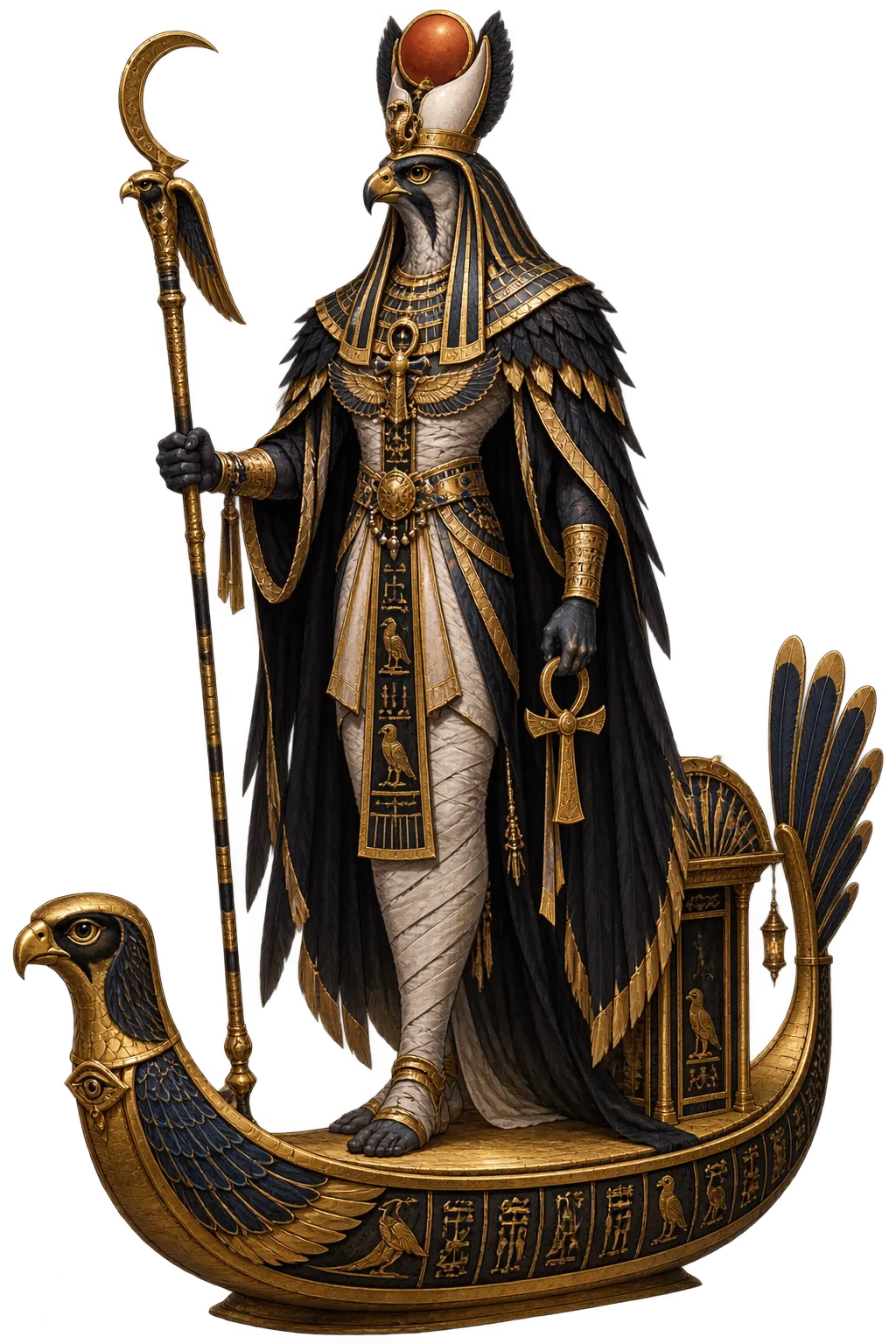
Stories of Skr
Sokar’s mythology is the theology of the Memphite necropolis as a creation-site. The desert west of Memphis — Rostjau, ‘the passage of the ram-heads’ — was, in his cult, the primeval mound where the work of resurrection is endlessly performed. With Ptah and Osiris he forms the great funerary trinity that carried Egyptian hopes of afterlife through two millennia.
Sokar’s domain was not merely burial-ground but cosmogram: the Memphite desert’s hillocks were read as the world’s first mound rising from Nun. His priests raised the Djed-pillar there each year — Osiris’ backbone set upright in Sokar’s earth — and the world’s order was reaffirmed at the threshold of the dead.
The Sokar-festival’s climax was the procession of the Henu: a ship-shaped shrine on a sledge, its prow a falcon-head, drawn around the Memphite walls at dawn. The dead of the necropolis were imagined sailing with him; the barque’s circuit through the desert gates was the afterlife’s rehearsal.
As Memphis’ theology systematised, Sokar fused with Ptah the creator and Osiris the resurrected into the compound Ptah-Sokar-Osiris — the complete god of the dead: the one who makes, the one who is buried, the one who rises. Late-period amulets and coffins carry the triple name as a single guarantee.
The royal necropolis workmen — the draughtsmen, carpenters and goldsmiths who built the Valley of the Kings — placed their craft under Sokar. Ostraca from Deir el-Medina invoke him as the foreman of the ultimate workshop, where every artefact is made to outlast eternity.
The Mysterious One, Patron of the Tomb-Makers
Sqr — Sokar — is the falcon of the Memphite dead: lord of the desert necropolis west of Memphis, master of its legendary tomb and workshop, and keeper of the mound where creation is annually re-declared. In him the arts of the dead — mummification, metalwork, resurrection — found their most ancient patron.
Sovereign of the necropolis region (Rosetjau) and its royal tomb workshops.
His shrine was the Henu barque with the head of a falcon — the solar-funeral vessel of the Memphite dead.
The tomb’s goldsmiths and smiths of sacred metal worked under his protection.
His festival raised the Djed-pillar on the primeval mound — Osiris’ spine set upright in the earth.
From the original script to the living URL
𓋴𓎡𓂋𓅃
The name in its original Egyptian form. Skr (𓋴𓎡𓂋𓅃) is attested in the source tradition — “The mysterious one”. Its original diacritics and script distinctions carry the full phonetic and orthographic weight of the source tradition.
sokar
The plain sokar form is identical to the Unicode restoration. Because this name is already written in Latin letters, no diacritics, stress, or script information were lost — only capitalization differs.
Skr
The Unicode restoration does not need to recover lost marks for Skr. Its value is canonical spelling and consistent cataloguing, not the reconstruction of erased orthography. The domain is readable as-is to both DNS and humanity.
Skr.com
This restoration is written entirely in ASCII letters — no Punycode encoding stands between Skr and the DNS. The domain reads identically to machines and to human eyes.
The attested spelling family of Skr
Skr
Restores 𓋴𓎡𓂋𓅃. The full Unicode restoration. skr.com is not in the PuniCodex collection — it is watched for release; if it drops, this temple upgrades to an owned flagship. Attested by Faulkner, Wb.
How Skr was spoken
How Skr travels from ancient script to the modern URL
Egyptian Skr; the original vocalisation is unknown. The name belongs to a falcon-god of the Memphis necropolis.
The lore you have read is the living myth. Extended Lore opens the scholarly vault beneath it: the cult and its material remains, a history of the image, the name after antiquity, a meditation on what the name still means, and the full scholarly apparatus — etymology, orthography, sources.
Enter Extended Lore