
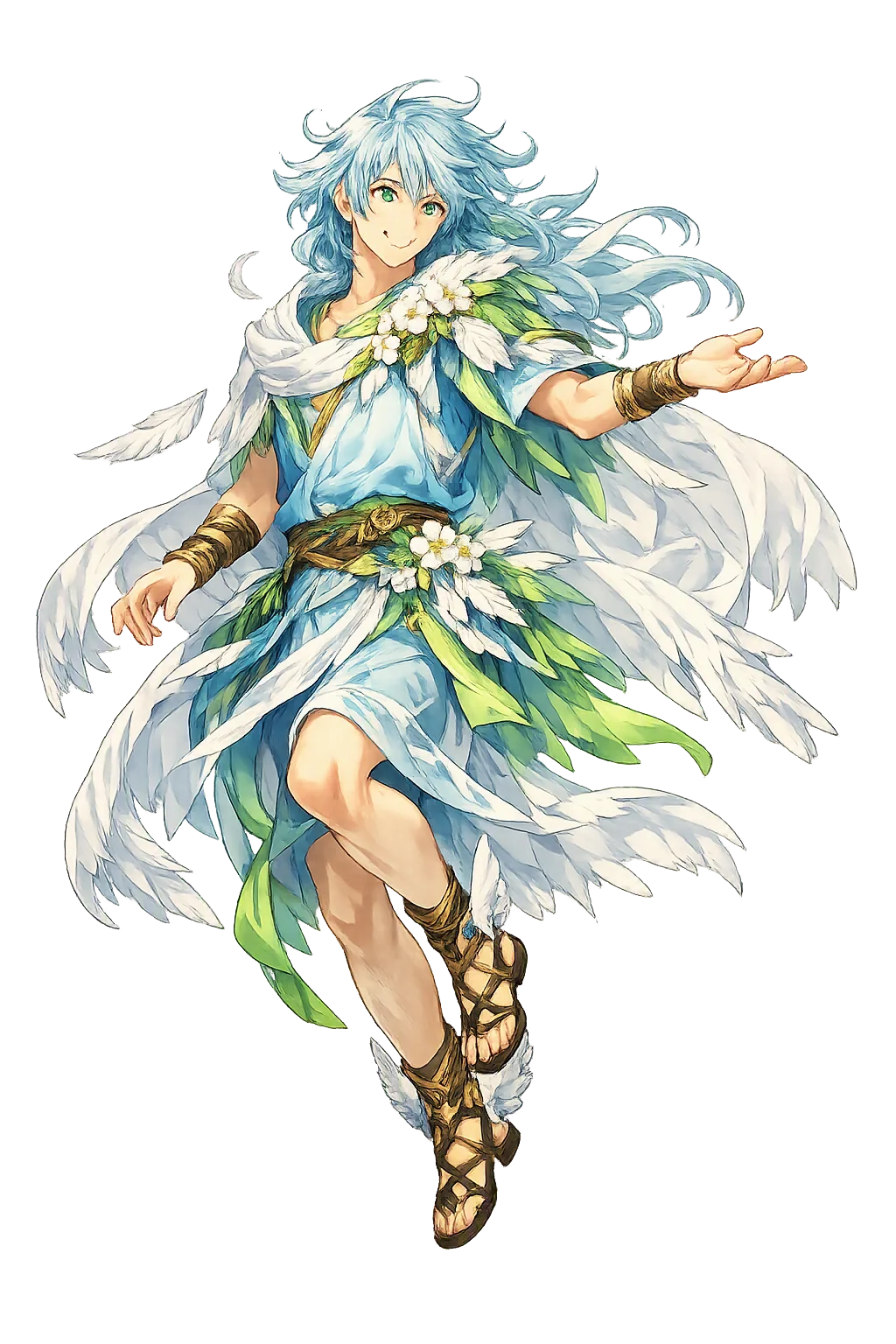
The name Zéphyros and the world it opens
A name is a door. Zéphyros opens onto an entire world: the domain of west wind, a Greek tradition, and centuries of storytelling, worship, and scholarship. This post walks through that world room by room — the name and its roots, the original script, the sound of it, the myths, the symbols, the sites, the afterlife across cultures — and ends at the newest room of all: a Unicode domain that makes the whole structure addressable. zephyros gets you to the same building, but only the restored form tells you why it was built.
At a Glance
- Restored name: Zéphyros
- ASCII form: zephyros
- Meaning: "The west wind"
- Domain of influence: West Wind
- Pantheon: Greek
- Classification: Tier 2
- Original script: Ζέφυρος (Greek)
- Live domain: zéphyros.com
Overview
Zéphyros (zephyros) — West Wind · The west wind — belongs to the Greek tradition, where it is catalogued under the domain "West Wind". The name means "The west wind".
Zéphyros is the west wind of the Greeks — the mildest of the four Anemoi, the breeze that loosens winter and calls up the flowers. Where Bóreas rages and Nótos drowns ships in rain, Zéphyros is the wind the poets loved: the steady, fruit-bearing breath that fans the orchards of the blessed and carries spring north into the human world.
PuniCodex restores the name as Zéphyros and serves its temple at zéphyros.com. The original preserves one prosodic feature — stress or vowel length — rather than both, which places the name in Tier 2. The plain ASCII form zephyros survives as a modern convenience imposed by the early domain-name system; the restoration, not the fallback, is the form the project defends as philologically complete.
The Name
The name is attested in Greek as Ζέφυρος. Etymologically it means "The west wind".
The ASCII form zephyros survives only because the early domain-name system could not carry diacritics; it is a technological compromise, not an ancient spelling. The Unicode restoration Zéphyros recovers the stress accent of the original directly in the address bar. The original preserves one prosodic feature — stress or vowel length — rather than both, which places the name in Tier 2.
The letter-by-letter transformation runs:
- z → Z — Z uppercase
- e → é — Acute on e
- p → p — p same
- h → h — h same
- y → y — y same
- r → r — r same
- o → o — o same
- s → s — s same
The project holds the domain zéphyros.com (xn--zphyros-bya.com) as the canonical home of this name.
The Original Script
The name is written in Greek as Ζέφυρος. This original script is the form against which the ASCII fallback zephyros and the PuniCodex restoration Zéphyros are measured: the restoration preserves its pitch accent of the written form, so that a reader typing the modern address still speaks the ancient name.
Pronunciation
The reconstructed pronunciation of the name is /ˈzdɛ.pʰy.ros/ — Attic Greek Reconstruction.
Phoneme by phoneme:
- Zé- — stressed first syllable; classical zeta was a true 'zd' cluster, as in English 'wisdom', not a modern 'z'
- -phy- — phi was an aspirated p (p + breath), not an f; upsilon was a rounded French-like 'u' [y]
- -ros — short final -os; the r lightly trilled
For the modern speaker, the closest approximation is: 'ZDEH-phee-ros' — stress the first syllable; begin with the 'zd' of 'wisdom', and let the phi puff air like an English 'up-hill', not an 'f'
Kindred and historical forms of the name:
- Greek — ζόφος (zophos), 'gloom, darkness; the dark quarter of the sky — the west' — the word's likely kin, naming the wind from the quarter it blows from
- PIE — uncertain; Beekes flags the formation as possibly Pre-Greek rather than securely Indo-European
Tier-2 — Accent-Preserving. The restoration Zéphyros preserves the acute stress of Ζέφυρος on the first syllable, a feature plain ASCII loses; it carries no long-vowel mark, so a single preserved feature places the name in Tier 2.
Mythology
Zéphyros is a minor god with an outsized poetic life: born of Dawn, lover of flowers, father of the fastest horses ever to run. His myths are few but luminous — each one binds the west wind to speed, desire, and the returning spring.
Son of Dawn and the Starry Sky (Birth of the Winds)
In Theogony 378–380, Hesiod records that Eōs (Dawn) bore to Astraios, the starry dusk, the mighty winds: Zéphyros, Bóreas, and Nótos — 'a goddess lying in love with a god'. The genealogy is exact: the clearing west wind is the child of first light and the star-field, born at the seam where night opens into day.
Father of Achilles's Horses (Iliad)
In Iliad 16 (149–151), Patroklos harnesses Achilles's immortal pair, Xánthos and Bálios, 'whom Pódargē, the harpy swift of foot, bore to Zéphyros the west wind as she grazed in a meadow beside the stream of Ōkeanos'. A wind coupling with a storm-snatcher in a meadow: Homer makes the horses' supernatural speed a literal inheritance. It is Xánthos, this same wind-begotten colt, who later speaks with a human voice to foretell Achilles's death (Iliad 19, 404–417).
The Abduction of Chlōris (Roman Flora)
In Ovid's Fasti 5 (195–214), the goddess Flora tells her own story: 'I who am now called Flora was once Chlōris… Zéphyros saw me, desired me, and carried me off' — then made her his lawful wife and gave her dominion over every flower, so that in her garden 'it is always spring'. Hyginus (Fabulae) preserves the fruit of the union: their son Karpós, 'Fruit' itself, the harvest that follows blossom.
The Breeze of the Blessed Orchards (Odyssey)
In Odyssey 7 (112–132), the garden of King Alkinoös on Scheria — fruit upon fruit, pear ripening on pear, never failing winter or summer — is kept in perpetual bearing because 'the breath of Zéphyros, ever blowing, causes some fruits to swell and others to ripen'. Homer needs no allegory here: the west wind simply is the climate of paradise, the mildest air imaginable, made divine.
Symbols & Iconography
The iconography associated with Zéphyros concentrates in a small set of recurring attributes, each a compressed statement about the name:
- Garland of Flowers — On the Tower of the Winds in Athens, Zéphyros is carved as a youth whose folded cloak spills blossoms — his spring-bearing nature made visible in stone.
- Wings — Like all the Anemoi, he is winged in Greek and Roman art; the winds fly, and their wings mark them as powers of the air rather than ordinary gods.
- Swift Horses — By Pódargē the harpy he fathered Xánthos and Bálios, the immortal horses of Achilles — the wind's own speed given equine form.
- The Swallow — The swallow's return was proverbially bound to the west wind's season; both were the first messengers that winter had broken.
- Billowing Sail — A kind wind for sailors: steady, mild, and western — the breeze that fills canvas without violence and carries ships home.
- Youthful Bloom — In art he appears as a beautiful, unbearded youth, a wind conceived not as a destroyer but as a lover — fitting the bridegroom of Chlōris.
Archaeology & Evidence
Zéphyros's most famous monument is the Tower of the Winds (Horologion of Andronikos Kyrrhestēs, 1st c. BCE) in the Roman Agora of Athens, whose octagonal frieze personifies the eight winds — Zéphyros on the west face as a youth scattering flowers from his folded cloak. Pausanias (2.12.1) records a sanctuary with an altar of the Winds at Titanē in Sikyonia, where a priest sacrificed to them annually — one of the few attested cult sites for the Anemoi as a group. In Rome, his cult life ran through his bride: the temple of Flora near the Circus Maximus and the games of the Floralia.
Realm & Domain
Zéphyros is the west wind of the Greeks — the mildest of the four Anemoi, the breeze that loosens winter and calls up the flowers. Where Bóreas rages and Nótos drowns ships in rain, Zéphyros is the wind the poets loved: the steady, fruit-bearing breath that fans the orchards of the blessed and carries spring north into the human world.
Herald of Spring
Father of Swift Horses
Bridegroom of Flora
Across Cultures
The Romans called him Favōnius, from favēre, 'to favor' — the propitious wind — and married him to their own flower-goddess Flōra, whose festival, the Floralia, kept the Greek Chlōris-marriage alive in cult. Horace (Odes 1.4) sings winter loosening 'under the welcome west wind', and Virgil lets Favonius breathe through the Georgics as the air that unbinds the fields. Through Latin poetry the name passed intact into every European vernacular: the gentle west wind of Greece became the zephyr of the modern world.
Within the Greek tradition, closely related names in the corpus include Achérōn, Achilleús, Adámas, Aḗr, Aithḗr, and Anánkē.
Cultural Legacy
English zephyr — 'a soft, gentle breeze' — descends directly from his name through Latin zephyrus, and has been a staple of English verse since Chaucer opened the Canterbury Tales with 'Zephirus… with his sweete breeth' quickening the spring crops. The word also gave its name to a fine, light yarn and to anything featherweight. Few Greek wind-gods survive so completely: not as a character, but as the very word English reaches for when the air turns kind.
The Scholarly Record
The account of Zéphyros given in this edition rests on the witnesses and reference works listed below. Lexica and etymological dictionaries secure the form and meaning of the name; the literary and religious texts supply the narrative evidence.
- Liddell-Scott-Jones Greek-English Lexicon, 9th ed. with 1996 supplement, 1940. Full text
- Etymological Dictionary of Greek, 2 vols., Brill, 2010. Full text
- Homer, Iliad / Odyssey, Loeb Classical Library / Oxford Classical Texts, 750 BCE. Full text
- Homer, Iliad, Oxford Classical Texts (Monro & Allen); Loeb, 750 BCE. Full text
- Odyssey.
- Hesiod, Theogony / Works and Days / Shield, Loeb Classical Library No. 57, 700 BCE. Full text
- Theogony.
- Ovid (Publius Ovidius Naso), Metamorphoses / Fasti / Heroides, Loeb Classical Library, 17. Full text
- Hyginus.
- Pausanias, Description of Greece, Loeb Classical Library, 180. Full text
A Meditation
The Greeks did not usually worship the winds with temples and myths of their own — they felt them, and feeling was enough. Zéphyros is the clearest case of a natural force crossing into personality precisely because it was pleasant: the storm winds stay brute daimones, but the wind that opens the flowers earned a wife, a marriage bed, and children. His ambivalence is quiet but real — the same wind that breeds Achilles's immortal horses also breeds the speed that carries the hero toward death. For the Greeks the west wind was proof that the divine could be gentle without ceasing to be power: a daimon you pray to by opening the orchard gate.
The Unicode Restoration
Zéphyros is classified as Tier 2: the original carries only one of the two prosodic features — stress or vowel length — not both. The ASCII fallback zephyros still resolves everywhere, but it is the restored form that carries the name's full information. Across the 8 characters of the name, the restoration adjusts 1: 1 mark of stress (é). That is the whole thesis of this temple: the marks are the message.
Character by Character
The journey from zephyros to Zéphyros, one character at a time:
- z → Z — Z uppercase
- e → é — Acute on e
- p → p — p same
- h → h — h same
- y → y — y same
- r → r — r same
- o → o — o same
- s → s — s same
The Domain Name
The restored name is live as a working domain: zéphyros.com, which the DNS carries in punycode form as xn--zphyros-bya.com — an ASCII-compatible encoding that lets a non-ASCII name travel the global network without breaking older infrastructure. The visitor sees Zéphyros; the machines see the encoding. That duality is the engineering compromise on which the entire restoration rests, and it is why a name written the way its own tradition wrote it in Greek can now be typed into any browser on earth.
The Greek Pantheon
Zéphyros is one of 266 entries the PuniCodex lexicon catalogues under the Greek pantheon. The Pantheon page gathers the tradition's major figures in one place, and the Lexicon lets you filter all 925 restorations by tradition, tier, or script — the fastest way to see where this name sits among its kin.
Frequently Asked Questions
What does Zéphyros mean? The traditional gloss is "The west wind."
Which tradition does Zéphyros belong to? Zéphyros is catalogued in the Greek pantheon of the PuniCodex lexicon.
Why is Zéphyros classified as Tier 2? Because the original carries only one of the two prosodic features — stress or vowel length — not both — and the marks in the restored spelling preserve exactly that evidence.
Is Zéphyros a working domain? Yes — zéphyros.com resolves today and routes to this temple.
What is the punycode for zéphyros.com? The DNS encoding is xn--zphyros-bya.com; browsers perform the translation automatically, so visitors only ever see the restored name.
Typing Zéphyros
You do not need a special keyboard to use this restoration. The PuniCodex Type Tool converts the ASCII form zephyros into Zéphyros as you type, and the browser extension offers the same conversion inside any text field. Copy the restored form, paste it into the address bar, and the DNS does the rest.
Sister Temples
Other temples in the Greek pantheon include Kleió, Knōssós, and Kósmos — each with its own restoration story, its own scholarly record, and its own place in the lexicon.
Why This Restoration Matters
A door only matters if people walk through it. zéphyros.com is open, and everything behind it — the myths, the scholarship, the canvas, the patrons — hangs on the restored spelling. The PuniCodex project bets that the web will make room for names as they were actually written, and Zéphyros is one of its standing proofs. Visit, share, cite, type it yourself: each use is a small rehearsal for a web where no name has to hide its marks to be found.
Explore Further
This post is one doorway into the temple. The home page carries the full character breakdown and the ambient canvas; the lore page tells the myths in long form; the Scholarly Edition preserves the sources, pronunciation data, and revision history; and the patron wall supports the restoration directly. For the wider map, browse the Lexicon, explore the Pantheon, or return to the PuniCodex blog.
Related Names
Sources
The full scholarly apparatus — every citation, revision, and review — lives in the Scholarly Edition. Key references for this post:
- Liddell-Scott-Jones Greek-English Lexicon, 9th ed. with 1996 supplement, 1940.
- Etymological Dictionary of Greek, 2 vols., Brill, 2010.
- Homer, Iliad / Odyssey, Loeb Classical Library / Oxford Classical Texts, 750 BCE.
- Pausanias, Description of Greece, Loeb Classical Library, 180.
- Homer, Iliad, Oxford Classical Texts (Monro & Allen); Loeb, 750 BCE.
- Hesiod, Theogony / Works and Days / Shield, Loeb Classical Library No. 57, 700 BCE.
- Odyssey.
- Theogony.
- Hyginus.
- Lexicon authorities for this entry: Homer, LSJ.