
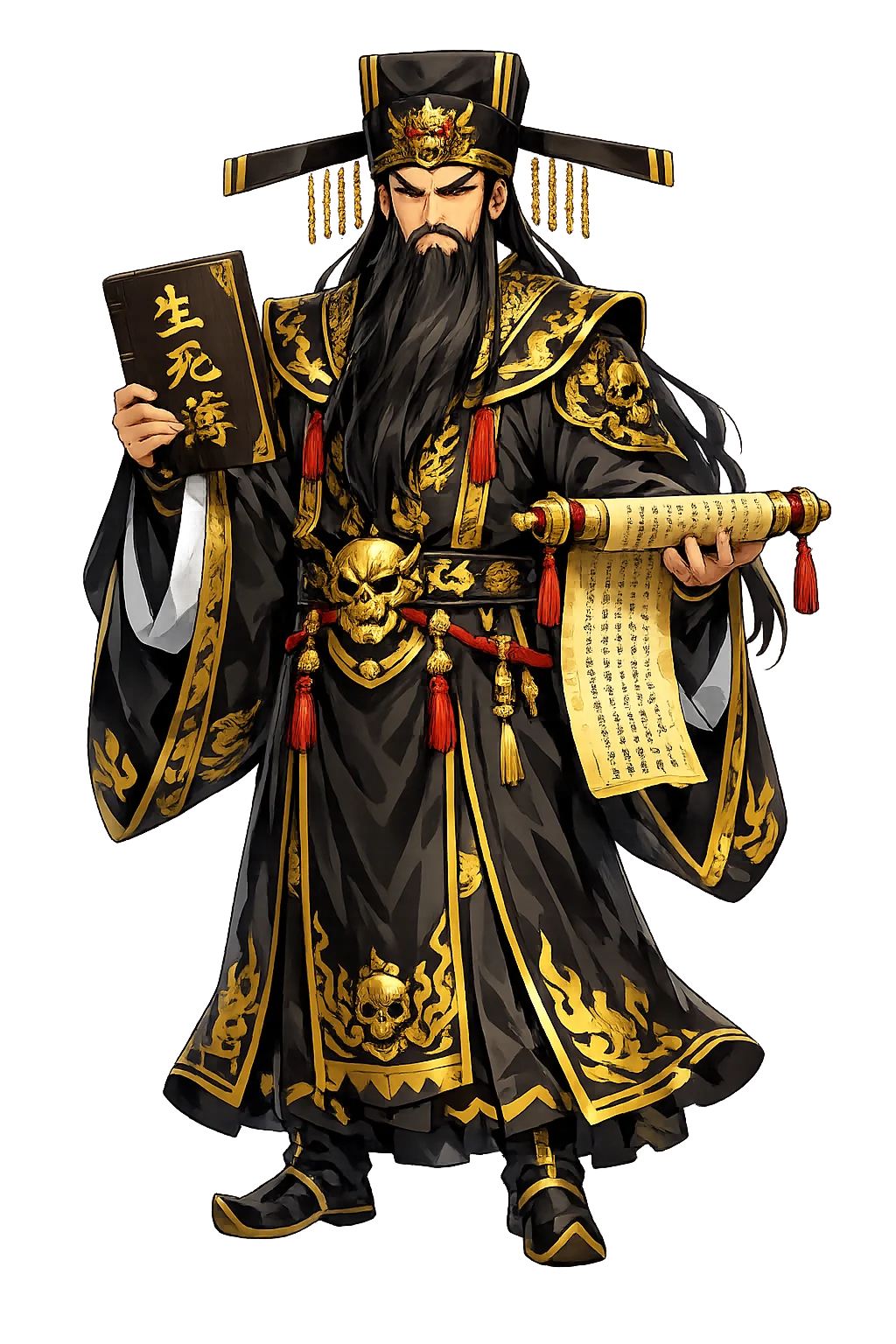
The name Yánluó and the world it opens
A name is a door. Yánluó opens onto an entire world: the domain of judgment, underworld, order, a Chinese tradition, and centuries of storytelling, worship, and scholarship. This post walks through that world room by room — the name and its roots, the original script, the sound of it, the myths, the symbols, the sites, the afterlife across cultures — and ends at the newest room of all: a Unicode domain that makes the whole structure addressable. yanluo gets you to the same building, but only the restored form tells you why it was built.
At a Glance
- Restored name: Yánluó
- ASCII form: yanluo
- Meaning: "'King Yan' (閻羅, from Yama), the judge of the dead"
- Domain of influence: Judgment, Underworld, Order
- Pantheon: Chinese
- Classification: Tier 2
- Live domain: yánluó.com
Overview
Yánluó (yanluo) — The Judge Below — belongs to the Chinese tradition, where it is catalogued under the domain "Judgment, Underworld, Order". The name means "'King Yan' (閻羅, from Yama), the judge of the dead".
Yánluó is the magistrate at the centre of the Chinese afterlife: the Indian god Yama enthroned in a Chinese courtroom, judging the dead from their own record books. Before him, the myth insists, wealth and rank are nothing — the only evidence is what you did.
PuniCodex restores the name as Yánluó and serves its temple at yánluó.com. The original preserves one prosodic feature — stress or vowel length — rather than both, which places the name in Tier 2. The plain ASCII form yanluo survives as a modern convenience imposed by the early domain-name system; the restoration, not the fallback, is the form the project defends as philologically complete.
The Name
No indigenous written attestation survives for this name; Yánluó is a scholarly transliteration of the reconstructed spoken form. Etymologically the name means "'King Yan' (閻羅, from Yama), the judge of the dead".
The ASCII form yanluo survives only because the early domain-name system could not carry diacritics; it is a technological compromise, not an ancient spelling. The Unicode restoration Yánluó recovers the stress accent of the original directly in the address bar. The original preserves one prosodic feature — stress or vowel length — rather than both, which places the name in Tier 2.
The letter-by-letter transformation runs:
- y → Y — Same letter
- a → á — Stress mark (acute/tone)
- n → n — Same letter
- l → l — Same letter
- u → u — Same letter
- o → ó — Stress mark (acute/tone)
The project holds the domain yánluó.com (xn--ynlu-5na5i.com) as the canonical home of this name.
The Original Script
The original script for this chinese name has not yet been added to PUNICODEX. The form shown is a scholarly transliteration.
The form Yánluó is therefore a scholarly transliteration rather than an attested ancient spelling; it encodes the reconstructed sound of the name for modern use, and no mark in it is decorative.
Written 阎罗 (simplified) / 閻羅 (traditional): the gate-radical graphs chosen purely for sound, transcribing Yama-. The Chinese name is thus a phonetic fossil of the Silk Road — Sanskrit carried into characters, then naturalized so completely that most speakers never know it was a loanword.
Pronunciation
The reconstructed pronunciation of the name is /jɛn˧˥ lwo˧˥/ — Mandarin (Hanyu Pinyin with tones).
For the modern speaker, the closest approximation is: yen-lwoh, rising tone on both syllables.
Kindred and historical forms of the name:
- Chinese — 閻羅
- Full title — 閻羅王 (Yánluó Wáng)
- Sanskrit — Yama
- Japanese — Enma
- Owned form — Yánluó
Yánluó 阎罗 abbreviates Yánluówáng 阎罗王, "King Yama" — the Sanskrit Yamarāja worn down by two millennia of Chinese speech. The second tone on yán and the rising luó are fixed by tradition; the full Sanskrit form survives in Buddhist ritual language beside the everyday king.
Mythology
Yánluó's mythology is procedural: not adventures but cases. His stories are judgments — and the judgments are always, the texts insist, simply the soul's own deeds read back to it.
Yama, the First Mortal (The Origin)
Before he was a king of hell he was the first man to die: the Ṛgveda's Yama chose mortality, found the road to the other world, and became the guide and host of the fathers — honoured with songs and offerings. Buddhism inherited him as the dharma-king who interrogates the dead: the three messengers — old age, sickness, death — are his summonses, sent to every house.
The Fifth Tribunal (The Court)
The Chinese Ten Kings system, formed by the Tang, stations Yánluó in the fifth court — the great reckoning after the first four screenings. There the record books are opened, the mirror of deeds is raised, and the verdict is assigned: paradise, rebirth, or the numbered hells. One legend says he once held the first court but was demoted for leniency — even the king of the dead is audited.
Bao Zheng on the Bench (The Mercy)
Chinese folklore kept electing incorruptible mortals to his office: the Song-dynasty judge Bao Zheng — "Justice Bao" of a hundred operas — was said to judge the living by day and the dead by night as Yánluó's incarnation. The identification is the myth's message: the perfect magistrate is already doing the underworld's work, and the underworld is only the courtroom made honest.
Symbols & Iconography
The iconography associated with Yánluó concentrates in a small set of recurring attributes, each a compressed statement about the name:
- The judge's cap — The Chinese magistrate's hat on an Indian god — the Silk Road in one image
- The brush — The instrument of the verdict — deaths recorded, sentences written
- The ox-head and horse-face — His bailiffs: the two wardens who fetch the souls of the dead
Archaeology & Evidence
The Ten Kings paintings — sets of hanging scrolls showing each court — survive from the Ningbo workshops of the 12th–13th centuries (the finest sets in Nara and the Metropolitan Museum), with Yánluó's tribunal at their dramatic centre. Fengdu ghost city's temples stage the full bureaucratic underworld in statuary. Dunhuang documents preserve the Sūtra of the Ten Kings, the charter-text of the whole system, copied in tens of thousands for the dead's benefit.
His temples are courtrooms in stone. Fengdu ghost city stages his tribunal among the Ten Kings — the judge enthroned above the mirror of deeds, ox-head and horse-face attending — as it has for centuries of Yangtze pilgrims. The Ten Kings paintings of the Ningbo workshops (the great sets at Nara and the Metropolitan Museum) fix his iconography: the magistrate's cap, the open register, the mirror raised. In Japan his cult crossed to the great Enma-dō halls — Kyoto's Sennyūji among them — where the red-faced king has glared at the faithful for a thousand years.
Realm & Domain
Yánluó is the magistrate at the centre of the Chinese afterlife: the Indian god Yama enthroned in a Chinese courtroom, judging the dead from their own record books. Before him, the myth insists, wealth and rank are nothing — the only evidence is what you did.
The Record Books
The registers of life and death: every deed entered, nothing argued away.
The Mirror
The karma-mirror that shows each soul its own actions — the courtroom's only witness.
The Ten Courts
Dìyù's bureaucracy: ten tribunals, his the fifth and most feared.
The Ledger of Lifespan
He holds the book of allotted years — the deadline no bribe extends.
Across Cultures
He is the supreme case of Buddhist localization: Yama became Yánluó in China, Enma in Japan (with his own mirror and the red-faced scowl of a thousand temple gates), Yeomna in Korea, and the judges of Vietnamese and Central Asian afterlives. Daoism staffed his courts with its own celestial bureaucrats; folk religion added Mèngpó's tea and the City God as his local deputies. The whole edifice — Indian god, Chinese paperwork, village morality — is East Asia's most successful religious import.
Within the Chinese tradition, closely related names in the corpus include [[bagua|Bāguà]], [[fuxi|Fúxī]], [[guanyin|Guānyīn]], [[long|Lóng]], [[mengpo|Méngpó]], and [[nuwa|Nǚwā]].
Cultural Legacy
"Meeting Yánluó" (见阎罗) remains the everyday Chinese idiom for dying; "Yánwáng ye" names any pitiless authority. Japanese Enma anchors a thousand festivals and anime (Jigoku Shōjo's Enma Ai made him a household name to a new century). The judgment imagery — mirror, ledger, no bribes — shaped East Asian ethics as deeply as any scripture: a whole civilization's conscience, staffed by one borrowed god.
The Scholarly Record
The account of Yánluó given in this edition rests on the witnesses and reference works listed below. Lexica and etymological dictionaries secure the form and meaning of the name; the literary and religious texts supply the narrative evidence.
- Ṛgveda Saṃhitā, Aufrecht; van Nooten & Holland metric text; GRETIL, 1200 BCE. Full text
- Chinese Buddhist canon (Dàzàngjīng / Taishō Tripiṭaka), Taishō Shinshū Daizōkyō (SAT digitization), 1924.
- Stephen F. Teiser, The Ghost Festival in Medieval China, Princeton University Press, 1988.
- Chinese folk religion (regional cults and underworld traditions), documented across temple and funerary practice, ongoing.
- Chinese Buddhist texts (Hanwen Canon), CBETA / Taishō Tripiṭaka, 400. Full text
- Buddhist canonical and commentarial literature, Pāli, Sanskrit, Chinese, and Tibetan recensions, various.
A Meditation
Yánluó is the god of the life review. His court invents nothing and forgives nothing; it only reads — and the terror and the comfort are the same: the record is exact. He asks the question his mirror has posed for two thousand years: if the book of your deeds were opened tonight, would you need a lawyer — or only a witness?
The records, the mirror, the brush: his court is bureaucracy sanctified, and East Asia read it as a promise as much as a threat — that somewhere, the ledger is accurate and the judge cannot be bought. In a world of imperfect courts, the fifth tribunal stands as the conscience's final appeal: not that punishment will come, but that the truth is on file.
It is fitting that a borrowed god became the conscience of three civilizations: judgment, the myth insists, is not native to anyone — it arrives, it is translated, and it sits down to read the file. The mirror of deeds needs no faith to function; it only needs the one thing every tradition agrees on, that the record should be exact.
The Unicode Restoration
Yánluó is classified as Tier 2: the original preserves at least one philological feature that ASCII cannot encode. The ASCII fallback yanluo still resolves everywhere, but it is the restored form that carries the name's full information. Across the 6 characters of the name, the restoration adjusts 2: 2 marks of stress (á, ó). That is the whole thesis of this temple: the marks are the message.
Character by Character
The journey from yanluo to Yánluó, one character at a time:
- y → Y — Same letter
- a → á — Stress mark (acute/tone)
- n → n — Same letter
- l → l — Same letter
- u → u — Same letter
- o → ó — Stress mark (acute/tone)
The Domain Name
The restored name is live as a working domain: yánluó.com, which the DNS carries in punycode form as xn--ynlu-5na5i.com — an ASCII-compatible encoding that lets a non-ASCII name travel the global network without breaking older infrastructure. The visitor sees Yánluó; the machines see the encoding. That duality is the engineering compromise on which the entire restoration rests, and it is why a name written the way its own tradition wrote it in Chinese characters can now be typed into any browser on earth.
The Chinese Pantheon
Yánluó is one of 46 entries the PuniCodex lexicon catalogues under the Chinese pantheon. The Pantheon page gathers the tradition's major figures in one place, and the Lexicon lets you filter all 915 restorations by tradition, tier, or script — the fastest way to see where this name sits among its kin.
Frequently Asked Questions
What does Yánluó mean? The traditional gloss is "'King Yan' (閻羅, from Yama), the judge of the dead."
Which tradition does Yánluó belong to? Yánluó is catalogued in the Chinese pantheon of the PuniCodex lexicon.
Why is Yánluó classified as Tier 2? Because the original preserves at least one philological feature that ASCII cannot encode — and the marks in the restored spelling preserve exactly that evidence.
Is Yánluó a working domain? Yes — yánluó.com resolves today and routes to this temple.
What is the punycode for yánluó.com? The DNS encoding is xn--ynlu-5na5i.com; browsers perform the translation automatically, so visitors only ever see the restored name.
Typing Yánluó
You do not need a special keyboard to use this restoration. The PuniCodex Type Tool converts the ASCII form yanluo into Yánluó as you type, and the browser extension offers the same conversion inside any text field. Copy the restored form, paste it into the address bar, and the DNS does the rest.
Sister Temples
Other temples in the Chinese pantheon include Bodhidharma, Fúxī, and Jiǔhuá — each with its own restoration story, its own scholarly record, and its own place in the lexicon.
Why This Restoration Matters
A door only matters if people walk through it. yánluó.com is open, and everything behind it — the myths, the scholarship, the canvas, the patrons — hangs on the restored spelling. The PuniCodex project bets that the web will make room for names as they were actually written, and Yánluó is one of its standing proofs. Visit, share, cite, type it yourself: each use is a small rehearsal for a web where no name has to hide its marks to be found.
Explore Further
This post is one doorway into the temple. The home page carries the full character breakdown and the ambient canvas; the lore page tells the myths in long form; the Scholarly Edition preserves the sources, pronunciation data, and revision history; and the patron wall supports the restoration directly. For the wider map, browse the Lexicon, explore the Pantheon, or return to the PuniCodex blog.
Related Names
Sources
The full scholarly apparatus — every citation, revision, and review — lives in the Scholarly Edition. Key references for this post:
- Ṛgveda Saṃhitā, Aufrecht; van Nooten & Holland metric text; GRETIL, 1200 BCE.
- Chinese Buddhist texts (Hanwen Canon), CBETA / Taishō Tripiṭaka, 400.
- Fēngshén Yǎnyì (Investiture of the Gods), various; English abridgment as Creation of the Gods, 1600.
- Chinese Buddhist canon (Dàzàngjīng / Taishō Tripiṭaka), Taishō Shinshū Daizōkyō (SAT digitization), 1924.
- Stephen F. Teiser, The Ghost Festival in Medieval China, Princeton University Press, 1988.
- Teiser, Ten Kings; the Nara Ten Kings painting corpus.
- Lexicon authorities for this entry: Fengshen Yanyi, Chinese Buddhist canon, Teiser.