
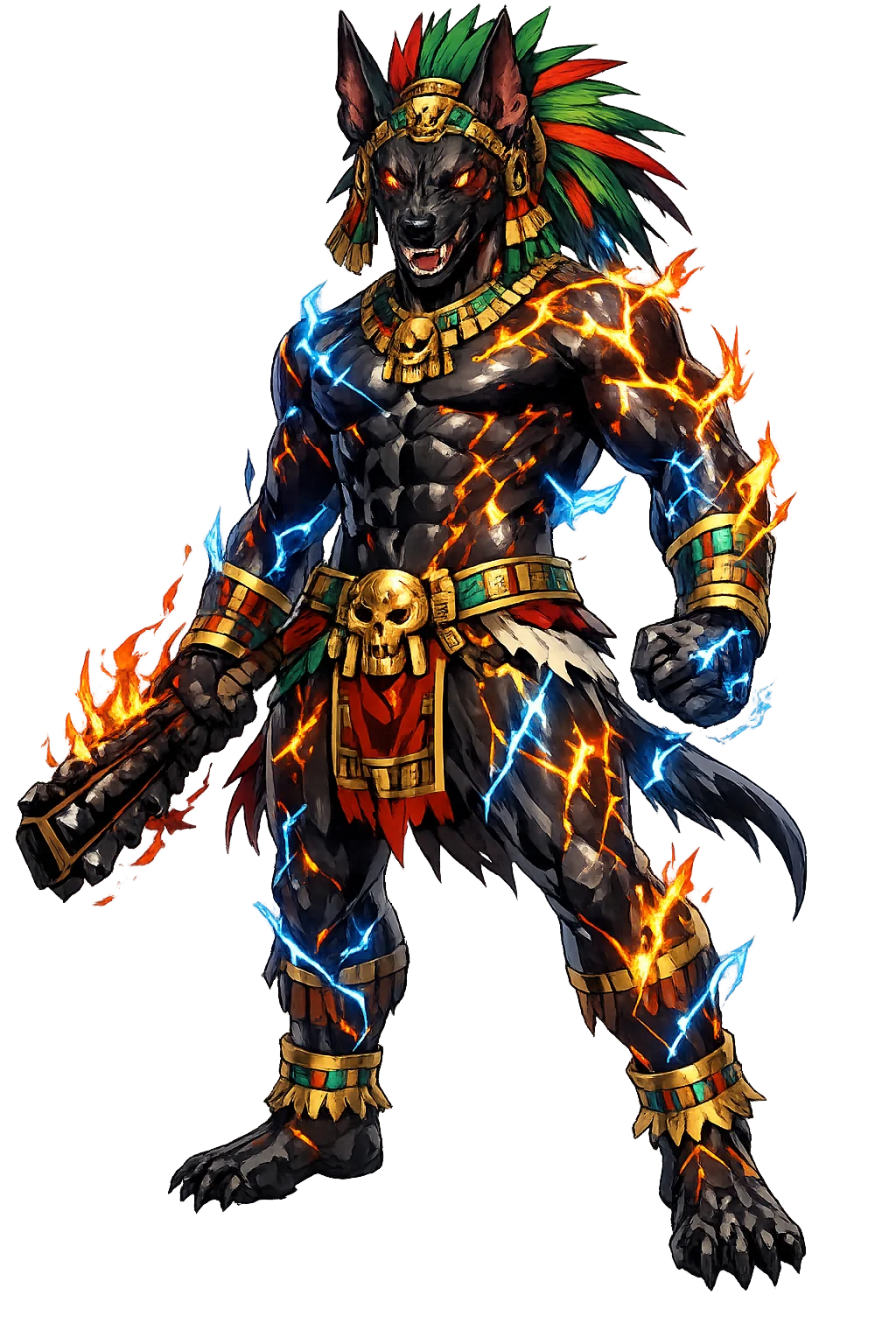
The hidden history behind Xōlōtl
Behind the modern ASCII form xolotl hides a much longer story. Xōlōtl reaches back through manuscripts, inscriptions, and oral tradition long before it ever touched a keyboard, and every mark in the restored spelling is a receipt from that journey. In what follows we trace the name from its Nahuatl transcription attestations through its mythology, its cult, its symbols, and its afterlife in other cultures — and we show how the PuniCodex project turned that philological record into a Unicode domain that resolves today. The history was never lost. It was only waiting for the infrastructure to catch up.
At a Glance
- Restored name: Xōlōtl
- ASCII form: xolotl
- Meaning: "The double, the monster"
- Domain of influence: Evening Star, Death, Twins
- Pantheon: Nahuatl
- Classification: Tier 1
- Live domain: xōlōtl.com
Overview
Xōlōtl (xolotl) — The Twin Who Leads the Sun — belongs to the Nahuatl tradition, where it is catalogued under the domain "Evening Star, Death, Twins". The name means "The double, the monster".
Xōlōtl is the twin who goes down with the sun: brother of Quetzalcōātl, guide of the dead across the underworld's river, and the god who turned himself into maize, maguey, and finally the axolotl rather than be sacrificed. He is the Aztec soul's ferryman — and the lake that still bears his name.
PuniCodex restores the name as Xōlōtl and serves its temple at xōlōtl.com. The original preserves one prosodic feature — stress or vowel length — rather than both, which places the name in Tier 2. The plain ASCII form xolotl survives as a modern convenience imposed by the early domain-name system; the restoration, not the fallback, is the form the project defends as philologically complete.
The Name
No indigenous written attestation survives for this name; Xōlōtl is a scholarly transliteration of the reconstructed spoken form. Etymologically the name means "The double, the monster".
The ASCII form xolotl survives only because the early domain-name system could not carry diacritics; it is a technological compromise, not an ancient spelling. The Unicode restoration Xōlōtl recovers the vowel length of the original directly in the address bar. The original preserves one prosodic feature — stress or vowel length — rather than both, which places the name in Tier 2.
The letter-by-letter transformation runs:
- x → X — Same, capitalized
- o → ō — Long vowel
- l → l — Same
- o → ō — Long vowel
- t → t — Same
- l → l — Same
The project holds the domain xōlōtl.com (xn--xltl-l3ab.com) as the canonical home of this name.
The Original Script
No indigenous writing system is securely attested for individual nahuatl names. The form shown is a modern scholarly transliteration.
The form Xōlōtl is therefore a scholarly transliteration rather than an attested ancient spelling; it encodes the reconstructed sound of the name for modern use, and no mark in it is decorative.
The codices write him as what he is: the dog-headed god, often shown twisted in transformation — half into maize, half into the water-beast — with the twin's ball-court and the Venus star in his glyphic entourage. The name and the animal (xōlōtl, "water monster," the axolotl) are one word: the god hiding inside his own spelling.
Pronunciation
The reconstructed pronunciation of the name is /ˈʃoː.loːtɬ/ — Classical Nahuatl.
For the modern speaker, the closest approximation is: SHOH-lotl, long ō on both syllables.
Kindred and historical forms of the name:
- Nahuatl — Xōlōtl
- His animal — axolotl
- Owned form — Xōlōtl
Xōlōtl carries two long ō vowels, both preserved in the restoration; the final -tl is Nahuatl's signature consonant cluster, released laterally — the sound every visitor learns on the name of the water-monster, the axolotl, that shares his name and, in myth, his skin. The final -tl is Nahuatl's lateral affricate, released to the side of the tongue — the sound that ends axolotl too.
Mythology
Xōlōtl's myths run on twoness: twin of the morning star, guide of the dying sun, the god who is always the second of a pair — and always the one who goes down into the dark.
Across the Nine Waters (The Guide)
The Aztec dead journeyed four years through Mictlān's nine levels, and at the deep river it was the dog — Xōlōtl's creature — who swam them across; a soul whose family had mistreated dogs in life found no ferryman. The funeral rite buried a red dog with the dead: the god's own form, sacrificed to carry its master home. Among the world's psychopomps, he is the only one who comes as a pet.
The God Who Hid (The Sacrifice)
At the creation of the fifth sun the gods gathered at Teotihuacan to sacrifice themselves and set the new sun moving. Xōlōtl refused to die: he fled, weeping so hard his eyes fell from their sockets, and hid — as the twin-stalked maize, as the doubled maguey, and at last as the axolotl in the lake. They found him even there, and he died like the rest: the myth of the price of survival, and of the god who begged to live and serves death anyway.
Venus Split in Two (The Twins)
Quetzalcōātl is Venus as morning star, herald of the light; Xōlōtl is Venus as evening star, which follows the sun into darkness. The astronomy is exact — one planet, two appearances — and the myth makes it biography: one twin leads the dawn out of the night, the other escorts the day into it. Together they keep the star's whole circuit, and the world's whole hope.
The Bones of the Fathers (The Descent)
When the fifth age needed people, Quetzalcōātl descended to Mictlān for the bones of the dead — and Xōlōtl went with him as guide through the underworld's traps. The bones, ground and sprinkled with the gods' own blood, became humankind: every Aztec child was thus made of the dead, carried up by the dog-god's knowledge of the road back.
Symbols & Iconography
The iconography associated with Xōlōtl concentrates in a small set of recurring attributes, each a compressed statement about the name:
- The dog ears — His constant feature in every codex — the faithful guide's mark
- The conch and crossbones — His lordship of death's roads, shared with Mictlāntēcutli
- The maize stalk — His first transformation — the god hiding in the staff of life
Archaeology & Evidence
Colima's ceramic dogs — plump, tumored, dancing, two thousand years old — are the west-Mexican ancestors of his cult, buried in shaft tombs to guide their masters. Aztec dog-effigy vessels and the Florentine Codex's account of the funeral dog detail the central-Mexican rite. Xochimilco's chinampa system — the floating gardens where the last wild axolotls hold on — is a UNESCO World Heritage site, the god's water-form's last stronghold, guarded by canals older than the Aztec state.
Realm & Domain
Xōlōtl is the twin who goes down with the sun: brother of Quetzalcōātl, guide of the dead across the underworld's river, and the god who turned himself into maize, maguey, and finally the axolotl rather than be sacrificed. He is the Aztec soul's ferryman — and the lake that still bears his name.
The Dog
His animal: the guide that leads the dead across the ninefold river of Mictlān.
The Evening Star
Venus at dusk — his station, twin to his brother's morning star.
The Axolotl
His final disguise: the water-monster of Xochimilco, gilled and smiling, that shares his name.
The Empty Sockets
The codices show him weeping his eyes out at the gods' sacrifice — grief itself, dog-eared.
Across Cultures
The friars identified him with the devil's lesser angels, but the people kept him closer to a saint of the road: the dog that guards the grave and guides the traveller survived in Mexican folk custom, and the hairless xoloitzcuintli — the national dog, named from his name — was never exorcised. Scholars pair him with every underworld canine from Cerberus to Anubis, and the Maya twins' underworld journey in the Popol Vuh runs on his same road. The axolotl, his water-form, became Mexico's ambassador-species: the smiling face of conservation itself.
Within the Nahuatl tradition, closely related names in the corpus include [[cihuacoatl|Cihuacōātl]], [[coatlicue|Cōātlīcue]], [[huitzilopochtli|Huitzilopōchtli]], [[itzpapalotl|Itzpapālōtl]], [[mictlantecutli|Mictlāntēcutli]], and [[quetzalcoatl|Quetzalcōātl]].
Cultural Legacy
The axolotl — Ambystoma mexicanum, the salamander that never grows up, regenerating limbs and heart — took his name into every biology classroom on earth; its survival in Xochimilco's canals is now a national project. The xoloitzcuintli dog is Mexico's national breed, and Dante's Divine Comedy has, in the Mexican imagination, a local answer: the Xolo that carries you across. Frida Kahlo painted her xolos; the 2018 animated films gave him to the world's children.
The Scholarly Record
The account of Xōlōtl given in this edition rests on the witnesses and reference works listed below. Lexica and etymological dictionaries secure the form and meaning of the name; the literary and religious texts supply the narrative evidence.
- Florentine Codex (General History of the Things of New Spain), Bernardino de Sahagún; School of American Research, 1577. Full text
- Bernardino de Sahagún, Florentine Codex, General History of the Things of New Spain, 1577. Full text
- Frances Karttunen, An Analytical Dictionary of Nahuatl, University of Texas Press, 1983. Full text
- Nahuatl dictionary (collective modern and colonial sources), Karttunen, Molina, and modern reference works, various.
- Popol Vuh, Translated by Dennis Tedlock, 1550. Full text
- Cambridge Ancient History, Multiple volumes, 1970. Full text
A Meditation
Xōlōtl is the god of the way through. He did not want the job — he wept, hid, and transformed to escape it — and he does it still: the sun into the dark, the dead across the river, the lost back home. He asks the guide's question, which is also the mourner's: who walks with you into the night — and whom, in your turn, will you guide?
The axolotl's refusal to grow up — keeping its gills, its larval smile, its power to regrow a heart — has made it the scientist's darling and the city's emblem, and it is the god's final joke: the deity who begged not to die survives as the animal that regenerates everything. Xōlōtl's question is the guide's own: transformation is not escape — but sometimes, in the last lake, it is enough.
The Unicode Restoration
Xōlōtl is classified as Tier 1: the original carries both stress and length, and only one valid Unicode restoration exists. The ASCII fallback xolotl still resolves everywhere, but it is the restored form that carries the name's full information. Across the 6 characters of the name, the restoration adjusts 2: 2 marks of length (ō, ō). That is the whole thesis of this temple: the marks are the message.
Character by Character
The journey from xolotl to Xōlōtl, one character at a time:
- x → X — Same, capitalized
- o → ō — Long vowel
- l → l — Same
- o → ō — Long vowel
- t → t — Same
- l → l — Same
The Domain Name
The restored name is live as a working domain: xōlōtl.com, which the DNS carries in punycode form as xn--xltl-l3ab.com — an ASCII-compatible encoding that lets a non-ASCII name travel the global network without breaking older infrastructure. The visitor sees Xōlōtl; the machines see the encoding. That duality is the engineering compromise on which the entire restoration rests, and it is why a name written the way its own tradition wrote it in Nahuatl transcription can now be typed into any browser on earth.
The Nahuatl Pantheon
Xōlōtl is one of 28 entries the PuniCodex lexicon catalogues under the Nahuatl pantheon. The Pantheon page gathers the tradition's major figures in one place, and the Lexicon lets you filter all 915 restorations by tradition, tier, or script — the fastest way to see where this name sits among its kin.
Frequently Asked Questions
What does Xōlōtl mean? The traditional gloss is "The double, the monster."
Which tradition does Xōlōtl belong to? Xōlōtl is catalogued in the Nahuatl pantheon of the PuniCodex lexicon.
Why is Xōlōtl classified as Tier 1? Because the original carries both stress and length, and only one valid Unicode restoration exists — and the marks in the restored spelling preserve exactly that evidence.
Is Xōlōtl a working domain? Yes — xōlōtl.com resolves today and routes to this temple.
What is the punycode for xōlōtl.com? The DNS encoding is xn--xltl-l3ab.com; browsers perform the translation automatically, so visitors only ever see the restored name.
Typing Xōlōtl
You do not need a special keyboard to use this restoration. The PuniCodex Type Tool converts the ASCII form xolotl into Xōlōtl as you type, and the browser extension offers the same conversion inside any text field. Copy the restored form, paste it into the address bar, and the DNS does the rest.
Sister Temples
Other temples in the Nahuatl pantheon include Coyolxāuhqui, Mayāhuel, and Mictlāntēcutli — each with its own restoration story, its own scholarly record, and its own place in the lexicon.
Why This Restoration Matters
The story of Xōlōtl did not end in antiquity; it changed medium. Names that survive for millennia do so because each generation finds a new carrier for them — clay, papyrus, print, and now DNS. The PuniCodex restoration simply makes the carrier honest: the spelling that resolves is the spelling the evidence supports. If this post showed anything, it is that xolotl and Xōlōtl are not the same name with different styling. They are a summary and the text it summarizes. The web can now serve the text.
Explore Further
This post is one doorway into the temple. The home page carries the full character breakdown and the ambient canvas; the lore page tells the myths in long form; the Scholarly Edition preserves the sources, pronunciation data, and revision history; and the patron wall supports the restoration directly. For the wider map, browse the Lexicon, explore the Pantheon, or return to the PuniCodex blog.
Related Names
Sources
The full scholarly apparatus — every citation, revision, and review — lives in the Scholarly Edition. Key references for this post:
- Florentine Codex (General History of the Things of New Spain), Bernardino de Sahagún; School of American Research, 1577.
- Frances Karttunen, An Analytical Dictionary of Nahuatl, University of Texas Press, 1983.
- Popol Vuh, Translated by Dennis Tedlock, 1550.
- Cambridge Ancient History, Multiple volumes, 1970.
- Nahuatl dictionary (collective modern and colonial sources), Karttunen, Molina, and modern reference works, various.
- Florentine Codex, Books 3 and 6; Codex Borgia (Xolotl cycles).
- Leyenda de los Soles; Codex Borgia (Venus almanacs).
- Motolinia and Durán (funeral rites); Sahagún, Florentine Codex.
- Lexicon authorities for this entry: Florentine Codex, Sahagún.