
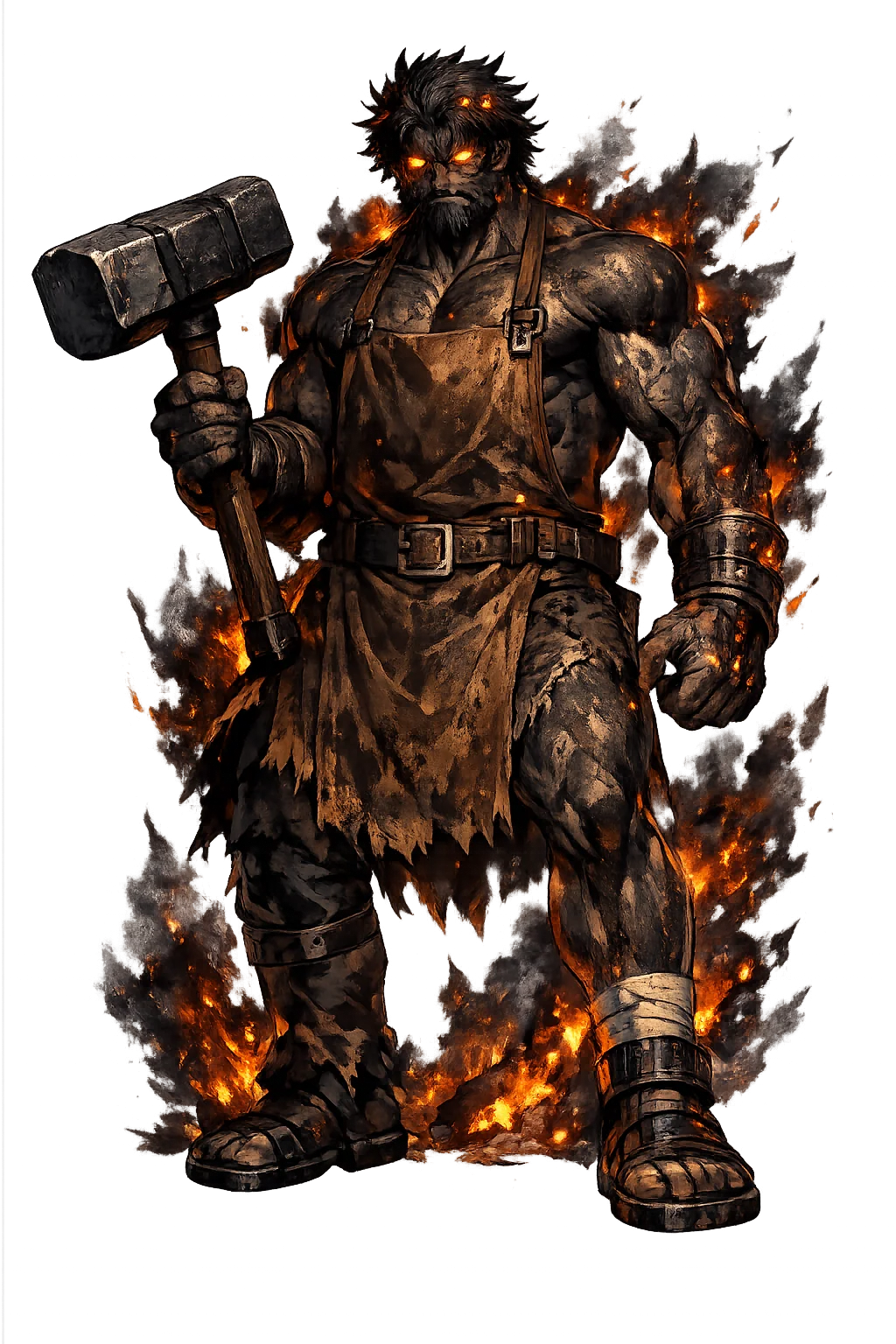
From Original Script to Unicode: the journey of Vulcānus
Long before it was a domain, this name traveled through scripts. Vulcānus begins in Original Script, passes through scholarly transliteration, and ends — for now — inside the punycode machinery of the global DNS. Each stage of that journey preserves some information and loses some, and the craft of restoration is knowing exactly which marks matter. This post follows the name stage by stage: the original script, the reconstructed pronunciation, the mythological record, the material evidence, and finally the Unicode form that carries all of it into the address bar. Think of it as a biography of a name, told through its spelling.
At a Glance
- Restored name: Vulcānus
- ASCII form: vulcanus
- Meaning: "Possibly from fulgere (to flash) or a pre-Roman fire root"
- Domain of influence: Fire, Forge, Craft
- Pantheon: Roman
- Classification: Tier 2
- Live domain: vulcānus.com
Overview
Vulcānus (vulcanus) — The Smith of the Gods — belongs to the Roman tradition, where it is catalogued under the domain "Fire, Forge, Craft". The name means "Possibly from fulgere (to flash) or a pre-Roman fire root".
Vulcānus is Rome's ambivalent fire: the destructive flame that must be kept outside the walls and the tamed forge-fire that arms the state. His festival burns fish alive in midsummer — not for food, but to buy the city's safety from the god who burns cities.
PuniCodex restores the name as Vulcānus and serves its temple at vulcānus.com. The original preserves one prosodic feature — stress or vowel length — rather than both, which places the name in Tier 2. The plain ASCII form vulcanus survives as a modern convenience imposed by the early domain-name system; the restoration, not the fallback, is the form the project defends as philologically complete.
The Name
No indigenous written attestation survives for this name; Vulcānus is a scholarly transliteration of the reconstructed spoken form. Etymologically the name means "Possibly from fulgere (to flash) or a pre-Roman fire root".
The ASCII form vulcanus survives only because the early domain-name system could not carry diacritics; it is a technological compromise, not an ancient spelling. The Unicode restoration Vulcānus recovers the vowel length of the original directly in the address bar. The original preserves one prosodic feature — stress or vowel length — rather than both, which places the name in Tier 2.
The letter-by-letter transformation runs:
- v → V — Same letter
- u → u — Same letter
- l → l — Same letter
- c → c — Same letter
- a → ā — Macron marks the long vowel
- n → n — Same letter
- u → u — Same letter
- s → s — Same letter
The project holds the domain vulcānus.com (xn--vulcnus-v3a.com) as the canonical home of this name.
The Original Script
The original script for this roman name has not yet been added to PUNICODEX. The form shown is a scholarly transliteration.
The form Vulcānus is therefore a scholarly transliteration rather than an attested ancient spelling; it encodes the reconstructed sound of the name for modern use, and no mark in it is decorative.
Pronunciation
The reconstructed pronunciation of the name is /vulˈkaː.nus/ — Classical Latin.
For the modern speaker, the closest approximation is: vul-KAH-nus, long ā on the stressed second syllable.
Kindred and historical forms of the name:
- Latin — Vulcānus
- Greek twin — Ἥφαιστος
- Modern word — volcano
- Owned form — Vulcānus
Latin Vulcānus — also Volcānus in inscriptions — scans with a long ā; its origin is pre-Roman and possibly Cretan (Wchanos has been proposed), making him one of the oldest names in the Roman pantheon. The macron marks the quantity on which the classical poets agree.
Mythology
Roman myth borrowed Hēphaistos' stories for him, but his cult is older and darker than the smith of Olympos: Vulcānus is first the fire that must be averted.
The Fish Fires (The Substitute)
At the Volcanalia, the hottest and driest month, Romans threw live fish from the Tiber into bonfires at the Volcanal. The calendars explain the rite as substitution: souls of water given to fire, so that fire takes the offering instead of the granaries. It is propitiation, not celebration — Rome's insurance premium paid in flame.
Venus and Mars (The Net)
Ovid retells the Odyssey's finest comedy: Vulcānus, tipped off by the Sun, forges a net finer than a spider's thread and catches his wife Venus in bed with Mars. The gods gather to laugh — and the myth carries its Roman moral: craft exposes what force cannot guard. The cuckolded smith is also the only god who ever shamed war itself.
The Binding Chair (The Throne)
The Roman version of the Hēphaistos cycle kept the revenge on Iūnō: Vulcānus sent his mother a golden throne that bound her fast when she sat — payment for being thrown from heaven at birth — and only wine, brought by Bacchus, persuaded the limping god to come loose her. Even the queen of heaven learns that the forge holds the stronger magic.
Aeneas' Shield (The Arming)
The Aeneid gives him his noblest commission: at Venus' plea, Vulcānus forges the arms of Aeneas, and on the shield he works the future of Rome — Actium, the triumphs, the unborn empire — "the fame and fate of his descendants." The smith-god is thus the secret author of Roman destiny: history itself as forge-work.
Symbols & Iconography
The iconography associated with Vulcānus concentrates in a small set of recurring attributes, each a compressed statement about the name:
- The hammer — Force made precise — the smith's answer to the flame
- The tongs — The hand's extension into fire; technology as safe distance
- The bonfire — Fire acknowledged and bargained with
Epithets & Cult Titles
His titles divide, as he does, between the dangerous fire and the tamed.
- Mulciber — 'the Softener'; the smith's title, fire as craft, used by all the poets.
- Quietus — 'the Stilled'; the averted fire, worshipped so it stays asleep.
- Armipotens — 'powerful in arms'; the forger of the state's weapons.
- Ignipotens — 'lord of fire'; the full epic style.
- Volcanus — the older spelling of his name, kept in the oldest inscriptions and the island that immortalized it.
Oracle Sites & Sanctuaries
The Volcanal in the Roman Forum — the open-air precinct above the Lapis Niger, beside the archaic inscription of Rome's oldest law — was his oldest seat, deliberately outside the city's sacred boundary: the dangerous fire worshipped at arm's length. His temple stood on the Campus Martius, likewise outside the walls. The Aeolian island of Vulcano, with its smoking fumaroles, was shown to travelers as his forge-chimney; its ancient obsidian industry — worked since the Neolithic — made the myth practical geology long before it was theology.
Archaeology & Evidence
The Volcanal in the Forum — an open precinct above the Lapis Niger, with the archaic dedication of a Senate's honorific to the god — anchors his cult in Rome's oldest ground. Vulcano in the Aeolian islands preserves the fumarole fields the ancients called his workshops, and the islands' obsidian industry fed Neolithic trade millennia before the myths. Pompeii's forges, with their anvils and half-finished work, show his everyday cult of the artisans who kept his festival as their own holiday.
Realm & Domain
Vulcānus is Rome's ambivalent fire: the destructive flame that must be kept outside the walls and the tamed forge-fire that arms the state. His festival burns fish alive in midsummer — not for food, but to buy the city's safety from the god who burns cities.
Mulciber
"The Softener" — his title as the smith who coaxes iron, taming fire into craft.
Volcanalia
August 23: live fish thrown into bonfires, a substitute-offering against the fire's hunger for the city.
The Volcanal
His open-air altar in the Forum — above the Lapis Niger, at the city's oldest sacred ground.
The Aeolian Forges
The island Vulcano, where his hammerings were heard beneath the smoking mountain.
Across Cultures
His equation with Hēphaistos is complete in art, but Rome insisted on the difference: Vulcānus is fire as danger, kept at arm's length — his oldest shrine outside the pomerium, his temple on the Campus Martius. Through Vulcano island his name fused with every smoking mountain; through the Aeolian forges he merged with the Cyclopes. The word "volcano" is his inheritance, which no other god can claim: a deity's name become a category of the planet.
Within the Roman tradition, closely related names in the corpus include [[diana|Diāna]], [[ianus|Iānus]], [[iuno|Iūnō]], [[iuppiter|Iūppiter]], [[neptunus|Neptūnus]], and [[hephaistos|Hēphaistos]].
Cultural Legacy
Vulcanization — Goodyear's process for rubber — borrowed his name for fire's mastery of matter; volcanoes, volcanology, and a Star Trek homeworld followed. In Rome he gave his title Mulciber to every poet's image of gentle strength. The deeper legacy is conceptual: he embodies technology's eternal contract — the same fire that forges the shield burns the city — and every safety code is his Volcanalia continued by other means.
The Scholarly Record
The account of Vulcānus given in this edition rests on the witnesses and reference works listed below. Lexica and etymological dictionaries secure the form and meaning of the name; the literary and religious texts supply the narrative evidence.
- Lewis & Short, A Latin Dictionary, Oxford, Clarendon Press; Perseus digitization, 1879. Full text
- Ovid (Publius Ovidius Naso), Metamorphoses / Fasti / Heroides, Loeb Classical Library, 17. Full text
- Varro, De Lingua Latina / Antiquitates Rerum Divinarum, Loeb Classical Library, 45 BCE.
- Cicero, Marcus Tullius — collected works, Loeb Classical Library, 43 BCE. Full text
- Pliny the Elder, Naturalis Historia, Loeb Classical Library, 77.
- Cambridge Ancient History, Multiple volumes, 1970. Full text
A Meditation
Vulcānus is the god of the firewall. He teaches that the power worth having is the power kept at the right distance: fire in the forge, not the bedroom; strength in the net, not the fist. Every craftsperson who has burned a hand learning the distance knows his liturgy — and every city that survives the summer pays his quiet premium.
His contract is written now in building codes and reactor protocols, in firewalls and safety factors: the fire is not the enemy — the distance is the discipline. Rome worshipped him outside the walls on purpose, and every civilization since has redrawn that line where the useful flame ends and the other kind begins. To keep a forge is to renegotiate his treaty daily, in steel, in silica, in code.
The Unicode Restoration
Vulcānus is classified as Tier 2: the original preserves at least one philological feature that ASCII cannot encode. The ASCII fallback vulcanus still resolves everywhere, but it is the restored form that carries the name's full information. Across the 8 characters of the name, the restoration adjusts 1: 1 mark of length (ā). That is the whole thesis of this temple: the marks are the message.
Character by Character
The journey from vulcanus to Vulcānus, one character at a time:
- v → V — Same letter
- u → u — Same letter
- l → l — Same letter
- c → c — Same letter
- a → ā — Macron marks the long vowel
- n → n — Same letter
- u → u — Same letter
- s → s — Same letter
The Domain Name
The restored name is live as a working domain: vulcānus.com, which the DNS carries in punycode form as xn--vulcnus-v3a.com — an ASCII-compatible encoding that lets a non-ASCII name travel the global network without breaking older infrastructure. The visitor sees Vulcānus; the machines see the encoding. That duality is the engineering compromise on which the entire restoration rests, and it is why a name written the way its own tradition wrote it in Original Script can now be typed into any browser on earth.
The Roman Pantheon
Vulcānus is one of 6 entries the PuniCodex lexicon catalogues under the Roman pantheon. The Pantheon page gathers the tradition's major figures in one place, and the Lexicon lets you filter all 915 restorations by tradition, tier, or script — the fastest way to see where this name sits among its kin.
Frequently Asked Questions
What does Vulcānus mean? The traditional gloss is "Possibly from fulgere (to flash) or a pre-Roman fire root."
Which tradition does Vulcānus belong to? Vulcānus is catalogued in the Roman pantheon of the PuniCodex lexicon.
Why is Vulcānus classified as Tier 2? Because the original preserves at least one philological feature that ASCII cannot encode — and the marks in the restored spelling preserve exactly that evidence.
Is Vulcānus a working domain? Yes — vulcānus.com resolves today and routes to this temple.
What is the punycode for vulcānus.com? The DNS encoding is xn--vulcnus-v3a.com; browsers perform the translation automatically, so visitors only ever see the restored name.
Typing Vulcānus
You do not need a special keyboard to use this restoration. The PuniCodex Type Tool converts the ASCII form vulcanus into Vulcānus as you type, and the browser extension offers the same conversion inside any text field. Copy the restored form, paste it into the address bar, and the DNS does the rest.
Sister Temples
Other temples in the Roman pantheon include Neptūnus, and Diāna — each with its own restoration story, its own scholarly record, and its own place in the lexicon.
Why This Restoration Matters
Every stage of the journey from Original Script to Unicode was an act of care: the scribe who first wrote the name, the lexicographer who glossed it, the engineer who taught the DNS to carry it. The PuniCodex restoration is the latest stage, not the last word — the Scholarly Edition is revised as the evidence improves. What does not change is the principle: a name deserves to be written the way its own tradition wrote it. Vulcānus in the address bar is that principle, made routable.
Explore Further
This post is one doorway into the temple. The home page carries the full character breakdown and the ambient canvas; the lore page tells the myths in long form; the Scholarly Edition preserves the sources, pronunciation data, and revision history; and the patron wall supports the restoration directly. For the wider map, browse the Lexicon, explore the Pantheon, or return to the PuniCodex blog.
Related Names
Sources
The full scholarly apparatus — every citation, revision, and review — lives in the Scholarly Edition. Key references for this post:
- Virgil (Publius Vergilius Maro), Aeneid / Eclogues / Georgics, Loeb Classical Library / Oxford Classical Texts, 19 BCE.
- Ovid (Publius Ovidius Naso), Metamorphoses / Fasti / Heroides, Loeb Classical Library, 17.
- Lewis & Short, A Latin Dictionary, Oxford, Clarendon Press; Perseus digitization, 1879.
- Cicero, Marcus Tullius — collected works, Loeb Classical Library, 43 BCE.
- Cambridge Ancient History, Multiple volumes, 1970.
- Varro, De Lingua Latina / Antiquitates Rerum Divinarum, Loeb Classical Library, 45 BCE.
- Pliny the Elder, Naturalis Historia, Loeb Classical Library, 77.
- Virgil, Aeneid 8; the Volcanal inscriptions.
- Dionysius 2.50 (the Volcanal); Thucydides 3.88 (the islands).
- Lexicon authorities for this entry: Lewis & Short, Virgil, Ovid.