
Inside the Valhǫll restoration: what the marks recover
Every name in this series was once flattened to fit a keyboard. Valhǫll is what the evidence put back.
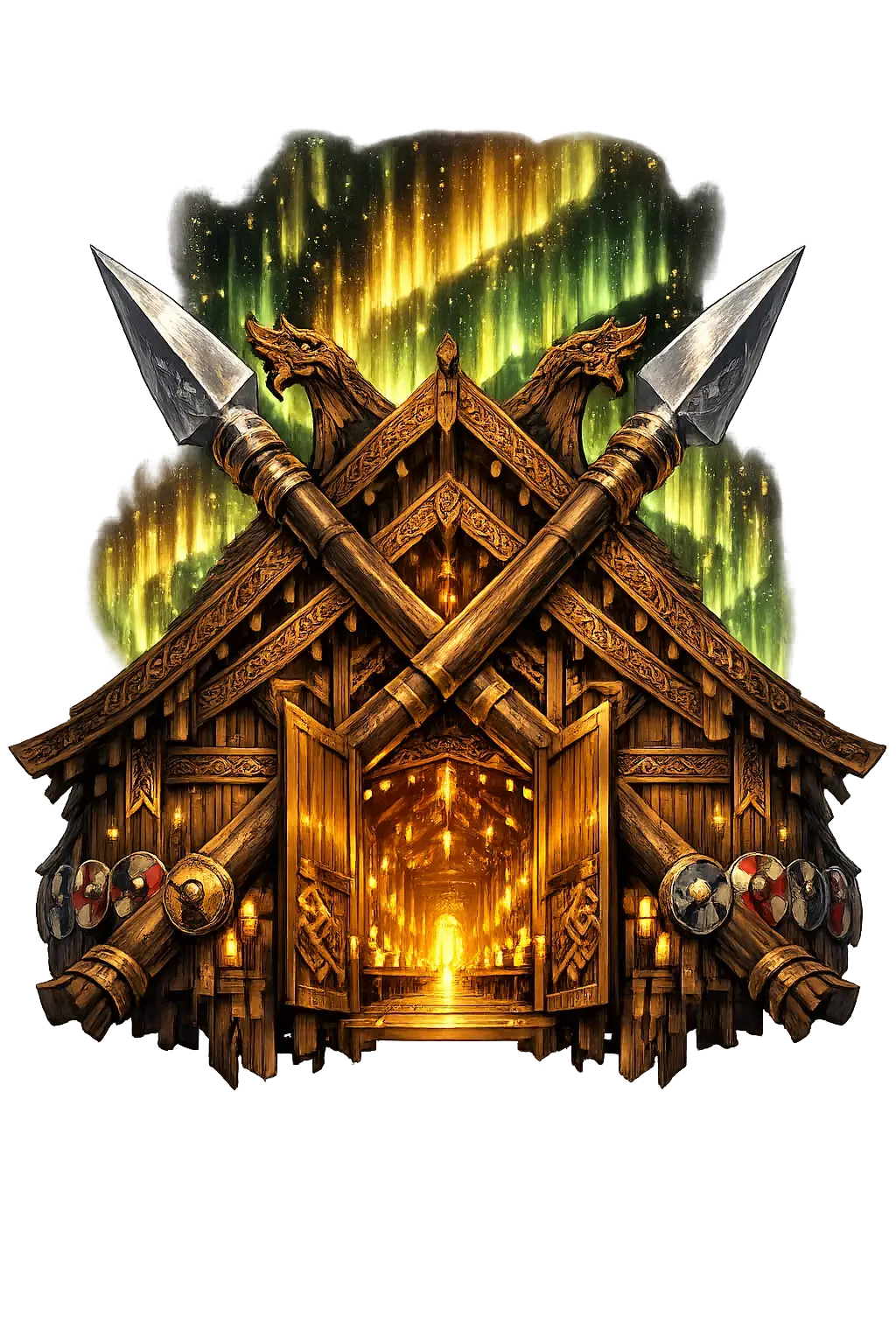
Valhǫll is less a single myth than a single place at the center of many myths. It is the destination of the valkyries, the home of the einherjar, and the staging ground for Ragnarök. Every battle death is implicitly a journey toward its doors. In Grímnismál, Óðinn in disguise describes Valhǫll in detail: it has 540 doors, and through each door eight hundred warriors will march abreast at Ragnarök. Its roof is covered with golden shields, its benches are strewn with mail coats, and the hall itself is so vast that it contains enough space for all the chosen dead.
That is the figure this file is about — and the temple now standing at its restored name.
At a Glance
- Restored name: Valhǫll
- ASCII form: valholl
- Meaning: "Hall of the slain warriors"
- Domain of influence: Hall of the Slain
- Pantheon: Norse
- Classification: Tier 1
- Original script: ᚢᛅᛚᚼᚢᛚ
- Series: The Restoration Files, No. 256 of 271
The Name Before the Marks
Valhǫll preserves its form without added diacritics: the restoration here is the exactness of the spelling itself, the form the tradition's own sources record. valholl and Valhǫll may look interchangeable to a search box; they are not interchangeable to a philologist.
The Temple That Stands Now
The restored name is not a plaque; it is an address. The temple of Valhǫll lives at /sites/valholl/, with its mythology in the lore halls, its peer-reviewed record in the Scholarly Edition, and its place in the pattern atlas on the patterns floor.
The restoration preserves more than the ASCII form can say — stress, length, or a letter the Latin keyboard lost — which places it in Tier-1: mechanically verifiable, information-rich.
Every flagship temple is hand-built to the same standard: the original script displayed with its provenance, the pronunciation reconstructed phoneme by phoneme, the sources named — because a restoration you cannot audit is just a spelling with confidence.
The Archetype at Work
A temple is also a reading of what this figure means — and meanings have addresses in the modern world. The pattern atlas maps Valhǫll to the industries its archetype genuinely resonates with, each match argued, weighted, and open to challenge:
- Gaming, Fantasy & Entertainment IP — Assassin’s Creed Valhalla is one title among many; the hall of the slain sells.
- Defense, Military & Security — The einherjar drill daily for the last war; readiness as an eternal institution.
- Funerary & Memorial Services — The hall of the slain; the warrior’s memorial.
This is the part of the file that surprises people: a four-thousand-year-old name, mapping cleanly onto twenty-first-century trades. The patterns are not marketing — they are the same myths, read forward.
In the Sacred Texts
The Norse tradition is not a vibe; it is a library. The Sacred Texts collection holds Poetic Edda and Prose Edda — the primary sources the temple's scholarship is built on, free to read, cross-linked back to the names they mention. The temple is the argument; the texts are the evidence.
The File Continues
This is one of 271 Restoration Files — a second dispatch from every flagship temple in the fleet. The temple's first dispatch tells the founding story of the name; the blog index holds the whole archive.
Continue the series — previous file: Vajrapāṇi (read it here) · next file: Váli (read it here).
The Restoration Files are written from the same canonical record as the temples themselves: the lexicon, the lore catalog, the pattern atlas, and the cited scholarly sources. If a file ever disagrees with its temple, the temple is right — tell us, and the file will be corrected.