
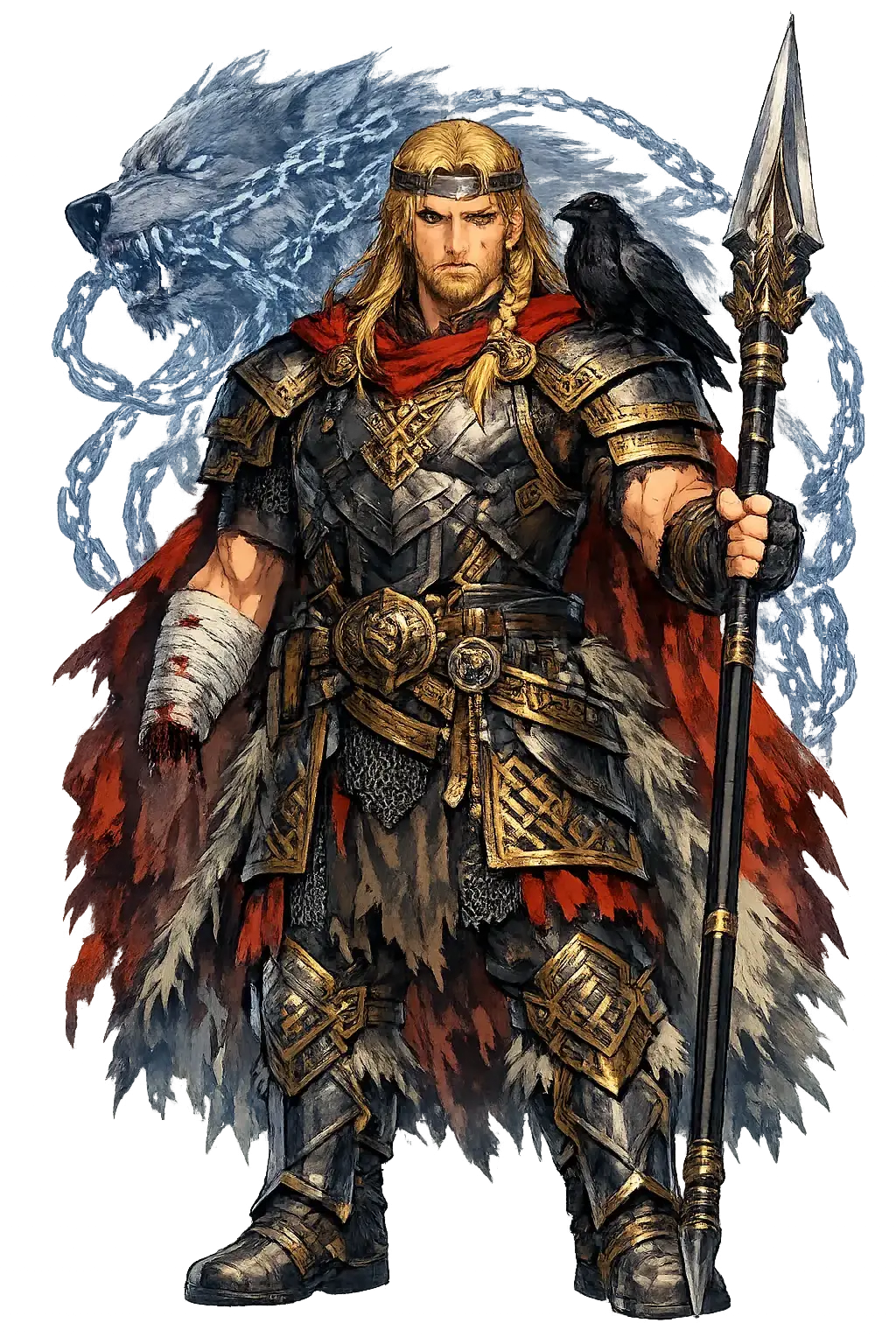
How Týr got its accent back
The ASCII form tyr is missing something. Týr restores the marks the source language used to distinguish this name from a thousand others — and those marks change how the name is read, pronounced, and understood. This post explains, with the full scholarly record behind it, what each restored mark preserves: the Younger Futhark evidence, the reconstructed sound, the myths the name carries, and the classification logic that separates Tier 1 restorations from Tier 2. By the end, the marks in Týr will look less like ornaments and more like what they are — recovered evidence, pinned back in its proper place.
At a Glance
- Restored name: Týr
- ASCII form: tyr
- Meaning: "God (cognate with Greek Zeus, Latin Jove)"
- Domain of influence: War, Law, Oaths
- Pantheon: Norse
- Classification: Tier 2
- Original script: ᛏᚢᚱ (Younger Futhark)
- Live domain: týr.com
Overview
Týr (tyr) — War, Law, Oaths · God (cognate with Greek Zeus, Latin Jove) — belongs to the Norse tradition, where it is catalogued under the domain "War, Law, Oaths". The name means "God (cognate with Greek Zeus, Latin Jove)".
Týr is the god who keeps his word even when it costs him his hand. In a pantheon famous for cunning and force, he stands for something older: the binding power of oath and law. Once among the most prominent gods of the Germanic peoples, he is remembered in the Norse sources chiefly for the binding of Fenrir, the great wolf who will devour Óðinn at Ragnarök.
PuniCodex restores the name as Týr and serves its temple at týr.com. The original preserves one prosodic feature — stress or vowel length — rather than both, which places the name in Tier 2. The plain ASCII form tyr survives as a modern convenience imposed by the early domain-name system; the restoration, not the fallback, is the form the project defends as philologically complete.
The Name
The name is attested in Younger Futhark as ᛏᚢᚱ, and the t-rune (ᛏ) itself bears his name: Proto-Germanic \Tīwaz* is embedded in the rune-row, the only theonym among the rune-names.
Týr descends from Proto-Germanic \Tīwaz, from the Indo-European root dyēus 'sky, sky-god' — the same root that gives Greek Zeús, Latin Iuppiter (Jove), and Sanskrit Dyáuṣ. The god's name is thus, etymologically, simply 'god'; the common Old Norse appellative survives in compounds such as hangatýr and sigtýr (Óðinn-names) and in the plural tívar* 'the gods' of Völuspá's refrain.
Cognate forms across related languages:
- Zeús (Greek) — from the same Indo-European root dyēus
- Iuppiter / Jove (Latin) — from Dyēus ph₂tēr, 'father sky-god'
- Tīw (Old English) — the Anglo-Saxon form, preserved in Tuesday
- Ziu (Old High German) — the continental form
The ASCII form tyr survives only because the early domain-name system could not carry diacritics; it is a technological compromise, not an ancient spelling. The Unicode restoration Týr recovers the stress accent of the original directly in the address bar. The original preserves one prosodic feature — stress or vowel length — rather than both, which places the name in Tier 2.
The letter-by-letter transformation runs:
- t → T — Same
- y → ý — Acute on y
- r → r — Same
The project holds the domain týr.com (xn--tr-0ka.com) as the canonical home of this name.
Etymology & Roots
The recorded derivation reads: God (cognate with Greek Zeus, Latin Jove)
The root gloss is "God."
The reconstruction is classed as attested.
Kindred forms recorded in the lexicon:
- Greek Zeus (related) — cognate
- Latin Jove) (related) — cognate
The Original Script
The name is preserved in Younger Futhark as ᛏᚢᚱ — Germanic runic, attested Viking Age, c. 800–1100 CE, in Scandinavia. The script is written left-to-right, top-to-bottom.
The scholarly transliteration is Týr (normalized Old Norse), giving the normalized reading /ˈtyːr/.
The rendering proceeds step by step:
- The Younger Futhark form ᛏᚢᚱ provides a Viking-Age runic attestation or normalized reconstruction; the t-rune itself carries the god's name.
- Younger Futhark has only sixteen runes and does not distinguish short/long vowels or voiced/voiceless stops.
- The normalized Old Norse form is based on 13th-century manuscript tradition (Poetic and Prose Eddas).
- The Unicode restoration Týr uses the accented vowel ý, a letter registrable in .com, to mark the long front rounded vowel.
Pronunciation
The reconstructed pronunciation of the name is /tyːr/ — Old Norse Reconstruction.
Phoneme by phoneme:
- T- — Voiceless alveolar stop [t], the same crisp t as in English 'stop'.
- -ý- — Long close front rounded vowel [yː], marked by the acute accent; pronounced like French 'tu' but held long and stressed.
- -r — Trilled or tapped alveolar [r], lighter than the geminated rr of Þórr.
For the modern speaker, the closest approximation is: 'TEWR' — start with a crisp 't', say the rounded 'ew' of 'few' while pursing the lips, hold it long, and finish with a light trilled r.
Kindred and historical forms of the name:
- Proto-Germanic — *Tīwaz, the celestial god from whom Týr descends
- Old English — Tīw, the Anglo-Saxon war god whose name survives in Tuesday
- Old High German — Ziu, the continental reflex, remembered in the historical weekday-name Ziestac
Týr is Tier 2: the acute on ý marks both stress and length on a distinctive long front rounded vowel, but the name has no additional long vowel or circumflex. The registrable form preserves the Old Norse vowel quality and the god's name as recorded in the Eddas and skaldic verse.
Mythology
Týr's mythology is narrower than that of Óðinn or Þórr, but it turns on a single, unforgettable scene: a god who pays for the common good with his own body. His stories are stories of pledges kept, monsters bound, and the law that outlasts the hand that swore it.
The Binding of Fenrir (Gylfaginning)
The wolf Fenrir grew among the gods, and only Týr dared feed him. When the gods forged the fetter Gleipnir — made of six impossible things such as the roots of a mountain and the breath of a fish — they invited Fenrir to test his strength against it. Suspecting treachery, Fenrir demanded that one god place a hand in his mouth as pledge. Týr stepped forward. The wolf was bound, and Týr lost his hand. The gods laughed; only Týr did not.
The Accusation at Ægir's Feast (Lokasenna)
In Lokasenna, Loki taunts Týr with the mutilation: 'Be silent, Týr; you could never bring two parties to terms' — and adds the obscenity that Týr's wife bore Loki a son. Týr answers that although he lacks a hand, Loki lacks the famous wolf, which must wait in bonds until the doom of the gods. The exchange pits two kinds of loss against each other: Týr's sacrificed hand and Loki's sacrificed honor.
The Journey to Hymir (Hymiskviða)
In Hymiskviða, Týr appears not as son of Óðinn but as son of the giant Hymir. He accompanies Þórr to Jötunheimr to fetch a cauldron large enough to brew ale for all the gods. The poem hints at older traditions in which Týr had a different genealogy and a larger cultic role.
Symbols & Iconography
The iconography associated with Týr concentrates in a small set of recurring attributes, each a compressed statement about the god:
- Sword — the weapon of the warrior and the symbol of lawful violence; Týr is called 'sword-god' in kennings.
- The t-rune (ᛏ) — the rune that bears his name, glossed in the Icelandic and Norwegian rune poems as 'the one-handed Áss'; Sigrdrífumál 6 bids the warrior carve victory-runes on the sword-hilt and 'name Týr twice'.
- Missing right hand — the visible cost of the pledge given to Fenrir; Gylfaginning 34 preserves the anatomical kenning úlflíðr, 'wolf-joint', for the wrist.
- Wolf — Fenrir, the bound beast whose capture defines Týr's myth and whose freedom defines his death at Ragnarök, where he meets the hound Garmr.
- Spear — the divine weapon shared with Óðinn, marking his older role as a war god.
Archaeology & Evidence
Týr's epigraphic footprint is real but oblique. His name survives in the t-rune and in the stacked t-rune sequences of Migration-Age charms — the Kylver stone, the Lindholm amulet, and the Seeland-II bracteate — treated in the runic-evidence section. The clearest monumental attestation is Roman: the third-century altar from Housesteads on Hadrian's Wall (RIB 1593) dedicates to 'Mars Thincsus and the two Alaisiagae, Bede and Fimmilene', identifying the Germanic war-god of the thing-assembly with the Roman Mars. The early Viking-Age Ribe skull fragment, a healing charm, names Óðinn and contains the sequence hōtýr, read variously as an Óðinn-epithet and as a survival of the god's own name; the question remains open. Place-names carry the cult further than the literature does: Tisvilde and Tirslund in Denmark, Týrsbergi in Sweden, and a wider scatter of Scandinavian Tis-/Tyr- compounds mark springs, groves, and hills once under his protection.
Realm & Domain
Týr is the god who keeps his word even when it costs him his hand. In a pantheon famous for cunning and force, he stands for something older: the binding power of oath and law. Once among the most prominent gods of the Germanic peoples, he is remembered in the Norse sources chiefly for the binding of Fenrir, the great wolf who will devour Óðinn at Ragnarök.
Oath and Treaty
The guarantor of public law and solemn promise; under the Roman interpretatio he was Mars Thingsus, patron of the assembly.
The Binding of Fenrir
He alone dared place his hand in the wolf's mouth as pledge; the gods gained a chained monster and Týr gained the name 'one-handed'.
Warrior's Courage
Snorri calls him the boldest and most valiant of the Æsir, a god who decides victory in battle.
The Thing
The Germanic assembly of free men gathered under his protection; the Housesteads altar names Mars Thincsus beside the Alaisiagae.
Across Cultures
Roman writers equated the Germanic war god with Mars, especially as Mars Thingsus, the patron of the thing assembly. The third-century altar at Housesteads on Hadrian's Wall invokes 'Mars Thincsus' alongside the Alaisiagae, a pair of Germanic goddesses named Bede and Fimmilene. In the interpretatio romana of Tacitus, the highest Germanic god was Mercury (Óðinn), but Mars remained the god honoured before battle and associated with the assembly. The Anglo-Saxon name Tīw and the day-name Tuesday preserve Týr's memory in English. Some scholars see him as the original chief god of early Germanic religion, later eclipsed by Óðinn and Þórr — an inference from his sky-god etymology rather than from the surviving mythology, where his role is already diminished.
Kindred figures in the PuniCodex cross-tradition index include [[anat|ꜥAnat]], [[ares|Árēs]], [[ashur|Aššur]], [[athena|Athénā]], [[durga|Durgā]], and [[huitzilopochtli|Huitzilopōchtli]], each linked through war / battle.
Cultural Legacy
Týr survives most visibly in the English word Tuesday ('Tīw's day'), a faint echo of a once-major deity. The t-rune kept his name embedded in the rune-row itself, quoted approvingly in the medieval rune poems. Tacitus' earth-born ancestor Tuisco (Germania 2) was long linked to Tīwaz by scholars seeking a Germanic sky-father, though the identification is contested. In modern Heathenry and Norse-inspired fantasy he is honored as the god of law, honor, and self-sacrifice — the deity who keeps oaths even at terrible cost — and the binding of Fenrir remains one of the most retold scenes in the entire Norse corpus. The philological interest of the name, a god whose name is simply 'god', has kept Týr at the center of Indo-European comparative mythology since the nineteenth century.
The Scholarly Record
The account of Týr given in this edition rests on the witnesses and reference works listed below. Lexica and etymological dictionaries secure the form and meaning of the name; the literary and religious texts supply the narrative evidence.
- Snorri Sturluson, Prose Edda: Gylfaginning (the binding of Fenrir and Týr's lost hand).
- Poetic Edda: Lokasenna (Loki's taunt and Týr's reply).
- Poetic Edda: Hymiskviða (Týr as son of Hymir).
- Tacitus, Germania (interpretatio romana of Germanic gods).
- Cleasby & Vigfusson, An Icelandic-English Dictionary (1874), s.v. Týr.
- Zoëga, A Concise Dictionary of Old Icelandic (1910), s.v. Týr.
- de Vries, Jan, Altgermanische Religionsgeschichte.
- Simek, Rudolf, Dictionary of Northern Mythology.
- Lindow, John, Norse Mythology: A Guide to the Gods, Heroes, Rituals, and Beliefs.
A Meditation
Týr is the god of the kept word. In a world of shifting alliances and clever speech, he stands for the promise that cannot be broken without breaking the promiser. His hand is not lost in battle; it is lost in diplomacy, in the necessary lie that binds a monster for the good of all.
There is something austere about Týr. He does not joke like Loki, scheme like Óðinn, or thunder like Þórr. He simply does what must be done and accepts the cost. In an age of broken contracts and disposable commitments, his mutilated hand is a quiet rebuke: the law is only as strong as those willing to suffer for it.
The Unicode Restoration
Týr is classified as Tier 2: the original preserves at least one philological feature that ASCII cannot encode. The ASCII fallback tyr still resolves everywhere, but it is the restored form that carries the name's full information. Across the 3 characters of the name, the restoration adjusts 1: 1 mark of stress (ý). That is the whole thesis of this temple: the marks are the message.
Character by Character
The journey from tyr to Týr, one character at a time:
- t → T — Same
- y → ý — Acute on y
- r → r — Same
The Domain Name
The restored name is live as a working domain: týr.com, which the DNS carries in punycode form as xn--tr-0ka.com — an ASCII-compatible encoding that lets a non-ASCII name travel the global network without breaking older infrastructure. The visitor sees Týr; the machines see the encoding. That duality is the engineering compromise on which the entire restoration rests, and it is why a name written the way its own tradition wrote it in Younger Futhark can now be typed into any browser on earth.
The Norse Pantheon
Týr is one of 86 entries the PuniCodex lexicon catalogues under the Norse pantheon. The Pantheon page gathers the tradition's major figures in one place, and the Lexicon lets you filter all 895 restorations by tradition, tier, or script — the fastest way to see where this name sits among its kin.
Frequently Asked Questions
What does Týr mean? The traditional gloss is "God (cognate with Greek Zeus, Latin Jove)."
Which tradition does Týr belong to? Týr is catalogued in the Norse pantheon of the PuniCodex lexicon.
Why is Týr classified as Tier 2? Because the original preserves at least one philological feature that ASCII cannot encode — and the marks in the restored spelling preserve exactly that evidence.
Is Týr a working domain? Yes — týr.com resolves today and routes to this temple.
What is the punycode for týr.com? The DNS encoding is xn--tr-0ka.com; browsers perform the translation automatically, so visitors only ever see the restored name.
Typing Týr
You do not need a special keyboard to use this restoration. The PuniCodex Type Tool converts the ASCII form tyr into Týr as you type, and the browser extension offers the same conversion inside any text field. Copy the restored form, paste it into the address bar, and the DNS does the rest.
Why This Restoration Matters
The marks in Týr were never lost; they were only waiting for a carrier that could hold them. Now that the carrier exists, the burden flips: every use of tyr is a choice to leave evidence on the table. The PuniCodex temple keeps the restored form in circulation — as a domain, a dataset entry, and a scholarly argument — so that the choice to use it stays easy. Accent by accent, macron by macron, that is how the original names come back: not with a single grand gesture, but with a spelling that finally works everywhere.
Explore Further
This post is one doorway into the temple. The home page carries the full character breakdown and the ambient canvas; the lore page tells the myths in long form; the Scholarly Edition preserves the sources, pronunciation data, and revision history; and the patron wall supports the restoration directly. For the wider map, browse the Lexicon, explore the Pantheon, or return to the PuniCodex blog.
Related Names
Sources
The full scholarly apparatus — every citation, revision, and review — lives in the Scholarly Edition. Key references for this post:
- Tacitus, Germania 9 (the interpretatio romana of Germanic gods).
- Tacitus, Germania 2 (Tuisco).
- Cleasby & Vigfusson, An Icelandic-English Dictionary (1874), s.v. Týr; Kroonen, Etymological Dictionary of Proto-Germanic (2013), s.v. Tīwaz.
- Snorri Sturluson, Prose Edda: Gylfaginning (the binding of Fenrir and Týr's lost hand).
- Simek, Rudolf, Dictionary of Northern Mythology (1993), s.v. Týr.
- Barnes, Michael P., Runes: A Handbook (Boydell, 2012); the Icelandic and Norwegian rune poems (the t-rune stanzas).
- Lexicon authorities for this entry: Cleasby-Vigfusson, Zoëga.