The Authentic Orthography
War, Law, Oaths · God (cognate with Greek Zeus, Latin Jove)
Unicode restoration and ASCII comparison
ᛏᚢᚱ
The name in its original Norse form. Týr (ᛏᚢᚱ) is attested in the source tradition — “God (cognate with Greek Zeus, Latin Jove)”. Its original diacritics and script distinctions carry the full phonetic and orthographic weight of the source tradition.
tyr
Reduced to plain tyr, the name loses everything that made it specific: original diacritics and script distinctions. What remains is an ASCII string that machines can parse but that no longer speaks with its original voice.
Týr
The Unicode restoration recovers what ASCII flattened. Týr restores original diacritics and script distinctions, returning the name to its original written dignity. The domain encodes to Punycode, but the browser displays the truth.
Týr.com → xn--tr-0ka.com
The non-ASCII characters in Týr are encoded while the ASCII remains visible. To the DNS, it is Punycode. To humanity, it is Týr.
How Týr travels from ancient script to the modern URL
Old Norse Týr; from Proto-Germanic *Tīwaz, cognate with Greek Zeus and Latin Juppiter; the one-handed god of law and war.
War, Law, Oaths
The Unicode restoration Týr uses registrable Thorn and vowel accents; the runic form is not used because runic TLD support is impractical.
How Týr was spoken
War, Law, and the Price of Oaths
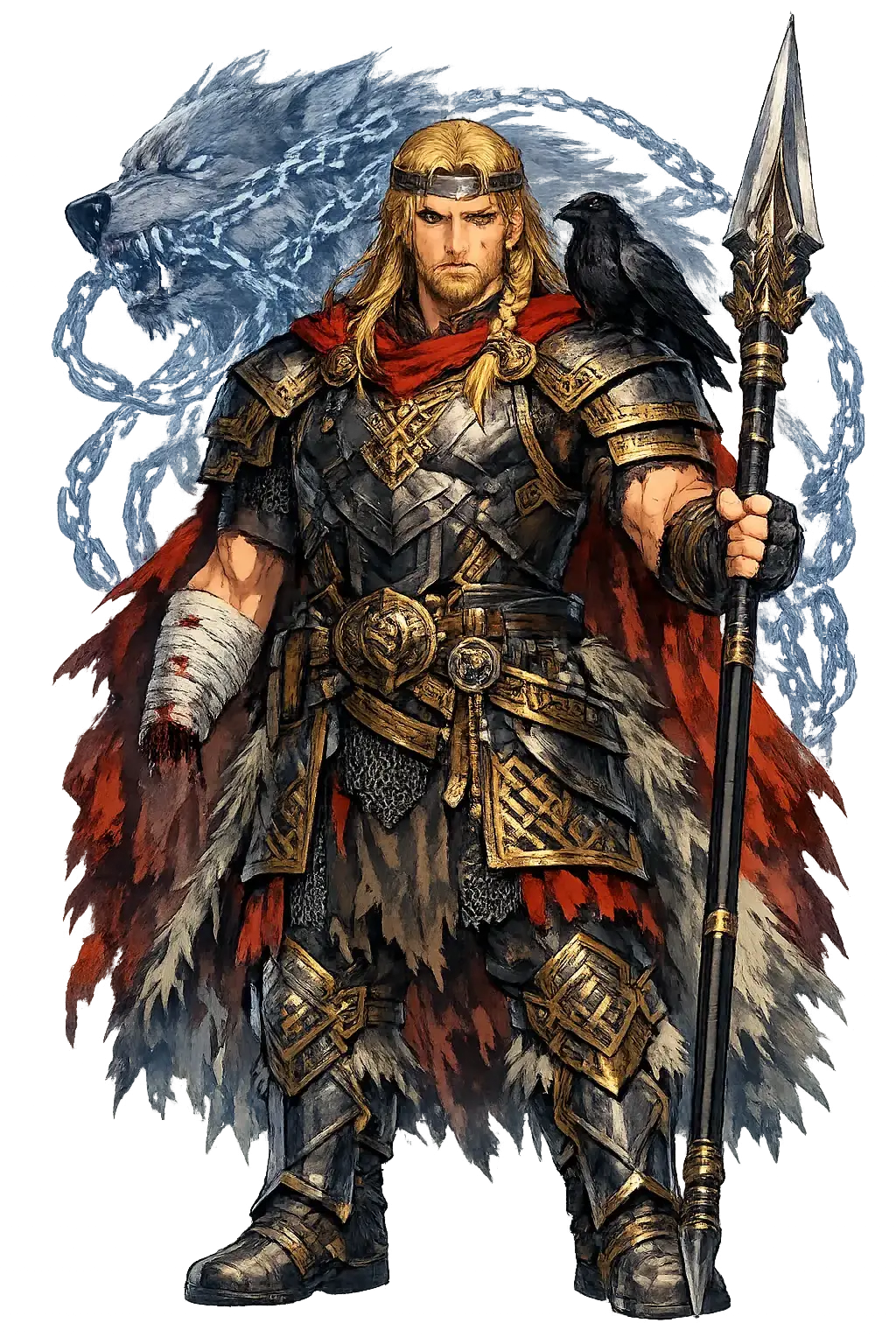
Týr is the god who keeps his word even when it costs him his hand. In a pantheon famous for cunning and force, he stands for something older: the binding power of oath and law. Once among the most prominent gods of the Germanic peoples, he is remembered in the Norse sources chiefly for the binding of Fenrir, the great wolf who will devour Óðinn at Ragnarök.
His name is invoked when men swear binding oaths; he is the guarantor of public law and solemn promise.
He alone dared place his hand in the wolf's mouth as pledge; the gods gained a chained monster and Týr gained the name 'one-handed'.
Snorri calls him the boldest and most valiant of the Æsir, a god of single combat and battlefield honor.
The Germanic assembly of free men gathered under his protection; Mars Thingsus was his Roman face.
Stories of Týr
Týr's mythology is narrower than that of Óðinn or Þórr, but it turns on a single, unforgettable scene: a god who pays for the common good with his own body. His stories are stories of pledges kept, monsters bound, and the law that outlasts the hand that swore it.
The wolf Fenrir grew among the gods, and only Týr dared feed him. When the gods forged the fetter Gleipnir — made of six impossible things such as the roots of a mountain and the breath of a fish — they invited Fenrir to test his strength against it. Suspecting treachery, Fenrir demanded that one god place a hand in his mouth as pledge. Týr stepped forward. The wolf was bound, and Týr lost his hand. The gods laughed; only Týr did not.
In Lokasenna, Loki taunts Týr with his mutilation: 'I spare not in speaking the truth: you are unmanly in your hand.' Týr answers that although he lacks a hand, Loki lacks a father of good report, and that Loki's own monstrous children will bring the gods to grief. The exchange pits two kinds of loss against each other: Týr's sacrificed hand and Loki's sacrificed honor.
In Hymiskviða, Týr appears not as son of Óðinn but as son of the giant Hymir. He accompanies Þórr to Jötunheimr to fetch a cauldron large enough to brew ale for all the gods. The poem hints at older traditions in which Týr had a different genealogy and a larger cultic role.
Týr is the god of the kept word. In a world of shifting alliances and clever speech, he stands for the promise that cannot be broken without breaking the promiser. His hand is not lost in battle; it is lost in diplomacy, in the necessary lie that binds a monster for the good of all.
Enter Extended Lore