
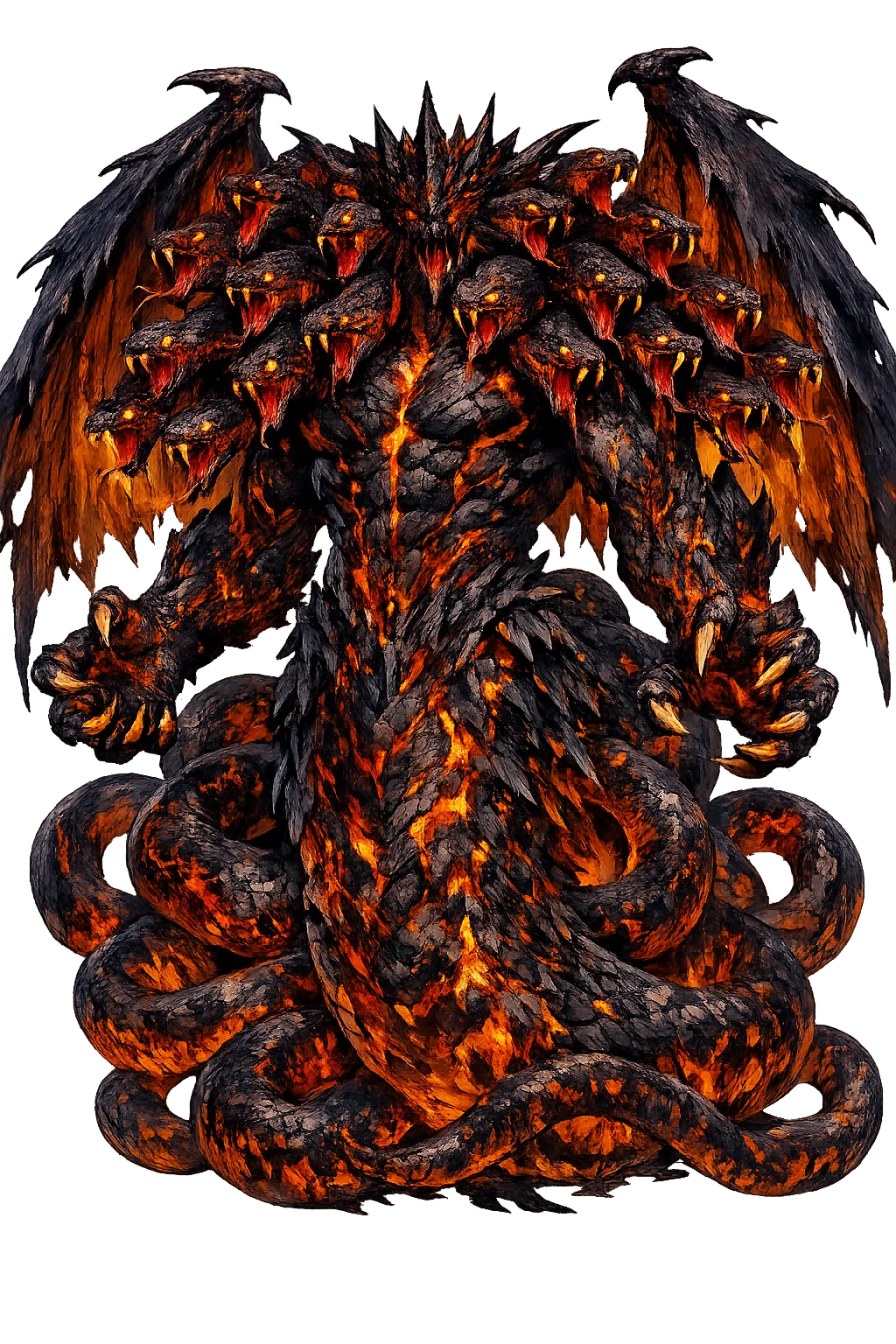
The many faces of Typhōn
No important name has only one face. Typhōn appears as a figure of myth, a scholarly reconstruction, a piece of material culture, a memory carried across languages, and — most recently — a Unicode domain. This post looks at each face in turn: the name and its roots, the Greek original, the reconstructed pronunciation, the mythological record, the symbols and sanctuaries, the cross-cultural afterlife, and the engineering that lets the restored spelling resolve in a browser. Taken together, those faces explain why typhon was never going to be enough — and why the restored form is worth a domain of its own.
At a Glance
- Restored name: Typhōn
- ASCII form: typhon
- Meaning: "Whirlwind, smoke"
- Domain of influence: Monster, Father of Monsters, Storms
- Pantheon: Greek
- Classification: Tier 1
- Original script: Τυφῶν (Greek)
- Live domain: typhōn.com
Overview
Typhōn (typhon) — The Smoke-and-Fire Titan · Father of Monstrous Things — belongs to the Greek tradition, where it is catalogued under the domain "Monster, Father of Monsters, Storms". The name means "Whirlwind, smoke".
Typhōn is the last thing the Olympians feared. Born from Gaia and the abyss, he is a serpentine giant with a hundred heads, voices of gods and beasts, and fire blazing from his eyes. He is the cosmic rebel who nearly unmade Zeus's order.
PuniCodex restores the name as Typhōn and serves its temple at typhōn.com. The original carries both stress and vowel length, and exactly one historically valid Unicode restoration exists, which places the name in Tier 1. The plain ASCII form typhon survives as a modern convenience imposed by the early domain-name system; the restoration, not the fallback, is the form the project defends as philologically complete.
The Name
The name is attested in Greek as Τυφῶν. Etymologically it means "Whirlwind, smoke".
The reconstructed proto-form is τῦφος (unknown, "smoke, vapor, whirlwind"). From Greek τῦφος ("smoke, vapor") or τυφώς ("whirlwind"), fitting the smoke-and-flame monster born from Tartaros
Cognate forms across related languages:
- τῦφος (Greek)
- τυφώς (Greek)
- typhoon (English)
The ASCII form typhon survives only because the early domain-name system could not carry diacritics; it is a technological compromise, not an ancient spelling. The Unicode restoration Typhōn recovers the vowel length of the original directly in the address bar. The original carries both stress and vowel length, and exactly one historically valid Unicode restoration exists, which places the name in Tier 1.
The letter-by-letter transformation runs:
- t → T — Same
- y → y — Same
- p → p — Same
- h → h — Same
- o → ō — Macron: long omega
- n → n — Same
Attested and derived spellings of the name:
- typhōn — owned form: Owned lowercase Unicode domain label
The project holds the domain typhōn.com (xn--typhn-j9a.com) as the canonical home of this name.
Etymology & Roots
The recorded derivation reads: From Greek τῦφος ("smoke, vapor") or τυφώς ("whirlwind"), fitting the smoke-and-flame monster born from Tartaros
The reconstructed proto-form is τῦφος (unknown), glossed as "smoke, vapor, whirlwind".
The reconstruction is classed as attested.
Kindred forms recorded in the lexicon:
- τῦφος (Greek) — cognate
- τυφώς (Greek) — cognate
- typhoon (English) — derivative
The Original Script
The name is preserved in Greek as Τυφῶν — Greek alphabet (Classical / Attic), attested Ancient Greek, c. 8th century BCE – present, in Greece and the Greek-speaking Mediterranean. The script is written left-to-right.
The scholarly transliteration is Typhōn (Greek alphabet with polytonic accents), giving the normalized reading /tyˈpʰɔːn/.
The rendering proceeds step by step:
- The Greek form Τυφῶν is written in the Classical Greek alphabet.
- Letters with acute, grave, or circumflex accents preserve the pitch accent of Ancient Greek.
- Macrons and omegas (η, ω) mark long vowels, a feature lost in the plain ASCII form.
- The Unicode restoration Typhōn encodes the scholarly spelling as a registrable domain name.
Pronunciation
The reconstructed pronunciation of the name is /tyːˈpʰɔːn/ — Attic Greek Reconstruction.
Phoneme by phoneme:
- Ty- — Short upsilon [y] — a rounded, front vowel like French "u" — the whirlwind's first breath.
- -phōn — Aspirated phi [pʰ] followed by long omega [ɔː] and nu; the name roars and sustains.
For the modern speaker, the closest approximation is: "tee-FOHN" — but the first vowel is like French "tu," and the second is long and breathy, like a storm that does not end quickly.
Kindred and historical forms of the name:
- Greek — τῦφος (typhos), "smoke, vapor"; τυφώς (typhōs), "whirlwind"
- English — typhoon — possibly influenced by Greek via Arabic/Persian tūfān, though the route is debated
- Egyptian — identified with Set, the red desert storm-god and enemy of Osiris
Typhōn is Tier 1 because the Greek Τυφῶν contains both stress and length: the circumflex over the omega marks a long vowel that also carries the pitch peak. The single character ῶ encodes both features, and the macron form Typhōn preserves the long vowel while implying the original stress position. The name sounds like what it describes: a long, smoky exhalation.
Mythology
Typhōn is the final adversary in the Greek succession myth. After the Titans fall, the earth produces one last monster to challenge the new king of the gods.
Son of Earth and Abyss (The Birth)
Hesiod writes that after Zeus drove the Titans from heaven, Gaia lay with Tártaros "by the aid of golden Aphrodité" and bore Typhōn, a monstrous son "who would have ruled over mortals and immortals" had Zeus not acted (Theogony 820–835). Apollodorus adds that Gaia conceived him in anger at the destruction of the Giants (Apollodorus 1.6.3).
The Typhonomachy (The Battle)
The battle shook the cosmos. Hesiod describes thunder, lightning, and Typhōn's fire boiling the sea and scorching the earth. Zeus finally struck him with his thunderbolt and cast him down, crippled, into Tártaros (Theogony 839–868). Later poets, including Pindar, placed the monster beneath Mount Etna.
Zeus Disarmed (The Wound)
Apollodorus preserves a more perilous version: Typhōn initially defeated Zeus, cut the sinews from his hands and feet, and imprisoned him in a Cilician cave. Hermes and Pan recovered the sinews, restoring Zeus, who then pursued Typhōn across the world and crushed him under Etna (Apollodorus 1.6.3).
Father of Monsters (The Children)
With Echidna, Typhōn produced the great monsters of Greek myth. Hesiod names Orthrus, Cerberus, the Lernaean Hydra, and the Chimera (Theogony 306–319). Apollodorus expands the list to include the Sphinx, the Nemean Lion, the Eagle of Prometheus, and the dragon of the Golden Fleece — a catalogue of every creature the heroes must overcome.
Symbols & Iconography
Typhōn's attributes are fixed by the archaic texts rather than by cult, for none existed:
- Hundred serpent heads — Hesiod gives him a hundred snake-heads springing from his shoulders, their tongues flickering dark (Theogony 824–828); art usually compresses the hundred into one bearded head above snaky limbs.
- Coiled serpent legs — 'from his thighs came two huge coiling vipers' (Theogony 823), the trait the snake-legged Giants of later Gigantomachy imagery inherit from him.
- Fire from the eyes — fire flashes from his eyes beneath the brows as he is struck (Theogony 824, 856–859), the glare poets later anchored beneath Mount Etna.
- Voices of gods and beasts — his heads utter 'every kind of unspeakable voice': god-speech, a bull's bellow, a lion's roar, the yelping of puppies (Theogony 829–835).
- Wings — not Hesiodic; they belong to his sixth-century artistic type and to Apollodorus' description of the winged form whose head 'often touched the stars.'
- Mount Etna — the prison-mountain of Pindar's Pythian 1, whose eruptions are the pinned giant's breath.
Typhōn has one of the oldest monster-types in Greek art: a bearded, winged giant from the waist up, twin serpent-coils below, arms spread against Zeús, who answers with the thunderbolt. The type is fixed by the mid-sixth century BCE — a Chalcidian hydria of c. 550 already shows the duel in exactly this form — and Attic black- and red-figure repeat it; the hundred heads of the texts are usually reduced to one human head and snaky limbs, size and wings doing the work of horror.
After the fifth century he merges into the snake-legged Giants of Gigantomachy imagery, culminating in the Pergamon altar, where his earth-born brothers coil against the gods. South Italian vases place him beneath Aitna or in the underworld, and Roman art inherited the anguipede type for its Giants wholesale. No cult image of Typhōn ever existed; every picture of him is a picture of his defeat.
Epithets & Cult Titles
A monster without cult has no cult titles; what Typhōn has are poetic descriptions that behave like epithets.
- ἑκατοντακάρανος (hekatonkakáranos) — 'hundred-headed,' Pindar's word for him in Pythian 1, where he lies pinned beneath Aitna and weighs on Sicily.
- ὁ Κιλίκιος (ho Kilíkios) — 'the Cilician': Pindar calls his famous lair the 'Cilician cave of many names,' the Corycian cave where Apollodorus has him hide the severed sinews of Zeús.
- Τυφωεύς / Τυφάων (Typhōeús / Typháōn) — the older name-forms carry force in themselves: Typhoeus for the blasted giant of the duel, Typhaōn for the mate of Echidna and sire of winds.
- ὁ ἐν Ἀρίμοις (ho en Arímois) — 'he that is in Arima,' Homer's haunting localization (Il. 2.783); later poets kept Arima as his address long after the place could no longer be found.
The Homeric Hymns
No Homeric Hymn celebrates Typhōn; he is the power hymns exist to keep down, not to invoke. His earliest hexameter attestations are already formidable. Homer knows him as Typhoeus, the monster round whom Zeús lashes the groaning earth, 'in the land of the Arimoi, where men say is Typhoeus' resting-place' (Il. 2.782–783). Hesiod gives him two names and two scenes: as Typhaōn he mates with Echidna to father the monsters of the heroic age (Theogony 306–332); as Typhoeus, last-born of Gaia and Tartaros, he fights the cosmos-shaking duel that ends only when Zeús hurls him, scorched and crippled, into the depths — and from him the ruinous storm-winds still blow (Theogony 820–880). The sprawling Typhonomachy of Nonnus' Dionysiaca (Books 1–2) is the late-antique heir of these verses.
Oracle Sites & Sanctuaries
Typhōn received neither temple nor oracle anywhere in the Greek world; the places attached to his name are not cult sites but the geography of his lair and his punishment. The Corycian cave in Cilicia was named as the den where he hid the severed sinews of Zeús until Hermēs and Pan stole them back. Mount Aitna in Sicily became his prison: Pindar already sings of the giant pinned beneath the mountain, whose eruptions are his breath, and Aeschylus makes the blast furnace of Hēphaistos sit on top of him. The Serbonian marsh on the Egyptian frontier was offered as the place where he hid after defeat — a localization Herodotus repeats in describing lake Serbōnis. And Homer's vague land of the Arimoi (Il. 2.783) was never securely placed, a fitting address for a monster: everyone knew where he was buried; no one could say where he lived.
Archaeology & Evidence
No temple, altar, or cult image of Typhōn is attested anywhere in the Greek world; his material record consists of mythic art and mythic geography. The earliest major monument is a Chalcidian black-figure hydria of c. 550 BCE (Munich, Staatliche Antikensammlungen), which already shows the duel in its canonical form: the winged, serpent-legged giant reeling before Zeus and the thunderbolt. On the Great Altar of Pergamon (c. 180–160 BCE, now in Berlin) his earth-born kin coil against the gods as snake-legged Giants, the iconographic descendants of his type. South Italian vases place the defeated monster beneath Etna, matching Pindar's Pythian 1. The landscape itself was also enlisted: the Corycian cave above Korykos in Cilicia (near modern Kızkalesi, Türkiye) was shown as the den where he hid the severed sinews of Zeus (Apollodorus 1.6.3), and Herodotus repeats the claim that the Serbonian marsh on the Egyptian frontier was the place of his hiding (Histories 3.5).
Realm & Domain
Typhōn is the last thing the Olympians feared. Born from Gaia and the abyss, he is a serpentine giant with a hundred heads, voices of gods and beasts, and fire blazing from his eyes. He is the cosmic rebel who nearly unmade Zeus's order.
The Hundred Heads
Each head speaks a different tongue — bull, lion, god, snake — a cacophony of chaos.
Fire and Etna
Buried beneath Mount Etna, his breath becomes volcanic eruption; Sicily trembles at his struggles.
The Typhon Winds
From him spring the destructive storm winds — the whirlwinds that wreck ships and harvests.
Progeny of Monsters
With Echidna he fathers Cerberus, Hydra, Chimera, Sphinx, Nemean Lion — the adversaries of heroes.
Across Cultures
From the fifth century BCE onward, Greeks identified Typhōn with the Egyptian god Set, the red-haired storm deity who murdered Osiris; Herodotus already makes Typhon the last divine king of Egypt and repeats the tradition that he hid in the Serbonian marsh. Plutarch's treatise on the Osiris myth uses Typhon simply as the Greek name of Seth, and this equation may have shaped Typhōn's later iconography: he became a winged, serpentine giant associated with the desert and destructive wind. Near Eastern storm-combats — the Hittite storm-god's battle with the serpent Illuyanka, Canaanite Baal in his conflict with Yam — are standard comparanda for the Greek figure. The Romans kept the name Typhon and used it for whirlwinds and volcanic eruptions, especially in Sicily.
Kindred figures in the PuniCodex cross-tradition index include [[tiamat|Tiāmat]] (chaos / monster), [[apep|Ꜥpp]] (chaos / primordial / world serpent), [[chaos|Cháos]] (chaos / primordial / world serpent), [[jormungandr|Jǫrmungandr]] (chaos / primordial / world serpent), [[leviathan|Liwyāṯān]] (chaos / primordial / world serpent), and [[yam|Yām]] (chaos / primordial / world serpent).
Cultural Legacy
Typhōn's most enduring offspring is a weather word. English typhoon reached the language in the sixteenth century by a documented confluence: Greek τυφῶν/τυφώς ('whirlwind') travelling east, Portuguese tufão (from Arabic ṭūfān, 'violent storm') brought back from India, and Cantonese taai-fūng ('great wind'); the modern form is a fusion of these streams, not a simple descent from Greek. In scholarship the monster became the type-case of the chaos-combat: Fontenrose's Python (1959) and Watkins's How to Kill a Dragon (1995) read the Typhonomachy beside the Hittite Illuyanka myth, the Ugaritic conflict of Baal with Yam, and the Vedic slaying of Vṛtra. Geology kept his address: from Pindar through the Roman poets, Etna's eruptions were explained as the breath or struggles of the pinned giant. Modern fantasy inherited him as the ultimate adversary — 'Typhon' names ancient dragons and final bosses across novels, role-playing games, and video games — the archetype of the rebellion that almost succeeded.
The Scholarly Record
The account of Typhōn given in this edition rests on the witnesses and reference works listed below. Lexica and etymological dictionaries secure the form and meaning of the name; the literary and religious texts supply the narrative evidence.
- Liddell-Scott-Jones Greek-English Lexicon, 9th ed. with 1996 supplement, 1843. Full text
- Etymological Dictionary of Greek, 2 vols., Brill, 2010. Full text
- Wörterbuch der griechischen Eigennamen, 3rd ed., 1863. Full text
- Hesiod, Theogony, Loeb Classical Library No. 57, 700 BCE. Full text
- Apollodorus, Library.
- Pindar, Pythian Ode 1.
- Aeschylus, Prometheus Bound.
- Herodotus, Histories.
A Meditation
Typhōn is what the ordered world keeps under the mountain. He is the hundred-headed argument against hierarchy, the storm that rises when the earth decides the gods have gone too far. Every pantheon needs such a figure: not a villain with a motive, but a force so large it can threaten heaven itself.
The Greeks did not kill Typhōn; they buried him alive. That is the most honest thing they could have done. To destroy him would be to pretend chaos can be eliminated; to imprison him is to admit it must be continuously held down. The smoke of Etna is the reminder: the monster is still breathing.
The Unicode Restoration
Typhōn is classified as Tier 1: the original carries both stress and length, and only one valid Unicode restoration exists. The ASCII fallback typhon still resolves everywhere, but it is the restored form that carries the name's full information. Across the 6 characters of the name, the restoration adjusts 1: 1 mark of length (ō). That is the whole thesis of this temple: the marks are the message.
The Domain Name
The restored name is live as a working domain: typhōn.com, which the DNS carries in punycode form as xn--typhn-j9a.com — an ASCII-compatible encoding that lets a non-ASCII name travel the global network without breaking older infrastructure. The visitor sees Typhōn; the machines see the encoding. That duality is the engineering compromise on which the entire restoration rests, and it is why a name written the way its own tradition wrote it in Greek can now be typed into any browser on earth.
Why This Restoration Matters
Myth, script, sound, cult, legacy, domain: the faces of Typhōn add up to a single argument — that a name is a record, and records deserve fidelity. The PuniCodex restoration keeps that record in working order: the temple presents it, the Scholarly Edition footnotes it, the lexicon catalogs it, and the domain makes it addressable. typhon will always exist as a fallback. But fallback is not identity. Typhōn is the name; everything else is a convenience.
Explore Further
This post is one doorway into the temple. The home page carries the full character breakdown and the ambient canvas; the lore page tells the myths in long form; the Scholarly Edition preserves the sources, pronunciation data, and revision history; and the patron wall supports the restoration directly. For the wider map, browse the Lexicon, explore the Pantheon, or return to the PuniCodex blog.
Related Names
Sources
The full scholarly apparatus — every citation, revision, and review — lives in the Scholarly Edition. Key references for this post:
- Liddell-Scott-Jones Greek-English Lexicon, 9th ed. with 1996 supplement, 1843.
- Etymological Dictionary of Greek, 2 vols., Brill, 2010.
- Wörterbuch der griechischen Eigennamen, 3rd ed., 1863.
- Hesiod, Theogony 820–880.
- Apollodorus, Library 1.6.3.
- Pindar, Pythian 1.
- Herodotus, Histories 2.144 and 3.5.
- Plutarch, On Isis and Osiris (Typhon as the Greek name of Seth).
- Lexicon authorities for this entry: LSJ, Pape-Benseler, Beekes.