
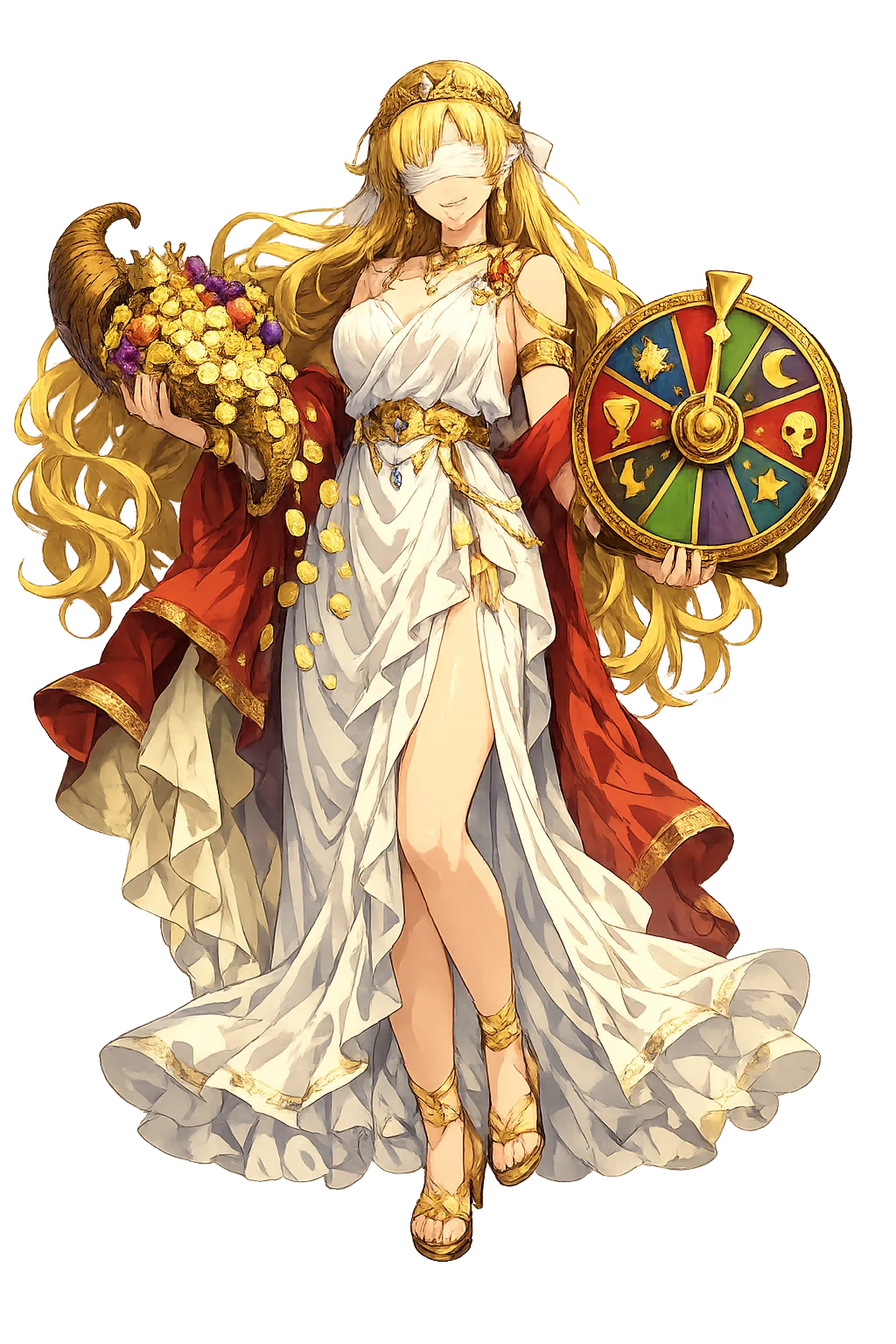
Why Týchē belongs in your address bar
Every address bar is a choice. When you type Týchē, you are not typing a novelty; you are restoring a name that the early DNS, built for English typewriters, could not carry. The plain ASCII form tyche is a leftover of that constraint, not the name itself. This post is the long version of the restoration: where the name comes from, how the Greek tradition wrote it, how it is pronounced, what the myths and the material record preserve, and why its Unicode form now lives as a working domain. The claim throughout is simple — the original spelling is not decoration. It is the name.
At a Glance
- Restored name: Týchē
- ASCII form: tyche
- Meaning: "'That which happens' (from τυγχάνω)"
- Domain of influence: Fortune, Chance, Turning
- Pantheon: Greek
- Classification: Tier 1
- Original script: Τύχη (Greek)
- Live domain: týchē.com
Overview
Týchē (tyche) — The Turning of the Wheel — belongs to the Greek tradition, where it is catalogued under the domain "Fortune, Chance, Turning". The name means "'That which happens' (from τυγχάνω)".
Týchē is the last goddess added to the Greek pantheon and the most modern in feeling: the personification of what happens. When the old gods' plans no longer explained the Hellenistic world's upheavals, the Greeks enthroned accident itself — and gave her a cornucopia, a rudder, and a wheel.
PuniCodex restores the name as Týchē and serves its temple at týchē.com. The original carries both stress and vowel length, and exactly one historically valid Unicode restoration exists, which places the name in Tier 1. The plain ASCII form tyche survives as a modern convenience imposed by the early domain-name system; the restoration, not the fallback, is the form the project defends as philologically complete.
The Name
The name is attested in Greek as Τύχη. Etymologically it means "'That which happens' (from τυγχάνω)".
The ASCII form tyche survives only because the early domain-name system could not carry diacritics; it is a technological compromise, not an ancient spelling. The Unicode restoration Týchē recovers both the stress accent and the vowel length of the original directly in the address bar. The original carries both stress and vowel length, and exactly one historically valid Unicode restoration exists, which places the name in Tier 1.
The letter-by-letter transformation runs:
- t → T — Same letter
- y → ý — Stress mark (acute/tone)
- c → c — Same letter
- h → h — Same letter
- e → ē — Macron marks the long vowel
Attested and derived spellings of the name:
- Tychē — macron-only form: LSJ convention: length only, no stress mark
The project holds the domain týchē.com (xn--tch-loa6i.com) as the canonical home of this name.
The Original Script
The name is written in Greek as Τύχη. This original script is the form against which the ASCII fallback tyche and the PuniCodex restoration Týchē are measured: the restoration preserves both its pitch accent and its vowel quantity of the written form, so that a reader typing the modern address still speaks the ancient name.
Pronunciation
The reconstructed pronunciation of the name is /tý.kʰɛː/ — Attic Greek.
For the modern speaker, the closest approximation is: TU-khee, stress on the first syllable with a long ē.
Kindred and historical forms of the name:
- Greek — Τύχη
- Latin — Fortuna
- Owned form — Týchē
Greek Τύχη bears the acute on the first syllable — Týchē — from τυγχάνω, "to happen, to hit the mark." The long eta of the second syllable is the standard macron; Stoic philosophers made her name the technical term for chance, and the word still means "outcome" in modern Greek. Modern Greek tychi keeps the meaning of outcome; the ancient accent on the first syllable is what the restoration marks.
Mythology
Týchē has almost no myths — she is a goddess of situations, not stories. Her biography is the biography of the Hellenistic age: when empires rose and fell in a generation, chance needed a face.
Two Fathers (The Genealogy)
Hesiod makes her an Oceanid, daughter of Ōkeanos and Tēthys — chance as one of the primordial waters' three thousand daughters. Pindar, elevating her, calls her Týchē Sōteira, "saviour fortune," and a child of Zeús Eleutherios: luck ennobled into divine pedigree. The disagreement is the point — even the Greeks could not decide if chance is cosmic or capricious.
The Tyche of Antioch (The Statue)
Around 300 BCE the sculptor Eutychides made for newly founded Antioch the most copied statue of the ancient world: the city's Týchē seated on rocks, wearing the city walls as a crown, with the river Orontes swimming at her feet. Every Hellenistic and Roman city commissioned its own version — fortune as the official portrait of urban identity.
Aristotle's Analysis (The Philosopher)
In the Physics, Aristotle gives týchē its most rigorous treatment: chance is a real cause, he argues, but only of events that could have been purposive — the man who goes to the market for bread and happens to meet his debtor. The goddess fades; the concept survives intact, and probability theory will one day be built on his definition.
Symbols & Iconography
The iconography associated with Týchē concentrates in a small set of recurring attributes, each a compressed statement about the name:
- The rudder — Steering without destination — guidance of the contingent
- The cornucopia — Abundance as accident; the gifts no one earned
- The mural crown — The city walls she wears — fortune as civic identity
- The wheel — Roman addition — the turning that raises and ruins
Her image is the most standardized of the Hellenistic age: seated or standing, wearing the mural crown of city walls, holding the cornucopia and a rudder — Eutychides' Tyche of Antioch (ca. 300 BCE) set the type, the river Orontes swimming at her feet. Cities from Palmyra to Alexandria minted their own versions on coins for five centuries; the Vatican's Roman copy preserves the lost bronze original. The wheel appears under Rome (Fortuna's attribute), and the globe and rudder together made her the empire's allegory of governance itself.
Epithets & Cult Titles
Chance accumulated titles as fast as temples.
- Ἀγαθή (Agathḗ) — 'the Good'; the standing civic epithet, Týchē Agathḗ of the altars.
- Σώτειρα (Sṓteira) — 'the Saviour'; Pindar's elevation of chance to a saving power.
- Αὐτοματία (Automatía) — 'the Self-Acting'; her cult title where the Stoic debate sharpened.
- Εὔπλοια (Eúploia) — 'Fair Voyage'; her harbour title at the Piraeus and the sea-towns.
- Ἀκραία (Akraía) — 'of the Heights'; her citadel title in the Peloponnese.
- Fortuna — her Roman fusion-name, older than Týchē's Greek cult and heir to it all.
The Homeric Hymns
Týchē arrived after the hymnic age, but late antiquity gave her a hymn of her own: Orphic Hymn 72, "To Tyche," addresses "noble Týchē, who steers the affairs of mortals," begging her favor "in deeds and in journey." The hymn is Pindar's Sōteira in liturgical form — chance invoked as helmswoman and begged for fair weather. Between Pindar's "saviour fortune, daughter of Zeús the deliverer" and the Orphic hymn stands her whole career: from an Oceanid's name in the Theogony's catalogue to the most prayed-to abstraction of the Hellenistic world.
Oracle Sites & Sanctuaries
Two sanctuaries define her worship. The Tycheion of Antioch, housing Eutychides' bronze, stood at the city's heart — the seated Fortune with her river-swimmer, the most copied civic image of the ancient world. Praeneste (Palestrina) held the oracle of Fortuna Primigenia: a mountainside sanctuary of seven terraces where the sortes — oak lots drawn by a child — answered questions for six centuries, and where the so-called "Barberini mosaic" of the Nile was set into the sanctuary floor. Cicero discusses its lots seriously; Caracalla consulted them; the sanctuary's ruins still crown the town.
Archaeology & Evidence
Eutychides' bronze original is lost, but the Vatican and Louvre Roman copies preserve the Tyche of Antioch exactly, and the type is confirmed by Antiochene coins and the tiny bronze "Antioch" statuettes. Praeneste's (Palestrina's) vast sanctuary of Fortuna Primigenia — a mountainside of terraces rediscovered by WWII bombing — shows the cult's architecture at full scale. Hundreds of civic coins bearing mural-crowned Tychai map the goddess's reach from Spain to Afghanistan.
Realm & Domain
Týchē is the last goddess added to the Greek pantheon and the most modern in feeling: the personification of what happens. When the old gods' plans no longer explained the Hellenistic world's upheavals, the Greeks enthroned accident itself — and gave her a cornucopia, a rudder, and a wheel.
The Happening
From τυγχάνω, "to happen" — the goddess of outcomes, not plans.
The Rudder
She steers the affairs of mortals — Pindar calls her the helmswoman of destiny.
The City's Crown
Hellenistic city-Tychai wear the walls as a crown — each city's own fortune personified.
The Cornucopia
The horn of plenty: fortune's gifts poured out without merit or warning.
Across Cultures
Rome merged her with Fortuna — a native Italian goddess with far older roots — and the fusion produced antiquity's most worshipped abstraction: Fortuna Primigenia at Praeneste with her famous sortes (lot-oracle), Fortuna Redux for safe returns, Fortuna Augusta for the emperor's luck. On coins, every city from Palmyra to Alexandria stamped its Tyche-Fortuna: the mural-crowned figure became the standard icon of urban pride across three continents.
Within the Greek tradition, closely related names in the corpus include [[acheron|Achérōn]], [[achilleus|Achilleús]], [[adamas|Adámas]], [[aer|Aḗr]], [[aither|Aithḗr]], and [[ananke|Anánkē]].
Cultural Legacy
The word outlasted the cult: tyche is Aristotle's and the Stoics' technical term, and "stochastic" — from the sibling root for aiming — now names the mathematics of chance. Polybius made Tyche the playwright of history ("she brings all human affairs onto one stage"), and every discussion of black swans, tail risk, and algorithmic randomness is, unknowingly, her temple.
The Scholarly Record
The account of Týchē given in this edition rests on the witnesses and reference works listed below. Lexica and etymological dictionaries secure the form and meaning of the name; the literary and religious texts supply the narrative evidence.
- Hesiod, Theogony, Loeb Classical Library No. 57, 700 BCE. Full text
- Pindar, Victory Odes (Olympian, Pythian, Nemean, Isthmian), Loeb Classical Library, 438 BCE. Full text
- Aristotle, collected works, Loeb Classical Library / Oxford Classical Texts, 322 BCE. Full text
- Polybius, Histories, Loeb Classical Library (Paton), 146 BCE.
- Pausanias, Description of Greece, Loeb Classical Library, 180. Full text
- Liddell-Scott-Jones Greek-English Lexicon, 9th ed. with 1996 supplement, 1843. Full text
A Meditation
Týchē is the honest goddess: she never promised to be fair. The Greeks' wisdom was to worship her anyway — to give chance a face so it could be addressed, appeased, and above all named. Every plan carries her signature in invisible ink; every city that crowned her understood that fortune is not the enemy of order but its weather.
To worship chance, the Hellenistic cities understood, is not to surrender to her but to be honest about her: the cornucopia and the rudder in the same hands, gifts and steering at once. Every risk model, every insurance premium, every prayer before a voyage is her liturgy translated — the human attempt to stand in a fair relation to what happens. She alone of the gods never pretended the world was just; that is why they trusted her.
The Unicode Restoration
Týchē is classified as Tier 1: the original carries both stress and length, and only one valid Unicode restoration exists. The ASCII fallback tyche still resolves everywhere, but it is the restored form that carries the name's full information. Across the 5 characters of the name, the restoration adjusts 2: 1 mark of stress (ý); 1 mark of length (ē). That is the whole thesis of this temple: the marks are the message.
Name Variations
The lexicon records 1 additional form of the name:
- Tychē (macron-only) — LSJ convention: length only, no stress mark
The temple uses Týchē as the primary form: it is the spelling that best balances philological accuracy with the practical limits of DNS.
Character by Character
The journey from tyche to Týchē, one character at a time:
- t → T — Same letter
- y → ý — Stress mark (acute/tone)
- c → c — Same letter
- h → h — Same letter
- e → ē — Macron marks the long vowel
The Domain Name
The restored name is live as a working domain: týchē.com, which the DNS carries in punycode form as xn--tch-loa6i.com — an ASCII-compatible encoding that lets a non-ASCII name travel the global network without breaking older infrastructure. The visitor sees Týchē; the machines see the encoding. That duality is the engineering compromise on which the entire restoration rests, and it is why a name written the way its own tradition wrote it in Greek can now be typed into any browser on earth.
The Greek Pantheon
Týchē is one of 268 entries the PuniCodex lexicon catalogues under the Greek pantheon. The Pantheon page gathers the tradition's major figures in one place, and the Lexicon lets you filter all 915 restorations by tradition, tier, or script — the fastest way to see where this name sits among its kin.
Frequently Asked Questions
What does Týchē mean? The traditional gloss is "'That which happens' (from τυγχάνω)."
Which tradition does Týchē belong to? Týchē is catalogued in the Greek pantheon of the PuniCodex lexicon.
Why is Týchē classified as Tier 1? Because the original carries both stress and length, and only one valid Unicode restoration exists — and the marks in the restored spelling preserve exactly that evidence.
Is Týchē a working domain? Yes — týchē.com resolves today and routes to this temple.
What is the punycode for týchē.com? The DNS encoding is xn--tch-loa6i.com; browsers perform the translation automatically, so visitors only ever see the restored name.
Typing Týchē
You do not need a special keyboard to use this restoration. The PuniCodex Type Tool converts the ASCII form tyche into Týchē as you type, and the browser extension offers the same conversion inside any text field. Copy the restored form, paste it into the address bar, and the DNS does the rest.
Sister Temples
Other temples in the Greek pantheon include Mómos, Monókerōs, and Nárkissos — each with its own restoration story, its own scholarly record, and its own place in the lexicon.
Why This Restoration Matters
Restoring Týchē is part of a larger effort to make the web multilingual by default. The PuniCodex project does not ask users to learn a new alphabet; it asks the infrastructure to respect the alphabets that already exist. Every section of this post — the script, the sound, the myths, the evidence — converges on the same point: the marks in Týchē are information, and information deserves an address of its own. A single Unicode domain is a small proof, but it is a proof that scales: every name restored makes the next one easier, and every visit to týchē.com is a vote for the restored form.
Explore Further
This post is one doorway into the temple. The home page carries the full character breakdown and the ambient canvas; the lore page tells the myths in long form; the Scholarly Edition preserves the sources, pronunciation data, and revision history; and the patron wall supports the restoration directly. For the wider map, browse the Lexicon, explore the Pantheon, or return to the PuniCodex blog.
Related Names
Sources
The full scholarly apparatus — every citation, revision, and review — lives in the Scholarly Edition. Key references for this post:
- Pindar, Victory Odes (Olympian, Pythian, Nemean, Isthmian), Loeb Classical Library, 438 BCE.
- Pausanias, Description of Greece, Loeb Classical Library, 180.
- Hesiod, Theogony, Loeb Classical Library No. 57, 700 BCE.
- Aristotle, collected works, Loeb Classical Library / Oxford Classical Texts, 322 BCE.
- Liddell-Scott-Jones Greek-English Lexicon, 9th ed. with 1996 supplement, 1843.
- Polybius, Histories, Loeb Classical Library (Paton), 146 BCE.
- Pindar, Olympian 12; Pausanias on the civic Tychai.
- Cicero, De Divinatione 2.85–87; on Praeneste, the sanctuary publications.
- Orphic Hymn 72 (Athanassakis & Wolkow); Pindar, Olympian 12.1–2.
- Lexicon authorities for this entry: LSJ, Pausanias, Polybius.