
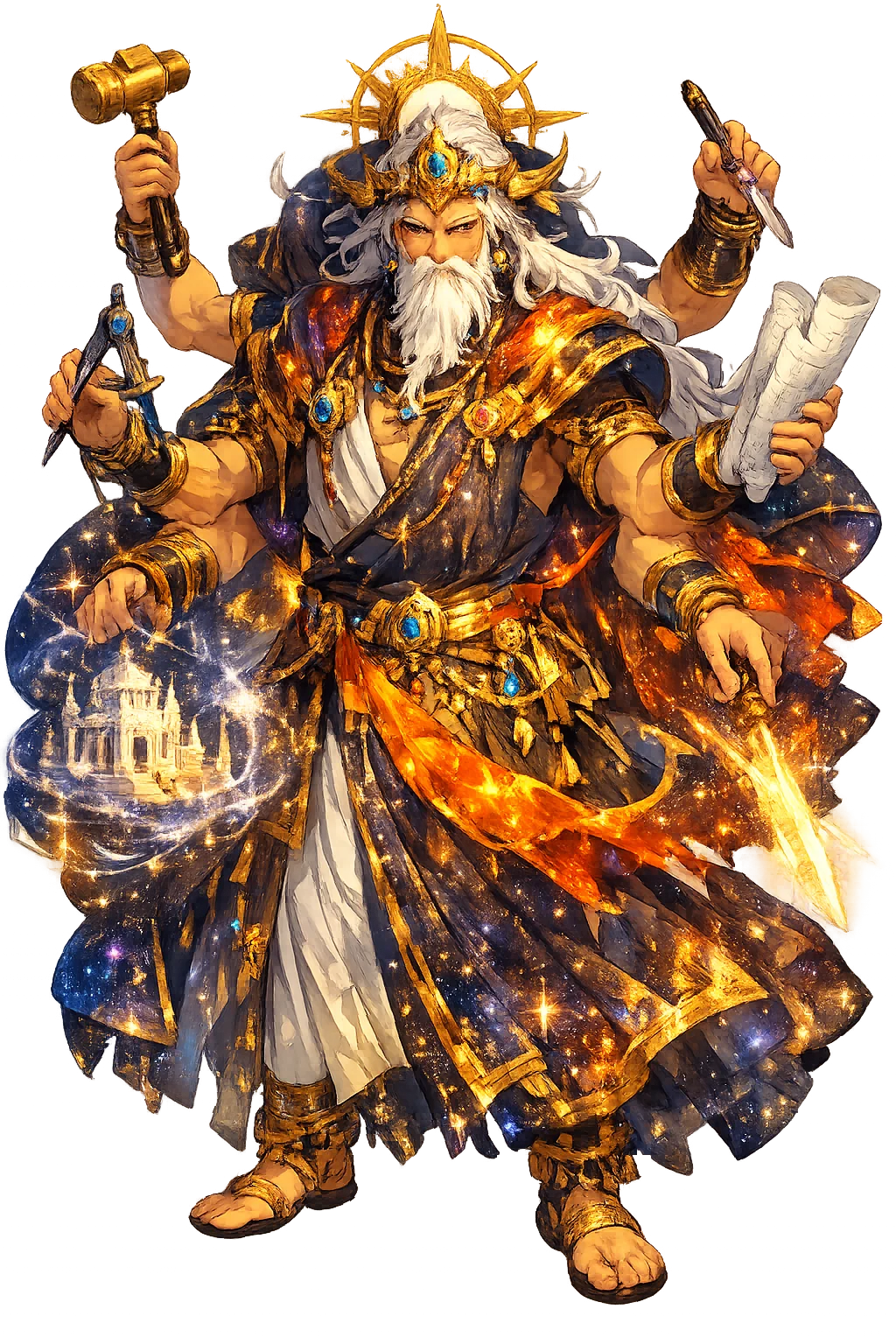
Tvaṣṭṛ walks into a manufacturing, craft & automation firm
The manufacturing, craft & automation world does not cite Tvaṣṭṛ in its documentation. It does not need to — it performs the archetype daily, unbilled.
Before the Office, the Story
Forging the Vajra. When the dragon Vṛtra held the waters captive, Indra needed a weapon worthy of the deed: Tvaṣṭṛ forged the vajra, the bolt that smashed the ninety-nine fortresses and split the dragon's jaw. The Ṛgveda repeats the attribution like a signature — "the bolt that Tvaṣṭṛ made for thee" — the smith's name stamped on the pantheon's supreme weapon.
Viśvarūpa's Three Heads. Tvaṣṭṛ's son Viśvarūpa — three-headed, six-eyed — served as priest of the gods while secretly feeding the anti-gods' share of the offerings. Indra struck off the heads; from them sprang the partridge, the sparrow, and the quail. The smith's grief at his son's death is the hinge of the whole cycle: the forge turns from weapons for the gods to a weapon against them.
At a Glance
- Temple: Tvaṣṭṛ
- Pantheon: Sanskrit
- Domain of influence: Craft, Making, Form
- Pattern seats: 3
- Sectors touched: Technology & Innovation · Home & Lifestyle
- Strongest seat: Manufacturing, Craft & Automation
- Series: The Resonance Files, No. 249 of 271
The Reveal, Seat by Seat
Manufacturing, Craft & Automation
Now read the why-line with the office in mind: The divine smith; the vajra and the soma cup from his bench. The people doing this work did not borrow the archetype. They re-derived it — the way Tvaṣṭṛ was always going to be re-derived wherever craft, making, form matters.
Architecture & Spatial Design
Viśvakarman, All-Maker: the architect of the gods’ own cities. Nobody in that trade worships at this temple. They just keep its hours.
Software, Cloud & Developer Infrastructure
Now read the why-line with the office in mind: The specification is destiny: a wrong accent doomed the monster; a wrong sign dooms the build. The people doing this work did not borrow the archetype. They re-derived it — the way Tvaṣṭṛ was always going to be re-derived wherever craft, making, form matters.
Not the First Rebrand
He is India's Hephaestus in function — the lame-footed Greek smith and the Vedic fashioner are the classic comparative pair, and scholars note the shared motif of the artisan who arms both gods and their enemies. Later Hinduism merged him into Viśvakarman, "All-Maker," the architect of the universe: the Ṛgvedic name faded as the office expanded, until the carpenter's caste-god absorbed the ancient smith entirely. The office is only the latest translation.
The Method, Stated Plainly
The atlas is not a horoscope. Seats are earned from the sources — argued, weighted, published — and every one of them can be challenged at the methodology page. A match that cannot survive an argument does not survive review. That is the whole trick: the patterns are claims, and claims can be tested.
For the Ones Who Work There
For a sponsor in manufacturing, craft & automation, the fit here is not adjacency — it is inheritance. Your trade already tells this story every working day; the temple simply holds the original. The patron tier and the advertising terms carry the mechanics; the myths above carry the reason.
The File Continues
This is one of 271 Resonance Files — the third dispatch from every flagship temple, where the myths meet the markets. The temple's founding dispatch tells the name's story; its Restoration File tells the spelling's; the blog index holds the whole archive.
Continue the series — previous: Tūmatauenga (read it) · next: Týchē (read it).
The Resonance Files are argued from the same canonical record as the pattern atlas itself: the lexicon, the lore catalog, and the cited sources. Every seat can be challenged at the methodology page — and the challenge is the point.