
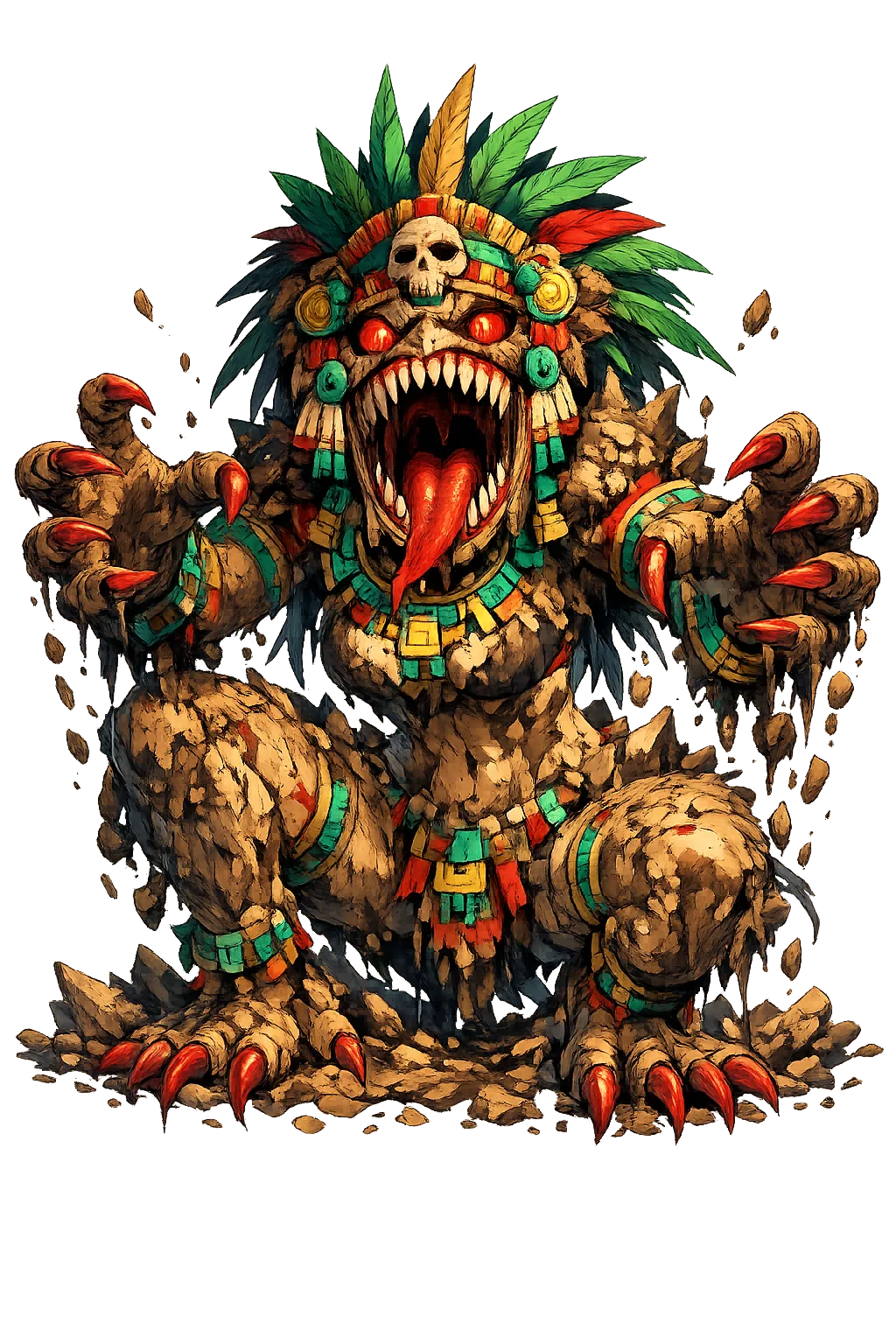
How Tlāltēcuhtli got its accent back
The ASCII form tlaltecuhtli is missing something. Tlāltēcuhtli restores the marks the source language used to distinguish this name from a thousand others — and those marks change how the name is read, pronounced, and understood. This post explains, with the full scholarly record behind it, what each restored mark preserves: the Nahuatl transcription evidence, the reconstructed sound, the myths the name carries, and the classification logic that separates Tier 1 restorations from Tier 2. By the end, the marks in Tlāltēcuhtli will look less like ornaments and more like what they are — recovered evidence, pinned back in its proper place.
At a Glance
- Restored name: Tlāltēcuhtli
- ASCII form: tlaltecuhtli
- Meaning: "Lord of the earth"
- Domain of influence: Earth
- Pantheon: Nahuatl
- Classification: Tier 1
- Live domain: tlaltecuhtli.com
Overview
Tlāltēcuhtli (tlaltecuhtli) — Earth · Lord of the earth — belongs to the Nahuatl tradition, where it is catalogued under the domain "Earth". The name means "Lord of the earth".
Tlāltēcuhtli is the living earth beneath the feet of the Fifth Sun, the monster-toad whose body became the world and whose gaping mouth swallows the sun each evening. Unlike the sky gods who demand attention with thunder and light, Tlāltēcuhtli works in silence: receiving the dead, pushing up crops, and reminding mortals that every step is taken on a conscious being.
PuniCodex restores the name as Tlāltēcuhtli and serves its temple at tlaltecuhtli.com. The original carries both stress and vowel length, and exactly one historically valid Unicode restoration exists, which places the name in Tier 1. The plain ASCII form tlaltecuhtli survives as a modern convenience imposed by the early domain-name system; the restoration, not the fallback, is the form the project defends as philologically complete.
The Name
The theonym is attested in colonial-period alphabetic Nahuatl — the Florentine Codex's ritual speeches address the earth lord by name; what does not survive is a pre-conquest logophonetic spelling, so the macron-bearing form is a scholarly reconstruction of the spoken name. Etymologically the name means 'Lord of the Earth.'
The ASCII form tlaltecuhtli survives only because the early domain-name system could not carry diacritics; it is a technological compromise, not an ancient spelling. The Unicode restoration Tlāltēcuhtli recovers the vowel length of the original directly in the address bar. The original carries both stress and vowel length, and exactly one historically valid Unicode restoration exists, which places the name in Tier 1.
The letter-by-letter transformation runs:
- t → T — Same, capitalized
- l → l — Same
- a → ā — Long vowel
- l → l — Same
- t → t — Same
- e → ē — Long vowel
- c → c — Same
- u → u — Same
- h → h — Same
- t → t — Same
- l → l — Same
- i → i — Same
The project holds the domain tlaltecuhtli.com (tlaltecuhtli.com) as the canonical home of this name.
The Original Script
Classical Nahuatl names survive in the alphabetic manuscripts of the colonial period, not in a fully deciphered pre-conquest phonetic script; the macron-bearing form shown here is a modern scholarly transliteration of the attested spoken name. The being itself was carved on the undersides of monuments rather than written in phonetic glyphs.
The name is a plain compound: tlālli, 'earth, land,' plus tēcutli, 'lord, esteemed personage.' Because Nahuatl nouns carry no grammatical gender, the title does not settle the being's sex: images range from a loinclothed male to a skirted female in the birth-giving squat, and related titles such as Tlālcihuātl, 'Lady of the Earth,' mark the female aspect. The macrons of the restoration Tlāltēcuhtli mark the long ā of tlālli and the long ē of tēcutli, lengths the colonial spelling Tlaltecuhtli never records. No mark in the restoration is decorative.
Pronunciation
The reconstructed pronunciation of the name is /tɬaːɬˈteː.kʷet͡ɬi/ — Classical Nahuatl Reconstruction.
Phoneme by phoneme:
- Tlāl- — Lateral affricate [tɬ] plus long open [aː]; tl- is a single Nahuatl initial, and ā marks vowel length.
- -tē- — Voiceless alveolar stop [t] plus long close-mid [eː], the honorific or lordly element.
- -cuhtli — Voiceless velar stop [k] plus rounded [we], then lateral affricate [tɬ] plus close front [i]; -cuhtli is the reverential suffix meaning 'lord.'
For the modern speaker, the closest approximation is: 'TLAH-lteh-KWEH-tlee' — begin with the single 'tl' sound, hold the first and second vowels long, and treat the final -tl as one release.
Kindred and historical forms of the name:
- Classical Nahuatl — Tlāltēcuhtli — from tlālli 'earth, land' + tēcuhtli 'lord'
- Nahuatl earth powers — Cōātlīcue, Tōnantzin, and Tlāloc share overlapping chthonic and agricultural domains
- Modern spelling — Tlaltecuhtli, the conventional form without vowel-length marking
The name is a straightforward compound of tlālli ('earth') and tēcuhtli ('lord'). The honorific suffix is not gender-exclusive in Nahuatl; Tlāltēcuhtli is depicted as both male and female, and sometimes as a toad-like being. Tier 1: the macrons on ā and ē preserve reconstructed vowel length.
Mythology
Tlāltēcuhtli stands at the beginning of the world and beneath every step taken in it: the earth monster whose body the creator gods split to make the present cosmos, and the power that swallows the sun each evening. The fullest Nahuatl telling survives in the Histoyre du Méchique, a colonial French transcript of a lost sixteenth-century original; cognate earth-monster myths across Mesoamerica confirm the story's depth.
The Dismemberment of the Earth Monster (Creation myth)
In the Histoyre du Méchique, [[quetzalcoatl|Quetzalcōātl]] and [[tezcatlipoca|Tezcatlipoca]] descend as serpents upon the primordial sea monster — caiman- or toad-like, with mouths at every joint, eternally crying for flesh. Tezcatlipoca baits it with his foot and loses it; together the two gods tear the body in two, raising one half as sky and stretching the other as earth. The offended gods then compensate the wound by ordaining the world's features from its members: the hair becomes trees and herbs, the skin grasses and small flowers, the eyes springs and wells, the shoulders mountains, the mouth caves and rivers. Yet the earth remains alive and hungry, refusing to yield fruit unless watered with human blood — the mythic charter of sacrifice.
The Sun's Nightly Journey (Solar myth)
Each evening the sun descends into the gaping mouth of Tlāltēcuhtli in the west, travels the body's darkness through the night, and is born again in the east. The daily swallowing and rebirth mirrors the agricultural cycle and the human journey from death to afterlife.
Maya Cognates (Comparative)
The K'iche' Maya Popol Vuh preserves the same pattern: the Hero Twins defeat the earth monster Vucub-Caquix and his monstrous kin, beings of exaggerated pride bound to the earth. The parallel marks the earth-monster complex as pan-Mesoamerican rather than Mexica alone.
Offerings to the Earth (Ritual foundation)
The Florentine Codex records that before building, planting, or burial the Nahua made offerings to the earth: food, flowers, incense, and sometimes blood. Without this payment the earth would refuse to receive or sustain. The practice expressed a contractual relationship between humans and the ground they walked upon.
Symbols & Iconography
The iconography of Tlāltēcuhtli is among the most codified in Mexica art:
- Crouching toad posture — The splayed, squatting stance of the earth images, expressing the earth as a low, wide, waiting creature; in the birth-giving hocker variant the head is flung back.
- Gaping jaws and flint knife — The mouth that receives the setting sun and the dead, often shown with a sacrificial flint between the teeth, as in the Codex Borbonicus.
- Mouths at the joints — Secondary gnashing faces at elbows and knees, the appetite that never sleeps.
- Skulls and skirt of bones with star border — The marks of primordial sacrifice and of the night sky the body was made to carry.
- Blood-red colouring — The red paint of vitality and offering, preserved even on the 2006 monolith.
- Curved fangs and claws — Predatory features that mark the earth's power to destroy as well as nourish
- Blood-red coloring — Aztec depictions often paint Tlāltēcuhtli red, the color of vitality and sacrifice
Archaeology & Evidence
The most spectacular find is the Tlāltēcuhtli monolith excavated in 2006 beside the Templo Mayor: a pink andesite slab of about 4 × 3.6 metres and nearly twelve tonnes, broken into four pieces, found face up, and still bearing red, white, black, and blue pigment. A claw clutches the year glyph 10-Rabbit (1502), the year the ruler Ahuizotl died, and beneath it lay Offering 126 with some twelve thousand objects; the stone now stands in the Templo Mayor Museum. Beyond the monolith, the earth lord was carved where humans were not meant to look: on the undersides of cuauhxicalli heart-boxes and sculptures, where the stone met the earth, and on temple cornerstones. The Templo Mayor excavations have also recovered crouching earth-lord reliefs and offering caches tied to the precinct's chthonic foundations.
Realm & Domain
Tlāltēcuhtli is the living earth beneath the feet of the Fifth Sun, the monster-toad whose body became the world and whose gaping mouth swallows the sun each evening. Unlike the sky gods who demand attention with thunder and light, Tlāltēcuhtli works in silence: receiving the dead, pushing up crops, and reminding mortals that every step is taken on a conscious being.
The Earth as Body
Mountains rise from Tlāltēcuhtli's back; rivers flow from its folds; caves are its open mouth.
Receiver of the Dead
The sun descends into Tlāltēcuhtli's jaws at sunset; corpses return to the earth that fed them.
Agricultural Generosity
Maize, beans, squash, and cotton rise from its body; offerings of blood ensure the earth's continued fruitfulness.
Devourer and Transformer
The earth consumes and renews; Tlāltēcuhtli is both tomb and womb, endings and beginnings.
Across Cultures
Tlāltēcuhtli overlaps with Cōātlīcue, Tōnantzin, and other female earth figures in Nahuatl religion; the gender and precise identity of the earth lord were fluid across regions and periods. In Maya traditions the cognate figure is often the crocodilian earth monster whose body supports the sky. Colonial Christian writers interpreted the earth devourer as a demonic figure, but the persistence of earth shrines and offerings suggests a deeper continuity of chthonic devotion.
Kindred figures in the PuniCodex cross-tradition index include [[babaluaye|Ọbalúayé]], [[bastet|Bꜣstt]], [[coatlicue|Cōātlīcue]], [[dagan|Dāgan]], [[demeter|Dēmētēr]], and [[gaia|Gaîa]], each linked through earth / mother / fertility.
Cultural Legacy
Tlāltēcuhtli entered global consciousness through the andesite monolith excavated in 2006 beside the Templo Mayor — a find that also reignited the scholarly debate over the earth lord's gender, since the crouching figure wears the pose and dress that other images assign to a female being. The deity had long anchored Mexica state art: the Coronation Stone of Motecuhzoma II (1503) bears the earth lord on its faces, and Mary Miller has argued that the devouring face at the centre of the Calendar Stone is Tlāltēcuhtli as the coming end of the Fifth Sun. Environmental writers now invoke the earth lord to express the ground as a living, hungry body to whom a debt is owed — a reading close to the sources themselves.
The Scholarly Record
The account of Tlāltēcuhtli given in this edition rests on the witnesses and reference works listed below. Lexica and etymological dictionaries secure the form and meaning of the name; the literary and religious texts supply the narrative evidence.
- Sahagún, Florentine Codex.
- Leyenda de los Soles.
- Popol Vuh (Maya parallels).
- Durán, Book of the Gods and Rites.
- Karttunen, An Analytical Dictionary of Nahuatl.
- López Austin, Tamoanchan, Tlalocan.
- Heyden, 'Metaphors, Nahualtocaitl, and Other 'Disguised' Terms'.
- Matos Moctezuma, The Great Temple of the Aztecs.
A Meditation
Every civilization needs a name for the ground it stands on. Tlāltēcuhtli is one of the most direct: 'Lord of the Earth.' But the name is not a title of ownership; it is a title of relation. The earth is not property but a being with jaws, with hunger, with the power to refuse. To walk on Tlāltēcuhtli is to incur a debt.
The image of the sun swallowed each evening and reborn each morning is one of the oldest visual metaphors in Mesoamerica. It teaches that nothing is lost, only transformed. The corpse becomes soil, the soil becomes maize, the maize becomes blood, the blood becomes prayer. Tlāltēcuhtli is the still center of that wheel, the being who receives everything and returns everything, at a price.
The Unicode Restoration
Tlāltēcuhtli is classified as Tier 1: the original carries both stress and length, and only one valid Unicode restoration exists. The ASCII fallback tlaltecuhtli still resolves everywhere, but it is the restored form that carries the name's full information. Across the 12 characters of the name, the restoration adjusts 2: 2 marks of length (ā, ē). That is the whole thesis of this temple: the marks are the message.
Character by Character
The journey from tlaltecuhtli to Tlāltēcuhtli, one character at a time:
- t → T — Same, capitalized
- l → l — Same
- a → ā — Long vowel
- l → l — Same
- t → t — Same
- e → ē — Long vowel
- c → c — Same
- u → u — Same
- h → h — Same
- t → t — Same
- l → l — Same
- i → i — Same
The Domain Name
The restored name is live as a working domain: tlaltecuhtli.com. Behind the scenes the DNS carries it in punycode form — an ASCII-compatible encoding that lets a non-ASCII name travel the global network without breaking older infrastructure. The visitor sees Tlāltēcuhtli; the machines see the encoding. That duality is the engineering compromise on which the entire restoration rests, and it is why a name written the way its own tradition wrote it in Nahuatl transcription can now be typed into any browser on earth.
The Nahuatl Pantheon
Tlāltēcuhtli is one of 28 entries the PuniCodex lexicon catalogues under the Nahuatl pantheon. The Pantheon page gathers the tradition's major figures in one place, and the Lexicon lets you filter all 895 restorations by tradition, tier, or script — the fastest way to see where this name sits among its kin.
Frequently Asked Questions
What does Tlāltēcuhtli mean? The traditional gloss is "Lord of the earth."
Which tradition does Tlāltēcuhtli belong to? Tlāltēcuhtli is catalogued in the Nahuatl pantheon of the PuniCodex lexicon.
Why is Tlāltēcuhtli classified as Tier 1? Because the original carries both stress and length, and only one valid Unicode restoration exists — and the marks in the restored spelling preserve exactly that evidence.
Is Tlāltēcuhtli a working domain? Yes — tlaltecuhtli.com resolves today and routes to this temple.
Typing Tlāltēcuhtli
You do not need a special keyboard to use this restoration. The PuniCodex Type Tool converts the ASCII form tlaltecuhtli into Tlāltēcuhtli as you type, and the browser extension offers the same conversion inside any text field. Copy the restored form, paste it into the address bar, and the DNS does the rest.
Sister Temples
Other temples in the Nahuatl pantheon include Mayāhuel, Ōmetēcuhtli, and Tonacatēcuhtli — each with its own restoration story, its own scholarly record, and its own place in the lexicon.
Why This Restoration Matters
The marks in Tlāltēcuhtli were never lost; they were only waiting for a carrier that could hold them. Now that the carrier exists, the burden flips: every use of tlaltecuhtli is a choice to leave evidence on the table. The PuniCodex temple keeps the restored form in circulation — as a domain, a dataset entry, and a scholarly argument — so that the choice to use it stays easy. Accent by accent, macron by macron, that is how the original names come back: not with a single grand gesture, but with a spelling that finally works everywhere.
Explore Further
This post is one doorway into the temple. The home page carries the full character breakdown and the ambient canvas; the lore page tells the myths in long form; the Scholarly Edition preserves the sources, pronunciation data, and revision history; and the patron wall supports the restoration directly. For the wider map, browse the Lexicon, explore the Pantheon, or return to the PuniCodex blog.
Related Names
Sources
The full scholarly apparatus — every citation, revision, and review — lives in the Scholarly Edition. Key references for this post:
- Sahagún, Florentine Codex.
- Histoire du Méchique (in Garibay, Teogonía e historia de los mexicanos).
- Popol Vuh (Maya parallels).
- Leyenda de los Soles.
- Lexicon authorities for this entry: Florentine Codex, Sahagún.