
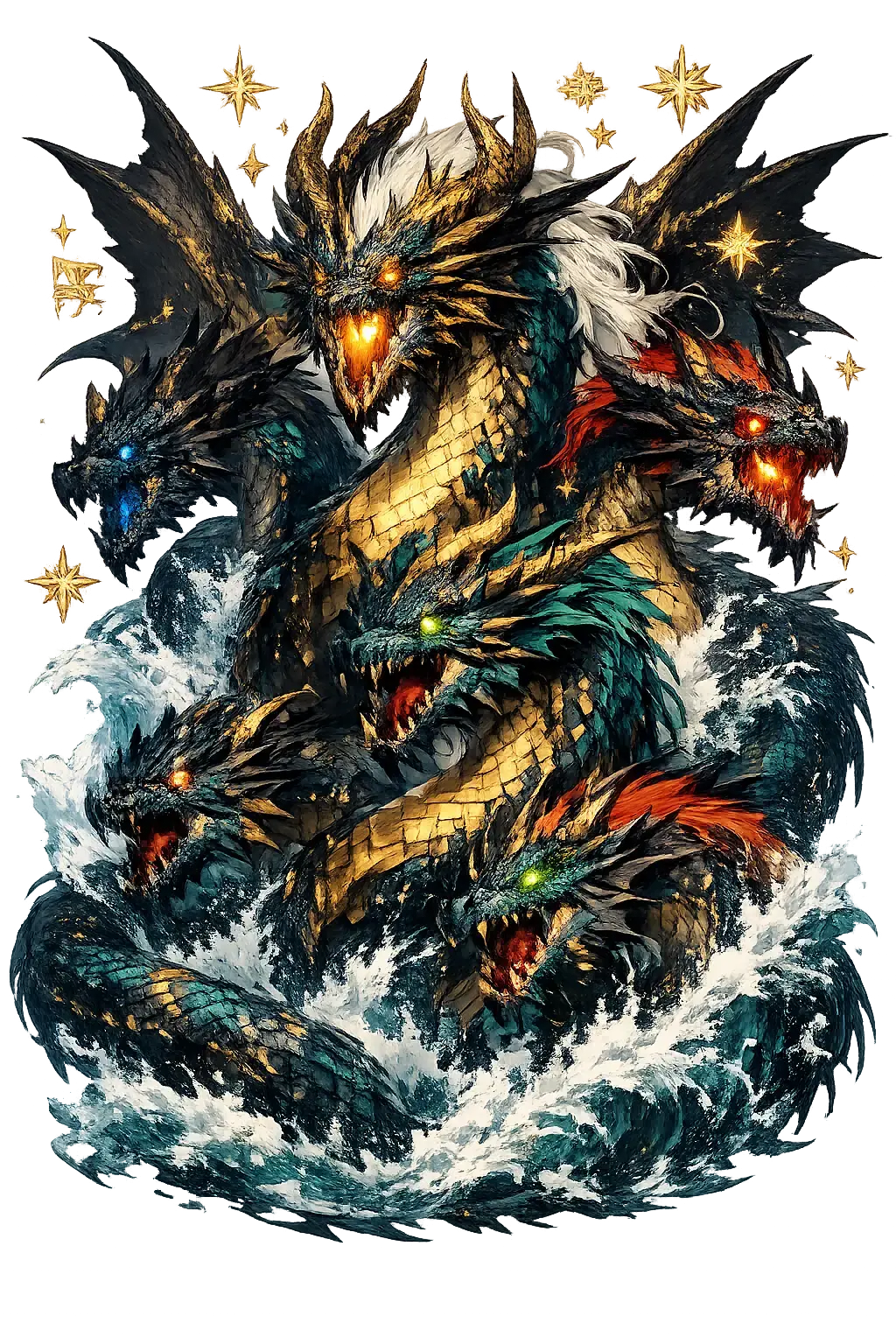
Why Tiāmat is spelled that way — and what it costs to get it right
Every name in this series was once flattened to fit a keyboard. Tiāmat is what the evidence put back.
Tiāmat is the Babylonian primordial salt sea — the churning watery chaos from whom the gods are born and against whom order must be asserted. In the Enuma Elish she is first the generative mother of the divine generations, then the dragon-mother of monsters, and finally the cosmic body out of which Marduk fashions heaven and earth. She is not merely a sea; she is the possibility of both creation and destruction that precedes form. Before the gods existed, there was only Apsû, the freshwater abyss, and Tiāmat, the salt sea. Their waters mingled and produced the first generation of deities: Lahmu and Lahamu, then Anshar and Kishar, then Anu, and finally Ea.
That is the figure this file is about — and the temple now standing at its restored name.
At a Glance
- Restored name: Tiāmat
- ASCII form: tiamat
- Meaning: "Sea"
- Domain of influence: Phonological Reconstruction, Salt Water, Chaos
- Pantheon: Mesopotamian
- Classification: Tier 1
- Original script: 𒀭𒋾𒊩𒆳
- Series: The Restoration Files, No. 241 of 271
The Name Before the Marks
Strip Tiāmat to tiamat and one piece of evidence vanishes:
- a → ā — Long vowel: the vowel length the ASCII form cannot show.
None of these marks is decoration. Each one is a fact about how the name was spoken, and each one is checkable against the scholarly record the temple cites.
The Temple That Stands Now
The restored name is not a plaque; it is an address. The temple of Tiāmat lives at /sites/tiamat/, with its mythology in the lore halls, its peer-reviewed record in the Scholarly Edition, and its place in the pattern atlas on the patterns floor.
The restoration preserves more than the ASCII form can say — stress, length, or a letter the Latin keyboard lost — which places it in Tier-1: mechanically verifiable, information-rich.
Every flagship temple is hand-built to the same standard: the original script displayed with its provenance, the pronunciation reconstructed phoneme by phoneme, the sources named — because a restoration you cannot audit is just a spelling with confidence.
The Archetype at Work
A temple is also a reading of what this figure means — and meanings have addresses in the modern world. The pattern atlas maps Tiāmat to the industries its archetype genuinely resonates with, each match argued, weighted, and open to challenge:
- Gaming, Fantasy & Entertainment IP — Dungeons & Dragons made her the five-headed icon of the monster manual.
- Environmental & Climate Services — Eco-spirituality’s primordial mother; her divided body is the earth and sea themselves.
- Women's Health & Femtech — Feminist theology’s reclaimed mother; the goddess order the storm-god displaced.
This is the part of the file that surprises people: a four-thousand-year-old name, mapping cleanly onto twenty-first-century trades. The patterns are not marketing — they are the same myths, read forward.
In the Sacred Texts
The Mesopotamian tradition is not a vibe; it is a library. The Sacred Texts collection holds Enūma Eliš and The Epic of Gilgamesh — the primary sources the temple's scholarship is built on, free to read, cross-linked back to the names they mention. The temple is the argument; the texts are the evidence.
The File Continues
This is one of 271 Restoration Files — a second dispatch from every flagship temple in the fleet. The temple's first dispatch tells the founding story of the name; the blog index holds the whole archive.
Continue the series — previous file: Ḏḥwty (read it here) · next file: Tiān (read it here).
The Restoration Files are written from the same canonical record as the temples themselves: the lexicon, the lore catalog, the pattern atlas, and the cited scholarly sources. If a file ever disagrees with its temple, the temple is right — tell us, and the file will be corrected.