
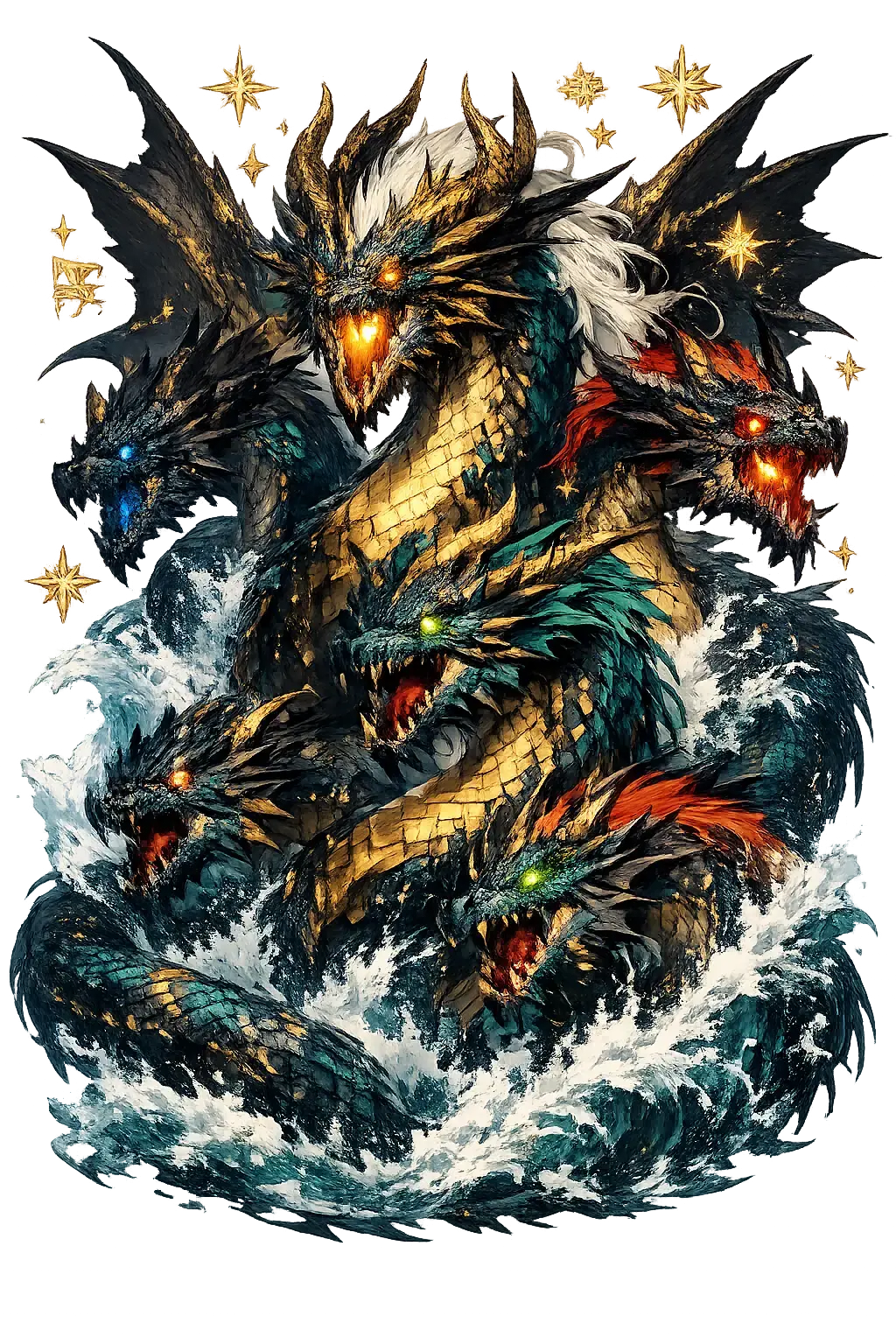
The name Tiāmat and the world it opens
A name is a door. Tiāmat opens onto an entire world: the domain of phonological reconstruction, salt water, chaos, a Mesopotamian tradition, and centuries of storytelling, worship, and scholarship. This post walks through that world room by room — the name and its roots, the original script, the sound of it, the myths, the symbols, the sites, the afterlife across cultures — and ends at the newest room of all: a Unicode domain that makes the whole structure addressable. tiamat gets you to the same building, but only the restored form tells you why it was built.
At a Glance
- Restored name: Tiāmat
- ASCII form: tiamat
- Meaning: "Sea"
- Domain of influence: Phonological Reconstruction, Salt Water, Chaos
- Pantheon: Mesopotamian
- Classification: Tier 2
- Original script: 𒀭𒋾𒊩𒆳 (Cuneiform)
- Live domain: tiāmat.com
Overview
Tiāmat (tiamat) — from Akkadian tiāmtu (later Babylonian tâmtu), 'sea' — is the primordial salt-water ocean of Babylonian cosmogony and the antagonist of the Enuma Elish. She is first the generative deep whose waters mingle with the freshwater [[apsu|Apsû]] to beget the gods; then, after Apsû's death, the mother of eleven monsters led by her consort Kingu; and finally the cosmic body Marduk splits to roof the sky and floor the earth. No temple, cult image, or hymn dedicated to her is known: the tradition remembers her as a cosmogonic principle, not a civic deity — a point the lexical record confirms, where tiāmtu remains the everyday Akkadian word for 'sea'.
The epic's manuscripts write the name syllabically with the divine determinative (dTI.A.MA.TUM). The macron on the first vowel of Tiāmat marks a length reconstructed from Akkadian phonology — discussable rather than sign-given — and places the name in Tier 2.
PuniCodex serves the temple at tiāmat.com; the plain ASCII tiamat is the fallback the early domain system imposed, not the restoration.
The Name
The name is the Akkadian common noun tiāmtu (later Babylonian tâmtu), 'sea, ocean', wearing the feminine ending -t; as a theonym it names the sea personified. The word belongs to a Semitic family of sea-names — compare Ugaritic thm and Hebrew tĕhôm, 'the deep' of Genesis 1:2 — so that the biblical deep and the Babylonian dragon are, linguistically, one word. Whether the Genesis writer consciously polemicized against the Babylonian goddess or simply inherited the shared noun is debated.
Cuneiform manuscripts of the Enuma Elish write the name syllabically (𒀭𒋾𒀀𒈲𒌈, dTI.A.MA.TUM), the determinative 𒀭 marking it as a theonym. The macron on Tiāmat records the long first vowel inferred from Akkadian phonology — discussable rather than sign-given — and places the name in Tier 2.
The ASCII form tiamat survives only because the early domain-name system could not carry diacritics; it is a technological compromise, not an ancient spelling. The letter-by-letter transformation runs:
- t → T — Same, capitalized
- i → i — Same
- a → ā — Macron: long first vowel, reconstructed from Akkadian phonology
- m → m — Same
- a → a — Same
- t → t — Same
The project holds the domain tiāmat.com (xn--timat-gwa.com) as the canonical home of this name.
The Original Script
The name is preserved in Cuneiform as 𒀭𒋾𒊩𒆳 — Sumero-Akkadian cuneiform, attested Sumerian / Old Babylonian – Neo-Assyrian, c. 2600–600 BCE, in Mesopotamia. The script is written left-to-right / top-to-bottom.
The scholarly transliteration is Tiāmat (Sumerian logogram + Akkadian scholarly), giving the normalized reading /tiˈaː.mat/.
The rendering proceeds step by step:
- The name is written 𒀭𒋾𒊩𒆳 in cuneiform.
- Sumerian logograms may be read with Akkadian values; the divine determinative 𒀭 marks theonyms.
- Macrons in the Unicode restoration mark long vowels inferred from Akkadian and Sumerian convention.
- The Unicode restoration Tiāmat is registrable in .com; the cuneiform form is not supported in the .com IDN table.
Pronunciation
The reconstructed pronunciation of the name is /tiˈaːmat/ — Akkadian Reconstruction.
Phoneme by phoneme:
- Ti- — Voiceless alveolar stop [t] followed by close front vowel [i]; the first syllable is light and leads into the long vowel.
- -ā- — Long open front vowel [aː] — the macron marks a reconstructed vowel length that Assyriologists infer from Akkadian phonology and cognates; the cuneiform signs do not encode length directly.
- -mat — Bilabial nasal [m], open vowel [a], and voiceless alveolar stop [t]; the final -t is the feminine ending of Akkadian tiāmtu, 'sea'.
For the modern speaker, the closest approximation is: 'tee-AH-maht' — stress the long second syllable and let it open like a calm sea before the final consonants close it.
Kindred and historical forms of the name:
- Akkadian — 𒀭𒋾𒀀𒈲𒌈 (tiāmtu / tâmtu), 'sea' — the cosmic salt water and the goddess identified with it
- Sumerian comparison — abzu, the freshwater abyss; Tiāmat is the salt-water counterpart to Apsû's fresh water
- Hebrew comparison — tĕhôm, the primordial deep of Genesis 1:2, likely a cognate or reflex of Tiāmat
Tiāmat is Tier 2 because the macron on the first a marks a reconstructed vowel length, not a canonical Greek-style stress or a universally agreed long vowel. It is a pedagogical mark: a visible question that invites discussion about how the name was pronounced in Akkadian. Standard Assyriology writes Tiamat or Tiāmat; the Unicode form Tiāmat belongs to PuniCodex's phonological reconstruction hub.
Mythology
Tiāmat is the Babylonian primordial salt sea — the churning watery chaos from whom the gods are born and against whom order must be asserted. In the Enuma Elish she is first the generative mother of the divine generations, then the mother of monsters, and finally the cosmic body out of which Marduk fashions heaven and earth. She is not merely a sea; she is the possibility of both creation and destruction that precedes form.
The Salt-Water Mother (Cosmogony)
Before the gods existed, there was only [[apsu|Apsû]], the freshwater abyss, and Tiāmat, the salt sea. Their waters mingled and produced the first generations of deities: Lahmu and Lahamu, then Anshar and Kishar, then Anu, and finally Ea. Tiāmat is therefore the primordial matrix — the saline womb in which the cosmos gestates. Where Apsû is stillness and depth, Tiāmat is movement, breadth, and the uncontained.
The War of the Gods (Conflict)
When the younger gods disturb Apsû's rest, Apsû resolves to destroy them; Tiāmat refuses. Ea slays Apsû and builds his house upon the corpse, but Tiāmat, stirred by the new winds and urged on by her offspring, raises an army of monsters — serpents, dragons, scorpion-men, and storm-demons — to avenge her consort. She places Kingu, her new consort, at the head of the host and fastens the Tablet of Destinies to his breast.
Marduk Splits Tiāmat (Transformation)
Marduk of Babylon accepts the challenge of battle on the condition that the gods grant him supreme kingship. He confronts Tiāmat with net, bow, and winds; when she opens her mouth to swallow him, he drives the evil wind into her so that she cannot close her lips, and shoots an arrow that splits her heart. He divides her corpse in two: from one half he makes the sky, from the other the earth.
The Cosmos from Chaos (Legacy)
From Tiāmat's eyes Marduk releases the Tigris and the Euphrates; he piles the mountains upon her breasts and bores springs through them to carry off the waters; her tail he twists into the dur-maḫ, the great bond that fastens heaven, earth, and the underworld together (Tablet V). Her death is not an annihilation but an ordering: the chaotic sea is reassembled into the fixed forms of the world, and every city, mountain, and river rests upon the body of the primordial salt-water mother.
Symbols & Iconography
The tradition gives Tiāmat no cult statue and no stable portrait — the Enuma Elish itself is vague about her shape — but a consistent set of images gathers around her:
- Salt water — the open sea as the uncontained deep: tiāmtu in Akkadian is the ocean that surrounds the world and the chaos that precedes it.
- The divided body — her split form, half sky and half earth, is the epic's central image: the ordered world is her anatomy.
- The monster host — the eleven creatures she bears for the war, among them fierce serpents, the mušḫuššu-dragon, scorpion-men, fish-men, and the bull-man: the combat myth's catalogue of chaos.
- The tail-bond — her tail, twisted by Marduk into the dur-maḫ, the great bond fastening heaven, earth, and the underworld (Tablet V).
- Dragon body — The cosmic form that becomes heaven and earth when split by Marduk
- Monster army — The forces of chaos mobilized against the younger gods
Archaeology & Evidence
Tiāmat has no temple and no cult site; her archaeology is the archaeology of a text. The Enuma Elish survives in copies from Nineveh, Sippar, Babylon, and Aššur, and in Babylon it was liturgy: festival ritual texts prescribe the epic's recitation before Marduk's statue during the New Year (akītu) festival, when the story of her defeat rehearsed the renewal of cosmic order. The E-sagil temple and the ziggurat Etemenanki — 'House, foundation of heaven and earth' — embodied in brick the order won from her body.
Her monster brood had a monumental afterlife of its own: the mušḫuššu-dragon, listed among the creatures she bore, became Marduk's sacred animal and marches in glazed brick across the Ishtar Gate of Babylon.
Realm & Domain
The name is written 𒀭𒋾𒀀𒈲𒌈. Standard Assyriology transliterates it as Tiamat or Tiāmat, from Akkadian tiāmtu, 'sea'. But the length of the first vowel — the very mark that turns Tiamat into Tiāmat — remains a reconstruction, not a sign-given fact. It is here, in the space between the cuneiform sign and the spoken sound, that this temple operates. This node of PuniCodex is dedicated to the phonological reconstruction and didactic grammar of the ancient Near East: vowel length is marked not because it is certain, but because it is discussable — the macron is a question mark made visible.
Tiāmat is nevertheless the salt-water chaos mother of Babylonian cosmogony — the primordial sea whose mingling with Apsû's fresh abyss produces the gods, and whose defeated body becomes the sky and earth. She is the contradiction at the heart of creation: the mother who must be overcome for the world to exist.
Salt Sea
The primordial tiāmtu, the cosmic salt water that surrounds and underlies the ordered world.
Mother of Monsters
She breeds dragons, serpents, and scorpion-men to avenge Apsû and challenge the younger gods.
Cosmic Body
Marduk divides her corpse to form heaven, earth, rivers, and mountains.
Chaos vs. Order
She embodies the formless deep that must be shaped — never simply evil, but the raw material of cosmos.
Across Cultures
Tiāmat's influence radiates across ancient Near Eastern and later mythologies.
The Unicode form Tiāmat is a reconstruction node: standard Assyriology writes Tiamat or Tiāmat, and the macron makes visible the open question of first-vowel length. In the Hebrew Bible, the primordial tĕhôm ('deep') of Genesis 1:2 likely preserves a memory of Tiāmat, now depersonified into the watery chaos that precedes God's ordering word. Greek sources knew the Babylonian chaos dragon through Berossus; the Hebrew Bible's combat hymns — God dividing the sea and crushing Leviathan and Rahab (Psalms 74 and 89, Job 26, Isaiah 51:9–10) — work the same combat pattern, and the dragon imagery of Revelation 12 extends it into Christian apocalyptic. In modern fantasy, games, and occult cosmology, Tiamat survives as the five-headed dragon queen and as a symbol of primordial feminine chaos suppressed by patriarchal order.
Kindred figures in the PuniCodex cross-tradition index include [[typhon|Typhōn]] (chaos / monster), [[apep|Ꜥpp]] (chaos / primordial / world serpent), [[chaos|Cháos]] (chaos / primordial / world serpent), [[jormungandr|Jǫrmungandr]] (chaos / primordial / world serpent), [[leviathan|Liwyāṯān]] (chaos / primordial / world serpent), and [[yam|Yām]] (chaos / primordial / world serpent).
Cultural Legacy
The image of a cosmic sea-monster split to create the world has never lost its power.
It appears in biblical creation hymns that depict God dividing the sea and crushing Leviathan (Psalm 74, Psalm 89, Job 26), in medieval maps that place dragons at the edges of the known world, and in modern geology's recognition that Earth's water and land are products of ancient cataclysms. Tiamat has become an icon of feminist theology and eco-spirituality: the primordial mother whose defeat by a storm-god encodes the violence of order against nature. PuniCodex keeps the macron not as a settled fact but as an invitation: every visitor is welcome into the philological conversation about how this name — and the chaos it names — was pronounced.
The Scholarly Record
The account of Tiāmat given in this edition rests on the witnesses and reference works listed below. Lexica and etymological dictionaries secure the form and meaning of the name; the literary and religious texts supply the narrative evidence.
- Enuma Elish: The Babylonian Epic of Creation, Standard Babylonian version, 1200 BCE. Full text
- CAD (Chicago Assyrian Dictionary).
- ETCSL (Electronic Text Corpus of Sumerian Literature).
- Jacobsen, The Treasures of Darkness.
- Dalley, Myths from Mesopotamia.
- Foster, Before the Muses.
- Atrahasis (Akkadian Flood Story).
- Berossus, Babyloniaca.
A Meditation
Every cosmogony must say what the world is made of. The Babylonian answer is blunt: it is made of a body. Sky, earth, rivers, mountains — the Enuma Elish builds each from the anatomy of the sea that came before, so that order is never created out of nothing but always carved out of something older and alive.
The name keeps that memory in grammar: Tiāmat is the ordinary Akkadian word for 'sea' wearing the divine determinative. To write it with the macron is to admit that the reconstruction is an inference — and the inference, like the world in the poem, rests on something deep that the surface does not show.
The Unicode Restoration
Tiāmat is classified as Tier 2: the original preserves at least one philological feature that ASCII cannot encode. The ASCII fallback tiamat still resolves everywhere, but it is the restored form that carries the name's full information. Across the 6 characters of the name, the restoration adjusts 1: 1 mark of length (ā). That is the whole thesis of this temple: the marks are the message.
Character by Character
The journey from tiamat to Tiāmat, one character at a time:
- t → T — Same, capitalized
- i → i — Same
- a → ā — Long vowel
- m → m — Same
- a → a — Same
- t → t — Same
The Domain Name
The restored name is live as a working domain: tiāmat.com, which the DNS carries in punycode form as xn--timat-gwa.com — an ASCII-compatible encoding that lets a non-ASCII name travel the global network without breaking older infrastructure. The visitor sees Tiāmat; the machines see the encoding. That duality is the engineering compromise on which the entire restoration rests, and it is why a name written the way its own tradition wrote it in Cuneiform can now be typed into any browser on earth.
The Mesopotamian Pantheon
Tiāmat is one of 30 entries the PuniCodex lexicon catalogues under the Mesopotamian pantheon. The Pantheon page gathers the tradition's major figures in one place, and the Lexicon lets you filter all 895 restorations by tradition, tier, or script — the fastest way to see where this name sits among its kin.
Frequently Asked Questions
What does Tiāmat mean? The traditional gloss is "Sea."
Which tradition does Tiāmat belong to? Tiāmat is catalogued in the Mesopotamian pantheon of the PuniCodex lexicon.
Why is Tiāmat classified as Tier 2? Because the original preserves at least one philological feature that ASCII cannot encode — and the marks in the restored spelling preserve exactly that evidence.
Is Tiāmat a working domain? Yes — tiāmat.com resolves today and routes to this temple.
What is the punycode for tiāmat.com? The DNS encoding is xn--timat-gwa.com; browsers perform the translation automatically, so visitors only ever see the restored name.
Why This Restoration Matters
A door only matters if people walk through it. tiāmat.com is open, and everything behind it — the myths, the scholarship, the canvas, the patrons — hangs on the restored spelling. The PuniCodex project bets that the web will make room for names as they were actually written, and Tiāmat is one of its standing proofs. Visit, share, cite, type it yourself: each use is a small rehearsal for a web where no name has to hide its marks to be found.
Explore Further
This post is one doorway into the temple. The home page carries the full character breakdown and the ambient canvas; the lore page tells the myths in long form; the Scholarly Edition preserves the sources, pronunciation data, and revision history; and the patron wall supports the restoration directly. For the wider map, browse the Lexicon, explore the Pantheon, or return to the PuniCodex blog.
Related Names
Sources
The full scholarly apparatus — every citation, revision, and review — lives in the Scholarly Edition. Key references for this post:
- Enuma Elish: The Babylonian Epic of Creation, Standard Babylonian version, 1200 BCE.
- CAD (Chicago Assyrian Dictionary).
- ETCSL (Electronic Text Corpus of Sumerian Literature).
- The Assyrian Dictionary of the Oriental Institute of the University of Chicago (CAD), s.v. tâmtu/tiāmtu.
- Lambert, Babylonian Creation Myths (Eisenbrauns, 2013).
- Lexicon authorities for this entry: Enuma Elish, Black-Green.