
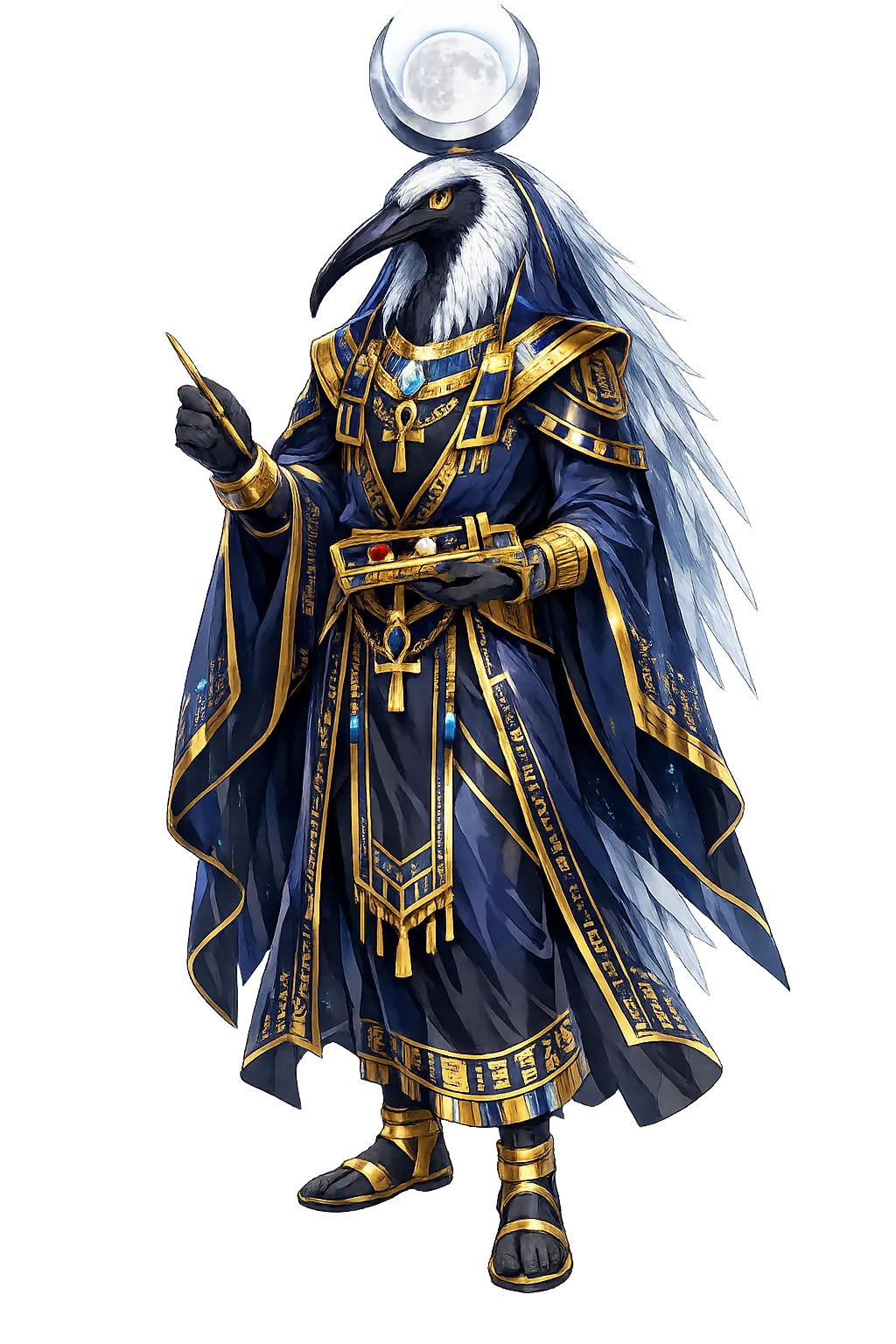
Pronouncing Ḏḥwty: a guide for the curious
Saying Ḏḥwty aloud is harder than reading it on a screen, and more rewarding. The restored spelling is a compressed pronunciation guide: every accent and macron is an instruction. This post unpacks those instructions — the reconstructed sound, the phoneme-by-phoneme record, the kindred forms in neighboring languages — and then zooms out to the full record around the name: its Hieroglyphs writing, its mythology, its cult, and its modern life as a Unicode domain. Whether you arrive as a linguist, a reader of myth, or a domainer, you will leave able to say the name the way the evidence suggests it was said — and able to type it the way it was written.
At a Glance
- Restored name: Ḏḥwty
- ASCII form: thoth
- Meaning: "He who is like the ibis"
- Domain of influence: Writing, Wisdom, Moon
- Pantheon: Egyptian
- Classification: Tier 2
- Original script: 𓅜𓏏 (Hieroglyphs)
- Live domain: ḏḥwty.com
Overview
Ḏḥwty (thoth) — Greek Θώθ — is the ibis-headed scribe of the gods: measurer of time, reckoner of accounts, inventor of writing, and the moon whose light orders the night. Egyptian wrote his name logographically with the sacred ibis on its perch, so that the traditional gloss runs 'he who is like the ibis'. His roles are the roles of knowledge put to work: he restores the Eye of [[horus|Ḥr]] after the conflict with Seth, mediates the divine tribunal, heals, and stands beside the scales in the Hall of the Two Truths to record the weighing of the heart against the feather of [[maat|Mꜣꜥt]]. At his city Khemenu — 'Eight-town', Greek Hermopolis — he presided over the theology of the eight primeval gods, and in the Graeco-Roman age he merged with Hermes to become Hermes Trismegistus, legendary author of the Hermetic corpus.
PuniCodex restores the name as Ḏḥwty and serves its temple at ḏḥwty.com: a Tier 2 restoration preserving the palatal ḏ (U+1E0E) and the pharyngeal ḥ (U+1E25) that the ASCII thoth collapses into digraphs.
The Name
The name is attested in Hieroglyphs as 𓅜𓏏 — the sacred ibis on its perch, with the bread-loaf t as phonetic complement — and is traditionally glossed 'he who is like the ibis'; fully phonetic spellings ḏ-ḥ-w-t-y are attested from an early date.
The ASCII form thoth is a technological compromise imposed by the early domain-name system, not an ancient spelling; what it preserves is the Greek Θώθ rather than the Egyptian. The Unicode restoration Ḏḥwty recovers the scholarly transliteration — palatal ḏ, pharyngeal ḥ — directly in the address bar as a Tier 2 form.
The letter-by-letter transformation runs:
- t → Ḏ — D-with-dot-below: palatalized d
- h → ḥ — H-with-dot: voiceless pharyngeal
- o → w — W: bilabial glide
- t → t — Same
- h → y — Y: palatal approximant
Attested and derived spellings of the name:
- Thóth — alternate stress, scholarly variant: Acute on omicron: alternate stress position
The project holds the domain ḏḥwty.com (xn--wty-2yy4e.com) as the canonical home of this name.
The Original Script
The name is preserved in Hieroglyphs as 𓅜𓏏 — Egyptian hieroglyphic, attested c. 3200 BCE – 4th century CE in the Nile Valley; the script runs right-to-left, top-to-bottom, or multidirectionally.
The scholarly transliteration is Ḏḥwty (Egyptological). The original vocalisation is unrecorded; the Greek rendering Θώθ and the Coptic month-name Ⲑⲱⲟⲩⲧ (Thōout) preserve the later pronunciation.
The rendering proceeds step by step:
- Ibis (𓅜) + bread sign (𓏏): a logographic writing of the moon-god of writing
- Fully phonetic spellings ḏ-ḥ-w-t-y are attested from an early date
- The initial Ḏ marks a voiced palato-alveolar affricate
PuniCodex registers Ḏḥwty as a Tier 2 restoration carrying the palatal ḏ (U+1E0E) and the pharyngeal ḥ (U+1E25) into the address bar; the hieroglyphic form itself lies outside the .com IDN table.
Pronunciation
The reconstructed pronunciation of the name is /tɨˈχuːtiː/ — Egyptological Reconstruction.
Phoneme by phoneme:
- Ḏ — Palatalized voiced alveolar stop [ɟ] or affricate, written with d-dot-below; the first consonant of Ḏḥwty
- ḥ — Voiceless pharyngeal fricative [ħ], the dotted h that follows the palatal d
- w — Bilabial glide [w], represented in writing by the quail-chick sign
- ty — Final consonants t-y, with the y indicating a palatalization or the Greek ending -is
For the modern speaker, the closest approximation is: tji-HOO-tee — the first consonant is like a 'dj' made against the hard palate, and the middle h is a dry throat-fricative.
Kindred and historical forms of the name:
- Egyptian hieroglyphs — 𓄟𓊃𓂧𓏏𓆇 (ḏḥwty), the ibis god's name written with the ibis and moon signs
- Coptic — Ⲑⲱⲟⲩⲧ (Thōout), the lunar month named after the god
- Greek — Θώθ (Thōth) / Ἑρμῆς (Hermes), the Graeco-Egyptian Hermes Trismegistus
Ḏḥwty is a Tier-2 consonantal restoration. Egyptian writing records only the consonants ḏ-ḥ-w-ty; the vowels are reconstructed from Coptic and Greek sources. The initial palatal ḏ and the pharyngeal ḥ are both non-English sounds preserved in the Unicode form.
Mythology
Thoth moves through Egyptian myth as the indispensable companion: he is present at creation, mediates divine quarrels, heals the wounded eye, and judges the dead. His stories are less about his own ambition than about the power of knowledge, writing, and measured speech to resolve conflict and preserve order.
The Word That Organized Creation (Heliopolitan Cosmogony)
In some versions of Egyptian cosmogony, Thoth is the tongue of Ptḥ, the means by which the creator's thoughts become articulate commands. He is also credited with inventing hieroglyphs, numbers, and the calendar, giving humanity the tools to maintain Maat. Without Thoth, creation would remain unspoken and unrecorded.
The Mediator of the Gods (Contendings of Horus and Seth)
In the New Kingdom narrative 'The Contendings of Horus and Seth,' Thoth acts as scribe and arbitrator before the divine tribunal. When Horus's eye is torn out and Seth's testicles are injured, Thoth heals both wounds and records the final verdict that makes Horus king of the living. His role is neither warrior nor king but the one who makes conflict resolvable through law and writing.
The Scribe of the Weighing (Funerary Theology)
In Spell 125 of the Book of the Dead, Thoth stands beside the scales in the Hall of Judgment and records the result of the weighing of the heart against the feather of Maat. His testimony is decisive: a favorable record means passage into the afterlife, while an unfavorable one means destruction by Ammit. The deceased often identifies himself with Thoth, claiming mastery of the sacred words that protect the soul.
Symbols & Iconography
The iconography associated with Ḏḥwty concentrates in a small set of recurring attributes, each a compressed statement about the name:
- Ibis — The bird whose curved beak and measured step made it emblematic of writing and calculation
- Baboon — Thoth's other sacred animal, associated with the dawn and the rising moon
- Scribal palette and reed pens — The tools of the divine scribe who records all deeds and spells
- Crescent moon and disk — The lunar phases by which Thoth measures time and renews the cosmic order
- Eye of Horus (wedjat) — Restored by Thoth after the conflict of Horus and Seth, symbolizing wholeness regained
Archaeology & Evidence
Thoth's principal cult centre was Khemenu, Greek Hermopolis Magna, modern el-Ashmunein in Middle Egypt. The temple itself is ruined almost beyond reading, but its scale survives in the colossal quartzite baboons dedicated by Amenhotep III — among the largest animal statues of pharaonic Egypt — and in the vast sacred-animal necropolis of Tuna el-Gebel across the river, whose galleries received mummified ibises and baboons offered to the god in their hundreds of thousands. A second great ibis catacomb lies in the Sacred Animal Necropolis of North Saqqara, excavated by W. B. Emery, where the ibis galleries again number their dead in the millions. Temple reliefs from the New Kingdom onward show Thoth writing, healing, and measuring, while the Graeco-Roman Hermetic texts and the Coptic month-name Ⲑⲱⲟⲩⲧ preserve his later reputation as Hermes Trismegistus.
Realm & Domain
Ḏḥwty is the ibis-headed scribe of the gods, the measurer of time, the reckoner of accounts, and the moon whose light lets humans see at night. He invented writing, preserved the laws of Maat, and stands beside Osiris in the Hall of Judgment to record the verdict of the heart. Where Ptḥ creates by speaking, Thoth creates by writing: he is the god who makes knowledge durable.
Moon and Measurement
Thoth is the moon that measures months, festivals, and the night hours of the Duat.
Scribe of Maat
He records the weighing of the heart and knows the spells that protect the justified dead.
Mediator and Healer
He intervenes in disputes among gods, restores the Eye of Horus, and masters medicine and magic.
Hermopolis
His city Khemenu, 'Eight-Town,' was a center of learning and the cult of the Ogdoad.
Across Cultures
Thoth's most enduring syncretism is with the Greek Hermes, producing Hermes Trismegistus, 'Thrice-Great Hermes,' the legendary author of the Hermetic corpus. This Graeco-Egyptian figure became a cornerstone of late antique mysticism, alchemy, and astrology, and was reclaimed by Renaissance humanists such as Ficino and Pico della Mirandola. In Coptic Egypt, Thoth's month name (Thōout) survived in the Christian calendar. His ibis and baboon forms influenced medieval bestiaries and early modern emblem books.
Kindred figures in the PuniCodex cross-tradition index include [[ganesha|Gaṇeśa]] (wisdom / writing), [[hermes|Hermês]] (messenger / travel / wisdom), [[ahuramazda|AhuraMazdā]] (wisdom / knowledge), [[artemis|Ártemis]] (moon / lunar), [[athena|Athénā]] (wisdom / knowledge), and [[hekate|Hekátē]] (moon / lunar).
Cultural Legacy
Thoth's longest afterlife runs under a Greek name. Fused with Hermes as Hermes Trismegistus, he became the legendary author of the Hermetic corpus — the treatises that Marsilio Ficino put into Latin in 1463 at Cosimo de' Medici's behest, ahead of Plato himself, setting Hermes at the head of the Renaissance revival of ancient wisdom; the English word 'hermetic' still carries the trace. In Egypt his name survives in the calendar: the Coptic month Ⲑⲱⲟⲩⲧ (Thout), first month of the year, keeps the god's name in liturgical use to this day. Modern Egyptology has recovered his own literary monument in the 'Book of Thoth', a Demotic-Greek initiatory dialogue between a disciple and the god. In popular culture he endures as patron of writers, librarians, and occultists — the scribe whose record decides the fate of souls.
The Scholarly Record
The account of Ḏḥwty given in this edition rests on the witnesses and reference works listed below. Lexica and etymological dictionaries secure the form and meaning of the name; the literary and religious texts supply the narrative evidence.
- Book of the Dead, Spell 125 (Thoth records the weighing of the heart).
- The Contendings of Horus and Seth (papyrus Chester Beatty I).
- Faulkner, A Concise Dictionary of Middle Egyptian.
- Wb, ḏḥwty (Erman & Grapow).
- Allen, Middle Egyptian: An Introduction to the Language and Culture of Hieroglyphs.
- Copenhaver, Hermetica: The Greek Corpus Hermeticum and the Latin Asclepius.
- Fowden, The Egyptian Hermes: A Historical Approach to the Late Pagan Mind.
- Jasnow & Zauzich, The Ancient Egyptian Book of Thoth.
- Kessler, Tuna el-Gebel I: Die Tiergalerien (1998).
- Emery, reports on the Sacred Animal Necropolis, North Saqqara (JEA, 1965–71).
- Crum, A Coptic Dictionary, s.v. Ⲑⲱⲟⲩⲧ.
A Meditation
Thoth is the god who believes that what is written endures. In a world of disappearing messages and ephemeral speech, he reminds us that some words must be preserved: laws, treaties, poems, names. The Egyptians trusted this so deeply that they made writing a divine invention and its god the recorder of every judgment — the being whose palette stands between a heart and its annihilation. To invoke Thoth is to take seriously the responsibility of the scribe — the one who decides what gets remembered and how. His moonlight is not the blazing sun of [[ra|Rꜥ]] but the softer light by which we read, measure, and think.
The Unicode Restoration
Ḏḥwty is classified as Tier 2: the original preserves at least one philological feature that ASCII cannot encode. The ASCII fallback thoth still resolves everywhere, but it is the restored form that carries the name's full information. Across the 5 characters of the name, the restoration adjusts 4: 4 further adjustments (Ḏ, ḥ, w, y). That is the whole thesis of this temple: the marks are the message.
Name Variations
The lexicon records 1 additional form of the name:
- Thóth (alt-stress) — Acute on omicron: alternate stress position
The temple uses Ḏḥwty as the primary form: it is the spelling that best balances philological accuracy with the practical limits of DNS.
Character by Character
The journey from thoth to Ḏḥwty, one character at a time:
- t → Ḏ — D-with-dot-below: palatalized d
- h → ḥ — H-with-dot: voiceless pharyngeal
- o → w — W: bilabial glide
- t → t — Same
- h → y — Y: palatal approximant
The Domain Name
The restored name is live as a working domain: ḏḥwty.com, which the DNS carries in punycode form as xn--wty-2yy4e.com — an ASCII-compatible encoding that lets a non-ASCII name travel the global network without breaking older infrastructure. The visitor sees Ḏḥwty; the machines see the encoding. That duality is the engineering compromise on which the entire restoration rests, and it is why a name written the way its own tradition wrote it in Hieroglyphs can now be typed into any browser on earth.
The Egyptian Pantheon
Ḏḥwty is one of 66 entries the PuniCodex lexicon catalogues under the Egyptian pantheon. The Pantheon page gathers the tradition's major figures in one place, and the Lexicon lets you filter all 895 restorations by tradition, tier, or script — the fastest way to see where this name sits among its kin.
Frequently Asked Questions
What does Ḏḥwty mean? The traditional gloss is "He who is like the ibis."
Which tradition does Ḏḥwty belong to? Ḏḥwty is catalogued in the Egyptian pantheon of the PuniCodex lexicon.
Why is Ḏḥwty classified as Tier 2? Because the original preserves at least one philological feature that ASCII cannot encode — and the marks in the restored spelling preserve exactly that evidence.
Is Ḏḥwty a working domain? Yes — ḏḥwty.com resolves today and routes to this temple.
What is the punycode for ḏḥwty.com? The DNS encoding is xn--wty-2yy4e.com; browsers perform the translation automatically, so visitors only ever see the restored name.
Typing Ḏḥwty
You do not need a special keyboard to use this restoration. The PuniCodex Type Tool converts the ASCII form thoth into Ḏḥwty as you type, and the browser extension offers the same conversion inside any text field. Copy the restored form, paste it into the address bar, and the DNS does the rest.
Sister Temples
Other temples in the Egyptian pantheon include Ꜣmun, Ꜥpp, and Dwꜣt — each with its own restoration story, its own scholarly record, and its own place in the lexicon.
Why This Restoration Matters
Pronunciation turns out to be the heart of the matter. The marks in Ḏḥwty are instructions for the voice, and a web that strips them is a web that mispronounces the past at scale. The restoration hands the instructions back: say it as the evidence suggests, type it as the tradition wrote it, and let the punycode machinery do the quiet translation in between. That is all the PuniCodex project asks of the infrastructure — and everything it asks of you, the reader, is to use the whole name.
Explore Further
This post is one doorway into the temple. The home page carries the full character breakdown and the ambient canvas; the lore page tells the myths in long form; the Scholarly Edition preserves the sources, pronunciation data, and revision history; and the patron wall supports the restoration directly. For the wider map, browse the Lexicon, explore the Pantheon, or return to the PuniCodex blog.
Related Names
Sources
The full scholarly apparatus — every citation, revision, and review — lives in the Scholarly Edition. Key references for this post:
- James P. Allen, Middle Egyptian: An Introduction to the Language and Culture of Hieroglyphs, Cambridge University Press, 2000.
- Wilkinson, The Complete Gods and Goddesses of Ancient Egypt (2003), s.v. Thoth.
- Faulkner, A Concise Dictionary of Middle Egyptian, s.v. ḏḥwty.
- Book of the Dead, Spell 125 (Thoth records the weighing of the heart).
- Fowden, The Egyptian Hermes: A Historical Approach to the Late Pagan Mind.
- Lexicon authorities for this entry: Faulkner, Wb.