Unicode restoration and ASCII comparison
𓅜𓏏
The name in its original Egyptian form. Ḏḥwty (𓅜𓏏) is attested in the source tradition — “He who is like the ibis”. Its emphatic consonants carry the full phonetic and orthographic weight of the source tradition.
thoth
Reduced to plain thoth, the name loses everything that made it specific: emphatic consonants. What remains is an ASCII string that machines can parse but that no longer speaks with its original voice.
Ḏḥwty
The Unicode restoration recovers what ASCII flattened. Ḏḥwty restores emphatic consonants, returning the name to its original written dignity. The domain encodes to Punycode, but the browser displays the truth.
Ḏḥwty.com → xn--wty-2yy4e.com
The non-ASCII characters in Ḏḥwty are encoded while the ASCII remains visible. To the DNS, it is Punycode. To humanity, it is Ḏḥwty.
How Ḏḥwty travels from ancient script to the modern URL
Egyptian Ḏḥwty; the original vocalisation is unknown. The name is conventionally derived from ḏḥw “ibis" or from a term for the moon.
How Ḏḥwty was spoken
Writing, Wisdom, Moon, and Judgment
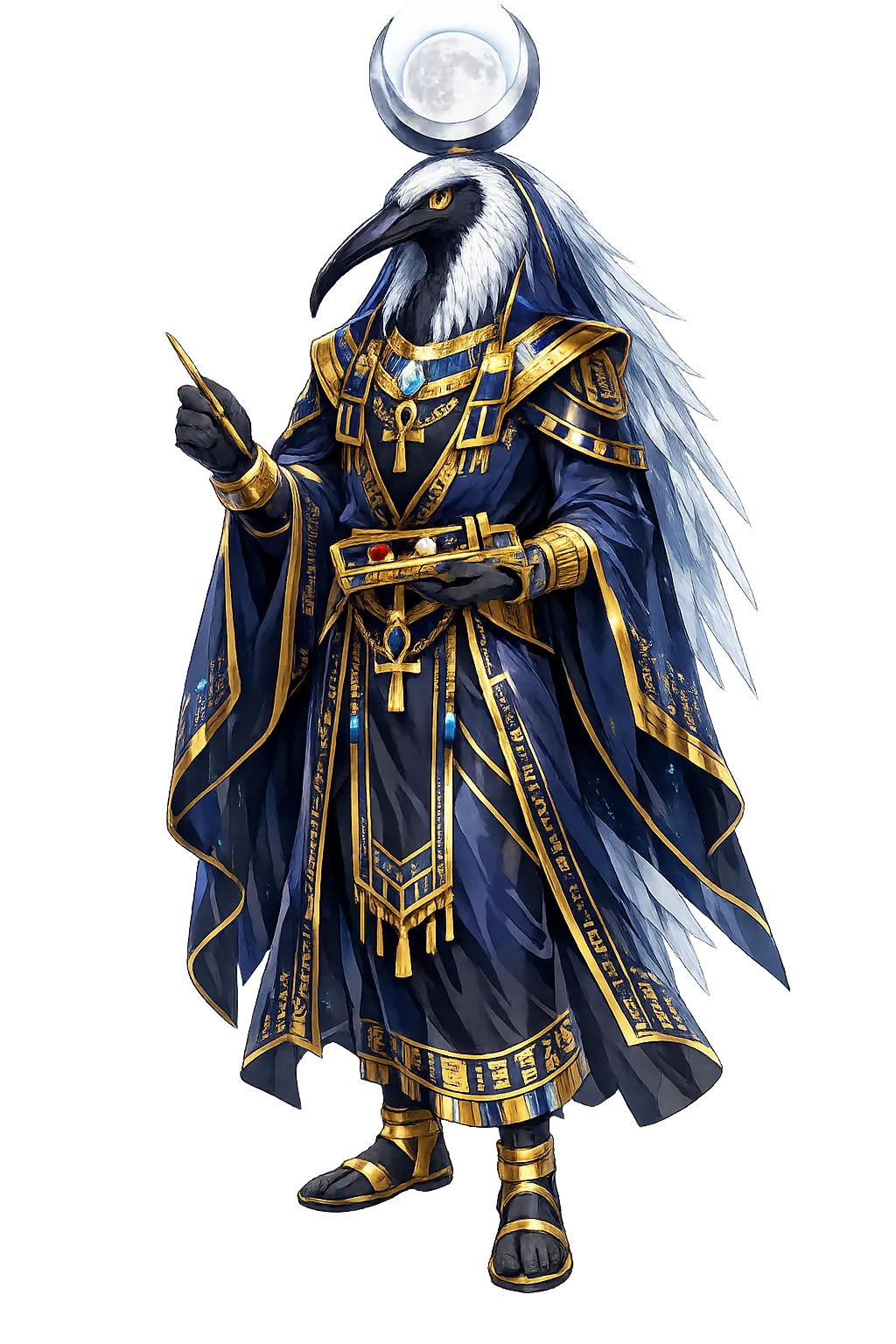
Ḏḥwty is the ibis-headed scribe of the gods, the measurer of time, the reckoner of accounts, and the moon whose light lets humans see at night. He invented writing, preserved the laws of Maat, and stands beside Osiris in the Hall of Judgment to record the verdict of the heart. Where Ptḥ creates by speaking, Thoth creates by writing: he is the god who makes knowledge durable.
Thoth is the moon that measures months, festivals, and the night hours of the Duat.
He records the weighing of the heart and knows the spells that protect the justified dead.
He intervenes in disputes among gods, restores the Eye of Horus, and masters medicine and magic.
His city Khemenu, 'Eight-Town,' was a center of learning and the cult of the Ogdoad.
Stories of Ḏḥwty
Thoth moves through Egyptian myth as the indispensable companion: he is present at creation, mediates divine quarrels, heals the wounded eye, and judges the dead. His stories are less about his own ambition than about the power of knowledge, writing, and measured speech to resolve conflict and preserve order.
In some versions of Egyptian cosmogony, Thoth is the tongue of Ptḥ, the means by which the creator's thoughts become articulate commands. He is also credited with inventing hieroglyphs, numbers, and the calendar, giving humanity the tools to maintain Maat. Without Thoth, creation would remain unspoken and unrecorded.
In the New Kingdom narrative 'The Contendings of Horus and Seth,' Thoth acts as scribe and arbitrator before the divine tribunal. When Horus's eye is torn out and Seth's testicles are injured, Thoth heals both wounds and records the final verdict that makes Horus king of the living. His role is neither warrior nor king but the one who makes conflict resolvable through law and writing.
In Spell 125 of the Book of the Dead, Thoth stands beside the scales in the Hall of Judgment and records the result of the weighing of the heart against the feather of Maat. His testimony is decisive: a favorable record means passage into the afterlife, while an unfavorable one means destruction by Ammit. The deceased often identifies himself with Thoth, claiming mastery of the sacred words that protect the soul.
Thoth is the god who believes that what is written endures. In a world of disappearing messages and ephemeral speech, he reminds us that some words must be preserved: laws, treaties, poems, names. To invoke Thoth is to take seriously the responsibility of the scribe — the one who decides what gets remembered and how. His moonlight is not the blazing sun of Ra but the softer light by which we read, measure, and think.
Enter Extended Lore