
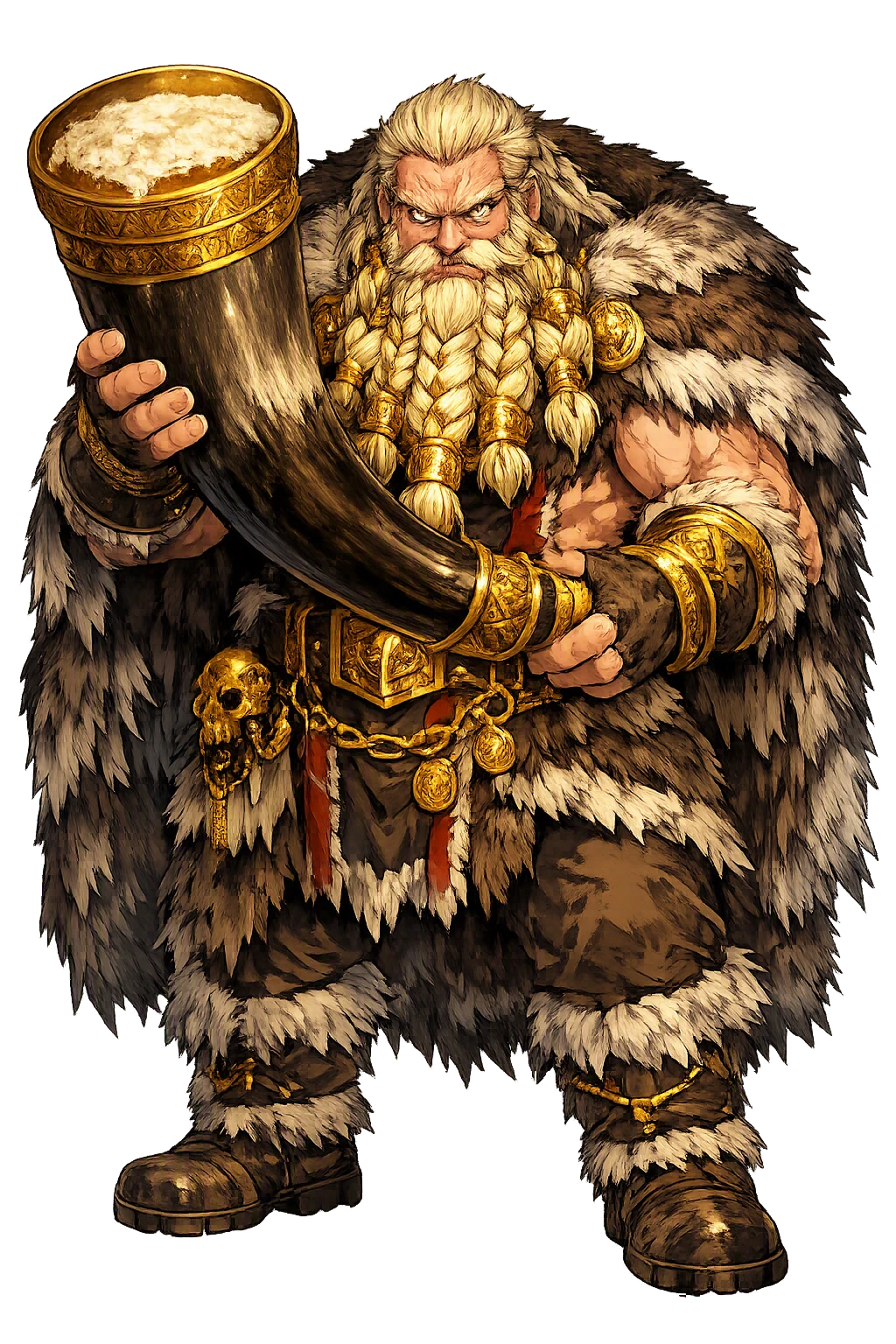
The many faces of Suttungr
No important name has only one face. Suttungr appears as a figure of myth, a scholarly reconstruction, a piece of material culture, a memory carried across languages, and — most recently — a Unicode domain. This post looks at each face in turn: the name and its roots, the Younger Futhark original, the reconstructed pronunciation, the mythological record, the symbols and sanctuaries, the cross-cultural afterlife, and the engineering that lets the restored spelling resolve in a browser. Taken together, those faces explain why suttungr was never going to be enough — and why the restored form is worth a domain of its own.
At a Glance
- Restored name: Suttungr
- ASCII form: suttungr
- Meaning: "Heavy with foundation"
- Domain of influence: Giant, Guardian of Mead
- Pantheon: Norse
- Classification: Tier 2
- Original script: ᛋᚢᛏᛏᚢᚾᚴᚱ (Younger Futhark)
Overview
Suttungr (suttungr) — Giant, Guardian of Mead · Heavy with foundation — is the jötunn son of Gillingr, brother of Baugi, and father of Gunnlöð: the giant who came to own the mead of poetry, took it as blood-ransom from the dwarfs who murdered his father, sealed it in the mountain Hnitbjörg, and lost it when Óðinn, disguised as the wanderer Bölverkr, drilled through the rock, won three nights and three drinks from Gunnlöð, and flew home as an eagle with Suttungr's eagle one beat behind.
The name's etymology is not settled. The handbooks register the theonym without a confident derivation, and the PuniCodex gloss 'Heavy with foundation' keeps the traditional reading in view without pretending the question is closed. Snorri gives Suttungr the continuous narrative of the mead's making, hoarding, and theft; Hávamál gives Óðinn's own first-person memory of the same events — seduction, perjury, and grand larceny confessed between counsels.
PuniCodex restores the name as Suttungr — identical to the ASCII input, because normalized Old Norse writes no diacritic in this name. The mechanical rule therefore places the name in Tier 2: nothing distinctive is lost in transit, a statement about orthography and never about the giant. The temple is domain-less: the plain-ASCII suttungr.com is registered to a third party outside the collection and is watched for release.
The Name
The name is attested in Old Norse as Suttungr — the giant's name and nothing else; no human personal name and no place-name descends from it. Its etymology is one of the honest open questions of the northern onomasticon: de Vries records the name without a settled derivation, Cleasby–Vigfusson and Zoëga gloss it simply 'name of a giant', and neither Simek nor Orchard offers more. The PuniCodex gloss 'Heavy with foundation' renders the traditional reading of the name's elements; the lexica's uncertainty stands beside it, unedited.
The ASCII form is not a fallback here but the form itself: normalized Old Norse writes eight plain Latin letters and a capital. The Unicode restoration Suttungr therefore preserves nothing the ASCII alphabet loses, and the mechanical rule classifies the name Tier 2 — an orthographic fact, not a judgment on the giant.
The letter-by-letter transformation runs:
- s → S — Same, capitalized
- u → u — Same
- t → t — Same
- t → t — Same
- u → u — Same
- n → n — Same
- g → g — Same
- r → r — Same
The project holds no domain for this name. The plain-ASCII suttungr.com is registered to a third party outside the collection and is watched for release; this temple claims nothing it does not hold.
The Original Script
The name is preserved in medieval Icelandic manuscripts in the Latin alphabet as Suttungr — Old Norse (North Germanic), attested 13th c. CE in the Codex Regius of the Poetic Edda (Hávamál) and the codices of Snorri's Edda (Skáldskaparmál), recording material centuries older. Before the Latin bookhand, Old Norse names were carved in the Younger Futhark; no runic attestation of this theonym survives, so the manuscript form is the primary witness. The runic rendering is ᛋᚢᛏᛏᚢᚾᚴᚱ (normalized suttunkr).
The scholarly rendering proceeds step by step:
- ᛋ (sól) writes /s/.
- ᚢ (úr) writes the rounded back vowels /u, o, ø, ǫ, y/ and /w/ — here short /u/ twice, on manuscript evidence.
- ᛏ (Týr) writes both /t/ and /d/ — the geminate /tː/ is fixed by the manuscript double tt, not by the runes.
- ᚾ (nauðr) writes /n/; ᚴ (kaun) writes both /k/ and /g/ — here the voiced cluster /ŋɡ/, fixed by the manuscript ng.
- ᚱ (reið) writes final syllabic /r̩/, the nominative ending.
- The spelling suttunkr is a normalized phonetic reconstruction; Younger Futhark does not distinguish voiced/voiceless stops or separate short and long vowels, so the Eddas' bookhand arbitrates every ambiguity.
Pronunciation
The reconstructed pronunciation of the name is /ˈsut.tuŋɡr/ — Old Norse Reconstruction.
Phoneme by phoneme:
- Su- — Voiceless alveolar sibilant [s] and short high back rounded [u], stressed on the first syllable as in every Old Norse word
- -ttu- — The geminate stop [tː] held audibly across the syllable boundary, then the second short [u], identical to the first
- -ngr — Velar nasal plus stop [ŋɡ] closing on a syllabic trill [r̩] — the nominative ending -r sounded as a true r, not swallowed
For the modern speaker, the closest approximation is: 'SOOT-toongr' — two beats, the first stressed, the double t held a fraction long in the middle, as in Icelandic Suttungur.
Kindred and historical forms of the name:
- Old Norse — Suttungr, son of Gillingr, brother of Baugi, father of Gunnlöð
- Younger Futhark — ᛋᚢᛏᛏᚢᚾᚴᚱ (normalized suttunkr), the Viking-Age runic rendering
- Manuscript Latin — Suttungr, unchanged; the Icelandic codices write the name in plain Latin bookhand
- Modern Icelandic — Suttungur, with the regular modern nominative ending -ur
Suttungr is Tier 2 because the restoration preserves nothing the ASCII form loses: no diacritic, no distinctive letter, no vowel length. English and Old Norse write the name identically.
Mythology
Suttungr's mythology is one continuous story told in two keys: Snorri's Skáldskaparmál narrates the mead's making, hoarding, and theft as prose history, while Hávamál lets Óðinn remember it in verse — a god confessing, between counsels, to seduction, perjury, and grand larceny.
How Suttungr Won the Mead (Skáldskaparmál 3-4)
When the Æsir and the Vanir made peace, they sealed the truce by spitting into a vat, and from the spittle they fashioned Kvasir, wisest of all beings. The dwarfs Fjalar and Galar killed him, drained his blood into the vats Óðrerir, Boðn, and Són, and mixed it with honey — the mead of poetry. The same dwarfs then drowned the giant Gillingr at sea and dropped a millstone on his weeping wife's head. Suttungr, Gillingr's son, came for the reckoning: he seized the dwarfs and stranded them on a skerry the tide would cover, and they ransomed their lives with the mead. Suttungr carried it home, stored it in Hnitbjörg, and set his daughter Gunnlöð to watch over it. This is why poetry is called Kvasir's blood, the dwarfs' drink — and Suttungr's mead.
Bölverkr at the Mountain (Skáldskaparmál 5-6)
Óðinn came disguised as the wanderer Bölverkr — 'evil-doer', the one honest name in the affair. He engineered the deaths of the nine slaves of Baugi, Suttungr's brother, then hired himself to do nine men's work for the summer at one wage: a drink of Suttungr's mead. When Suttungr refused the bargain, Bölverkr produced the auger Rati and had Baugi bore through the mountain — the first tunnel a cheat, the second true — then turned to a snake, slipped through the hole, lay three nights with Gunnlöð, and at three drinks emptied Óðrerir, Boðn, and Són. Then he took eagle shape and flew, and Suttungr, in eagle shape, flew after him.
The Eagle Chase and the Rhymester's Share (Skáldskaparmál 6; Hávamál 104-110)
The Æsir saw the flight coming and set out vats in the court of Ásgarðr; Óðinn spewed the mead into them with Suttungr's eagle at his tail-feathers — but the pursuit came so close that, in his fear, he sent some of the mead out backwards, and that ungathered portion is called the rhymester's share, the bad poet's portion. Hávamál lets the god tell his own version, and it is less heroic: he boasts that he spoke many words to his advantage in Suttungr's hall; he records that Gunnlöð gave him the precious mead from her golden seat and that the reward he paid her was poor; and he confesses the perjury — the frost-giants came asking after Bölverkr, and Óðinn had sworn a ring-oath, and who now can trust his oaths? He had robbed Suttungr of his mead and made Gunnlöð weep.
The Giant Poetry Is Named After (kennings and þulur)
Suttungr lost the treasure and kept the name. Skáldskaparmál's kennings for poetry run through his story at every turn — the mead of Suttungr, the find of Óðinn, the drink of the dwarfs, Gunnlöð's lost wealth — and the þulur hold him among the jǫtna heiti, catalogued with the giants he belongs to.
Symbols & Iconography
The iconography of Suttungr is narrative rather than cultic — the corpus gives him no temple regalia, but fixed around his one story a set of objects no retelling can omit:
- The vats Óðrerir, Boðn, and Són — the three vessels of the poetry-mead, 'mind-stirrer', 'offering', and 'atonement', emptied in three drinks
- Hnitbjörg — the mountain vault of the mead: treasure sealed in stone, poetry kept from the world
- The auger Rati — the drill that gnawed the snake-road into the rock: the slender breach through which all poetry escaped
- The eagle form — Óðinn's flight with the mead, Suttungr's eagle at his tail: the chase every kenning remembers
- The skerry at flood — the tide-washed rock where he stranded the dwarf-murderers until they paid: the ransom that made him poetry's gaoler
Archaeology & Evidence
Suttungr is a wholly textual giant: no runestone invokes him, no votive deposit names him, and no Viking-Age image can be securely identified with his story. His attestation hangs on the manuscript witnesses of the mead myth — the Codex Regius of the Poetic Edda for Hávamál's account, and the Codex Regius of Snorri's Edda with its fellow codices for Skáldskaparmál's continuous narrative.
The story's pictorial life begins only in the early modern North: the eighteenth-century Icelandic paper manuscripts of the Edda — SÁM 66 and the Melsteð Edda — illustrate the myth with scenes of Óðinn as an eagle above the Æsir's waiting vats, Suttungr's eagle behind him: proof of the tale's hold on post-medieval readers, not of older iconography. Claims that figures on the Gotland picture stones depict the mead of poetry remain interpretive and are not accepted as secure identifications; the stone record is silent, and the word-hoard of the skalds — the kennings that kept 'Suttungr's mead' current for centuries — is the only true monument.
Realm & Domain
Suttungr is catalogued under Giant, Guardian of Mead — and the pairing is exact: the sources give him no cult, no genealogy beyond his father and brother, and no story outside the mead; his whole mythological identity is the hoard and its loss.
Giant
He belongs to the jötnar of the mountain world, kin to the giants of Jötunheimr — yet the tradition calls him wise, gives him a hall the god himself praises, and lets him act lawfully at every turn: a giant cast as proprietor, not as brute.
Guardian of Mead
Suttungr took the poetry-mead as blood-ransom for his murdered father Gillingr, stored it in Hnitbjörg in the vats Óðrerir, Boðn, and Són, and set his daughter Gunnlöð to guard it. Poetry's oldest kenning — 'Suttungr's mead' — names the guard, not the thief.
Avenger
He is the one figure in the mead myth who acts from justice: the dwarfs Fjalar and Galar drowned his father and brained his mother, and Suttungr's ransom — the skerry at flood, exchanged for the mead — is the lex talionis of his world.
The Loser Who Keeps the Name
Every kenning for verse in the skaldic corpus — the mead of Suttungr, the find of Óðinn, the liquid of Óðrerir — keeps his title on the treasure he lost: the tradition's own accounting of whose loss made poetry possible.
Across Cultures
Suttungr's closest kin are inside the corpus itself. The mead myth belongs to the great northern pattern of the coveted treasure prised from giant-keepers: Þórr winning the mile-wide brewing cauldron from the giant Hymir so that Ægir can brew for the gods is the same plot in beer rather than poetry, and Lindow reads the two tales as sibling statements about how culture's goods are obtained — never made at home, always taken across the boundary.
Cross-culturally, the comparativists' dossier is older and larger: the Indo-European school long paired Óðinn's mead-theft with the Indic myths of soma won by the eagle — the bird that carries the intoxicating draught of inspiration down to the gods — and the parallel is genuinely striking: a divine bird, a guarded liquor, a theft that founds an art. Current handbooks keep the comparison but drop the certainty: Simek and Orchard treat Suttungr as a figure wholly of the mead complex, with no cult, no place-name, and no etymology solid enough to build on. Within the corpus, his related figures are the actors his story binds together: Baugi, Óðinn, and the giant-kind of Jötunheimr.
Cultural Legacy
Suttungr's afterlife is the afterlife of the mead itself: every retelling of Norse poetry's origin, from the Kearys' The Heroes of Asgard (1857) onward, replays the auger-hole, the golden seat, and the two eagles over the wall of Ásgarðr. The romantics loved Gunnlöð and made Suttungr a brooding proprietor; the skaldic scholars made him something rarer — a mnemonic fixed point, because 'Suttungr's mead' stayed a living kenning and his name travelled inside every stanza that called verse by its owner's title.
In modern Heathen and Ásatrú practice he is remembered, with some sympathy, at the edge of sumbel and skaldic rites as the giant from whom inspiration was taken, and the 'rhymester's share' — the mead spilt backwards in the chase — survives as the tradition's own dry name for bad verse. As a personal name he never entered the living Scandinavian stock; his immortality is entirely literary, and it is complete.
The Scholarly Record
The account of Suttungr given in this edition rests on the witnesses and reference works listed below. Skáldskaparmál 3-6 supplies the continuous narrative and the kennings; Hávamál the god's own verses; Cleasby–Vigfusson, Zoëga, and de Vries the name's unsettled etymology, with Simek, Orchard, and Lindow arbitrating attestation and the mead complex.
- Snorri Sturluson, Edda, Skáldskaparmál 3-6 (Kvasir's blood and the mead's brewing; Gillingr's death and Suttungr's ransom; Hnitbjörg and Gunnlöð; Bölverkr, Baugi, and the auger Rati; the eagle chase and the rhymester's share), with 1 (kennings for poetry) and the þulur (jǫtna heiti), ed. and trans. Anthony Faulkes (London: Viking Society for Northern Research, 1998).
- The Poetic Edda, trans. Carolyne Larrington, 2nd ed. (Oxford: Oxford University Press, 2014): Hávamál 104-110 (Suttungr's hall, Gunnlöð's golden seat, Rati's mouth, the ring-oath) and 13-14 (the heron of forgetfulness; 'drunk I was at wise Fjalar's').
- Cleasby, Richard, and Guðbrandur Vigfússon, An Icelandic-English Dictionary, 2nd ed. (Oxford: Clarendon Press, 1957), s.v. suttungr.
- Zoëga, Geir T., A Concise Dictionary of Old Icelandic (Oxford: Clarendon Press, 1910), s.v. suttungr.
- de Vries, Jan, Altnordisches etymologisches Wörterbuch, 2nd ed. (Leiden: Brill, 1962), s.v. Suttungr.
- Simek, Rudolf, Dictionary of Northern Mythology, trans. Angela Hall (Cambridge: D. S. Brewer, 1993), s.vv. Suttung, mead of poetry.
- Orchard, Andy, Dictionary of Norse Myth and Legend (London: Cassell, 1997), s.v. Suttung.
- Lindow, John, Norse Mythology: A Guide to the Gods, Heroes, Rituals, and Beliefs (Oxford: Oxford University Press, 2001), s.vv. Suttung, mead, Kvasir, Hymir.
- Gordon, E. V., An Introduction to Old Norse, 2nd ed. rev. A. R. Taylor (Oxford: Clarendon Press, 1957).
- Keary, Annie, and Eliza Keary, The Heroes of Asgard: Tales from Scandinavian Mythology (London: Macmillan, 1857).
A Meditation
Suttungr is the rare giant who loses nothing through his own fault. He avenged his father lawfully, took ransom in the manner of his world, stored his treasure in stone, set his own child as its guard, and refused a bargain he had every right to refuse. Then a god lied to his brother, seduced his daughter, and emptied his mountain — and the tradition tells the story as a triumph, and names the product after the victim.
The myth knows what it is doing: Hávamál makes Óðinn himself recite the perjury, and the kennings keep Suttungr's name on the mead as if to balance the account. Poetry, the North seems to say, is not a thing that can be owned — but it can be hoarded, and the difference between the giant's vault and the god's gift is only the auger-hole between them. Every verse ever drunk from the vats of Óðrerir, Boðn, and Són is poured, in the end, from Suttungr's loss.
The Unicode Restoration
Suttungr is classified as Tier 2: the restoration needs no distinctive letters or diacritics its ASCII form would lose. The ASCII fallback suttungr still resolves everywhere, but it is the restored form that carries the name's full information. That is the whole thesis of this temple: the marks are the message.
Why This Restoration Matters
Myth, script, sound, cult, legacy, domain: the faces of Suttungr add up to a single argument — that a name is a record, and records deserve fidelity. The PuniCodex restoration keeps that record in working order: the temple presents it, the Scholarly Edition footnotes it, the lexicon catalogs it, and the domain makes it addressable. suttungr will always exist as a fallback. But fallback is not identity. Suttungr is the name; everything else is a convenience.
Explore Further
This post is one doorway into the temple. The home page carries the full character breakdown and the ambient canvas; the lore page tells the myths in long form; the Scholarly Edition preserves the sources, pronunciation data, and revision history; and the patron wall supports the restoration directly. For the wider map, browse the Lexicon, explore the Pantheon, or return to the PuniCodex blog.
Related Names
Sources
The full scholarly apparatus — every citation, revision, and review — lives in the Scholarly Edition. Key references for this post:
- Snorri Sturluson, Edda, Skáldskaparmál 3-6, ed. and trans. Anthony Faulkes (London: Viking Society for Northern Research, 1998).
- de Vries, Jan, Altnordisches etymologisches Wörterbuch, 2nd ed. (Leiden: Brill, 1962), s.v. Suttungr.
- Hávamál 104-110 (Poetic Edda), trans. Carolyne Larrington, The Poetic Edda, 2nd ed. (Oxford: Oxford University Press, 2014).
- de Vries, Jan, Altnordisches etymologisches Wörterbuch, 2nd ed. (Leiden: Brill, 1962), s.v. Suttungr; Cleasby, Richard, and Guðbrandur Vigfússon, An Icelandic-English Dictionary, 2nd ed. (Oxford: Clarendon Press, 1957), s.v. suttungr; Zoëga, Geir T., A Concise Dictionary of Old Icelandic (Oxford: Clarendon Press, 1910), s.v. suttungr.
- Lexicon authorities for this entry: Cleasby-Vigfusson, Zoëga.