The Authentic Orthography
Sun, Light, Health · the sun or its deity (in the Veda the name Sūrya is generally distinguished from Savitṛ [q.v.], and denotes the most concrete of the solar gods, whose connection with the luminary
Unicode restoration and ASCII comparison
सूर्य
The name in its original Sanskrit form. Sūrya (सूर्य) is attested in the source tradition — “the sun or its deity (in the Veda the name Sūrya is generally distinguished from Savitṛ [q.v.], and denotes the most concrete of the solar gods, whose connection with the luminary”. Its macron-length vowels carry the full phonetic and orthographic weight of the source tradition.
surya
Reduced to plain surya, the name loses everything that made it specific: macron-length vowels. What remains is an ASCII string that machines can parse but that no longer speaks with its original voice.
Sūrya
The Unicode restoration recovers what ASCII flattened. Sūrya restores macron-length vowels, returning the name to its original written dignity. The domain encodes to Punycode, but the browser displays the truth.
Sūrya.com → xn--srya-v7a.com
The non-ASCII characters in Sūrya are encoded while the ASCII remains visible. To the DNS, it is Punycode. To humanity, it is Sūrya.
How Sūrya travels from ancient script to the modern URL
How Sūrya was spoken
Sun, Light, Health, and Cosmic Sight
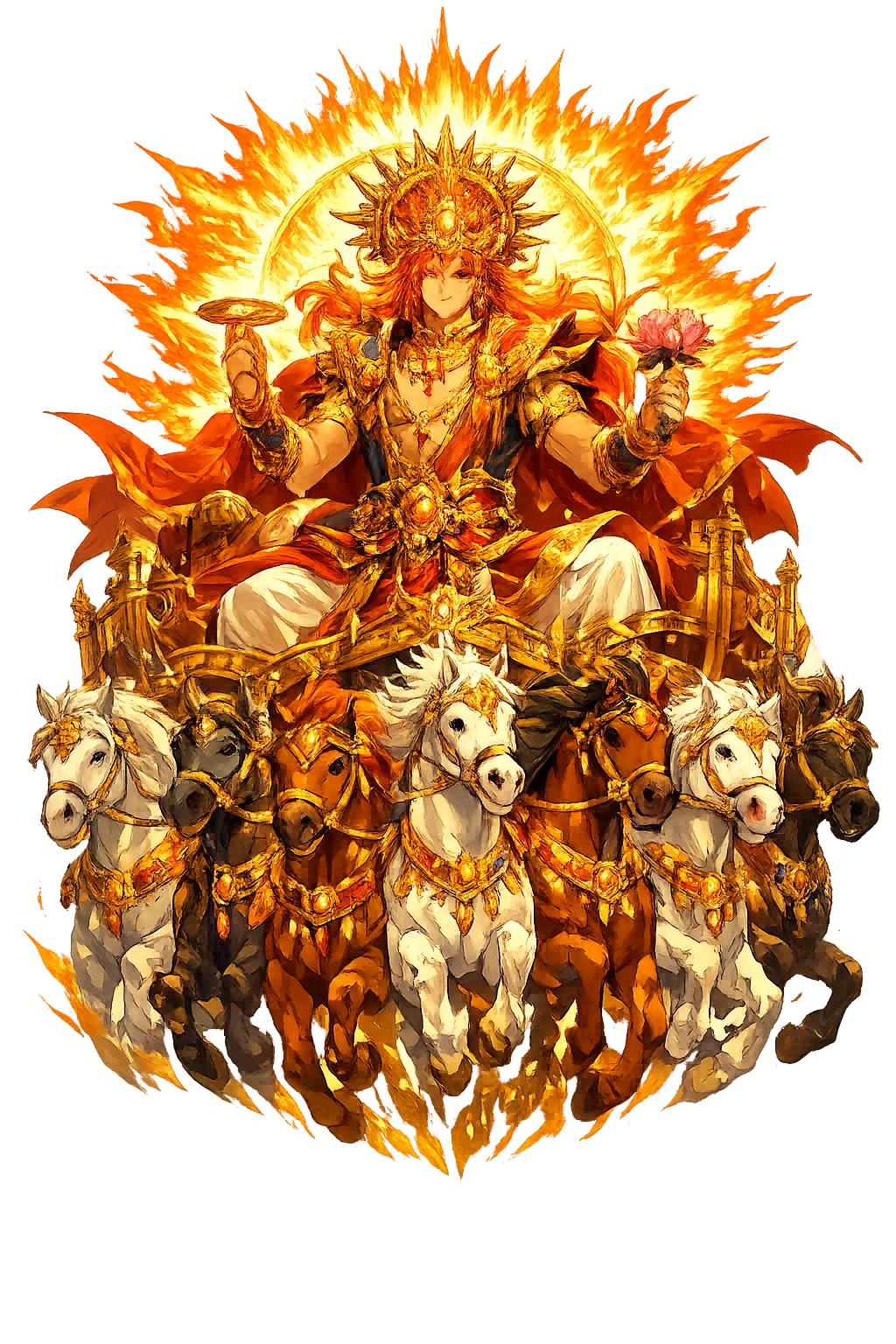
Sūrya is the sun not merely as a heavenly body but as the all-seeing eye of the cosmos. In the Ṛgveda he rises on his chariot, drawn by seven horses, and crosses the sky as the witness of every deed. He is the healer who drives away disease, the king who traverses the realms, and the hidden friend who sees what mortals do in secret.
His cult produced some of the most magnificent temples and rituals in South Asia, from the sandhya prayers performed at dawn and dusk to the great solar observatories of Jaipur and Delhi. Where other gods fade into myth, Sūrya remains tangible: every sunrise is his epiphany.
He rides across heaven in a chariot drawn by seven horses, representing the days of the week or the colors of light.
The sun removes darkness literally and metaphorically; his gaze is health, truth, and moral witness.
Twice-daily prayers at sunrise and sunset align the worshipper with the sun's renewing passage.
The sun governs the year, the seasons, and the ritual calendar; his movement is the clock of dharma.
Stories of Sūrya
Sūrya's mythology is woven through the Vedas, epics, and Purāṇas. He is both a natural force and a divine person, the father of heroes and the relentless witness whose presence makes ethics possible.
Ṛgveda 1.50 hymns Sūrya as the god who travels on a chariot yoked by the Aśvins, with swift horses and a golden seat. He is the eye of Mitra and Varuṇa, the spy of the whole world, the remover of darkness and the bringer of light. His rising is a daily renewal of cosmic law, and his rays are compared to arms stretched out over the earth.
The monkey king Sugrīva, Rāma's ally in the war against Rāvaṇa, is born from Sūrya. This solar lineage gives him the speed, brightness, and royal dignity that make him indispensable to Rāma's campaign. It also reflects a broader pattern: Sūrya's children — Sugrīva, Yamarāja, the Aśvins, and Karṇa — are marked by energy, justice, or sacrifice.
Karṇa, the tragic hero of the Mahābhārata, is Sūrya's son by the unwed Kuntī. Born with golden armor and earrings that made him invincible, he was abandoned by his mother and raised by a charioteer. His loyalty to the Kauravas, his generosity, and his eventual death at Arjuna's hands make him one of the most moving figures in the epic, a son of the sun destroyed by the very radiance that marked him.
Sūrya teaches that witnessing is a form of love. The sun does not judge; it simply sees, and in seeing, it makes life possible. Every secret act is held in its light, every shadow defined by its presence.
Enter Extended Lore