PuniCodex

Extended Lore

सूर्य Sūrya

Etymology · Phonology · Orthography · Cultural Legacy · Primary Sources

Tier 1 Sūrya.com
Sūrya — Sun, Light, Health
01

Quick Facts

Essential information about Sūrya, Sun, Light, Health

Original Scriptसूर्य
Unicode RestorationSūrya
Reconstructed Pronunciation/ˈsuːr.jə/
PantheonSanskrit
DomainSun, Light, Health
Meaningthe sun or its deity (in the Veda the name Sūrya is generally distinguished from Savitṛ [q.v.], and denotes the most concrete of the solar gods, whose connection with the luminary
ClassificationTier 1
Primary DomainSūrya.com
Sacred SymbolsSeven horses, Lotus, Chariot and wheel (cakra), Ruby and gold, The lotus of the heart (hṛdaya padma)
02

Etymology & Word Family

From original script to Unicode restoration

Original Script सूर्य Sūrya — "the sun or its deity (in the Veda the name Sūrya is generally distinguished from Savitṛ [q.v.], and denotes the most concrete of the solar gods, whose connection with the luminary"
Unicode Restoration Sūrya Restored stress, length, and script
Modern ASCII surya Plain-ASCII fallback

Sūrya is Tier 1 because the initial ū is long. In Vedic usage, Sūrya is the visible disk of the sun, while Savitṛ is the sun as the power that impels sacrifice and life.

03

Unicode Character Breakdown

Character-by-character philological analysis

CharacterUnicodeNameBlockPhonetic Role
SU+0053Latin Capital Letter SBasic LatinSame
ūU+016BLatin Small Letter U with MacronLatin Extended-AMacron: long /uː/
rU+0072Latin Small Letter RBasic LatinSame
yU+0079Latin Small Letter YBasic LatinSame
aU+0061Latin Small Letter ABasic LatinShort /a/

The Tier 1 classification reflects which ancient features stress, length, or script are preserved in this restoration.

04

Cultural Significance

From ancient cult to modern Unicode

Ancient Domain

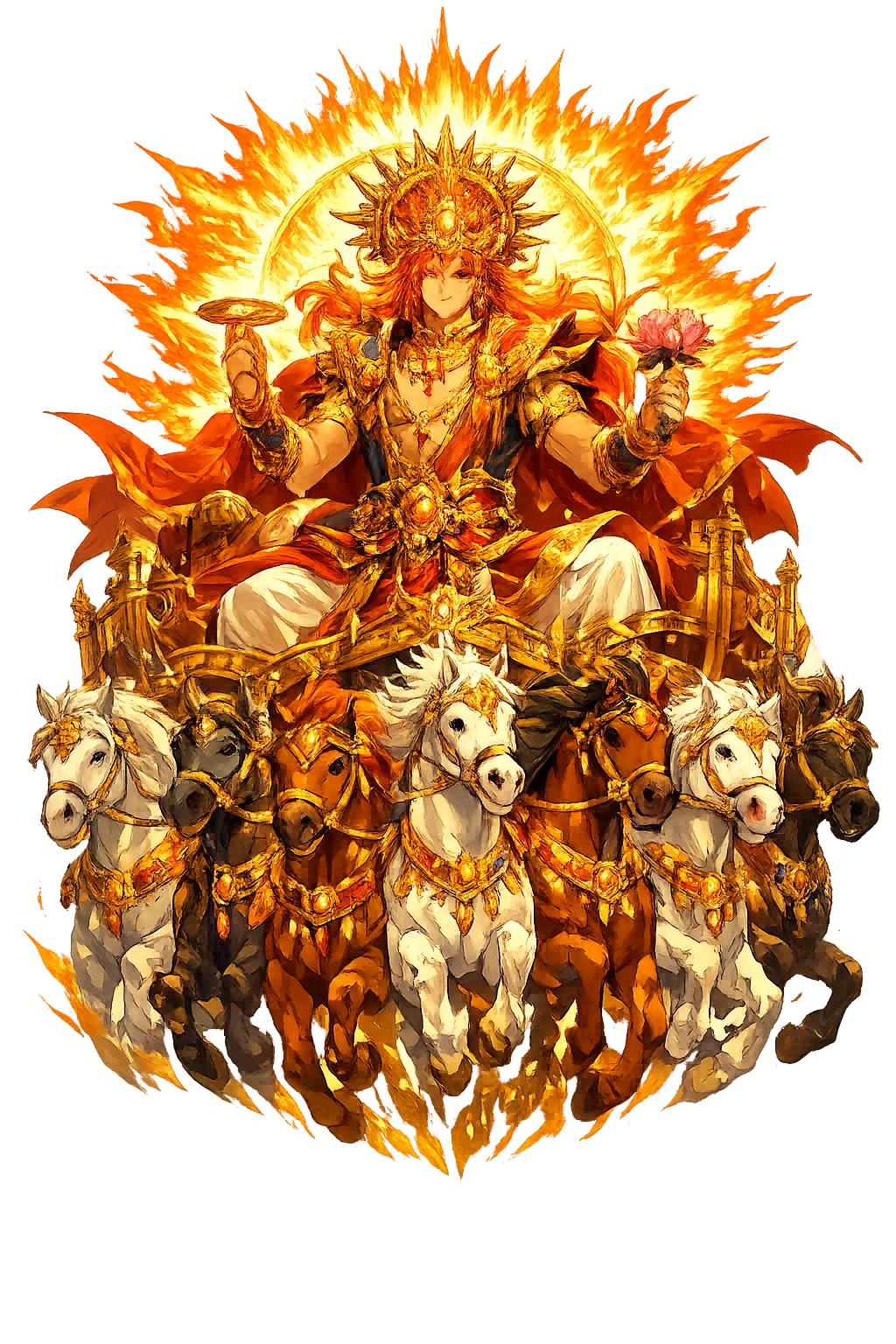
Sūrya is the sun not merely as a heavenly body but as the all-seeing eye of the cosmos. In the Ṛgveda he rises on his chariot, drawn by seven horses, and crosses the sky as the witness of every deed. He is the healer who drives away disease, the king who traverses the realms, and the hidden friend who sees what mortals do in secret.

His cult produced some of the most magnificent temples and rituals in South Asia, from the sandhya prayers performed at dawn and dusk to the great solar observatories of Jaipur and Delhi. Where other gods fade into myth, Sūrya remains tangible: every sunrise is his epiphany.

Sūrya in Later Traditions

Sūrya was one of the few Vedic gods to retain and expand his worship into the medieval and modern periods, perhaps because the sun itself is impossible to demote. He absorbed Persian and Hellenistic solar imagery after the Indo-Greek and Kushan periods, and his iconography shows clear Greco-Roman influence in the boots, tunic, and royal attributes of classical Sūrya images. In Southeast Asia, the sun god appears in Cambodian and Javanese temple art, while in India the Saura tradition became one of the major religious streams. The Japanese Amaterasu, the Egyptian Rꜥ, and the Iranian Mithra are distant cousins in the broader ancient Near Eastern and Eurasian solar cult, though Sūrya's specific Vedic roots and his association with chariot, lotus, and healing mantras are distinctively Indic.

Modern Legacy

Sūrya remains central to Hindu daily life. The Gāyatrī mantra, addressed to Savitṛ, is recited by millions at dawn; sūrya namaskāra, the sun salutation, is practiced in yoga classes worldwide. Sun temples such as Konark in Odisha and Modhera in Gujarat stand as architectural masterpieces of solar worship, while the Jantar Mantar observatories in Jaipur and Delhi translate his movement into monumental geometry. In Ayurveda and traditional medicine, sunlight is a healing force, and the sun's position determines auspicious moments (muhūrta) for every important undertaking. The name Sūrya is common across South Asia, and the sun continues to symbolize clarity, justice, and vital energy in popular culture.

Unicode Restoration as Cultural Act

Restoring Sūrya in a domain name is more than orthographic accuracy. It is a statement that the internet should recognize the full range of human writing — not only the ASCII keyboard.

05

Frequently Asked Questions

Common questions about Sūrya, Sun, Light, Health, and Unicode restoration

01How do you pronounce Sūrya?

In reconstructed pronunciation, Sūrya is /ˈsuːr.jə/ — approximately 'SOO-ryuh' — hold the first syllable long and bright, as in 'sue' stretched out; the final 'yuh' is quick..

02What does Sūrya mean?

Sūrya means the sun or its deity (in the Veda the name Sūrya is generally distinguished from Savitṛ [q.v.], and denotes the most concrete of the solar gods, whose connection with the luminary in the sanskrit tradition.

03What are the symbols of Sūrya?

Sūrya is associated with Seven horses (The steeds of Sūrya's chariot, often identified with the seven days or the seven meters of Sanskrit verse), Lotus (The sun rising from the lotus, a symbol of emergence, purity, and renewal), Chariot and wheel (cakra) (The vehicle of the sun and the turning wheel of time and cosmic order), Ruby and gold (The colors and materials associated with solar radiance and kingship), The lotus of the heart (hṛdaya padma) (In yoga, the inner sun is visualized within the heart lotus, the source of vital energy).

04Why restore Sūrya in Unicode?

Plain ASCII surya strips the stress, length, and script that make the name specific. Unicode restoration returns the name to its original written dignity.

05What is the most important myth about Sūrya?

Ṛgveda 1.50 hymns Sūrya as the god who travels on a chariot yoked by the Aśvins, with swift horses and a golden seat. He is the eye of Mitra and Varuṇa, the spy of the whole world, the remover of darkness and the bringer of light. His rising is a daily renewal of cosmic law, and his rays are compared to arms stretched out over the earth.

06

Scholarly Sources

The philological foundations of this restoration

Every claim on this page is grounded in established scholarship. The orthographic restorations follow disciplinary convention. The etymological chain follows the best available reference works. This is not invention — it is resurrection through scholarship.

Lexicography & Philology

  • MW
  • KEWA

Primary Texts

  • Ṛgveda Saṃhitā 1.50, 1.115, 7.63 (Sūrya hymns)
  • Brahmāṇḍa Purāṇa and Sūrya Purāṇa

Archaeology & Art History

  • Material evidence — iconography, inscriptions, and temple archaeology — for Sūrya and related cults.
  • Images of Sūrya are among the most widespread in Indian art, from Kushan-period statuary showing Greco-Roman influence to the colossal chariot temple at Konark (13th century CE). The sun temple at Modhera (Gujarat) and the Martand temple in Kashmir preserve elaborate sculptural programs of solar mythology. Copperplate inscriptions and land grants frequently invoke Sūrya, and his cult was particularly strong in Odisha, Gujarat, Rajasthan, and Kashmir. The Jantar Mantar observatories in Jaipur and Delhi, built by Jai Singh II in the 18th century, are late but spectacular expressions of the royal interest in solar measurement.

Religious Studies

  • Mahābhārata, Karṇa Parvan (birth and death of Karṇa)
  • Rāmāyaṇa, Kiṣkindhākāṇḍa (Sugrīva's alliance with Rāma)
  • Gonda, The Vedic God Mitra-Varuṇa and Sūrya
  • Kramrisch, The Presence of Śiva (on solar iconography)
  • Williams, The Art of Gupta India: Empire and Province
Return

The Surface Awaits

You have traced the name from its earliest attestation to its Unicode restoration. Now return to the myth. The story is where the name lives.

Back to Lore
Sūrya mascot