
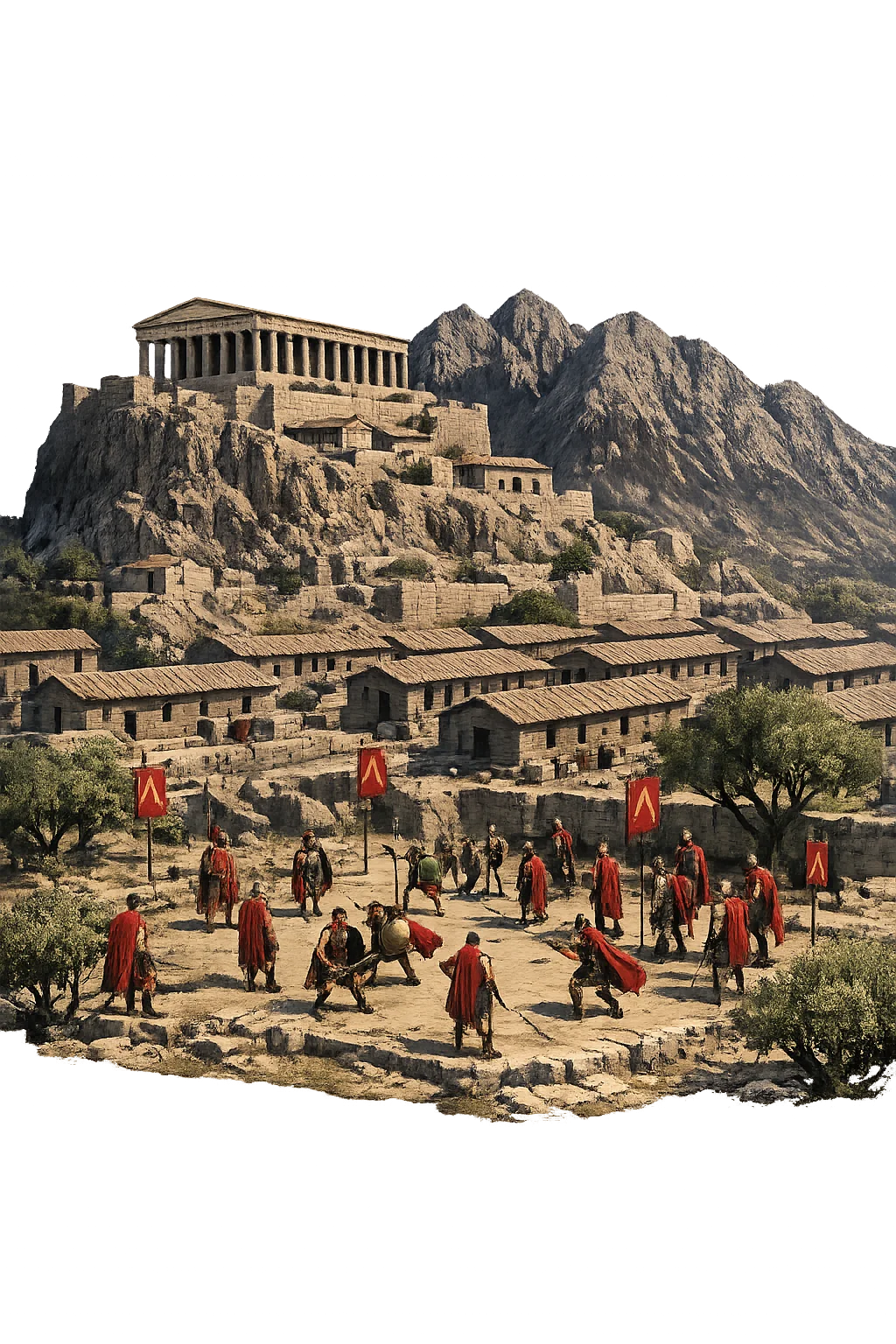
Why defense, military & security keeps re-telling the story of Spártē
Archetypes are not metaphors; they are job descriptions written early. Spártē's was unusually clear.
Spártē is the warrior city of the southern Peloponnese, but Greek myth gives it a human namesake as well. Sparta is the daughter of the river-god Eurotas and the wife of Lacedaemon, the son of Zeus; through her, the city receives both its name and its mythic charter. The Spartans themselves traced their institutions back to the legendary lawgiver Lycurgus, who was said to have received their constitution from Delphi.The city's military ethos left a deep mark on Greek literature. Tyrtaeus of Sparta composed marching songs and elegies that made civic death in battle the highest virtue, while Xenophon's Constitution of the Lacedaemonians marveled at the agoge, the state upbringing that shaped boys into soldiers. For all its austerity, Spartan myth also preserved a strong ritual current: the Gymnopaediae and Hyacinthia drew worshippers from across Laconia and kept Apollo and the dead hero Hyacinthus at the center of civic identity. Sparta's dual kingship, gerousia, and ephorate formed a constitution admired by philosophers from Herodotus to Polybius. Its austere civic ethic produced one of antiquity's most feared armies and one of its most controversial societies. The city's decline after Leuctra did not diminish its symbolic power; Sparta became shorthand for military discipline and civic sacrifice.
The pattern atlas — which maps every flagship temple to the industries its archetype demonstrably resonates with, each match argued and open to challenge — seats this temple in 5 industries. This file reads those seats the way they were earned: through the myths.
At a Glance
- Temple: Spártē
- Pantheon: Greek-location
- Domain of influence: Warrior City
- Pattern seats: 5
- Sectors touched: Commerce & Governance · Culture & Entertainment
- Strongest seat: Defense, Military & Security
- Series: The Resonance Files, No. 227 of 271
The Myth at Work
Sparta and Lacedaemon. The river Eurotas had a daughter named Sparta, beautiful and vigorous. Lacedaemon, son of Zeus and Taygete, came to Laconia and married her, uniting two divine lineages. — hold that image; the industries below are where it goes to work.
Lycurgus and the Delphic Oracle. The Spartans attributed their distinctive customs to Lycurgus, a semi-legendary lawgiver of the eighth or seventh century BCE. Herodotus and Xenophon report that Lycurgus traveled to Delphi and received the oracle's approval for his reforms. — that is not just a story. It is a business model, four thousand years early.
The Seats
Each of these is argued in the atlas with a weight and a why-line. What the atlas cannot fit in one line is the whole myth — so here is each seat with its story restored.
Defense, Military & Security
Defense contracting, security services, and strategic studies. (Sector: Commerce & Governance)
The warrior city; the adjective “spartan” still brands discipline. Swap the costume and the sentence is indistinguishable from the myth. That is what a resonance seat means.
Leadership, Governance & Public Administration
Government, executive leadership, and statecraft. (Sector: Commerce & Governance)
Dual kings, gerousia, and ephorate; the mixed constitution studied from Polybius onward. Swap the costume and the sentence is indistinguishable from the myth. That is what a resonance seat means.
Legal, Justice & Compliance
Law, courts, and regulatory compliance. (Sector: Commerce & Governance)
Lycurgus brought her laws from Delphi; legislation itself is the city's founding myth. Swap the costume and the sentence is indistinguishable from the myth. That is what a resonance seat means.
Sports, Fitness & Competition
Athletics, fitness brands, and competitive leagues. (Sector: Culture & Entertainment)
The agoge forged the citizen-athlete; obstacle races still trade on her name. — the atlas stops there, out of discipline. The myth keeps going: the function Spártē performs in the stories is precisely the function this industry sells.
Travel, Tourism & Place Branding
Destinations, heritage tourism, and city branding. (Sector: Culture & Entertainment)
The warrior city; heritage tourism with a laconic brand. Swap the costume and the sentence is indistinguishable from the myth. That is what a resonance seat means.
Read the myth again after the seats and it stops sounding ancient: Spártē is the warrior city of the southern Peloponnese, but Greek myth gives it a human namesake as well. The age changed. The work did not.
The Method, Stated Plainly
None of this is numerology. A seat exists only where the match can be argued from the deity's documented domains and deeds — weighted, published, and falsifiable. The full derivation, the weights, and the challenge process are public on the methodology page. If a seat in this file reads wrong, the atlas itself tells you how to prove it — and the correction becomes part of the record.
For the Ones Who Work There
If you work in defense, military & security, leadership, governance & public administration, or any trade this temple holds a seat in, this is the honest version of what a placement means: your industry beside the story it has been re-telling all along — on the temple floor itself, before an audience that came specifically to read it. The patron tier and the advertising terms describe the mechanics; the resonance above describes the fit. The story is the pitch; the seats are just where it already works.
The File Continues
This is one of 271 Resonance Files — the third dispatch from every flagship temple, where the myths meet the markets. The temple's founding dispatch tells the name's story; its Restoration File tells the spelling's; the blog index holds the whole archive.
Continue the series — previous: Šəlōmōh (read it) · next: Sphínx (read it).
The Resonance Files are argued from the same canonical record as the pattern atlas itself: the lexicon, the lore catalog, and the cited sources. Every seat can be challenged at the methodology page — and the challenge is the point.