The Authentic Orthography
Virtue, Devotion, Fertility · The Daughter of the Furrow
Unicode restoration and ASCII comparison
सीता
The name in its original Sanskrit form. Sītā (सीता) is attested in the source tradition — “a furrow, the track or line of a ploughshare (also personified, and apparently once worshipped as a kind of goddess resembling Pomona; in RV. iv, 57, 6”. Its macron-length vowels carry the full phonetic and orthographic weight of the source tradition.
sita
Reduced to plain sita, the name loses everything that made it specific: macron-length vowels. What remains is an ASCII string that machines can parse but that no longer speaks with its original voice.
Sītā
The Unicode restoration recovers what ASCII flattened. Sītā restores macron-length vowels, returning the name to its original written dignity. The domain encodes to Punycode, but the browser displays the truth.
Sītā.com → xn--st-ela0o.com
The non-ASCII characters in Sītā are encoded while the ASCII remains visible. To the DNS, it is Punycode. To humanity, it is Sītā.
How Sītā travels from ancient script to the modern URL
How Sītā was spoken
Devotion, Exile, Trial, and the Opened Earth
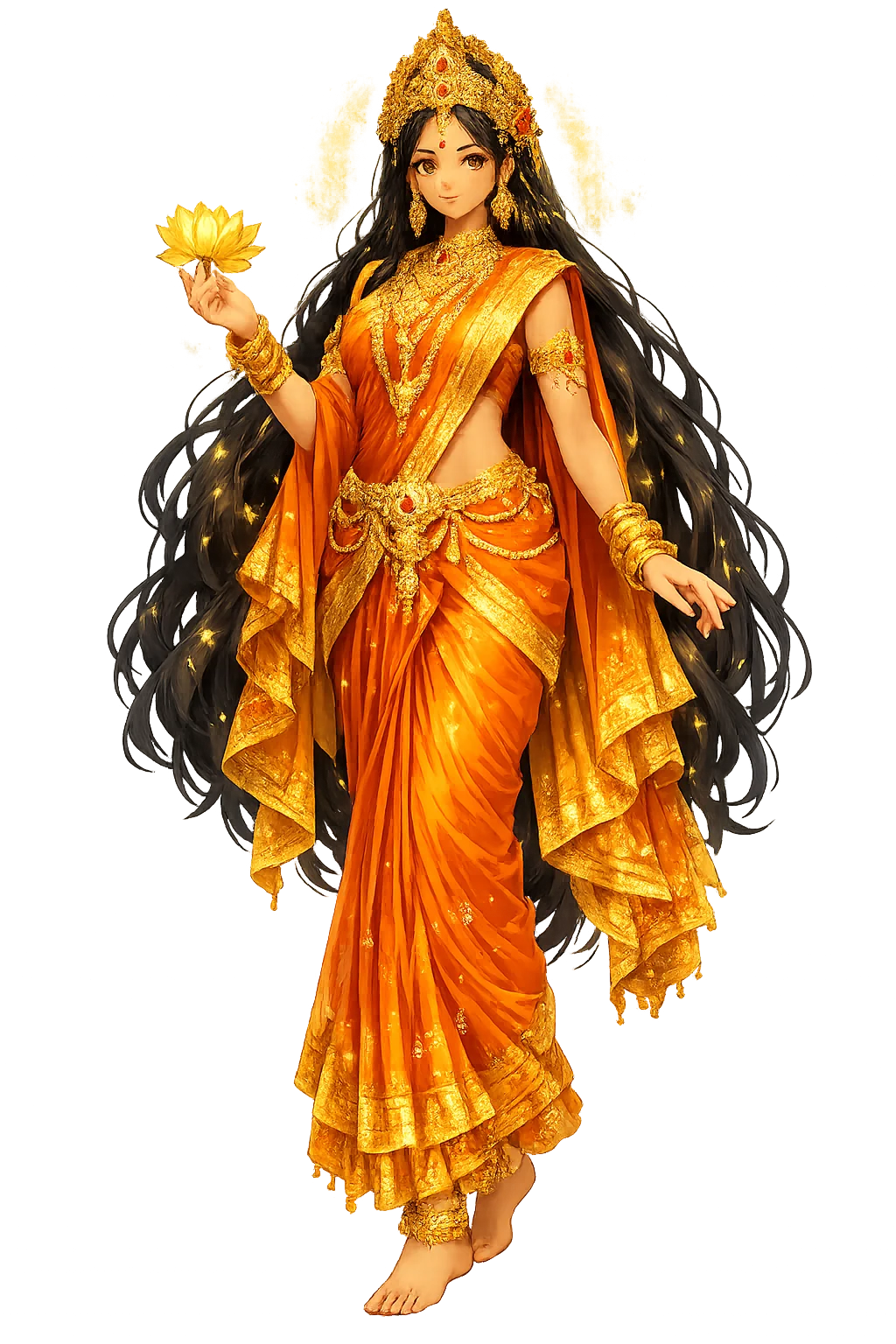
Sītā is the epic of India told from its quiet center: the furrow-born princess whose abduction sets the Rāmāyaṇa in motion, whose fidelity survives fire, and whose final return is not to her husband but to the earth that bore her. She is virtue tested past every reasonable limit — and found whole.
King Janaka found her in the plough-line of a sacrificial field — the earth's own child, named for the cut in the soil.
The agni-parīkṣā: the trial by fire she walked into to prove what everyone watching already knew.
Fourteen years in the forest, the abduction to Laṅkā, the second exile while pregnant — endurance as biography.
Her answer to the second doubt: the earth opens, and the daughter of the furrow goes home.
Stories of Sītā
The Rāmāyaṇa calls itself Rāma's story, but its moral engine is Sītā: every choice that matters is measured against her.
King Janaka of Mithilā, ploughing a sacrificial field, struck something that was not stone: an infant in the furrow, whom he named Sītā — "furrow" — and raised as his daughter. Earth-born, not womb-born, the texts insist: her mother is the field itself, and the Rāmāyaṇa's most beloved heroine begins as a gift of agriculture. Her marriage to Rāma follows the bow of Śiva that only he could string.
In the forest of Daṇḍaka, during the fourteen-year exile, the demon Mārīca became a golden deer to draw Rāma from her side, and Rāvaṇa came as a wandering ascetic. She crossed the line — the lakṣmaṇa-rekhā drawn for her protection — only to give alms, and was carried through the sky to Laṅkā. A year in the Aśoka grove, under guard, refusing a king: the epic's center of gravity is her refusal.
Rescued after the war, she was met not with embrace but with doubt, publicly, before the armies. Sītā's answer was the fire: she walked into the flames, and Agni himself bore her out unburned, declaring her purity to the three worlds. The Rāmāyaṇa's hardest scene is also its most debated — every generation of India has argued whether the test was justice or injury, and the arguing is the point.
Years later, crowned and pregnant, she was exiled again on a rumor — and raised her twin sons in Vālmīki's hermitage. When Rāma finally came for her and asked one more public proof, she asked the earth instead: "If I have been faithful, open for me." The ground split, a golden throne rose, and the daughter of the furrow descended into the earth that bore her — the epic's most devastating line, and its most quoted.
Sītā's story is the oldest case study in the difference between being good and being believed. She is proven right every time — by fire, by gods, by the earth itself — and the proving never stops being demanded. Her final answer is the only one that ends the asking: not another proof, but a refusal to be measured again. The furrow closes over her, and the field goes on feeding everyone — which is what the earth, all along, was trying to say.
Enter Extended Lore