
Why Śiva belongs in your address bar
Every address bar is a choice. When you type Śiva, you are not typing a novelty; you are restoring a name that the early DNS, built for English typewriters, could not carry. The plain ASCII form shiva is a leftover of that constraint, not the name itself. This post is the long version of the restoration: where the name comes from, how the Devanagari tradition wrote it, how it is pronounced, what the myths and the material record preserve, and why its Unicode form now lives as a working domain. The claim throughout is simple — the original spelling is not decoration. It is the name.
At a Glance
- Restored name: Śiva
- ASCII form: shiva
- Meaning: "The auspicious one; the deity of destruction, transformation, and regeneration, the third member of the Hindu Trimūrti alongside Brahmā and Viṣṇu."
- Domain of influence: Destruction, Transformation, Dance
- Pantheon: Sanskrit
- Classification: Tier 2
- Original script: शिव (Devanagari)
- Live domain: śiva.com
Overview
Śiva (Sanskrit शिव, 'the auspicious one') is one of the principal deities of Hinduism, reckoned in the later Trimūrti scheme as destroyer and transformer alongside Brahmā the creator and [[vishnu|Viṣṇu]] the preserver. His cult descends from the Vedic Rudra, the feared archer of the Ṛgveda, whose propitiatory epithet śivá ('kindly, auspicious') hardened over centuries into the god's proper name; by the Śvetāśvatara Upaniṣad, Rudra-Śiva is hymned as the one supreme lord of all beings. His mythology binds apparent opposites — ascetic and householder, destroyer and healer, cremation-ground wanderer and cosmic dancer — into a single figure whose worship now extends across South Asia and the global Hindu diaspora.
PuniCodex restores the name as Śiva and serves its temple at śiva.com. The acute accent on Ś marks the palatal sibilant [ɕ] of the Sanskrit original; because Sanskrit accentuation is pitch-based and unwritten, this single preserved feature places the name in Tier 2. The plain ASCII form shiva is a modern convention of the early domain-name system, not an ancient spelling.
The Name
The name is attested in Devanagari as शिव. Etymologically it means "The auspicious one; the deity of destruction, transformation, and regeneration, the third member of the Hindu Trimūrti alongside Brahmā and Viṣṇu.".
The reconstructed proto-form is śi- (proto-indo-european, "to be auspicious, kind"). From Sanskrit Śiva "the auspicious one", from śiv- "kind, gracious". The destroyer/transformer.
The ASCII form shiva survives only because the early domain-name system could not carry diacritics; it is a technological compromise, not an ancient spelling. The Unicode restoration Śiva recovers the full diacritic detail of the scholarly transliteration directly in the address bar. The original preserves one prosodic feature — stress or vowel length — rather than both, which places the name in Tier 2.
The letter-by-letter transformation runs:
- s → Ś — S-acute: palatal /ɕ/
- h → — — Dropped: digraph simplified
- i → i — Short /i/
- v → v — Same
- a → a — Short /a/
Attested and derived spellings of the name:
- Siva — alternate stress, scholarly variant: Alternate transliteration: Siva
The project holds the domain śiva.com (xn--iva-bza.com) as the canonical home of this name.
Etymology & Roots
The recorded derivation reads: From Sanskrit Śiva "the auspicious one", from śiv- "kind, gracious". The destroyer/transformer.
The reconstructed proto-form is *śi- (proto-indo-european), glossed as "to be auspicious, kind".
The reconstruction is classed as attested.
The Original Script
The name is written in Devanagari as शिव. Devanagari is a Brahmic abugida — a script in which each consonant sign carries an inherent vowel — written left-to-right; it descends from Brāhmī through the Nāgarī scripts, is attested in inscriptions from about the 7th century CE, and today serves as the standard script of Sanskrit, Hindi, and Marathi.
The scholarly transliteration is Śiva (IAST), giving the normalized reading /ˈɕiːʋə/. The rendering proceeds step by step:
- Sanskrit Śiva is written शिव in Devanagari.
- The akṣaras are शि (śi) and व (va); the inherent /a/ of व is regularly dropped in connected speech (schwa deletion).
- IAST writes the palatal sibilant as ś — s with an acute accent, not a haček — corresponding to Devanagari श.
- The name means 'the auspicious one', an epithet that rises from Vedic Rudra to become one of the supreme deities of Hinduism.
Pronunciation
The reconstructed pronunciation of the name is /ˈɕi.ʋə/ — Sanskrit Reconstruction.
Phoneme by phoneme:
- Śi- — Voiceless palatal fricative [ɕ], like an extra-hissing 'sh', plus short close front [i]; Śiva means 'the auspicious one'
- -va — Voiced labiodental approximant [ʋ] — softer than English 'v' — plus short open [a]
For the modern speaker, the closest approximation is: 'SHEE-vuh' — the first consonant is a sharp, high 'sh' made with the tongue near the hard palate, and the 'v' is light, almost like a 'w'.
Kindred and historical forms of the name:
- Sanskrit — शिव (śiva), 'auspicious, kind, gracious', the adjective from which the god's name derives
- Tamil — சிவன் (Civaṉ), the Dravidian rendering of the deity
- Pali — siva, the Middle-Indic form used in Buddhist texts
Śiva is Tier 2: the acute on Ś marks the palatal sibilant [ɕ], a sound distinct from both English 'sh' and Sanskrit retrophalatal ṣ. Sanskrit stress is pitch-accent based and not marked here; the acute is used to flag the palatal character of the initial sibilant.
Mythology
Śiva's mythology is among the most philosophically ambitious in the Sanskrit tradition. He is not merely a destroyer but the principle of transformation itself: the dancer whose final gesture dissolves a weary cosmos, the ascetic whose inner heat saves the gods from poison, and the householder whose marriage to the mountain-goddess reunites withdrawal and engagement. His stories move between Himalayan forest and cremation ground, bridal chamber and battlefield, teaching that creation and destruction are phases of a single rhythm. Every major strand of Hindu text — Vedic hymn, Upaniṣadic meditation, Purāṇic narrative, and Tamil devotional poetry — returns to him as both absolute beyond and intimate lord. Śiva's worship spread from the subcontinent to Southeast Asia, Tibet, and the diaspora, producing distinct regional forms. Tamil poets, Kashmiri philosophers, and Nepalese tantric communities all shaped his cult. Today he is one of the most widely recognized Hindu deities, his image meditating in bronze, stone, and film across the global Hindu world.
The Blue-Throated Savior (Samudra Manthan)
When the gods and demons churned the cosmic ocean in search of amṛta, the elixir of immortality, the first thing to rise was not nectar but Halāhala, a poison black enough to scorch every world. Creation began to suffocate. The gods fled to Śiva, who sat motionless on Kailāsa. Without hesitation he took the poison into his palm and drank it. Pārvatī pressed her hands against his throat to keep the toxin from descending, and it burned there forever, turning his neck blue. From that day he has been called Nīlakaṇṭha, the Blue-Throated One, the god who absorbs destruction so that life may continue.
The Archer of the Three Cities (Tripura)
The three demon cities of Tripura — golden, silver, and iron — rolled through heaven, earth, and the underworld, protected by a single shared moment of vulnerability. Their tyrant inhabitants mocked the gods and upset the order of the worlds. Śiva agreed to destroy them, but only after the gods had first earned the merit to deserve such an intervention. He climbed his chariot, made of the earth itself, with Brahmā as driver and Mount Mandara as bow. He bent the bowstring until it touched his ear, then released a single arrow at the exact conjunction when all three cities aligned. The missile flashed like a smile and the cities burned, restoring cosmic balance.
The Marriage of Śiva and Pārvatī (Devotion)
After the death of his first wife Satī, Śiva withdrew into severe asceticism on the mountain, draped in ash and serpents, indifferent to the world. The gods grew anxious: without a wife he would have no son to lead them against the demon Tāraka. The Himalayan princess Pārvatī, Satī reborn, resolved to win him through her own ascetic power. She fasted, stood in snow, and repeated his name until the mountain itself shuddered. One morning Śiva appeared before her disguised as an old Brahmin, testing her devotion with harsh words. Pārvatī did not waver. He revealed himself, accepted her, and their wedding became the model of every sacred marriage in the Hindu imagination — the union of stillness and energy, ascetic and king.
The Ganges in Śiva's Hair (Devotion)
When King Bhagīratha sought to bring the celestial Gangā down to purify the ashes of his ancestors, the river's descent was so violent it threatened to shatter the earth. Bhagīratha prayed to Śiva, who caught the falling torrent in his matted locks and released it in measured streams. This act of controlled descent revealed Śiva as the one who receives cosmic force without being overwhelmed, turning destructive flood into life-giving river. Pilgrims have honored him as Gangādhara ever since.
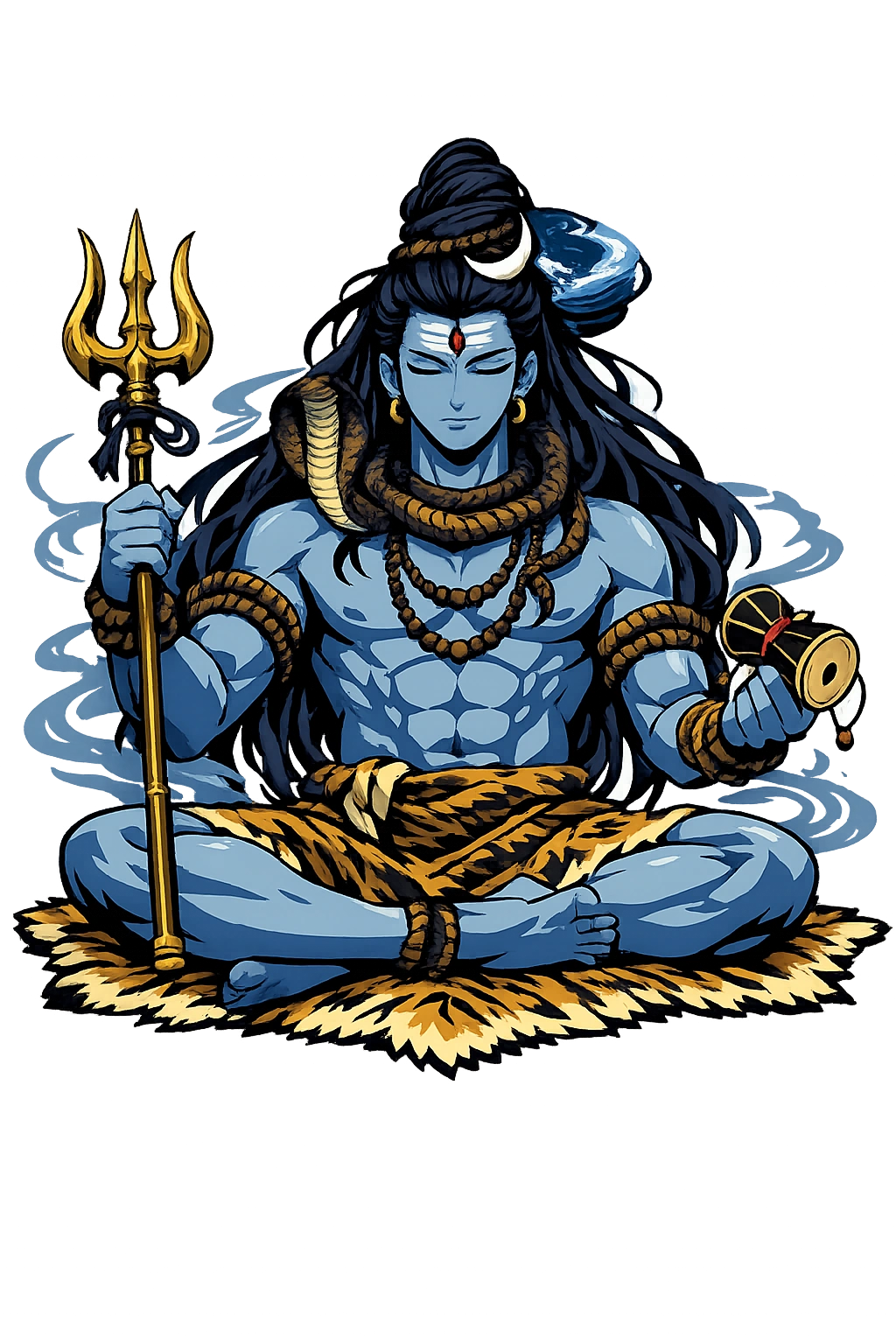
Symbols & Iconography
Śiva's iconography is among the most stable in Hindu art; its core attributes are codified in the medieval iconographic manuals (śilpaśāstra) and are already visible in Kuṣāṇa-period sculpture.
- Trishula (triśūla) — the three-pronged weapon inherited from his Vedic ancestor Rudra; later exegesis reads the prongs as the three guṇas (sattva, rajas, tamas) over which he is lord.
- Damaru drum — the hourglass drum (ḍamaru) whose beat sounds the rhythm of creation and dissolution; in the Naṭarāja bronze he carries it in an upper hand.
- Third eye — the vertical eye of wisdom on his forehead, which burned the love-god Kāma to ash when he disturbed the god's meditation — hence Kāma's epithet Anaṅga, 'the bodiless'.
- Nandi bull — his vehicle (vāhana) and gatekeeper, the white bull of dharma, seated facing the liṅga in every Śaiva temple.
- Rudrākṣa beads — the 'Rudra-eyed' seeds worn by his devotees, whose sectarian myth derives them from Rudra's own eyes.
Archaeology & Evidence
The material record for Śiva's cult reaches from possible prehistory to monumental stone. The famous 'Paśupati seal' from Mohenjo-daro (c. 2500–1900 BCE) — a horned figure seated in a yogic posture among wild animals — was interpreted by John Marshall as a proto-Śiva, a 'lord of animals'; the identification remains influential but is disputed, and much current scholarship treats Indus iconography as undeciphered. Securely Śaiva evidence begins with Kuṣāṇa coinage: from Vīma Kadphises onward (2nd century CE), emperors issued gold and copper coins depicting Oēšo, the Bactrian rendering of Śiva, with trident and bull. The great cave temples follow in the early medieval period: the Elephanta cave near Mumbai (6th century CE) with its colossal three-faced Sadāśiva bust, and the Kailāsanātha temple at Ellora (8th century CE), cut from the living rock under the Rāṣṭrakūṭa king Kṛṣṇa I.
Realm & Domain
Śiva's sphere of power is codified in the Sanskrit sources through a series of functional epithets, each anchored to a specific myth. The four below map the core of his cultic territory as epic and Purāṇic tradition presents it.
Nataraja
As Lord of the Dance (Naṭarāja), Śiva's cosmic tāṇḍava destroys a weary universe and prepares the ground for rebirth; the dance mythology later receives its classic visual form in the Cōla-period bronzes of Tamil Nadu.
Blue Throat
When the churning of the ocean of milk brought up the Halāhala poison before the nectar, Śiva gathered it in his palm and drank it, holding it in his throat so that it burned there and turned his neck blue — hence the epithet Nīlakaṇṭha, 'the blue-throated'.
Tripurāntaka
He burned the three demon cities of Tripura — gold, silver, and iron — with a single arrow at the one moment of their conjunction, a deed the epic already celebrates as the restoration of cosmic order.
Gangādhara
He caught the falling celestial Gangā in his matted locks at Bhagīratha's prayer and released her in gentle streams to purify the earth.
Across Cultures
Śiva absorbed and was absorbed by countless regional deities across South Asia and beyond. In Kashmir he became the focus of sophisticated monistic theology; in Tamil country he was the beloved of the Nāyaṉār poets; in Nepal and Tibet he entered tantric Buddhist pantheons as fierce protectors. Southeast Asian kingdoms from Champa to Angkor adopted Śaiva cult as a source of royal legitimacy, and his phallic liṅga became one of the most widespread aniconic emblems in Hindu worship.
Within the Sanskrit tradition, closely related names in the corpus include [[ganesha|Gaṇeśa]], [[durga|Durgā]], [[kali|Kālī]], [[lakshmi|Lakṣmī]], [[nirmata|Nirmātā]], and [[om|Oṃ]].
Cultural Legacy
Śiva's legacy is carried by living cult as much as by text. Mahāśivarātri, the 'great night of Śiva', remains one of the most widely observed festivals of the Hindu year, and the great pilgrimages — to the Amarnāth ice-liṅga in Kashmir and to Kedārnāth in the Himalaya — draw vast numbers of devotees annually. In art history the Cōla-period bronze Naṭarāja (10th–12th centuries) has become the global emblem of Indian sculpture: Ananda Coomaraswamy's essay 'The Dance of Śiva' (1918) made the image canonical for Western scholarship, and a Naṭarāja bronze now stands outside the CERN laboratory in Geneva, presented by India as an emblem of the cosmic dance of matter. Śaiva traditions also travelled early beyond the subcontinent — the Śaiva sanctuaries of Mỹ Sơn in Champa and the 9th-century Prambanan complex in Java attest state-sponsored Śaiva kingship in Southeast Asia — and diaspora communities today maintain Śiva temples from Mauritius to Trinidad. Within scholarship the name anchors entire disciplines — Śaiva Siddhānta, Kashmir Śaivism, and the Tamil bhakti corpus of the Nāyaṉārs — and the recovery of the theonym from the Vedic propitiatory epithet śivá is a textbook case of an apotropaic title becoming a god's proper name.
The Scholarly Record
The account of Śiva given in this edition rests on the witnesses and reference works listed below. Lexica and etymological dictionaries secure the form and meaning of the name; the literary and religious texts supply the narrative evidence.
- Monier-Williams, M. A Sanskrit-English Dictionary. Oxford, 1899; s.v. śiva.
- Macdonell, A. A. Sanskrit Grammar for Students. Oxford, 1916.
- Ṛgveda Saṃhitā 2.33 (Rudra hymns, the Vedic precursor of Śiva).
- Śvetāśvatara Upaniṣad 3.1–5 (Rudra-Śiva as supreme Īśvara).
- Śiva Purāṇa, Rudra Saṃhitā (birth narratives and exploits of Śiva).
- Liṅga Purāṇa 1.1–1.6 (liṅga cosmology and Śiva as cosmic pillar).
A Meditation
Śiva is the still point around which the cosmos turns. His name means auspicious, yet his dance ends worlds; his asceticism is absolute, yet he is the most devoted of husbands. He holds contradiction without resolving it, teaching that destruction is not the opposite of grace but one of its forms. The Śvetāśvatara Upaniṣad already frames him in exactly these terms: the one God hidden in all beings, all-pervading, the inner self of every creature.
To restore Śiva in Unicode is to refuse the flattening of this paradox. The diacritics are not ornaments; they are the linguistic technology that lets the name carry its full weight across time, from Vedic hymn to digital text.
The Unicode Restoration
Śiva is classified as Tier 2: the original preserves at least one philological feature that ASCII cannot encode. The ASCII fallback shiva still resolves everywhere, but it is the restored form that carries the name's full information. Across the 5 characters of the name, the restoration adjusts 2: 2 further adjustments (Ś, h). That is the whole thesis of this temple: the marks are the message.
The Domain Name
The restored name is live as a working domain: śiva.com, which the DNS carries in punycode form as xn--iva-bza.com — an ASCII-compatible encoding that lets a non-ASCII name travel the global network without breaking older infrastructure. The visitor sees Śiva; the machines see the encoding. That duality is the engineering compromise on which the entire restoration rests, and it is why a name written the way its own tradition wrote it in Devanagari can now be typed into any browser on earth.
Why This Restoration Matters
Restoring Śiva is part of a larger effort to make the web multilingual by default. The PuniCodex project does not ask users to learn a new alphabet; it asks the infrastructure to respect the alphabets that already exist. Every section of this post — the script, the sound, the myths, the evidence — converges on the same point: the marks in Śiva are information, and information deserves an address of its own. A single Unicode domain is a small proof, but it is a proof that scales: every name restored makes the next one easier, and every visit to śiva.com is a vote for the restored form.
Explore Further
This post is one doorway into the temple. The home page carries the full character breakdown and the ambient canvas; the lore page tells the myths in long form; the Scholarly Edition preserves the sources, pronunciation data, and revision history; and the patron wall supports the restoration directly. For the wider map, browse the Lexicon, explore the Pantheon, or return to the PuniCodex blog.
Related Names
Sources
The full scholarly apparatus — every citation, revision, and review — lives in the Scholarly Edition. Key references for this post:
- Monier-Williams, M. A Sanskrit-English Dictionary. Oxford, 1899; s.v. śiva.
- Macdonell, A. A., Vedic Mythology (Strassburg, 1897), chapter on Rudra.
- Flood, G., An Introduction to Hinduism (Cambridge University Press, 1996).
- Macdonell, A. A. Sanskrit Grammar for Students. Oxford, 1916.
- Lexicon authorities for this entry: MW, KEWA.