The Authentic Orthography
Knowledge, Music, Arts, Speech · The River of Eloquence
Unicode restoration and ASCII comparison
सरस्वती
The name in its original Sanskrit form. Sarasvatī (सरस्वती) is attested in the source tradition — “of the goddess of eloquence and learning (cf. above; she is opposed to Śrī or Lakṣmī [cf. Vikr. v, 24], and sometimes considered as the daughter and also wife of Brahmā”. Its macron-length vowels carry the full phonetic and orthographic weight of the source tradition.
saraswati
Reduced to plain saraswati, the name loses everything that made it specific: macron-length vowels. What remains is an ASCII string that machines can parse but that no longer speaks with its original voice.
Sarasvatī
The Unicode restoration recovers what ASCII flattened. Sarasvatī restores macron-length vowels, returning the name to its original written dignity. The domain encodes to Punycode, but the browser displays the truth.
Sarasvatī.com → xn--sarasvat-hjb.com
The non-ASCII characters in Sarasvatī are encoded while the ASCII remains visible. To the DNS, it is Punycode. To humanity, it is Sarasvatī.
How Sarasvatī travels from ancient script to the modern URL
How Sarasvatī was spoken
Speech, Learning, Music, and the Flowing Word
Sarasvatī is the only goddess the Ṛgveda hymns as both river and word: the mightiest stream of the Vedic heartland, and Vāk, Speech itself — the current on which all knowledge, music, and scripture flows. Where she moves, rivers run and verses sing.
The Vedic Sarasvatī — greater than the Indus, the hymns say — whose vanishing shaped a civilization's memory.
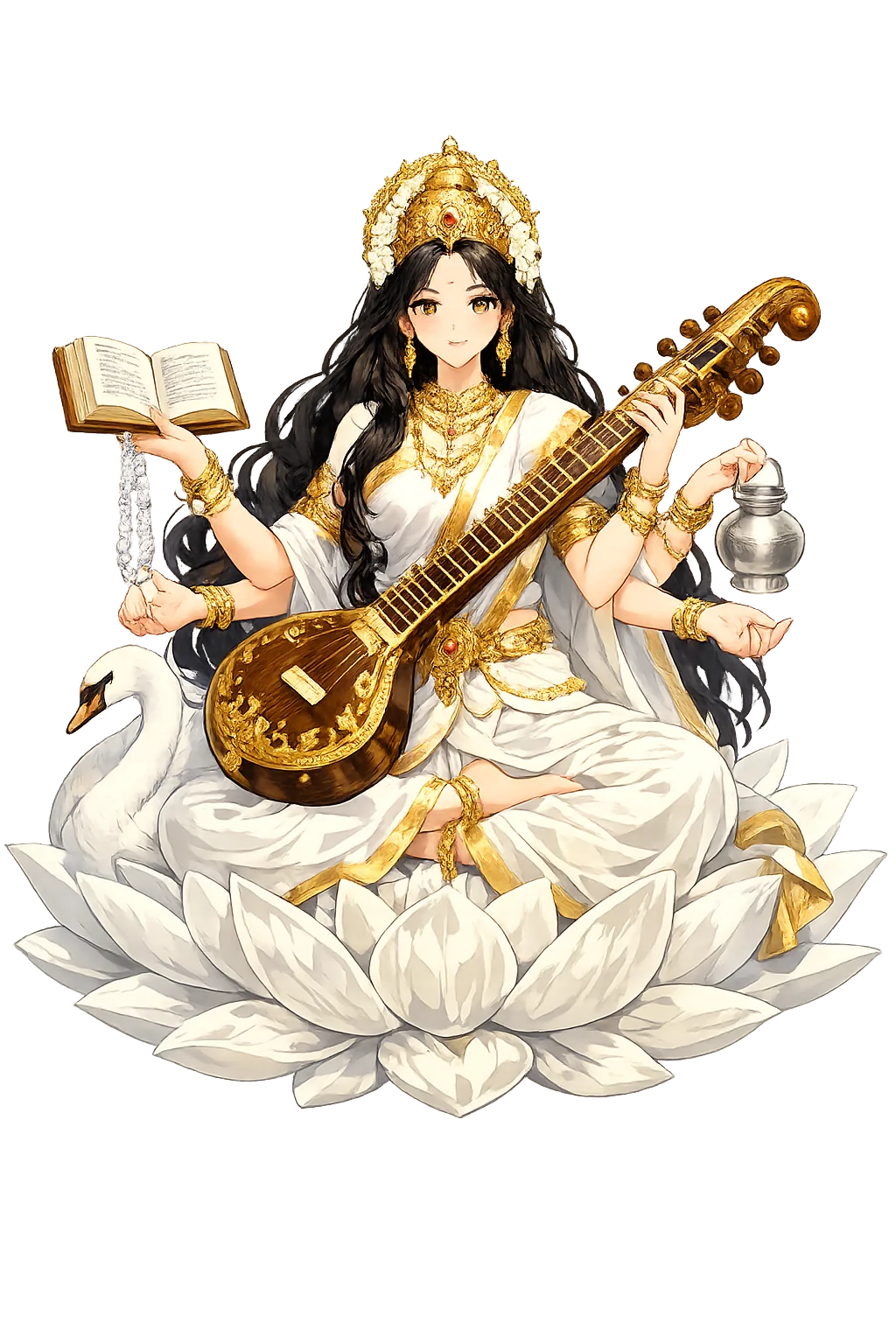
Her instrument: the stringed lute whose seven notes order all music, as her speech orders all thought.
The swan that separates milk from water — the emblem of discernment, learning's first virtue.
Speech personified: the Ṛgveda's own word for the goddess of the word, hymn 10.125.
Stories of Sarasvatī
Sarasvatī's double biography — river first, word second — is the oldest story of how a landscape becomes a mind.
The Ṛgveda hymns her as a river "surpassing all others in might": pure in her course from the mountains to the sea, mother of waters, destroyer of the Pārāvata foes. The Nadīstuti ("hymn to the rivers") names her between the Yamunā and the Śutudrī — the heartland stream of the Vedic people, invoked for wealth, descendants, and wisdom in one breath.
Ṛgveda 10.125 is her own voice: "I move with the Rudras, the Vasus, the Ādityas; I uphold Mitra and Varuṇa, Indra and Agni, the twin Aśvins. I am the queen, the gatherer of riches, the knowing — the gods established me in many places." Speech crowns herself supreme: every hymn ever sung is, by her account, her body.
Later tradition makes her Brahmā's daughter-consort — the power by which the creator speaks the world into being. When Brahmā's heads recited the Vedas, Sarasvatī was their voice; when he created, she was his śakti, the energy of formation. The iconography settles into its final form: white-robed, vīṇā in hand, book and prayer-beads, riding the discerning swan.
The Mahābhārata already knows a diminished Sarasvatī: she "loses herself" in the desert, appearing and vanishing at named fords — Vinaśana, "the place of disappearance." Later hydrography reads the myth as memory: the great river dried as its tributaries were captured by the Indus and the Ganges systems, leaving the Ghaggar-Hakra channels the Thar swallowed. The word outlived the water.
Sarasvatī is the proof that attention is a kind of water: it flows, it gathers, it carves channels in the mind that outlast the floods that made them. The river dried and the goddess did not — the word learned to flow without banks. She asks the student's oldest question: not what do you know, but what current carries it — and where, in the dry season of distraction, will you dig for the buried stream?
Enter Extended Lore