PuniCodex

Extended Lore

सरस्वती Sarasvatī

Etymology · Phonology · Orthography · Cultural Legacy · Primary Sources

Tier 1 Sarasvatī.com
Sarasvatī — Knowledge, Music, Arts, Speech
01

Quick Facts

Essential information about Sarasvatī, Knowledge, Music, Arts, Speech

Original Scriptसरस्वती
Unicode RestorationSarasvatī
Reconstructed Pronunciation/sarasvatˈiː/
PantheonSanskrit
DomainKnowledge, Music, Arts, Speech
Meaningof the goddess of eloquence and learning (cf. above; she is opposed to Śrī or Lakṣmī [cf. Vikr. v, 24], and sometimes considered as the daughter and also wife of Brahmā
ClassificationTier 1
Primary DomainSarasvatī.com
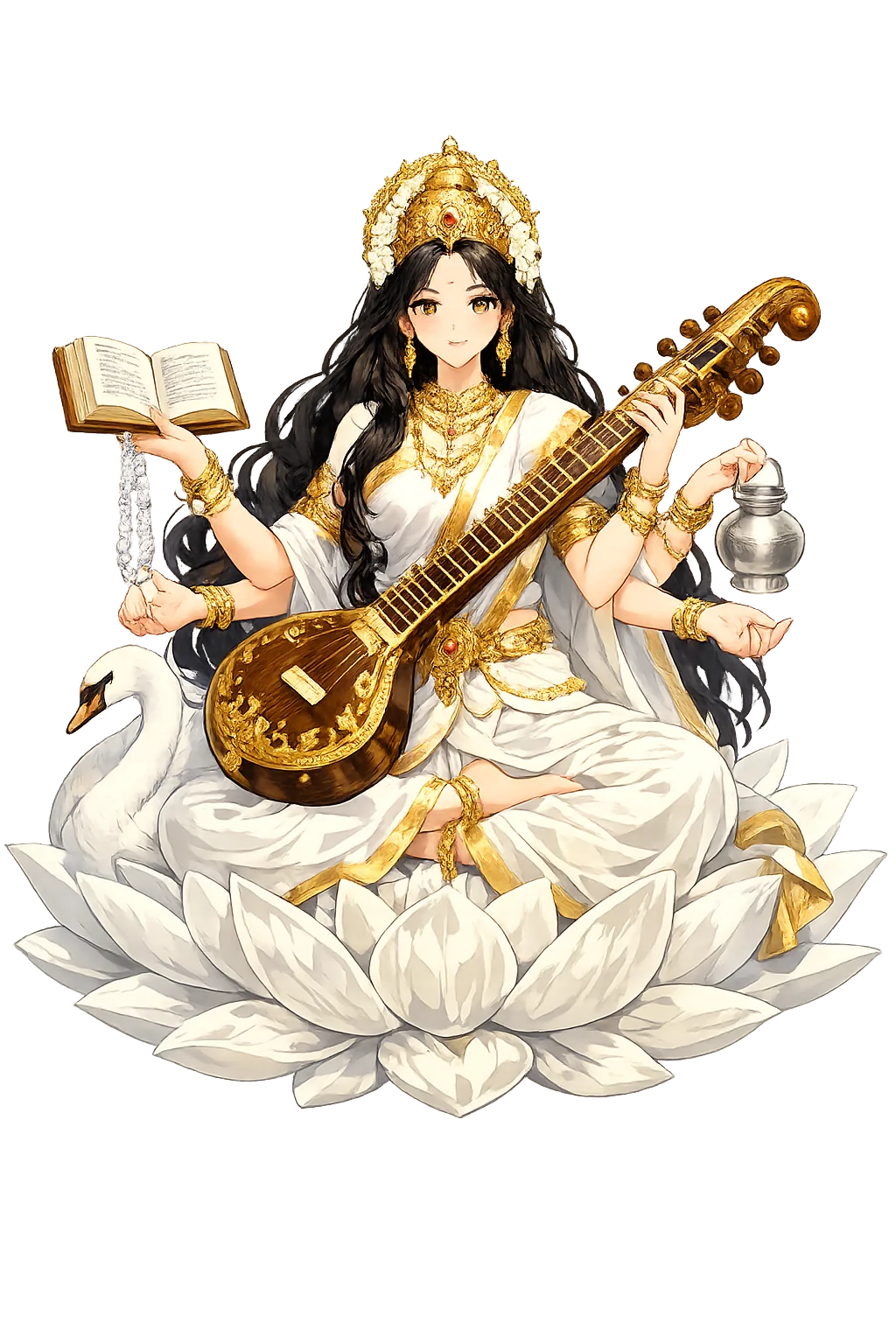
Sacred SymbolsThe white lotus, The vīṇā, The haṃsa (swan), The palm-leaf book
02

Etymology & Word Family

From original script to Unicode restoration

Original Script सरस्वती Sarasvatī — "of the goddess of eloquence and learning (cf. above; she is opposed to Śrī or Lakṣmī [cf. Vikr. v, 24], and sometimes considered as the daughter and also wife of Brahmā"
Unicode Restoration Sarasvatī Restored stress, length, and script
Modern ASCII saraswati Plain-ASCII fallback

Sanskrit sarasvatī carries three long vowels; the restoration Sarasvatī keeps all three macrons. The v of IAST is the labiodental व, which Hindi pronunciation softens toward w — hence the double life of the name as "Saraswati" in speech and "Sarasvatī" in scholarship. The IAST form is the owned one: the standard of the libraries she governs.

03

Unicode Character Breakdown

Character-by-character philological analysis

CharacterUnicodeNameBlockPhonetic Role
SU+0053Latin Capital Letter SBasic LatinSame
aU+0061Latin Small Letter ABasic LatinShort /a/
rU+0072Latin Small Letter RBasic LatinSame
aU+0061Latin Small Letter ABasic LatinShort /a/
sU+0073Latin Small Letter SBasic LatinSame
vU+0076Latin Small Letter VBasic LatinV: labiodental fricative
aU+0061Latin Small Letter ABasic LatinShort /a/
tU+0074Latin Small Letter TBasic LatinSame
īU+012BLatin Small Letter I with MacronLatin Extended-AMacron: long /iː/

The Tier 1 classification reflects which ancient features stress, length, or script are preserved in this restoration.

04

Cultural Significance

From ancient cult to modern Unicode

Ancient Domain

Sarasvatī is the only goddess the Ṛgveda hymns as both river and word: the mightiest stream of the Vedic heartland, and Vāk, Speech itself — the current on which all knowledge, music, and scripture flows. Where she moves, rivers run and verses sing.

Sarasvatī in Later Traditions

Her eastward journey is one of Asia's great religious migrations: as **Benzaiten** in Japan she became one of the Seven Gods of Fortune, goddess of music, water, and wealth, with island shrines at Enoshima and Chikubushima; in Tibet she is Yangchenma, "goddess of melody"; in Bali she is the island's tutelary of learning, with her own festival, Saraswati Day. Burmese and Thai traditions keep her as Thurathadi and Suratsawadi. The Buddhist Prajñāpāramitā literature absorbed her into the perfection-of-wisdom lineage — the river of speech becoming the ocean of insight.

Modern Legacy

She is the most actively worshipped scholar-deity on earth: Basant Panchami each spring sees hundreds of millions in yellow dress honor her with books, instruments, and the first letters children ever write (vidyā-ārambha, the "beginning of learning" ceremony). Her name brands India's largest chain of schools (Vidya Bharati), universities, and the national digital library's heritage portal. The lost river named for her drives modern archaeology and politics alike: the "Sarasvati River" debate over the Ghaggar-Hakra paleochannels is India's most contested meeting of hymn and hydrology.

Unicode Restoration as Cultural Act

Restoring Sarasvatī in a domain name is more than orthographic accuracy. It is a statement that the internet should recognize the full range of human writing — not only the ASCII keyboard.

05

Frequently Asked Questions

Common questions about Sarasvatī, Knowledge, Music, Arts, Speech, and Unicode restoration

01How do you pronounce Sarasvatī?

In reconstructed pronunciation, Sarasvatī is /sarasvatˈiː/ — approximately sah-RAH-swah-tee — the final ī long, the v soft as in verse..

02What does Sarasvatī mean?

Sarasvatī means of the goddess of eloquence and learning (cf. above; she is opposed to Śrī or Lakṣmī [cf. Vikr. v, 24], and sometimes considered as the daughter and also wife of Brahmā in the sanskrit tradition.

03What are the symbols of Sarasvatī?

Sarasvatī is associated with The white lotus (Purity of mind; knowledge unsullied by the muddy water it rises from), The vīṇā (Music as cosmic order — Nāda Brahman, the sound that is the absolute), The haṃsa (swan) (Viveka, discernment — the power to take the true and leave the rest), The palm-leaf book (The written word she guards as goddess of libraries and letters).

04Why restore Sarasvatī in Unicode?

Plain ASCII saraswati strips the stress, length, and script that make the name specific. Unicode restoration returns the name to its original written dignity.

05What is the most important myth about Sarasvatī?

The Ṛgveda hymns her as a river "surpassing all others in might": pure in her course from the mountains to the sea, mother of waters, destroyer of the Pārāvata foes. The Nadīstuti ("hymn to the rivers") names her between the Yamunā and the Śutudrī — the heartland stream of the Vedic people, invoked for wealth, descendants, and wisdom in one breath.

06

Scholarly Sources

The philological foundations of this restoration

Every claim on this page is grounded in established scholarship. The orthographic restorations follow disciplinary convention. The etymological chain follows the best available reference works. This is not invention — it is resurrection through scholarship.

Lexicography & Philology

  • MW
  • KEWA

Primary Texts

  • Rigveda

Archaeology & Art History

  • Material evidence — iconography, inscriptions, and temple archaeology — for Sarasvatī and related cults.
  • The Ghaggar-Hakra dry channels between the Yamunā and the Indus — traced by satellite (Landsat imagery of buried paleochannels) and drilled by the Geological Survey of India — are the standard candidates for the Vedic river; Harappan sites (Kalibangan, Banawali) line their banks in densities the Indus itself cannot match. Her temples are comparatively few for so great a goddess — the Sharada Peeth in Kashmir (now across the LoC), Sringeri's Sharadamba, Basara's Gnana Saraswati in Telangana, and Pushkar's shrine — because her true temple has always been the school and the library.

Religious Studies

  • Monier-Williams
  • Mahabharata
  • Puranas
  • MW
  • Macdonell
  • Cambridge
Return

The Surface Awaits

You have traced the name from its earliest attestation to its Unicode restoration. Now return to the myth. The story is where the name lives.

Back to Lore
Sarasvatī mascot