
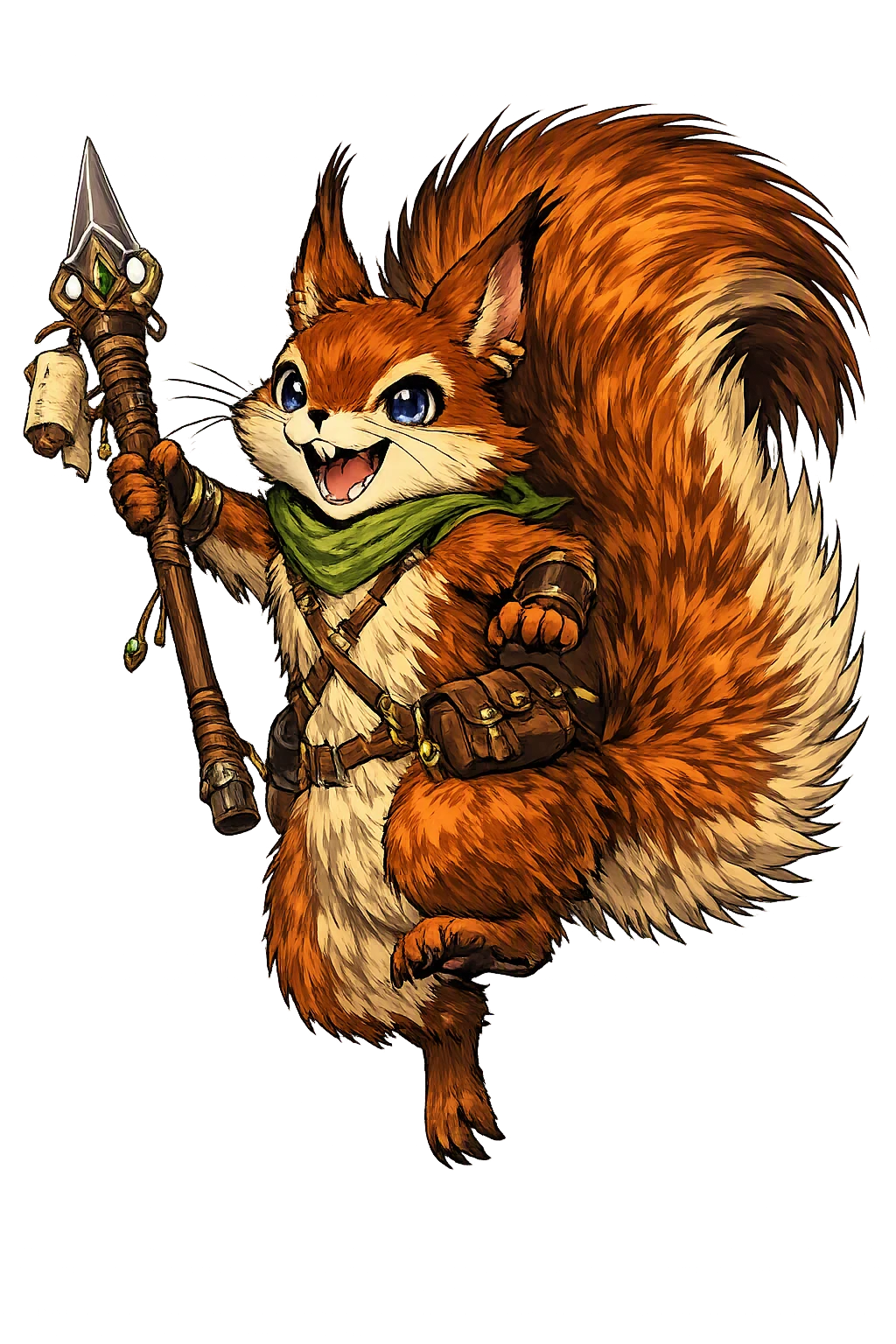
From Younger Futhark to Unicode: the journey of Ratatoskr
Long before it was a domain, this name traveled through scripts. Ratatoskr begins in Younger Futhark, passes through scholarly transliteration, and ends — for now — inside the punycode machinery of the global DNS. Each stage of that journey preserves some information and loses some, and the craft of restoration is knowing exactly which marks matter. This post follows the name stage by stage: the original script, the reconstructed pronunciation, the mythological record, the material evidence, and finally the Unicode form that carries all of it into the address bar. Think of it as a biography of a name, told through its spelling.
At a Glance
- Restored name: Ratatoskr
- ASCII form: ratatoskr
- Meaning: "Drill-tooth"
- Domain of influence: Squirrel of Yggdrasil
- Pantheon: Norse
- Classification: Tier 2
- Original script: ᚱᛅᛏᛅᛏᚢᛋᚴᚱ (Younger Futhark)
Overview
Ratatoskr (ratatoskr) — Squirrel of Yggdrasil · Drill-tooth — is the squirrel of the world-ash Yggdrasill: the small, tireless runner who bears the eagle's words down from the crown of the tree and carries Níðhǫggr's answers back up from the roots, keeping the feud between the top and the bottom of the cosmos supplied with fresh insults.
His attestation is as narrow as his road is long. One stanza of the Poetic Edda's Grímnismál names him and his office — ‘Ratatoskr is the squirrel who must run on Yggdrasill's ash; the eagle's words he must bear from above and tell to Níðhǫggr below’ — and one chapter of Snorri's Gylfaginning fills out the scene, adding the hawk Veðrfölnir between the eagle's eyes and naming the squirrel's cargo as öfundarorð, ‘malicious words’. Nothing else in the Old Norse corpus mentions him.
The name is a compound: rati, ‘borer, auger’ — the very name of the gimlet Óðinn drives through the mountain in the mead-myth — and toskr, ‘tusk, tooth’, whence the standard gloss ‘drill-tooth’; a rival derivation from rata, ‘to travel, find one's way’, yields ‘travel-tooth’, and the dispute is genuinely open. PuniCodex restores the name as Ratatoskr — identical to the ASCII input, since normalized Old Norse writes no diacritic in it — and the mechanical rule therefore places it in Tier 2. No domain is claimed: the plain-ASCII ratatoskr.com is registered to a third party outside the collection and is watched for release.
The Name
The name is attested in Old Norse as Ratatoskr (nominative), a compound of two ordinary words. The second element is secure: toskr, ‘tusk, tooth’, cognate with Old English tusc. The first is the philologist's problem. The standard reading takes rati, ‘borer, auger’ — the name of the drill with which Óðinn bores into the mountain Hnitbjǫrg in the mead-of-poetry myth (Hávamál 106; Skáldskaparmál) — giving ‘drill-tooth’, a tooth that bores: exactly the instrument a squirrel carries in its face.
The alternative derives the first element from the verb rata, ‘to travel, to find one's way’, yielding ‘travel-tooth’ — a derivation the handbooks register without settling, and one whose fit for the tireless courier of the world-tree has tempted more than one commentator. What is not in dispute is the word-class: Ratatoskr is a mythological coinage, never an ordinary human anthroponym, and appears nowhere outside the two Eddic witnesses.
The ASCII form survives unchanged because normalized Old Norse writes the name in plain Latin letters; the Unicode restoration Ratatoskr differs from the input only by its capital. Because the restoration preserves nothing the ASCII form loses — no diacritic, no distinctive letter, no vowel length — the name is classified Tier 2, a statement about orthography and never about the creature.
The letter-by-letter transformation runs:
- r → R — Same, capitalized
- a → a — Same
- t → t — Same
- a → a — Same
- t → t — Same
- o → o — Same
- s → s — Same
- k → k — Same
- r → r — Same
The project holds no domain for this name: the plain-ASCII ratatoskr.com is registered outside the collection and watched for release, and this temple stands without an address of its own.
The Original Script
The name is preserved in medieval Icelandic manuscripts in the Latin alphabet as Ratatoskr — Old Norse (North Germanic), attested 13th c. CE in the Codex Regius of the Poetic Edda (Grímnismál) and the early 14th-c. Codex Regius of the Prose Edda (Gylfaginning). Before the Latin bookhand, Old Norse names were carved in the Younger Futhark; no runic attestation of this name survives, so the manuscript form is the sole witness.
The scholarly rendering proceeds step by step:
- The compound is rati ‘borer, auger’ + toskr ‘tusk, tooth’, with the nominative singular ending -r.
- Old Norse orthography writes the name in nine plain Latin letters; no length marks or special characters occur.
- In the Younger Futhark the name maps to ᚱᛅᛏᛅᛏᚢᛋᚴᛦ (r-a-t-a-t-u-s-k-R): the ᚢ rune writes the short o, and ᛦ writes the final nominative -r — a normalized reconstruction, not an attested carving.
- The Unicode restoration Ratatoskr therefore differs from the ASCII form ratatoskr only by its capital; nothing distinctive is lost in transit, and the name is Tier 2 by the mechanical rule.
Pronunciation
The reconstructed pronunciation of the name is /ˈrɑ.tɑ.toskr/ — Old Norse Reconstruction.
Phoneme by phoneme:
- Ra- — Trilled [r], short open [ɑ]; the stress falls here, on the first syllable, as in every Old Norse word
- -ta- — Voiceless dental stop [t], short open [ɑ]
- -toskr — Voiceless stop [t], short rounded [o], then the cluster [skr]: sibilant, velar stop, and the final nominative [r], lightly syllabic as in modern Icelandic
For the modern speaker, the closest approximation is: ‘RAH-tah-toskr’ — three even beats with the weight on the first, all vowels clipped short, and the final -r sounded as a light trill, as in Icelandic Ratatoskur.
Kindred and historical forms of the name:
- Old Norse — Ratatoskr, the íkorni (squirrel) of the world-ash
- Name elements — rati ‘borer, auger’ (Óðinn's gimlet) + toskr ‘tusk, tooth’ (cf. Old English tusc)
- Younger Futhark — ᚱᛅᛏᛅᛏᚢᛋᚴᛦ, the normalized Viking-Age runic rendering (reconstructed; unattested)
- Modern Icelandic — Ratatoskur, the living form
- Owned form — none; the temple claims no domain
Ratatoskr is Tier 2 because the restoration preserves nothing the ASCII alphabet cannot write: no diacritic, no distinctive letter, no length mark. The name travels from manuscript to address bar without losing a single feature — the tier rule records that fact mechanically.
Mythology
Ratatoskr's mythology is two passages long — one stanza and one prose chapter — and it is complete: a road, a cargo, a character. No saga, þula, or skaldic verse adds a word to him.
The Squirrel's Stanza (Grímnismál 32)
In Grímnismál, Óðinn — masked as Grímnir and bound between the fires of King Geirrøðr — recites the inhabitants of the world-ash, and the squirrel receives his stanza: Ratatoskr is the íkorni who must run on Yggdrasill's ash; the eagle's words he must bear from above and tell to Níðhǫggr below. The verb is skal, ‘shall, must’: the running is an office, written into the tree's economy as fixedly as the dew that falls from its branches.
The Suffering Ash (Grímnismál 33-35)
The surrounding stanzas build the tree's full menagerie and its misery. Four harts bite the new shoots; more serpents lie beneath the ash than any unwise ape would think — Góinn and Móinn, Grábakr and Grafvölluðr, Ófnir and Sváfnir — and gnaw the roots forever. Then the poem's most famous sentence: the ash of Yggdrasill suffers agony more than men know — the hart bites from above, the trunk rots at the side, and Níðhǫggr gnaws from below. Ratatoskr runs his messages through a tree being eaten alive at every level.
Malice Up and Down the Trunk (Gylfaginning 16)
Snorri fills the stanza into a portrait. An eagle sits in the limbs of the ash and has knowledge of many things, and between its eyes sits a hawk called Veðrfölnir; the squirrel called Ratatoskr springs up and down the ash and bears öfundarorð — words of malice — between the eagle and Níðhǫggr. Where Grímnismál described a messenger, Snorri describes an agent provocateur: the squirrel does not merely deliver the correspondence of crown and root, he keeps the feud alive.
The Dragon at the Root (Gylfaginning 15 · Völuspá 66)
The lower terminus of the squirrel's road is the worst address in the cosmos: the third root of the ash, over Niflheimr and the spring Hvergelmir, where Níðhǫggr gnaws from below among countless serpents. Völuspá gives the Malice-Striker his other aspect — sucking the corpses of the dead at Nástrǫnd, and rising at last from Niðafjǫll with dead men on his wings — so that every word Ratatoskr carries down lands in the ear of the world's undertaker, and every word he carries up rises from it.
Symbols & Iconography
Ratatoskr's iconography is fixed by two passages and nothing else — but those passages equip him completely:
- The world-ash — Yggdrasill, ‘the greatest and best of all trees’: his road, his world, and the axis of everyone else's
- The malicious message — öfundarorð, Snorri's exact word for the cargo: not news but malice, carried between powers too proud to speak directly
- The drill-tooth — the name itself, rati + toskr: the boring auger and the tusk, a tooth that drills and a tongue that bores
- The hawk between the eyes — Veðrfölnir, perched in the eagle's brow above the squirrel's route: the unblinking audit over every errand
- The four harts — Dáinn, Dvalinn, Duneyrr, Duraþrór, biting the buds of the ash he runs: the tree's other tenants, eaters where he is a talker
Archaeology & Evidence
Ratatoskr is an entirely textual creature: no picture stone, runestone, amulet, or toponym preserves him, and the squirrel is otherwise invisible in Norse material culture. His two attestations hang on the great codices. Grímnismál survives in the Codex Regius of the Poetic Edda (c. 1270), and Gylfaginning in the early fourteenth-century Codex Regius of the Prose Edda and its sister manuscripts, with the Grímnismál stanzas on the world-ash also copied into the Codex Wormianus and the Uppsala Edda tradition.
The world-ash itself has material echoes — the animal-and-tree compositions of Scandinavian and Insular art are sometimes compared to Yggdrasill's menagerie — but none can be tied to the squirrel by name. His evidence is the manuscript page alone, which is fitting for a figure made entirely of words.
Realm & Domain
Ratatoskr is the courier of the world-ash — the one creature in Yggdrasill's great menagerie defined by an errand rather than by appetite, and the only messenger in the corpus whose cargo is mischief itself.
The World-Tree's Courier
Grímnismál sets him his route with the modal skal — he must run: from the eagle in the crown to Níðhǫggr at the root, the full height of the cosmos in a squirrel's stride.
Mischief
Snorri names the cargo: öfundarorð, ‘words of malice’ — the slander-tidings that keep the eagle above and the dragon below forever at enmity.
The Vertical Axis
His road is the trunk of Yggdrasill itself, the axis on which the Nine Worlds hang; no other creature in the Edda is given the whole height of the universe as a daily commute.
The Tree's Menagerie
He runs in company: the unnamed eagle and the hawk Veðrfölnir above, the four harts in the branches, the serpents and Níðhǫggr beneath the roots in Niflheimr — a household of gnawers and watchers among whom the squirrel alone speaks.
Across Cultures
Ratatoskr belongs to a configuration far older and wider than Iceland: the world-tree with an eagle in its crown and a serpent at its root. The famous ancient parallel is the Mesopotamian Etana legend, in which an eagle and a serpent dwell in a single great tree and their broken pact drives the plot — a resemblance noted by comparativists for over a century. No line of borrowing has ever been demonstrated, and the standard handbooks treat the eagle-and-serpent tree as a widely distributed motif rather than a loan into the North.
Within the Germanic world the squirrel has no counterpart at all: he is the Edda's own addition to the tree-menagerie, and the only member defined by speech. His nearest functional kin are Óðinn's ravens Huginn and Muninn, who likewise range the world and return with words — but the ravens gather news, while Ratatoskr, on Snorri's telling, manufactures a feud. Related figures in the corpus include Yggdrasill (the tree he runs), Mímir (whose well stands beneath another of the tree's roots), and Jǫrmungandr (the pantheon's other great serpent, though bound in the sea and no correspondent of the dragon at the root).
Cultural Legacy
Ratatoskr's afterlife grew with the tree he runs. Padraic Colum's The Children of Odin (1920) carried the squirrel into English-language retellings, and every popular handbook of Norse myth since has kept him running up and down the ash. Twentieth- and twenty-first-century readings sharpened Snorri's hint into an emblem: the squirrel as the patron of the poisonous go-between — the forwarder of insults, the courier who keeps enemies supplied — a role that has only gained force in the age of the forwarded message.
He has become a minor star of games and popular culture: a playable god in Smite (2015), and the scene-stealing squirrel of God of War Ragnarök (2022), where the ancient slander-courier is played, faithfully to Snorri, as the most insulting creature in the Nine Realms. In Iceland the name lives on as Ratatoskur, and modern Heathen and Ásatrú retellings keep him as the comic-dark emblem of how small tongues keep great hatreds fed.
The Scholarly Record
The account of Ratatoskr given in this edition rests on the witnesses and reference works listed below. Grímnismál supplies the stanza; Gylfaginning the portrait and the word öfundarorð; the lexica and etymological dictionaries secure the name; the handbooks arbitrate the comparative questions.
- The Poetic Edda, trans. Carolyne Larrington, 2nd ed. (Oxford: Oxford University Press, 2014): Grímnismál 32-35 (Ratatoskr; the harts; the serpents; the suffering ash); Völuspá 66 (Níðhǫggr); Hávamál 106 (the auger Rati).
- Snorri Sturluson, Edda, Gylfaginning 15-16, ed. and trans. Anthony Faulkes (London: Everyman, 1987).
- Cleasby, Richard, and Guðbrandur Vigfússon, An Icelandic-English Dictionary, 2nd ed. (Oxford: Clarendon Press, 1957), s.v. ratatoskr, toskr, rata.
- Zoëga, Geir T., A Concise Dictionary of Old Icelandic (Oxford: Clarendon Press, 1910), s.v. ratatoskr.
- de Vries, Jan, Altnordisches etymologisches Wörterbuch, 2nd ed. (Leiden: Brill, 1962), s.v. Ratatoskr, toskr.
- Simek, Rudolf, Dictionary of Northern Mythology, trans. Angela Hall (Cambridge: D. S. Brewer, 1993), s.v. Ratatoskr, Yggdrasill.
- Orchard, Andy, Dictionary of Norse Myth and Legend (London: Cassell, 1997), s.v. Ratatosk.
- Lindow, John, Norse Mythology: A Guide to the Gods, Heroes, Rituals, and Beliefs (Oxford: Oxford University Press, 2001), s.v. Ratatoskr, Yggdrasill.
- Gordon, E. V., An Introduction to Old Norse, 2nd ed. rev. A. R. Taylor (Oxford: Clarendon Press, 1957).
- Dalley, Stephanie, Myths from Mesopotamia (Oxford: Oxford University Press, 1989), the Etana legend.
- Colum, Padraic, The Children of Odin: The Book of Northern Myths (New York: Macmillan, 1920).
A Meditation
Ratatoskr is the Edda's smallest cosmological fact and one of its sharpest. The universe is held in a tree; the tree is being eaten from crown to root; and through the middle of the disaster runs a squirrel, up and down, carrying the worst things the top and the bottom can think of to say to each other.
Snorri's word for the cargo is exact: öfundarorð — not news, not warnings, but malice. The myth knows something the etiquette books miss: that feuds do not survive on hatred alone but on delivery — that between every great enmity runs some small, quick, indispensable creature who keeps the words fresh. Ratatoskr never fights, never schemes on his own account, never speaks a line the sources record. He only carries. And the Edda gives him eternity for it: while the ash stands, the squirrel runs, and the eagle and the dragon never lack for ammunition.
The Unicode Restoration
Ratatoskr is classified as Tier 2: the restoration needs no distinctive letters or diacritics its ASCII form would lose. The ASCII fallback ratatoskr still resolves everywhere, but it is the restored form that carries the name's full information. That is the whole thesis of this temple: the marks are the message.
Why This Restoration Matters
Every stage of the journey from Younger Futhark to Unicode was an act of care: the scribe who first wrote the name, the lexicographer who glossed it, the engineer who taught the DNS to carry it. The PuniCodex restoration is the latest stage, not the last word — the Scholarly Edition is revised as the evidence improves. What does not change is the principle: a name deserves to be written the way its own tradition wrote it. Ratatoskr in the address bar is that principle, made routable.
Explore Further
This post is one doorway into the temple. The home page carries the full character breakdown and the ambient canvas; the lore page tells the myths in long form; the Scholarly Edition preserves the sources, pronunciation data, and revision history; and the patron wall supports the restoration directly. For the wider map, browse the Lexicon, explore the Pantheon, or return to the PuniCodex blog.
Related Names
Sources
The full scholarly apparatus — every citation, revision, and review — lives in the Scholarly Edition. Key references for this post:
- Grímnismál 32 (Poetic Edda), trans. Carolyne Larrington, The Poetic Edda, 2nd ed. (Oxford: Oxford University Press, 2014).
- Snorri Sturluson, Edda, Gylfaginning 16, ed. and trans. Anthony Faulkes (London: Everyman, 1987).
- Cleasby, Richard, and Guðbrandur Vigfússon, An Icelandic-English Dictionary, 2nd ed. (Oxford: Clarendon Press, 1957), s.v. ratatoskr, toskr; Lindow, John, Norse Mythology: A Guide to the Gods, Heroes, Rituals, and Beliefs (Oxford: Oxford University Press, 2001), s.v. Ratatoskr.
- Cleasby, Richard, and Guðbrandur Vigfússon, An Icelandic-English Dictionary, 2nd ed. (Oxford: Clarendon Press, 1957), s.v. ratatoskr, toskr.
- Lexicon authorities for this entry: Poetic Edda, Cleasby-Vigfusson.