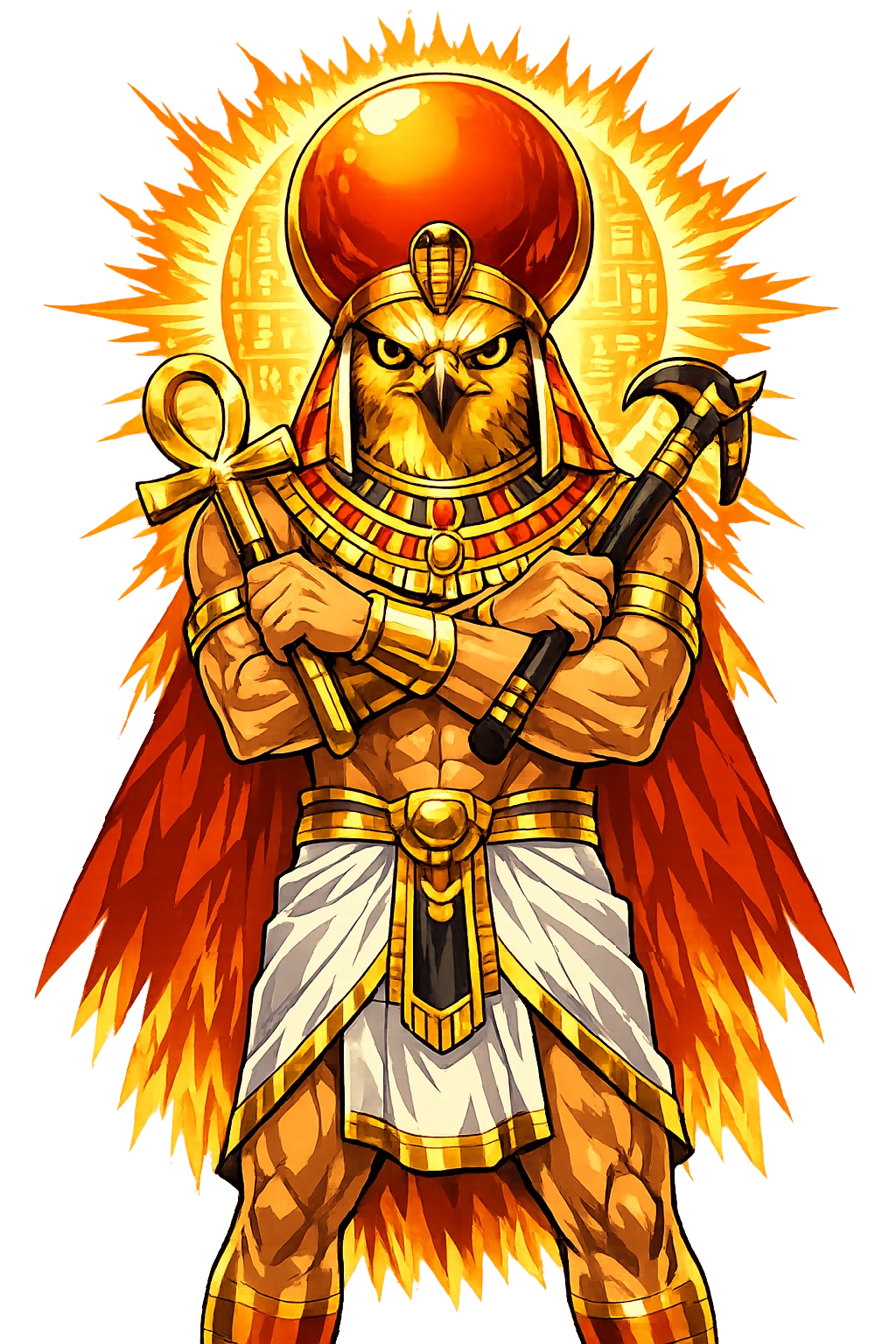
Unicode restoration and ASCII comparison
𓂋𓂝𓇳
The name in its original Egyptian form. Rꜥ (𓂋𓂝𓇳) is attested in the source tradition — “Sun (from Egyptian rꜥ)”. Its Egyptological ain and alef letters carry the full phonetic and orthographic weight of the source tradition.
ra
Reduced to plain ra, the name loses everything that made it specific: Egyptological ain and alef letters. What remains is an ASCII string that machines can parse but that no longer speaks with its original voice.
Rꜥ
The Unicode restoration recovers what ASCII flattened. Rꜥ restores Egyptological ain and alef letters, returning the name to its original written dignity. The domain encodes to Punycode, but the browser displays the truth.
Rꜥ.com → xn--r-2w3e.com
The non-ASCII characters in Rꜥ are encoded while the ASCII remains visible. To the DNS, it is Punycode. To humanity, it is Rꜥ.
How Rꜥ travels from ancient script to the modern URL
Probably identical with Egyptian rꜥ 'sun, day'; the sun-god as the visible solar disk.
Sun-god, creator, and king of the gods; central deity of the Heliopolitan cosmogony.
The Unicode form Rꜥ uses the Egyptological alef/ayin characters (U+A722/U+A725), registrable in .com as Punycode; the hieroglyphic form is not used because hieroglyphs are outside the .com IDN table.
How Rꜥ was spoken
The domain of Rꜥ
In the egyptian tradition, Rꜥ governed sun, creation, kingship. The name encodes a sphere of power that shaped ritual, narrative, and social order.
Ra sails the Mandjet by day and the Mesektet through the underworld, defeating Apophis each night.
He is the scarab at dawn, the reigning sun at noon, and the weary creator at evening.
His eye, embodied as Sekhmet or Hathor, punishes rebellion and returns as the protective uraeus on his brow.
The pharaoh rules as Ra's son; every obelisk is a frozen ray of the sun-god's first light.
Stories of Rꜥ
Rꜥ is the Egyptian sun-god in whom creation, kingship, and cosmic law converge. Each dawn he is born from the eastern horizon as Khepri, the scarab-beetle pushing the sun-disk into the sky; at noon he reigns in full splendor; at evening he becomes Atum, the weary creator entering the western Duat. The pharaoh rules as Rꜥ's son, and every temple obelisk is a frozen ray of his first light. To name Rꜥ is to name the power that makes day possible.
The central image of Rꜥ theology is the solar barque, the Mesektet or Mandjet, in which the god sails across the sky by day and through the underworld by night. The Book of the Dead and the Books of the Underworld describe this voyage in exhaustive detail: Rꜥ is defended by other gods against Apophis, the serpent of chaos who waits in the Duat to swallow the sun. Each sunrise is therefore a victory, the reassertion of ordered light over the formless dark.
One of Egypt's most widespread myths tells how Rꜥ sent his eye—embodied as the goddess Sekhmet or Hathor—to punish rebellious mankind. The eye's rage proved so terrible that Rꜥ had to trick it into drunkenness by dyeing beer the color of blood, saving humanity from annihilation. When the eye returned, it was restored as the uraeus on Rꜥ's brow, the cobra of protective wrath that no enemy could withstand. The myth encodes a theology of divine kingship: the sun-god's power can be terrible, but it is also carefully measured to preserve the world.
In later temple theology, the Eye of Rꜥ became a cosmic principle in its own right, identified with the moon, the royal uraeus, and the goddess Maat. Its departure and return were rehearsed in annual festivals, making Rꜥ not only the source of light but the guarantor that light would always return.
Names are not merely labels; they are compressed worlds. Rꜥ carries within it a egyptian understanding of sun (from egyptian rꜥ). Unicode restoration returns that world to readable form.
Enter Extended Lore