
How Rꜥ got its accent back
The ASCII form ra is missing something. Rꜥ restores the marks the source language used to distinguish this name from a thousand others — and those marks change how the name is read, pronounced, and understood. This post explains, with the full scholarly record behind it, what each restored mark preserves: the Hieroglyphs evidence, the reconstructed sound, the myths the name carries, and the classification logic that separates Tier 1 restorations from Tier 2. By the end, the marks in Rꜥ will look less like ornaments and more like what they are — recovered evidence, pinned back in its proper place.
At a Glance
- Restored name: Rꜥ
- ASCII form: ra
- Meaning: "Sun (from Egyptian rꜥ)"
- Domain of influence: Sun, Creation, Kingship
- Pantheon: Egyptian
- Classification: Tier 2
- Original script: 𓂋𓂝𓇳 (Hieroglyphs)
- Live domain: rꜥ.com
Overview
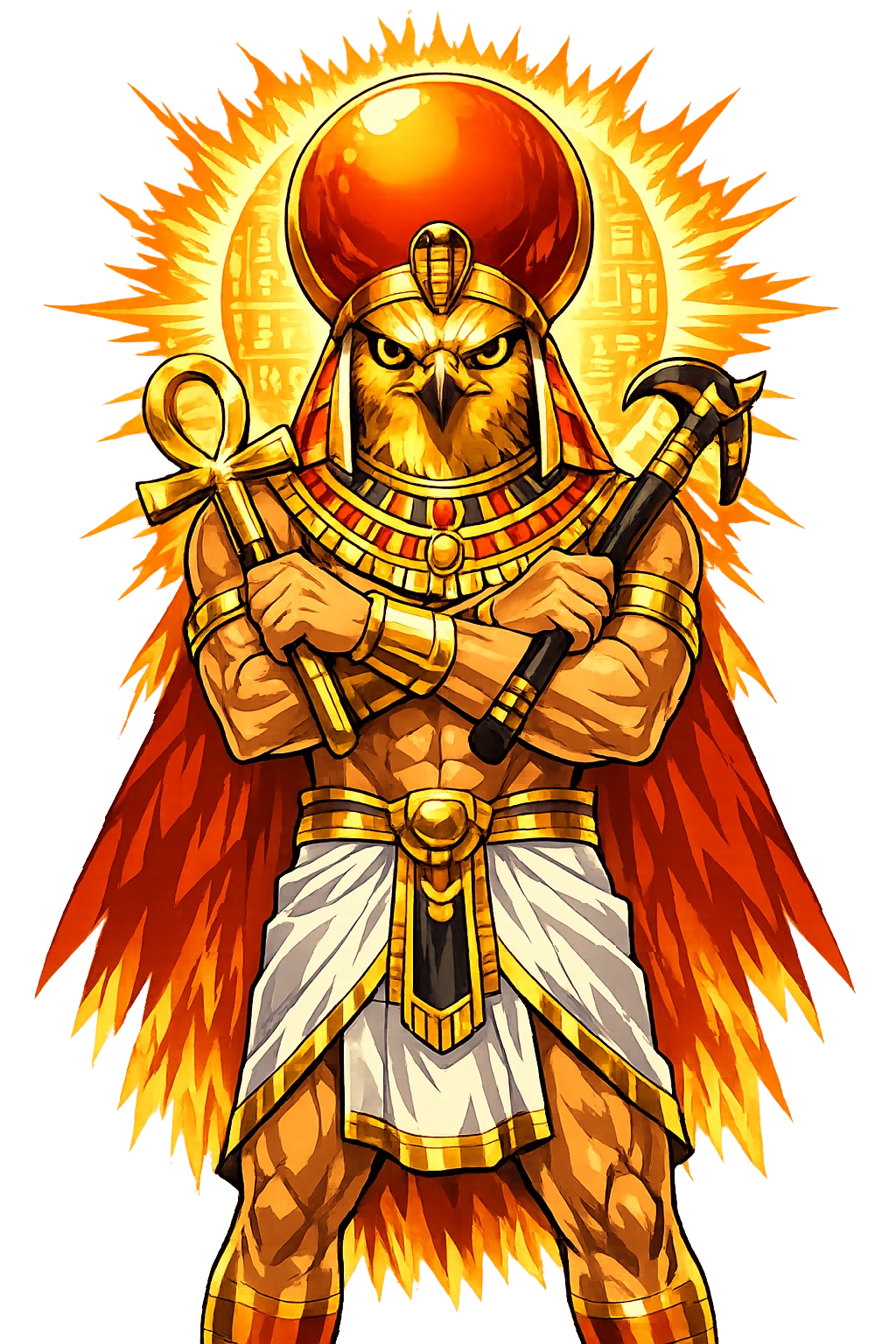
Rꜥ (ra) is the sun-god of ancient Egypt and the centre of the Heliopolitan cosmogony: the word rꜥ is simply the Egyptian noun for 'sun, day', and the god is the celestial body conceived as a living king. From the Fifth Dynasty onward, Egyptian kings styled themselves 'Son of Rꜥ' (sꜣ Rꜥ), and the god's daily circuit — dawn as Khepri, noon as Ra, evening as Atum — supplied the model for both royal ideology and funerary hope.
His theology is kinetic: by day he crosses the sky in the Mandjet barque, by night he passes the Duat in the Mesektet, where the serpent Apep (Apophis) must be defeated before each sunrise. From the New Kingdom he is most often worshipped in the composite form Amun-Ra, king of the gods.
PuniCodex restores the name as Rꜥ, keeping the ayin of the consonantal skeleton, and serves its temple at rꜥ.com. The ASCII ra is a modern technological fallback, not an ancient spelling; the restoration preserves a single class of diacritic detail — its marked consonant — rather than both stress and vowel length, which places the name in Tier 2.
The Name
The name is attested in Hieroglyphs as 𓂋𓂝𓇳 — the mouth sign r (Gardiner D21), the arm sign ꜥ (D36), and the sun disk (N5) serving as ideogram. The god's name is the common noun rꜥ 'sun, day'; Egyptian theology made no distinction between the star and its person.
The ASCII form ra survives only because the early domain-name system could not carry diacritics; it is a technological compromise, not an ancient spelling. The Unicode restoration Rꜥ recovers the ayin of the scholarly transliteration directly in the address bar. The name preserves a single class of diacritic detail — its marked consonant — rather than both stress and vowel length, which places it in Tier 2. Note that the macron form Rā is not a scholarly spelling: Egyptian rꜥ carries no long vowel in Egyptological analysis, and the Rā.com domain is registered by a third party.
The letter-by-letter transformation runs:
- r → R — Same
- a → ꜥ — Ayin: pharyngeal fricative
Attested and derived spellings of the name:
- Rá — alternate stress, scholarly variant: a modern stress marking of the conventional vocalisation 'Ra'; the Egyptological spelling records only the consonants rꜥ.
The project holds the domain rꜥ.com (xn--r-2w3e.com) as the canonical home of this name.
Etymology & Roots
The recorded derivation reads: From Egyptian rꜥ "sun, day". The solar creator god.
The reconstructed proto-form is *rꜥ (proto-afro-asiatic), glossed as "sun, day".
The reconstruction is classed as attested.
The Original Script
The name is preserved in Hieroglyphs as 𓂋𓂝𓇳 — Egyptian hieroglyphic, attested from the Old Kingdom to Late Antiquity (c. 2600 BCE – 400 CE) in Heliopolis, Egypt. The script is written right-to-left or top-to-bottom.
The scholarly transliteration is Rꜥ (Egyptological convention); the conventional reading is /raː/, and the original vocalisation is unknown.
The rendering proceeds step by step:
- The name is written rꜥ (𓂋𓂝) with the sun-disk (𓇳) as a determinative/rebus for 'sun'.
- The consonantal skeleton r-ꜥ is vocalised as Ra in Egyptological convention; the original vocalisation is unknown.
- Coptic ⲣⲏ provides a late phonetic reflex.
- From the New Kingdom onward Ra is frequently combined with Amun as Amun-Ra.
Pronunciation
The reconstructed pronunciation of the name is /raʕ/ — Egyptological Reconstruction.
Phoneme by phoneme:
- r — Alveolar trill or tap [r], the first consonant of the solar god's name
- ꜥ — Voiced pharyngeal fricative [ʕ], the ayin that closes the Egyptian root rꜥ
- a — Short open vowel [a], supplied by convention; Egyptian writing gave only rꜥ
For the modern speaker, the closest approximation is: 'rah-ʿA' — a rolled or tapped 'r', then a deep throaty 'ah' like the Arabic ع.
Kindred and historical forms of the name:
- Egyptian — rꜥ, the standard hieroglyphic writing of the sun god's name
- Coptic — ⲣⲏ (rē), 'sun', the ordinary Coptic noun: the god's name surviving as the everyday word for the daylight sky
- Greek — no transliteration of the name is attested; Greek writers rendered the god by equivalence as Ἥλιος (Helios) and called his cult city Heliopolis, 'City of the Sun'
Rꜥ is a Tier-2 consonantal restoration. Egyptologists vocalise the name as Ra or Rꜥa, but the hieroglyphs record only rꜥ. The ayin (ꜥ) is the defining non-English sound; the acute variant Rá is a modern stress marker, not an ancient vowel sign.
Mythology
Rꜥ is the Egyptian sun-god in whom creation, kingship, and cosmic law converge. Each dawn he is born from the eastern horizon as Khepri, the scarab-beetle pushing the sun-disk into the sky; at noon he reigns in full splendor; at evening he becomes Atum, the weary creator entering the western Duat. The pharaoh rules as Rꜥ's son, and every temple obelisk is a frozen ray of his first light. To name Rꜥ is to name the power that makes day possible.
The Barque of Millions of Years (Solar Theology)
The central image of Rꜥ theology is the solar barque, the Mesektet or Mandjet, in which the god sails across the sky by day and through the underworld by night. The Book of the Dead and the Books of the Underworld describe this voyage in exhaustive detail: Rꜥ is defended by other gods against Apophis, the serpent of chaos who waits in the Duat to swallow the sun. Each sunrise is therefore a victory, the reassertion of ordered light over the formless dark.
The Distant Goddess and the First Men (Myth of the Eye)
One of Egypt's most widespread myths tells how Rꜥ sent his eye—embodied as the goddess Sekhmet or Hathor—to punish rebellious mankind. The eye's rage proved so terrible that Rꜥ had to trick it into drunkenness by dyeing beer the color of blood, saving humanity from annihilation. When the eye returned, it was restored as the uraeus on Rꜥ's brow, the cobra of protective wrath that no enemy could withstand. The myth encodes a theology of divine kingship: the sun-god's power can be terrible, but it is also carefully measured to preserve the world.
In later temple theology, the Eye of Rꜥ became a cosmic principle in its own right, identified with the moon, the royal uraeus, and the goddess Maat. Its departure and return were rehearsed in annual festivals, making Rꜥ not only the source of light but the guarantor that light would always return.
Symbols & Iconography
The iconography associated with Rꜥ concentrates in a small set of recurring attributes, each a compressed statement about the name:
- Solar barque (Mandjet) — The morning boat in which Ra crosses the sky from east to west
- Scarab beetle (khepri) — The self-begetting form of the sun at dawn, pushing the disk like dung
- Falcon head with sun-disk — Ra as sky-falcon, the dominant icon of the solar god
- Bennu heron — The soul of Ra and the prototype of the phoenix, rising from the Persea tree
- Eye of Ra (wedjat) — The aggressive solar eye that destroys enemies and restores cosmic order
Archaeology & Evidence
The archaeological footprint of the solar cult is unusually deep. The sun temples of the Fifth Dynasty at Abu Ghurab — of which Niuserre's is the best preserved — and the obelisk of Senusret I at Heliopolis, the oldest standing obelisk in Egypt, mark the Old and Middle Kingdom centres; at Thebes the Karnak complex grew around Amun-Ra, and the axis of Abu Simbel is aligned so that sunlight strikes the sanctuary statues on two mornings of the year.
Akhenaten's solar revolution left the Amarna boundary stelae and the Great Hymn to the Aten, and the royal tombs of the Valley of the Kings display Ra's day- and night-barques in the underworld books painted on their walls.
Realm & Domain
Rꜥ's domain is the visible order of the sky: the sun as creator, king, and judge, whose daily and nightly circuits frame Egyptian time, kingship, and hope of resurrection.
Solar Barque
Ra sails the Mandjet by day and the Mesektet through the underworld, defeating Apophis each night.
Khepri, Ra, Atum
He is the scarab at dawn, the reigning sun at noon, and the weary creator at evening.
Eye of Ra
His eye, embodied as Sekhmet or Hathor, punishes rebellion and returns as the protective uraeus on his brow.
Kingship
The pharaoh rules as Ra's son; every obelisk is a frozen ray of the sun-god's first light.
Across Cultures
Ra is the great combiner of Egyptian religion: his name fuses with other gods to make composite deities, each keeping Ra's solar kingship. The New Kingdom's state god is Amun-Ra, 'king of the gods', joining the hidden god of Thebes (Amun) with the visible sun; Ra-Horakhty unites him with Horus of the Two Horizons; Khepri-Ra and Atum-Ra fold dawn and dusk into his person; and regional gods such as Sobek and Khnum ruled locally as Sobek-Ra and Khnum-Ra.
Greek writers performed the equivalence from the other side: they rendered Ra as Ἥλιος (Helios) and called his cult centre Iunu 'Heliopolis', the City of the Sun. No Greek transliteration of the name itself circulated; the identification worked through function, not sound.
Kindred solar figures in the PuniCodex cross-tradition index include Hēlios, Apóllōn, Šamaš, Šāpšu, Dažbog, and Huitzilopōchtli, each linked through sun and light.
Cultural Legacy
The god's name outlived his cult by becoming a common noun: Coptic ⲣⲏ (rē) is the ordinary Coptic word for the sun, so that the last native speakers of Egyptian named the daylight sky with Ra's own name.
His titulary legacy is equally direct. From the Fifth Dynasty to the Roman emperors, rulers of Egypt bore the title 'Son of Ra' (sꜣ Rꜥ), and royal names built on the element — Djedefre, Khafre, Menkaure in the Old Kingdom; Ramesses (rꜥ-ms-sw, 'Ra bore him') in the New — carried it across twenty-five centuries.
The solar disk he wore became one of the most copied emblems of Egyptian art, and receptions from nineteenth-century Egyptomania to modern Kemetic revival movements still invoke Ra as the very type of the sun-god. Restoring Rꜥ in Unicode keeps the ayin that the flattened Ra erased.
The Scholarly Record
The account of Rꜥ given in this edition rests on the witnesses and reference works listed below. The lexica secure the form and meaning of the name; the religious corpora supply the narrative and ritual evidence; the modern monographs frame the solar theology.
- Faulkner, R. O. The Ancient Egyptian Pyramid Texts. Oxford: Clarendon, 1969.
- Faulkner, R. O. The Ancient Egyptian Coffin Texts. Warminster: Aris & Phillips, 1973–1978.
- Faulkner, R. O. (trans.); Andrews, C. (ed.). The Ancient Egyptian Book of the Dead. London: British Museum Press, 1985 (Spells 15 and 17; Papyrus of Ani, BM EA 10470).
- Erman, A. & Grapow, H. Wörterbuch der ägyptischen Sprache, vol. II, s.v. rꜥ.
- Quirke, S. The Cult of Ra: Sun-Worship in Ancient Egypt. London: Thames & Hudson, 2001.
- Hornung, E. The Ancient Egyptian Books of the Afterlife. Ithaca: Cornell University Press, 1999.
- Lichtheim, M. Ancient Egyptian Literature, vol. II. Berkeley: University of California Press, 1976 (Great Hymn to the Aten; Destruction of Mankind).
A Meditation
To contemplate Rꜥ is to stand before the boldest identification Egyptian thought ever made: that the name of a thing in the sky could also be a person who hears, ages, bleeds, and judges. The sun that blinds the eye is the same rꜥ who sails a boat, grows weary each evening, and is born again each dawn — Egypt held the physics and the person together without embarrassment.
The restoration asks a small thing of the reader: one letter, the ayin, that English cannot say. Yet that letter is the difference between a word about a star and a word that named, for three thousand years of worshippers, the king of the sky.
The Unicode Restoration
Rꜥ is classified as Tier 2: the original preserves at least one philological feature that ASCII cannot encode. The ASCII fallback ra still resolves everywhere, but it is the restored form that carries the name's full information. Across the 2 characters of the name, the restoration adjusts 1: 1 further adjustment (ꜥ). That is the whole thesis of this temple: the marks are the message.
Name Variations
The lexicon records 1 additional form of the name:
- Rá (alt-stress) — Modern stress form: the acute marks the stressed vowel in the conventional vocalization "Ra". The Egyptological spelling records only the consonants rꜥ.
The temple uses Rꜥ as the primary form: it is the spelling that best balances philological accuracy with the practical limits of DNS.
Character by Character
The journey from ra to Rꜥ, one character at a time:
- r → R — Same
- a → ꜥ — Ayin: pharyngeal fricative
The Domain Name
The restored name is live as a working domain: rꜥ.com, which the DNS carries in punycode form as xn--r-2w3e.com — an ASCII-compatible encoding that lets a non-ASCII name travel the global network without breaking older infrastructure. The visitor sees Rꜥ; the machines see the encoding. That duality is the engineering compromise on which the entire restoration rests, and it is why a name written the way its own tradition wrote it in Hieroglyphs can now be typed into any browser on earth.
The Egyptian Pantheon
Rꜥ is one of 66 entries the PuniCodex lexicon catalogues under the Egyptian pantheon. The Pantheon page gathers the tradition's major figures in one place, and the Lexicon lets you filter all 895 restorations by tradition, tier, or script — the fastest way to see where this name sits among its kin.
Frequently Asked Questions
What does Rꜥ mean? The traditional gloss is "Sun (from Egyptian rꜥ)."
Which tradition does Rꜥ belong to? Rꜥ is catalogued in the Egyptian pantheon of the PuniCodex lexicon.
Why is Rꜥ classified as Tier 2? Because the original preserves at least one philological feature that ASCII cannot encode — and the marks in the restored spelling preserve exactly that evidence.
Is Rꜥ a working domain? Yes — rꜥ.com resolves today and routes to this temple.
What is the punycode for rꜥ.com? The DNS encoding is xn--r-2w3e.com; browsers perform the translation automatically, so visitors only ever see the restored name.
Typing Rꜥ
You do not need a special keyboard to use this restoration. The PuniCodex Type Tool converts the ASCII form ra into Rꜥ as you type, and the browser extension offers the same conversion inside any text field. Copy the restored form, paste it into the address bar, and the DNS does the rest.
Why This Restoration Matters
The marks in Rꜥ were never lost; they were only waiting for a carrier that could hold them. Now that the carrier exists, the burden flips: every use of ra is a choice to leave evidence on the table. The PuniCodex temple keeps the restored form in circulation — as a domain, a dataset entry, and a scholarly argument — so that the choice to use it stays easy. Accent by accent, macron by macron, that is how the original names come back: not with a single grand gesture, but with a spelling that finally works everywhere.
Explore Further
This post is one doorway into the temple. The home page carries the full character breakdown and the ambient canvas; the lore page tells the myths in long form; the Scholarly Edition preserves the sources, pronunciation data, and revision history; and the patron wall supports the restoration directly. For the wider map, browse the Lexicon, explore the Pantheon, or return to the PuniCodex blog.
Related Names
Sources
The full scholarly apparatus — every citation, revision, and review — lives in the Scholarly Edition. Key references for this post:
- Herodotus, Histories 2.59 (the assemblies at Heliopolis, the 'City of the Sun'); trans. A. D. Godley, Loeb Classical Library.
- James P. Allen, Middle Egyptian: An Introduction to the Language and Culture of Hieroglyphs, Cambridge University Press, 2000.
- Quirke, S. The Cult of Ra: Sun-Worship in Ancient Egypt. London: Thames & Hudson, 2001.
- Hornung, E. Conceptions of God in Ancient Egypt: The One and the Many. Ithaca: Cornell University Press, 1982.
- Erman, A. & Grapow, H. Wörterbuch der ägyptischen Sprache, vol. II, s.v. rꜥ.
- Faulkner, R. O. A Concise Dictionary of Middle Egyptian. Oxford: Griffith Institute, 1962, s.v. rꜥ.
- Lexicon authorities for this entry: Faulkner, Wb.