
Ancient Domain
In the egyptian tradition, Rꜥ governed sun, creation, kingship. The name encodes a sphere of power that shaped ritual, narrative, and social order.
Extended Lore
Etymology · Phonology · Orthography · Cultural Legacy · Primary Sources
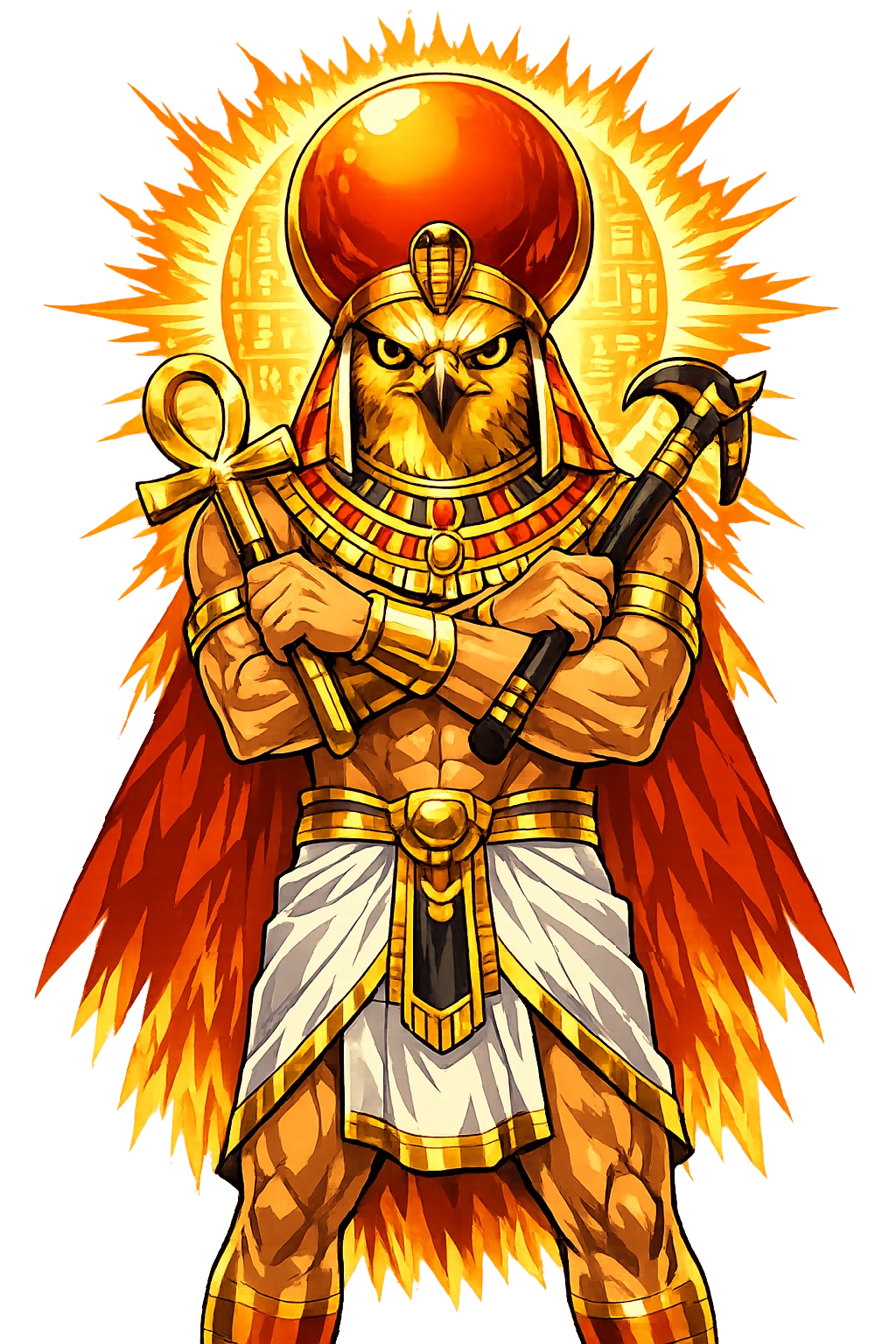
Essential information about Rꜥ, Sun, Creation, Kingship
From original script to Unicode restoration
Rꜥ is a Tier-2 consonantal restoration. Egyptologists vocalise the name as Ra or Rꜥa, but the hieroglyphs record only rꜥ. The ayin (ꜥ) is the defining non-English sound; the acute variant Rá is a modern stress marker, not an ancient vowel sign.
Character-by-character philological analysis
| Character | Unicode | Name | Block | Phonetic Role |
|---|---|---|---|---|
| R | U+0052 | Latin Capital Letter R | Basic Latin | Same |
| ꜥ | U+A725 | Latin Small Letter Egyptological Ain | Latin Extended-D | Ayin: pharyngeal fricative |
The Tier 2 classification reflects which ancient features stress, length, or script are preserved in this restoration.
From ancient cult to modern Unicode
In the egyptian tradition, Rꜥ governed sun, creation, kingship. The name encodes a sphere of power that shaped ritual, narrative, and social order.
Egyptian deities were syncretized with one another and, in the Greco-Roman period, with Greek and Roman gods; temple theology developed complex composite forms.
The name survives in Egyptological scholarship, museum collections, modern spirituality, and the global fascination with Pharaonic civilization. Restoring Rꜥ in Unicode preserves the name's cultural specificity against the flattening force of plain ASCII.
Restoring Rꜥ in a domain name is more than orthographic accuracy. It is a statement that the internet should recognize the full range of human writing — not only the ASCII keyboard.
Common questions about Rꜥ, Sun, Creation, Kingship, and Unicode restoration
In reconstructed pronunciation, Rꜥ is /raʕ/ — approximately 'rah-ʿA' — a rolled or tapped 'r', then a deep throaty 'ah' like the Arabic ع..
Rꜥ means Sun (from Egyptian rꜥ) in the egyptian tradition.
Rꜥ is associated with Solar barque (Mandjet) (The morning boat in which Ra crosses the sky from east to west), Scarab beetle (khepri) (The self-begetting form of the sun at dawn, pushing the disk like dung), Falcon head with sun-disk (Ra as sky-falcon, the dominant icon of the solar god), Bennu heron (The soul of Ra and the prototype of the phoenix, rising from the Persea tree), Eye of Ra (wedjat) (The aggressive solar eye that destroys enemies and restores cosmic order).
Each is a historically defensible restoration. Rá.com is the alt-stress form: Modern stress form: the acute marks the stressed vowel in the conventional vocalization "Ra". The Egyptological spelling records only the consonants rꜥ..
Plain ASCII ra strips the stress, length, and script that make the name specific. Unicode restoration returns the name to its original written dignity.
The central image of Rꜥ theology is the solar barque, the Mesektet or Mandjet, in which the god sails across the sky by day and through the underworld by night. The Book of the Dead and the Books of the Underworld describe this voyage in exhaustive detail: Rꜥ is defended by other gods against Apophis, the serpent of chaos who waits in the Duat to swallow the sun. Each sunrise is therefore a victory, the reassertion of ordered light over the formless dark.
The philological foundations of this restoration
Every claim on this page is grounded in established scholarship. The orthographic restorations follow disciplinary convention. The etymological chain follows the best available reference works. This is not invention — it is resurrection through scholarship.
You have traced the name from its earliest attestation to its Unicode restoration. Now return to the myth. The story is where the name lives.
Back to Lore