
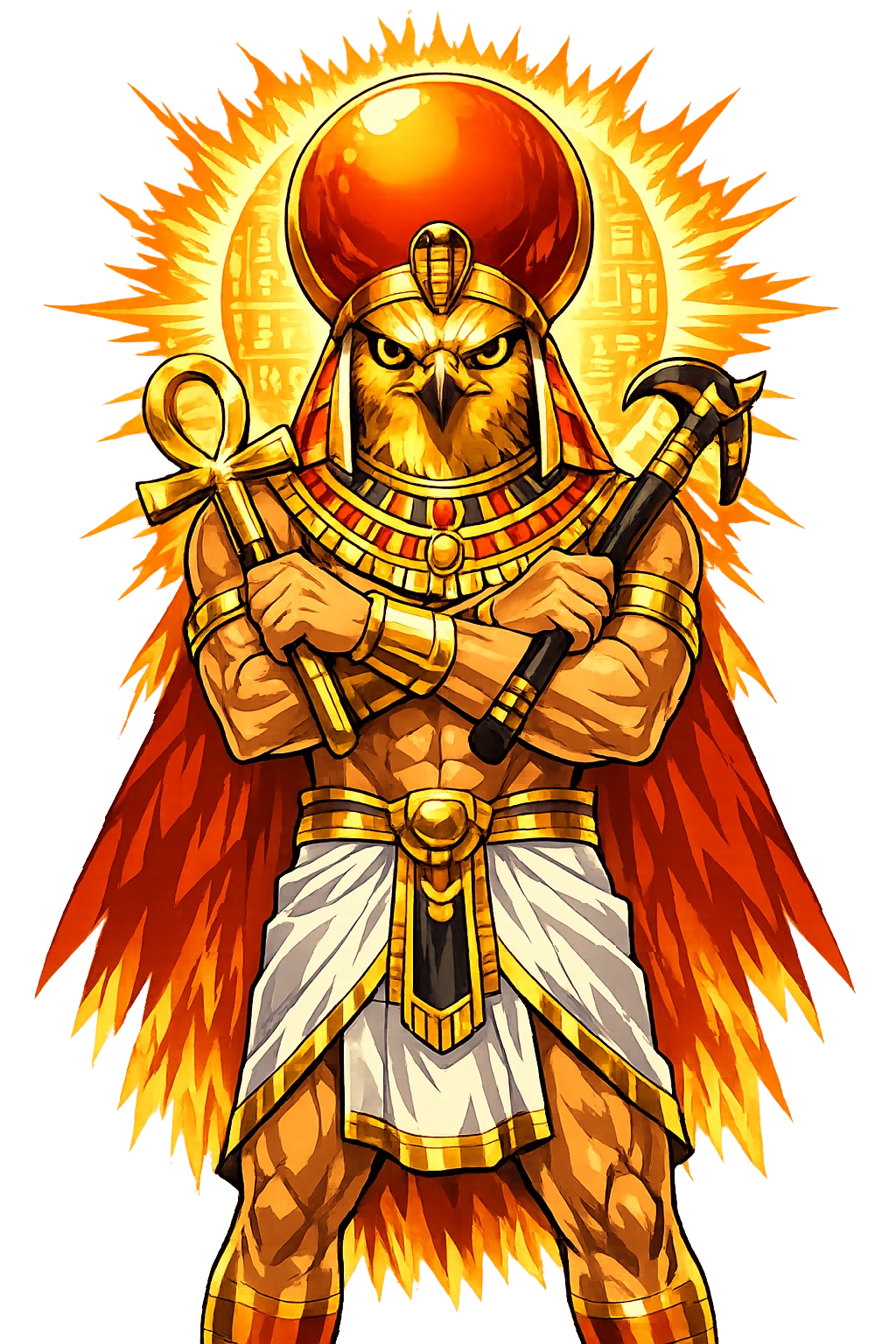
Rꜥ, spelled the way the sources wrote it
There is a version of this name the early internet had to settle for: ra. This is the file on how Rꜥ replaced it.
Rꜥ is the Egyptian sun-god in whom creation, kingship, and cosmic law converge. Each dawn he is born from the eastern horizon as Khepri, the scarab-beetle pushing the sun-disk into the sky; at noon he reigns in full splendor; at evening he becomes Atum, the weary creator entering the western Duat. The pharaoh rules as Rꜥ's son, and every temple obelisk is a frozen ray of his first light. To name Rꜥ is to name the power that makes day possible. The central image of Rꜥ theology is the solar barque, the Mesektet or Mandjet, in which the god sails across the sky by day and through the underworld by night. The Book of the Dead and the Books of the Underworld describe this voyage in exhaustive detail: Rꜥ is defended by other gods against Apophis, the serpent of chaos who waits in the Duat to swallow the sun.
That is the figure this file is about — and the temple now standing at its restored name.
At a Glance
- Restored name: Rꜥ
- ASCII form: ra
- Meaning: "Sun (from Egyptian rꜥ)"
- Domain of influence: Sun, Creation, Kingship
- Pantheon: Egyptian
- Classification: Tier 1
- Original script: 𓂋𓂝𓇳
- Series: The Restoration Files, No. 205 of 271
The Name Before the Marks
Rꜥ preserves its form without added diacritics: the restoration here is the exactness of the spelling itself, the form the tradition's own sources record. ra and Rꜥ may look interchangeable to a search box; they are not interchangeable to a philologist.
The Temple That Stands Now
The restored name is not a plaque; it is an address. The temple of Rꜥ lives at /sites/ra/, with its mythology in the lore halls, its peer-reviewed record in the Scholarly Edition, and its place in the pattern atlas on the patterns floor.
The restoration preserves more than the ASCII form can say — stress, length, or a letter the Latin keyboard lost — which places it in Tier-1: mechanically verifiable, information-rich.
Every flagship temple is hand-built to the same standard: the original script displayed with its provenance, the pronunciation reconstructed phoneme by phoneme, the sources named — because a restoration you cannot audit is just a spelling with confidence.
The Archetype at Work
A temple is also a reading of what this figure means — and meanings have addresses in the modern world. The pattern atlas maps Rꜥ to the industries its archetype genuinely resonates with, each match argued, weighted, and open to challenge:
- Leadership, Governance & Public Administration — Creator and king; the state’s first solar brand.
- Solar & Renewable Energy — The sun ferried across the sky in his barque each day, creator and king of the gods — Egypt’s solar engine.
- Automotive & Mobility — The solar barque crossing heaven by day and the underworld by night — the vessel as archetype of travel.
The mapping is conservative on purpose: only resonances that can be argued aloud. The rest of the atlas follows the same rule, industry by industry.
In the Sacred Texts
The Egyptian tradition is not a vibe; it is a library. The Sacred Texts collection holds The Book of the Dead — the primary sources the temple's scholarship is built on, free to read, cross-linked back to the names they mention. The temple is the argument; the texts are the evidence.
The File Continues
This is one of 271 Restoration Files — a second dispatch from every flagship temple in the fleet. The temple's first dispatch tells the founding story of the name; the blog index holds the whole archive.
Continue the series — previous file: Quetzalcōātl (read it here) · next file: Rādhā (read it here).
The Restoration Files are written from the same canonical record as the temples themselves: the lexicon, the lore catalog, the pattern atlas, and the cited scholarly sources. If a file ever disagrees with its temple, the temple is right — tell us, and the file will be corrected.