
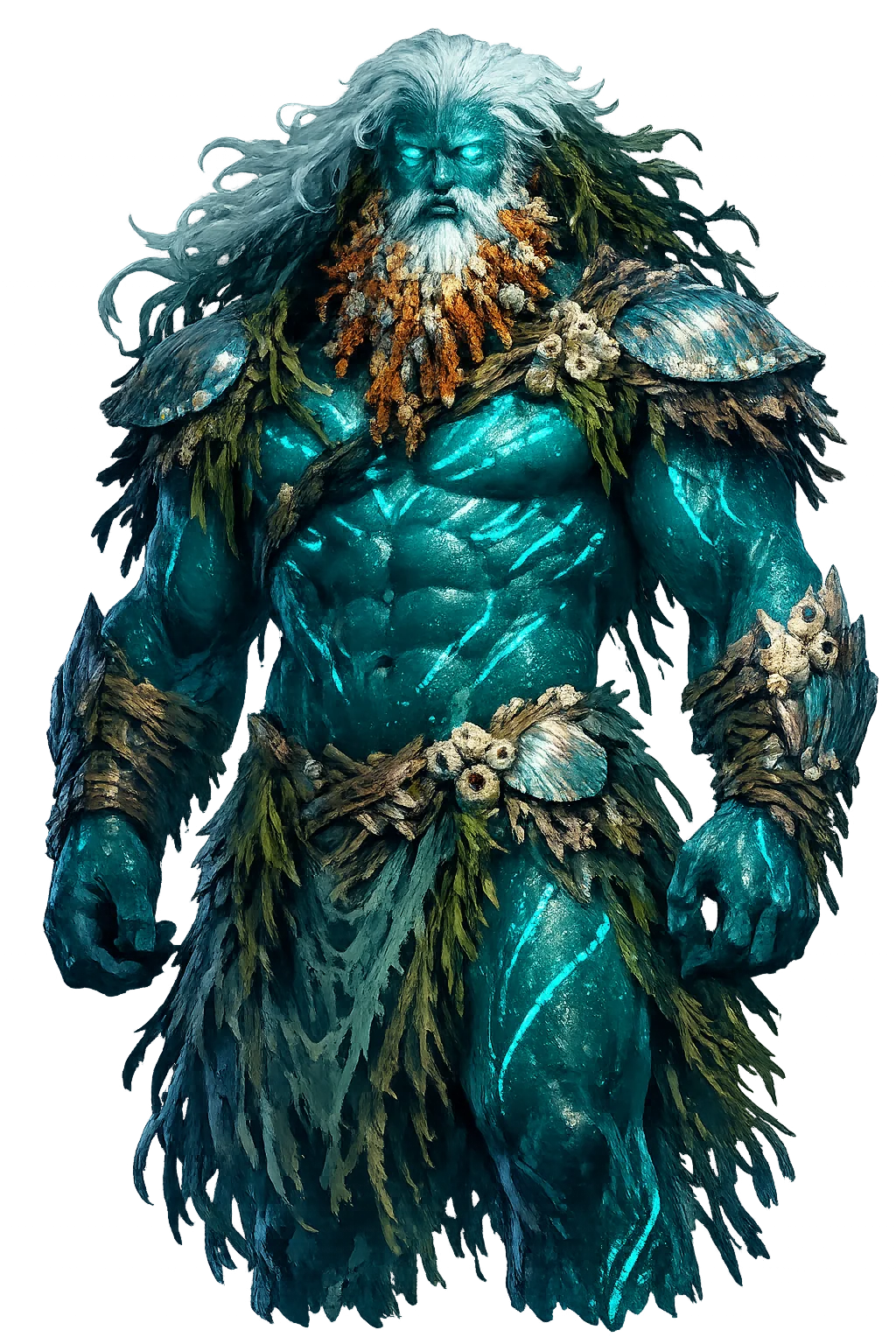
How Póntos got its accent back
The ASCII form pontos is missing something. Póntos restores the marks the source language used to distinguish this name from a thousand others — and those marks change how the name is read, pronounced, and understood. This post explains, with the full scholarly record behind it, what each restored mark preserves: the Greek evidence, the reconstructed sound, the myths the name carries, and the classification logic that separates Tier 1 restorations from Tier 2. By the end, the marks in Póntos will look less like ornaments and more like what they are — recovered evidence, pinned back in its proper place.
At a Glance
- Restored name: Póntos
- ASCII form: pontos
- Meaning: "Sea (from πόντος)"
- Domain of influence: The Primordial Sea
- Pantheon: Greek
- Classification: Tier 2
- Original script: Πόντος (Greek)
- Live domain: póntos.com
Overview
Póntos (pontos — Greek Πόντος) is the primordial Sea of Greek cosmogony: the sea as a body and a parent, older than Poseidôn's rule. In Hesiod's Theogony Gaîa bears him 'without delightful love', together with Ouranós and the Mountains (Th. 126–132), and with Gaia he then fathers the sea's divine population — Nēreus, Thaumas, Phorkys, Kētō, and Eurybia (Th. 233–239). Where Poseidôn is the storm that rules the water, Póntos is the water itself: the surface across which Greek life depended and beneath which Greek sailors feared to go.
PuniCodex restores the name as Póntos and serves its temple at póntos.com. The Greek Πόντος preserves one prosodic feature — the acute stress on the first omicron — rather than both stress and length, which places the name in Tier 2. The plain ASCII form pontos is a modern fallback imposed by the early domain-name system, not an ancient spelling.
The Name
The name is attested in Greek as Πόντος, the common noun for the open sea elevated to a theonym. The traditional etymology derives it from the Indo-European *pont-eh₂-, 'path, crossing': the sea as the route one takes. The same root yields Latin pōns ('bridge', originally 'crossing'), Sanskrit pánthās ('path'), and Old Church Slavonic pǫtь ('way'); within Greek it stands beside πάτος, 'trodden path'. Beekes, however, judges the connection insecure and leaves the word's origin uncertain — possibly Pre-Greek; the dispute is unresolved.
The restoration Póntos writes the acute accent of the original directly in the address bar. The letter-by-letter transformation runs:
- p → P — Pi
- o → ó — Acute on omicron
- n → n — Nu
- t → t — Tau
- o → o — Omicron
- s → s — Sigma
Because the Greek preserves only the stress and no long vowel or diphthong, the name is Tier 2 (accent-preserving); the ASCII pontos is the domain-name system's fallback. The project holds the domain póntos.com (xn--pntos-0ta.com) as the canonical home of this name.
Etymology & Roots
The recorded derivation reads: From πόντος "sea", cognate with Latin pons "bridge, path". The primordial sea.
The reconstructed proto-form is *pont- (proto-indo-european), glossed as "sea, path".
The reconstruction is classed as attested.
Kindred forms recorded in the lexicon:
- pons (latin) — Bridge, path
The Original Script
The name is preserved in Greek as Πόντος — Greek alphabet (Classical / Attic), attested Ancient Greek, c. 8th century BCE – present, in Greece and the Greek-speaking Mediterranean. The script is written left-to-right.
The scholarly transliteration is Póntos (Greek alphabet with polytonic accents), giving the normalized reading /ˈpon.tos/.
The rendering proceeds step by step:
- The Greek form Πόντος is written in the Classical Greek alphabet.
- Letters with acute, grave, or circumflex accents preserve the pitch accent of Ancient Greek.
- Macrons and omegas (η, ω) mark long vowels, a feature lost in the plain ASCII form.
- The Unicode restoration Póntos encodes the scholarly spelling as a registrable domain name.
Pronunciation
The reconstructed Attic pronunciation of the name is /pón.tos/: two syllables, acute pitch on the first, short omicrons throughout.
Phoneme by phoneme:
- Pón- — pi plus short omicron carrying the acute pitch accent.
- -tos — tau, short omicron, sigma: the masculine nominative ending.
For the modern speaker the closest approximation is 'PON-toss', with the first syllable pitched higher, not louder.
Kindred and historical forms of the name:
- PIE pont-eh₂- — 'path, crossing': the traditional root of Greek πόντος, Latin pōns, Sanskrit pánthās (the derivation is disputed by Beekes).
- Greek πάτος (patos), 'trodden path' — the land-bound cousin of the sea-route.
- Πόντος Εὔξεινος (Pontos Euxeinos) — the 'Hospitable Sea': the euphemistic historical name of the Black Sea, earlier Ἄξεινος, 'Inhospitable'.
Póntos is Tier 2 because the Greek Πόντος preserves stress (acute on the short ό) but no long vowel. The name means 'sea' but is traditionally traced to 'path' or 'crossing' — the sea as the route one takes, not merely the water itself.
Mythology
Póntos has few myths because he is a personification rather than a character. His importance is genealogical: he is the source of the sea's divine population.
Son of Gaia (The Birth)
In Hesiod's Theogony (131–132) Gaîa bears Póntos 'without delightful love' — that is, parthenogenetically, together with Ouranós and the Mountains. He is therefore as old as the mountains and as fundamental as the sea itself: the wet, mobile counterpart to the Ourea born beside him.
The Sea Gods and Monsters (The Children)
With Gaia, Póntos fathers Nēreus, the truthful Old Man of the Sea; Thaumas, 'wonder', father of Iris and the Harpies; Phorkys and Kētō, parents of the Graeae, the Gorgons, and the dragon of the Hesperides; and Eurybia, 'wide-force' (Th. 233–239, 265–336). This single genealogy makes him the ancestor of everything monstrous and marvellous in the Mediterranean — Apollodorus retails the same catalogue in handbook form (Library 1.2.6–7).
The Pontos Euxeinos (The Euxine)
The Greeks called the Black Sea the Euxine Pontos, the 'Hospitable Sea' — a euphemism over an older Áxeinos, 'Inhospitable', kept by Pindar in the Argonautic tradition (P. 4.203). Greek colonies lined its coasts from the seventh century BCE; to sail the Pontos was to enter the god's own territory.
Póntos in Ritual (Later Cult)
The sea received the ad hoc religion of seafarers — libations and victims before and after voyages, offered with Poseidôn and the Nēreids — but no Panhellenic sanctuary. Xerxes both whipped the Hellespont for destroying his bridges and, before crossing, poured it a libation from a golden phial: the two faces of Greek traffic with the water (Hdt. 7.35, 7.54).
Symbols & Iconography
No symbols belong to Póntos personally: he never acquired an anthropomorphic type, and so carries no attribute of his own. Ancient art figures the sea itself through metonyms:
- Waves — the curling spiral of water that stands for the sea on vases and reliefs.
- Fish and sea-creatures — the life teeming beneath the surface, from the dolphins of marine thiasos scenes to the ketē (sea-monsters) of the Andromeda type.
- The ship — the human path across his body, and the emblem of the Black Sea city-coinages.
- The divine children — where art needs a face for the sea, it borrows his offspring: Nēreus, Tritōn, the Nēreids riding hippocampi and dolphins.
The trident and the bull from the sea, sometimes loosely assigned to him in modern lists, are Poseidôn's, not Póntos's.
Póntos never acquired a stable anthropomorphic type. Greek art figures the sea indirectly — through waves, fish, ships, and sea-creatures — while the named sea-powers who receive bodies are his children (Nēreus, Tritōn) or Poseidôn himself. The great personified water of archaic art is Ōkeanos, who rings the outermost rim of the Shield of Achilles (Il. 18.607–608), not Póntos. Roman and late-antique mosaics glorify Oceanus and a labeled Thalassa, but images of Póntos are unknown to the standard catalogues; the coinage of the Black Sea cities prefers Poseidôn, Nēreids, or ships.
Epithets & Cult Titles
Póntos has no cult epithets; the tradition offers the epic formulas of the sea instead, the fixed adjectives through which Homer lets the water be known.
- οἴνοψ (oînops) — 'wine-faced, wine-dark'; Homer's stock formula for the open sea (oinopa ponton).
- ἰχθυόεις (ichthyóeis) — 'fish-teeming'; attached to the sea across epic poetry.
- ἄτρυγετος (atrýgetos) — 'unharvested, barren'; the sea as a field that yields no crop.
- Εὔξεινος (Eúxeinos) — 'Hospitable'; the euphemistic renaming of the Black Sea, which Pindar still calls by its older name Ἄξεινος (Áxeinos), 'Inhospitable', when the Argonauts pass its mouth (P. 4.203).
The Homeric Hymns
No Homeric Hymn to Póntos survives — Hymn 22 addresses Poseidôn, the sea's ruler, not the primordial sea itself: seven lines invoking him as 'mover of the earth and of the barren sea, god of the deep who is lord of Helicon and wide Aegae'. The hymn's sea is a ruled element; Póntos is the element itself. Póntos the god is essentially Hesiod's creation: the Theogony has Gaîa bear him 'without delightful love', alongside the Mountains, and then lists his children by Gaia — Nēreus, Thaumas, Phorkys, Kētō, and Eurybia. In Homer, πόντος is simply the common noun 'sea', enriched by stock formulas such as 'wine-dark sea'; the personification belongs to genealogical, not narrative, epic.
Oracle Sites & Sanctuaries
No oracle of Póntos is known, and no Panhellenic sanctuary bore his name; the sea was too impersonal to house. His cult was the ad hoc religion of seafarers: libations and sacrifices before and after voyages, offered to the waters together with Poseidôn and the Nēreids. The most famous recorded acts are Xerxes': after the storm destroyed his first bridges he had the Hellespont given three hundred lashes and fettered (Hdt. 7.35), and before the crossing he poured a libation into it from a golden phial, praying toward the rising sun (Hdt. 7.54) — punishment and propitiation offered to the same water. In the Pontos Euxeinos itself, colonies such as Olbia, Sinope, and Pantikapaion sanctified his shores with harbor temples, though their dedications ran to Apollo, Poseidon, and the civic gods rather than to the personified sea.
Archaeology & Evidence
Póntos himself left no temples: his archaeology is the archaeology of the sea named after him. The Greek colonies of the Euxine — Olbia and Berezan at the Dnieper-Bug estuary, Sinope and her daughter-city Trapezous on the south coast, Pantikapaion on the Cimmerian Bosporus — preserve sanctuaries, harborworks, and city mints from the Archaic period onward. The Olbian bone tablets of the fifth century BCE carry Dionysiac and eschatological graffiti — 'life–death–life', 'peace–war', 'body–soul' — the most personal religious documents of the Pontic colonies, though none invokes the sea-god himself. Underwater archaeology has made the Pontos itself an archive: the Classical wreck at Tektaş Burnu documents the coastal trade of the fifth century, and deep-water survey in the anoxic depths off Sinope (Ballard's expeditions, 2000–2003) found ancient hulls preserved whole in the oxygen-free water.
Realm & Domain
Póntos is the sea as primordial body, older than Poseidôn's rule. He is Gaîa's son, the father of sea-gods and sea-monsters, the surface across which Greek life depended and beneath which Greek sailors feared to go. Where Poseidôn is the storm, Póntos is the water.
The Open Sea
The surface of the deep, the path between cities, the barrier and highway of the Greek world — in Homer the word is simply the sea, 'wine-dark' and 'fish-teeming'.
Father of Sea Powers
With Gaia he fathers Nēreus the Old Man of the Sea, Thaumas (father of Iris and the Harpies), Phorkys and Kētō (parents of the Graeae and the Gorgons), and Eurybia, 'wide-force' (Th. 233–239, 265–291).
The Dangerous Deep
Beneath his surface lie monsters and the unknown; seafarers propitiated the water before and after voyages, most famously when Xerxes poured a libation into the Hellespont from a golden phial (Hdt. 7.54).
The Black Sea
The historical Pontos par excellence: the Euxine, 'Hospitable Sea' — earlier the Axeinos, 'Inhospitable' — ringed by Greek colonies from the seventh century BCE onward.
Scholarly Controversy
The etymology is unresolved — Indo-European *pont-eh₂- 'path' against Beekes's doubt — and the very name of the Black Sea is a euphemism, a case study in how Greeks managed hostile powers by renaming them.
Across Cultures
The Romans had no distinct equivalent of Póntos; they borrowed the name as Pontus for the sea and, above all, for the region south of it. The personification was absorbed into Poseidôn-Neptune, and in later Greek πόντος reverted to the common noun 'sea'. The historical afterlife of the name is geopolitical: the kingdom of Pontus in northern Anatolia, the power of Mithridates VI Eupator, Rome's most stubborn enemy of the first century BCE, took its name from the sea it fronted (Appian, Mithridatic Wars). Modern Greek calls the sea πέλαγος or θάλασσα; 'Pontos' survives in historical and geographical names and in the identity of the Pontic Greeks of the Black Sea coast.
Kindred figures in the PuniCodex cross-tradition index include Ašeratu, Ọbalúayé, Ēa, Manannán, Njǫrðr, and Poseidôn, each linked through sea and water.
Cultural Legacy
Póntos represents the sea as environment rather than deity. The Greeks lived on islands and coasts; the sea was their road, their food source, their enemy, and their horizon, and the colonization of the Pontos Euxeinos made the Black Sea a Greek lake from the seventh century BCE onward. The name's afterlife is geopolitical and human: the kingdom of Mithridates VI, the Roman province, and the Pontic Greek communities of the southern Black Sea coast, whose millennia-long presence ended in the compulsory Greek–Turkish population exchange of 1923. The shift of the sea's own name from Áxeinos ('Inhospitable') to Eúxeinos ('Hospitable') remains the textbook case of apotropaic renaming — managing a dangerous power by flattering it (Strabo 7.3.6). Restoring Póntos restores the name of the primordial sea that made Greek civilization a maritime civilization.
The Scholarly Record
The account of Póntos given in this edition rests on the witnesses and reference works listed below. Lexica and etymological dictionaries secure the form and meaning of the name; the literary, historical, and archaeological works supply the narrative and material evidence.
- Liddell-Scott-Jones Greek-English Lexicon, 9th ed. with 1996 supplement. Full text
- Beekes, Etymological Dictionary of Greek, 2 vols., Brill, 2010. Publisher
- Pape-Benseler, Wörterbuch der griechischen Eigennamen, 3rd ed., 1863. Full text
- Hesiod, Theogony 131–132, 233–336. Full text
- Homer, Iliad and Odyssey (πόντος and the sea-formulas).
- Apollodorus, Library 1.2.6–7. Full text
- Herodotus, Histories 7.35, 7.54.
- Pindar, Pythian 4; Strabo, Geography 7.3.6.
- J. Boardman, The Greeks Overseas, 4th ed., Thames & Hudson, 1999.
A Meditation
Póntos is the sea before it has a mood. He is not angry or calm; he simply is. The Greek vocabulary keeps the distinction: θάλασσα is the sea as the element one swims and fishes, πέλαγος the open expanse, but πόντος is the sea as a single great body — the deep one crosses and cannot argue with. This makes him less dramatic than Poseidôn but more fundamental. The Greeks crossed him, fished him, feared him, and named him, but they never fully domesticated him.
The modern world has mapped the ocean floor and built ships that cross it in days, yet the sea remains alien. Póntos reminds us that most of our planet is not ours. The restoration of his name is a recognition that the sea was a god long before it was a highway.
The Unicode Restoration
Póntos is classified as Tier 2: the original preserves at least one philological feature that ASCII cannot encode. The ASCII fallback pontos still resolves everywhere, but it is the restored form that carries the name's full information. Across the 6 characters of the name, the restoration adjusts 1: 1 mark of stress (ó). That is the whole thesis of this temple: the marks are the message.
The Domain Name
The restored name is live as a working domain: póntos.com, which the DNS carries in punycode form as xn--pntos-0ta.com — an ASCII-compatible encoding that lets a non-ASCII name travel the global network without breaking older infrastructure. The visitor sees Póntos; the machines see the encoding. That duality is the engineering compromise on which the entire restoration rests, and it is why a name written the way its own tradition wrote it in Greek can now be typed into any browser on earth.
Why This Restoration Matters
The marks in Póntos were never lost; they were only waiting for a carrier that could hold them. Now that the carrier exists, the burden flips: every use of pontos is a choice to leave evidence on the table. The PuniCodex temple keeps the restored form in circulation — as a domain, a dataset entry, and a scholarly argument — so that the choice to use it stays easy. Accent by accent, macron by macron, that is how the original names come back: not with a single grand gesture, but with a spelling that finally works everywhere.
Explore Further
This post is one doorway into the temple. The home page carries the full character breakdown and the ambient canvas; the lore page tells the myths in long form; the Scholarly Edition preserves the sources, pronunciation data, and revision history; and the patron wall supports the restoration directly. For the wider map, browse the Lexicon, explore the Pantheon, or return to the PuniCodex blog.
Related Names
Sources
The full scholarly apparatus — every citation, revision, and review — lives in the Scholarly Edition. Key references for this post:
- Hesiod, Theogony 126–132, 233–239.
- Liddell-Scott-Jones Greek-English Lexicon, 9th ed., s.v. πόντος, πάτος.
- Beekes, Etymological Dictionary of Greek (Brill, 2010), s.v. πόντος.
- Apollodorus, Library 1.2.6–7.
- Pape-Benseler, Wörterbuch der griechischen Eigennamen, 3rd ed., 1863.
- Liddell-Scott-Jones Greek-English Lexicon, 9th ed., s.v. πόντος.
- Pindar, Pythian 4.203 (the Ἄξεινος); Strabo, Geography 7.3.6 (the euphemism).
- Homer, Iliad and Odyssey (πόντος as common noun with sea-formulas).
- Herodotus, Histories 7.54.
- Lexicon authorities for this entry: LSJ, Pape-Benseler, Beekes.