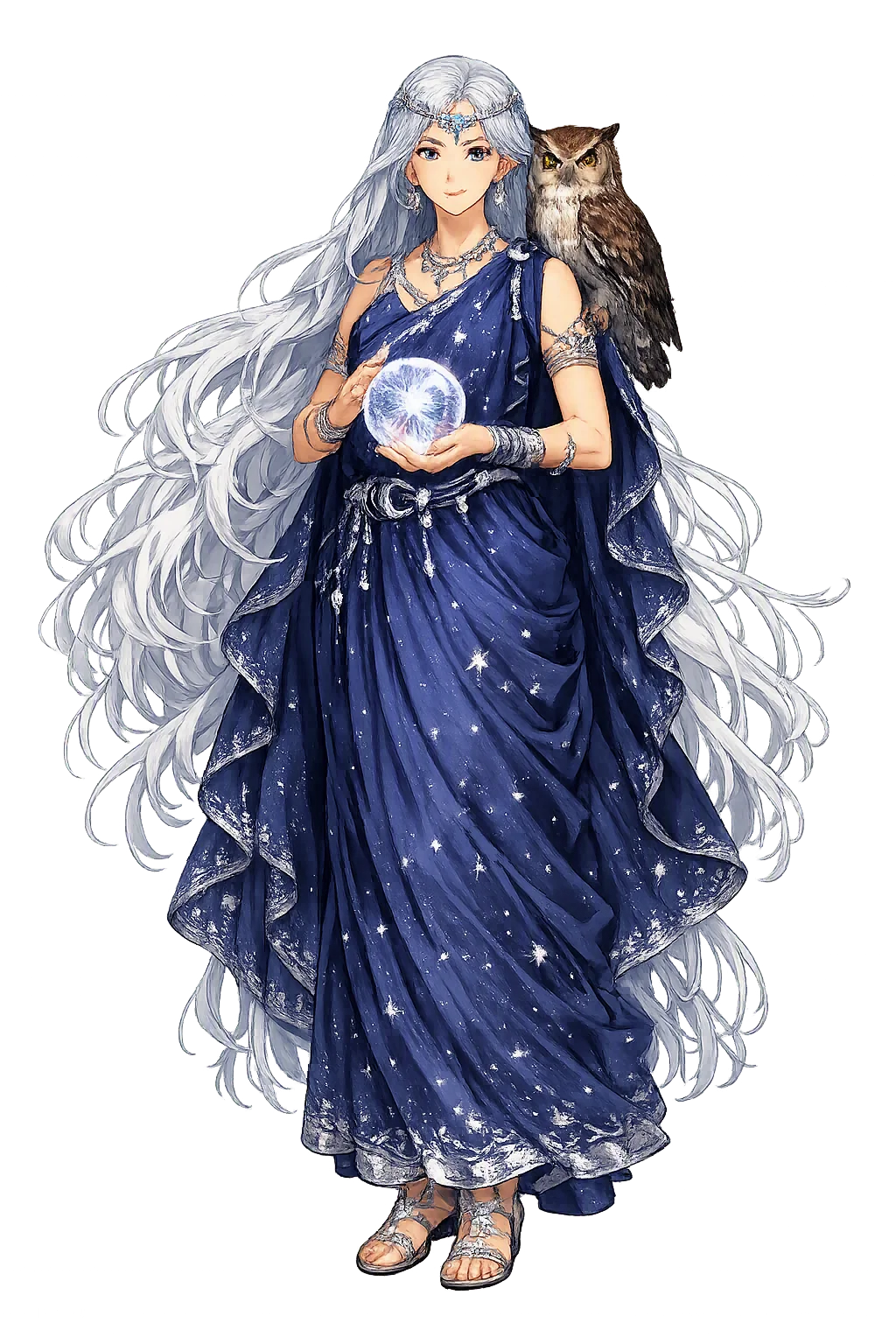
PuniCodex

Extended Lore

Φοίβη Phoíbē

Etymology · Phonology · Orthography · Cultural Legacy · Primary Sources

Tier 1 Phoíbē.com
Phoíbē — Titaness of Prophecy
01

Quick Facts

Essential information about Phoíbē, Titaness of Prophecy

Original ScriptΦοίβη
Unicode RestorationPhoíbē
Reconstructed Pronunciation/pʰóɪ.bɛː/
PantheonGreek
DomainTitaness of Prophecy
MeaningBright, shining
ClassificationTier 1
Primary DomainPhoíbē.com
Sacred SymbolsGolden Crown, Delphic Tripod, Omphalos, Laurel, Prophetic Radiance
02

Etymology & Word Family

From original script to Unicode restoration

Original Script Φοίβη Phoíbē — "Bright, shining"
Unicode Restoration Phoíbē Restored stress, length, and script
Modern ASCII phoebe Plain-ASCII fallback

Tier-1: the Greek Φοίβη carries both an accent (the acute on the diphthong οί) and a long vowel (η), so the restoration Phoíbē preserves stress and quantity together — two facts of the name that plain ASCII 'Phoebe' silently erases.

03

Unicode Character Breakdown

Character-by-character philological analysis

CharacterUnicodeNameBlockPhonetic Role
PU+0050Latin Capital Letter PBasic LatinP uppercase
hU+0068Latin Small Letter HBasic Latinh same
oU+006FLatin Small Letter OBasic Latino same
íU+00EDLatin Small Letter I with AcuteLatin-1 SupplementSpecial character
bU+0062Latin Small Letter BBasic Latinb same
ēU+0113Latin Small Letter E with MacronLatin Extended-AMacron: long vowel

The Tier 1 classification reflects how much of the original phonology this restoration preserves — stress and vowel length for Greek names, distinctive letters and diacritics for every other tradition.

04

Cultural Significance

From ancient cult to modern Unicode

Ancient Domain

Phoíbē is the Titaness of prophecy, the 'shining one' whose name is simply the feminine of φοῖβος, 'bright'. Before Apollo ever spoke at Delphi, the Pythia's own prayer names her the oracle's third keeper — after Gaia and Themis — who passed the seat to her grandson as a birthday gift. She is light as foresight: the radiance that sees before it shines.

Phoíbē in Later Traditions

Phoíbē never received a Roman cult of her own; Rome met her inside Apollo, whose Greek epithet Phoebus became a standard poetic name — and whose name Aeschylus had already declared to be hers (Eumenides 7–8). In Latin poetry the feminine Phoebē then hardens into a name of the moon itself, paired with Phoebus the sun, so the Titaness survives in Rome as a word rather than a worship. Through her granddaughter ArtemisDiana, later poets quietly fold her into the lunar goddess, but the equation remains poetic, never cultic, and no ancient author confuses the two genealogies.

Modern Legacy

The name lives on in English as Phoebe — entering the Christian tradition through Phoíbē of Cenchreae, the deaconess Paul commends to the Roman church (Romans 16:1) — and it has been one of the most durable classical given names in the language ever since. Astronomy keeps the Titaness herself: Phoebe, the dark retrograde outer moon of Saturn discovered by W. H. Pickering in 1899, is named for her, a fitting moon for the Titaness of light. And whenever literature writes 'Phoebus Apollo', it repeats — whether it knows it or not — her name, which Aeschylus says Apollo took from his grandmother. The small American flycatcher called the phoebe, by contrast, is named for its call: a false friend, not a descendant.

Unicode Restoration as Cultural Act

Restoring Phoíbē in a domain name is more than orthographic accuracy. It is a statement that the internet should recognize the full range of human writing — not only the ASCII keyboard.

05

Frequently Asked Questions

Common questions about Phoíbē, Titaness of Prophecy, and Unicode restoration

01How do you pronounce Phoíbē?

In reconstructed pronunciation, Phoíbē is /pʰóɪ.bɛː/ — approximately 'FOY-beh' — the first syllable rhymes with 'boy' and carries the rising pitch; the second is a long, open 'eh', not 'bee'..

02What does Phoíbē mean?

Phoíbē means Bright, shining in the greek tradition.

03What are the symbols of Phoíbē?

Phoíbē is associated with Golden Crown (Hesiod's sole epithet for her in the Titan catalogue — Φοίβην τε χρυσοστέφανον, 'Phoebe of the golden crown' (Theogony 136): the royalty of the eldest generation, and light worn on the brow.), Delphic Tripod (The Pythia's three-legged seat at Delphi, which Aeschylus' succession makes hers third, after Gaia and Themis (Eumenides 1–8) — the one concrete object to which her mythic tenure attaches.), Omphalos (The navel-stone marking Delphi as the center of the world; part of the sanctuary landscape of the oracle she held and handed on. She has no independent iconography — her attributes are Delphi's.), Laurel (The prophetic tree of Delphi, inherited by Apollo together with the seat she gave him; with her it marks the continuity of the shrine rather than a personal emblem.), Prophetic Radiance (Her name itself — the feminine of φοῖβος, 'bright, shining' — is her symbol: light understood as foresight, the gleam that sees ahead.).

04Why restore Phoíbē in Unicode?

Plain ASCII phoebe strips the stress, length, and script that make the name specific. Unicode restoration returns the name to its original written dignity.

05What is the most important myth about Phoíbē?

In the Theogony (132–136), Hesiod catalogues the twelve Titans born to Ouranos and Gaia — Ocean, Koios, Krios, Hyperion, Iapetus, Theia, Rheia, Themis, Mnemosyne, Tethys, and Kronos — and among them 'Phoíbē of the golden crown' (Φοίβην τε χρυσοστέφανον). She is one of the few in the list to carry an epithet at all, and hers is an epithet of light. Hesiod records no deed of hers; the eldest Titans are not actors but origins, the generation from which the Olympian world descends.

06

Scholarly Sources

The philological foundations of this restoration

Every claim on this page is grounded in established scholarship. The orthographic restorations follow disciplinary convention. The etymological chain follows the best available reference works. This is not invention — it is resurrection through scholarship.

Lexicography & Philology

  • Hesiod
  • Liddell, H. G., Scott, R., & Jones, H. S. A Greek-English Lexicon. Oxford: Clarendon Press, 9th ed. 1996.

Primary Texts

  • Hesiod
  • Theogony
  • Aeschylus
  • Apollodorus
  • Pausanias

Archaeology & Art History

  • Material evidence — iconography, inscriptions, and temple archaeology — for Phoíbē and related cults.
  • Phoíbē has no temple, sanctuary, or cult image of her own anywhere in the Greek world — she belongs to genealogy and to Delphi's remembered past rather than to ritual. Her setting is the sanctuary of Apollo at Delphi, where French excavations since 1892 have uncovered the Archaic and Classical temples above the adyton in which the Pythia sat, the very seat whose pre-Apolline tenants the Pythia lists in Aeschylus' prologue; Pausanias (10.5.5–7) records the parallel Delphic tradition of an older oracle of Earth and Themis, passed on until Apollo held it. The omphalos copies and tripod dedications in the Delphi museum are the material shadow of the throne she is said to have kept third.

Religious Studies

  • Comparative studies of greek religion and the place of Phoíbē within it.
Return

The Surface Awaits

You have traced the name from its earliest attestation to its Unicode restoration. Now return to the myth. The story is where the name lives.

Back to Lore
Phoíbē mascot