
Pronouncing Phánēs: a guide for the curious
Saying Phánēs aloud is harder than reading it on a screen, and more rewarding. The restored spelling is a compressed pronunciation guide: every accent and macron is an instruction. This post unpacks those instructions — the reconstructed sound, the phoneme-by-phoneme record, the kindred forms in neighboring languages — and then zooms out to the full record around the name: its Greek writing, its mythology, its cult, and its modern life as a Unicode domain. Whether you arrive as a linguist, a reader of myth, or a domainer, you will leave able to say the name the way the evidence suggests it was said — and able to type it the way it was written.
At a Glance
- Restored name: Phánēs
- ASCII form: phanes
- Meaning: "Bringer of light"
- Domain of influence: Procreation, Light
- Pantheon: Greek
- Classification: Tier 1
- Original script: Φάνης (Greek)
- Live domain: phánēs.com
Overview
Phánēs (phanes) — The First Shining One — belongs to the Greek tradition, where it is catalogued under the domain "Procreation, Light". The name means "Bringer of light".
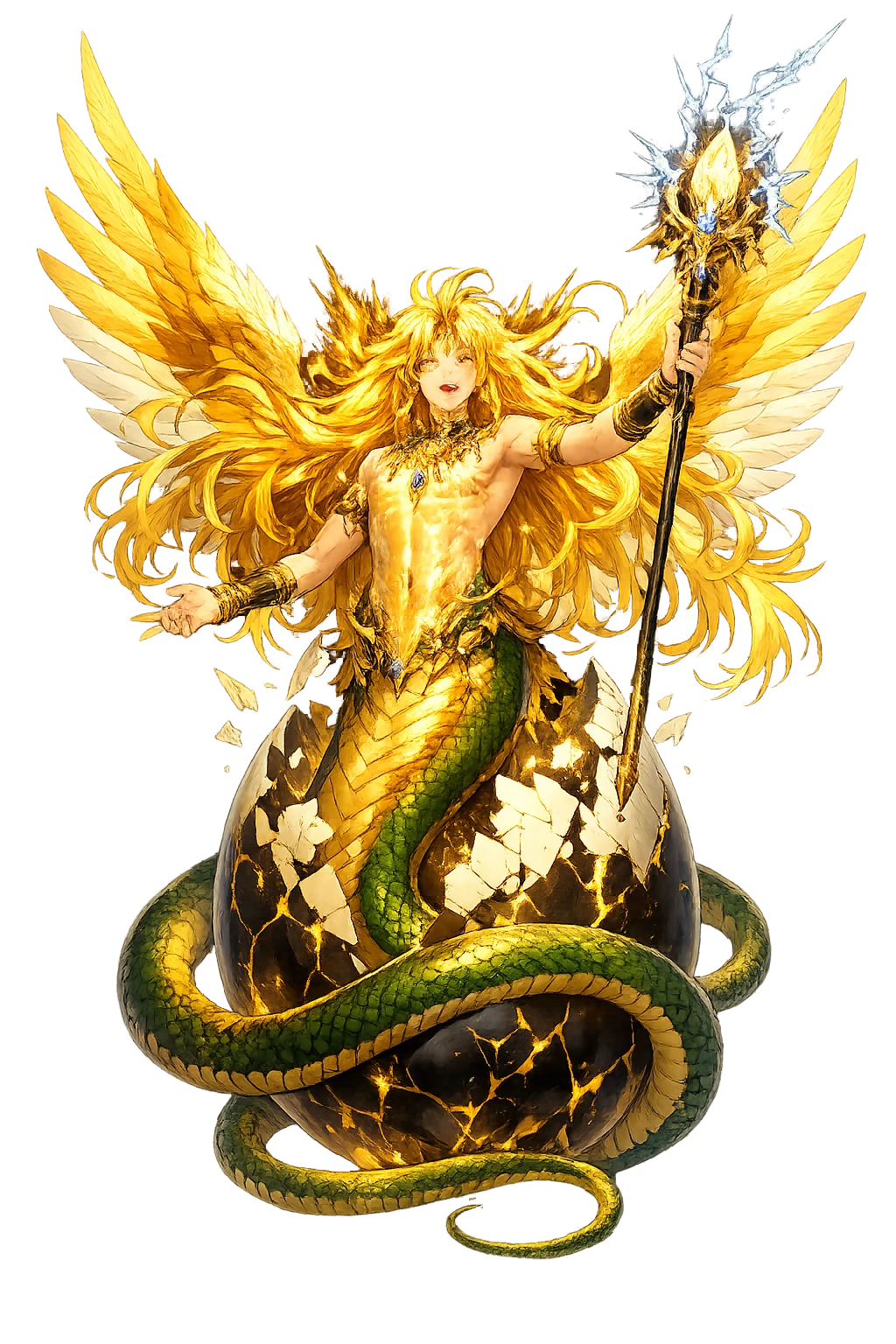
Phánēs is the hidden first god of the Orphic theogonies: hatched from the silver egg of Time, winged and shining, the first form in which the universe could see itself. Zeús himself will swallow him — and in swallowing, become everything.
PuniCodex restores the name as Phánēs and serves its temple at phánēs.com. The original carries both stress and vowel length, and exactly one historically valid Unicode restoration exists, which places the name in Tier 1. The plain ASCII form phanes survives as a modern convenience imposed by the early domain-name system; the restoration, not the fallback, is the form the project defends as philologically complete.
The Name
The name is attested in Greek as Φάνης. Etymologically it means "Bringer of light".
The ASCII form phanes survives only because the early domain-name system could not carry diacritics; it is a technological compromise, not an ancient spelling. The Unicode restoration Phánēs recovers both the stress accent and the vowel length of the original directly in the address bar. The original carries both stress and vowel length, and exactly one historically valid Unicode restoration exists, which places the name in Tier 1.
The letter-by-letter transformation runs:
- p → P — P uppercase
- h → h — h same
- a → á — Acute on a
- n → n — n same
- e → ē — Macron: long vowel
- s → s — s same
The project holds the domain phánēs.com (xn--phns-6na51a.com) as the canonical home of this name.
The Original Script
The name is written in Greek as Φάνης. This original script is the form against which the ASCII fallback phanes and the PuniCodex restoration Phánēs are measured: the restoration preserves both its pitch accent and its vowel quantity of the written form, so that a reader typing the modern address still speaks the ancient name.
Pronunciation
The reconstructed pronunciation of the name is /pʰá.nɛːs/ — Attic Greek.
For the modern speaker, the closest approximation is: FAH-nace, stress on the first syllable with a long ē.
Kindred and historical forms of the name:
- Greek — Φάνης
- Orphic title — Πρωτόγονος
- Owned form — Phánēs
Phánēs takes his name from the verb φαίνω, "to bring to light, to reveal" — the same root as "phenomenon" and "epiphany." The accent is recessive on the first syllable; the long ē of the second syllable is what the macron preserves in the restoration. The Orphic hymns scan the name as two syllables, stress on the first; the Latin poets wrote it Phanes unchanged.
Mythology
Phánēs belongs to the other Greece — the Orphic theogonies sung by initiates, where the cosmos begins not with Chaos' yawn but with an egg, and the first god is light itself given a name.
Born of the Egg (The Hatching)
In the Orphic Rhapsodies, Chronos — Time unaging — fashions a silver egg in the divine aithēr. The egg splits, and Phánēs emerges: double-sexed, four-eyed, golden-winged, a bull-roarer here, a serpent there, "the first-born, the revealer," who brings light to the blessed gods and gives birth to the race of immortals.
Fourth King of the Gods (The Sovereignty)
The Orphic succession differs from Hesiod's: after Ouranós and Kronos, Phánēs holds the sceptre — fourth king, before Zeús. He creates the sun and moon, founds the first Olympus, and rules a cosmos that is still, as the hymns say, "all in one."
Zeús Becomes All (The Swallowing)
The supreme Orphic mystery: Zeús swallows Phánēs whole, and with him the entire first creation. The preserved fragment marvels — "thus all things were made anew within Zeús: sky, earth, sea, the stars, and the blessed gods" — and the cosmos is born a second time from the king's body. Creation is not once but twice: first revealed, then reabsorbed and reborn.
The Derveni Commentary (The Papyrus)
The Derveni papyrus — Europe's oldest surviving book, carbonized in a Macedonian funeral pyre around 340 BCE — quotes the Orphic poem about Protogonos and glosses him as "Mind": the first thing to leap forth. It proves the Phánēs theology was already old, already allegorized, before Plato wrote a word.
Instructions for the Dead (The Tablets)
The Orphic gold tablets, buried with initiates from Thessaly to South Italy, coach the soul for the underworld: avoid the spring of forgetfulness, drink from the lake of memory, and say to the guardians, "I am a child of Earth and starry Heaven; but my race is of Heaven alone." The tablets never name Phánēs — but their cosmology is his: the initiate's soul, like the first-shining one, claims descent from light, and the journey of the dead replays the hatching of the world.
Symbols & Iconography
The iconography associated with Phánēs concentrates in a small set of recurring attributes, each a compressed statement about the name:
- The golden wings — The speed of first light spreading through unformed aithēr
- The egg — The cosmos before division — shell, white, and yolk as earth, sea, and sky
- The serpent wrapped with him — Time and necessity coiled around the first revelation
Almost no certain image survives: an initiatory god has no public iconography. The Modena relief — a winged, sometimes double-sexed figure emerging from an egg, wrapped by the serpent of Time — is the standard candidate, its identification argued from the Orphic attributes. The Mithraic lion-headed god of the Roman mysteries shares his form vocabulary (wings, serpent-coils, keys) and is often reproduced beside him in studies, the identification itself debated. His truest portrait is verbal: the Orphic Hymn's "golden-winged, egg-born, double-sexed, wandering in the ether."
Epithets & Cult Titles
The Orphic tradition gives him more names than any other god — the theology of the many-named first principle.
- Πρωτόγονος (Prōtógonos) — 'First-born'; his formal title in the Derveni papyrus and the Rhapsodies.
- Ἠρικεπαῖος (Ērikepaîos) — the untranslatable ritual name, possibly 'life-giver'; his mystery invocation.
- Φαέθων (Phaéthōn) — 'the Shining'; the name his own name glosses.
- Μῆτις (Mêtis) — 'Counsel'; the Orphic equation of first light with first wisdom.
- Ἔρως (Érōs) — Hesiod's oldest power, absorbed into the Orphic first god.
- Διόνυσος (Diónysos) — in the Orphic succession, Phánēs is Dionysos in his first, pre-Zagreus form.
The Homeric Hymns
The Homeric corpus predates Orphic theology and knows nothing of him; but the Orphic Hymn 6, "To Protogonos," is his liturgy entire: "much-honoured Protogonos I call, double-sexed, great, wandering in the ether, egg-born, golden-winged, loud as a bull, the origin of gods and mortals, the glorious seed." Every attribute of the Rhapsodies is in the hymn — the egg, the wings, the double nature, the primacy — making it the single best surviving document of his cult. The Derveni commentator's equation of Protogonos with Mind is the philosophical gloss composed a century earlier.
Oracle Sites & Sanctuaries
Phánēs had no temples — Orphism was a religion of books and initiates, not of civic sanctuaries. His "sites" are graves: the Derveni tomb near Thessaloniki, where the papyrus commentary on the theogony burned on a pyre around 340 BCE and survived carbonized; the gold-tablet burials of Thurii, Petelia, and Pelinna, whose initiates carried the cosmology's passwords underground; and, in art, the Modena relief of a winged, egg-born god (2nd c. CE), the one candidate image of the first-shining one, kept in the Galleria Estense.
Archaeology & Evidence
Phánēs left no temples — Orphic cult was initiatory and book-based — but two extraordinary documents survive: the Derveni papyrus (Thessaloniki, Archaeological Museum), quoting and interpreting the theogony, and the Orphic gold tablets from graves in Thessaly, Crete, and South Italy, whose instructions to the dead ("I am a child of Earth and starry Heaven") breathe the same cosmology. The Modena relief of a winged, egg-born deity (2nd century CE) is often, if cautiously, associated with his iconography.
Realm & Domain
Phánēs is the hidden first god of the Orphic theogonies: hatched from the silver egg of Time, winged and shining, the first form in which the universe could see itself. Zeús himself will swallow him — and in swallowing, become everything.
The Silver Egg
Formed by Chronos in the aithēr; from it the shining one hatches with golden wings.
Protogonos
"First-born" — his other name; also Erikepaios, Mētis, and bright-winged Erōs.
The Swallowing
Zeús devours Phánēs and with him all that is: sky, earth, sea, and the blessed gods.
The Key of Mind
Orphic verse calls him "the key of the mind" — the first intelligence to shine in darkness.
Across Cultures
Greeks equated him with Erōs (the oldest god in Hesiod's alternative genealogy), with Mētis ("counsel"), and with Dionysos in his first, pre-Zagreus form — Orphism's theology is deliberately fluid. Scholars have long noted the kinship between Phánēs and the Mithraic lion-headed god wrapped by the serpent, and between the Orphic egg and Egyptian and Vedic world-eggs: the "first-shining" is one of humanity's recurring answers to the question of beginnings.
Within the Greek tradition, closely related names in the corpus include [[acheron|Achérōn]], [[achilleus|Achilleús]], [[adamas|Adámas]], [[aer|Aḗr]], [[aither|Aithḗr]], and [[ananke|Anánkē]].
Cultural Legacy
Plato absorbed Orphic creation into the Timaeus; the Neoplatonists made Phánēs a fixed metaphysical grade — Proclus cites him constantly. The word he gives us is as large as his myth: "phenomenon" (that which shines forth), "epiphany," "fantasy." Modern depth psychology's "primordial light" and the physics metaphor of the cosmic egg both descend, by way of Alexandria and Byzantium, from his hatching.
The Scholarly Record
The account of Phánēs given in this edition rests on the witnesses and reference works listed below. Lexica and etymological dictionaries secure the form and meaning of the name; the literary and religious texts supply the narrative evidence.
- Orphic texts and fragments, Orphicorum Fragmenta (Kern); Orphic Hymns, 500 BCE. Full text
- Plato, Dialogues, Loeb Classical Library / Oxford Classical Texts, 348 BCE. Full text
- Liddell-Scott-Jones Greek-English Lexicon, 9th ed. with 1996 supplement, 1843. Full text
- Etymological Dictionary of Greek, 2 vols., Brill, 2010. Full text
- Aristotle, collected works, Loeb Classical Library / Oxford Classical Texts, 322 BCE. Full text
- Cambridge Ancient History, Multiple volumes, 1970. Full text
A Meditation
Phánēs is the god of first versions — the shining draft that must be swallowed and rewritten before the world can be published. Every creator knows him: the first form of anything true is radiant, total, and unusable, and only its sacrifice makes the durable cosmos. He asks a hard question: what are you willing to swallow of your first light so that something greater can be born?
The Orphic initiates buried with their gold tablets understood him as instruction, not cosmology: remember that you are hatched from light, and the dark of the grave is only the egg's second shell. That is why his cult left no temples and his myth left no images — the first-shining one is not worshipped but recognized, in every first draft, every first light, every beginning that must be swallowed before the real world can begin.
The Unicode Restoration
Phánēs is classified as Tier 1: the original carries both stress and length, and only one valid Unicode restoration exists. The ASCII fallback phanes still resolves everywhere, but it is the restored form that carries the name's full information. Across the 6 characters of the name, the restoration adjusts 2: 1 mark of stress (á); 1 mark of length (ē). That is the whole thesis of this temple: the marks are the message.
Character by Character
The journey from phanes to Phánēs, one character at a time:
- p → P — P uppercase
- h → h — h same
- a → á — Acute on a
- n → n — n same
- e → ē — Macron: long vowel
- s → s — s same
The Domain Name
The restored name is live as a working domain: phánēs.com, which the DNS carries in punycode form as xn--phns-6na51a.com — an ASCII-compatible encoding that lets a non-ASCII name travel the global network without breaking older infrastructure. The visitor sees Phánēs; the machines see the encoding. That duality is the engineering compromise on which the entire restoration rests, and it is why a name written the way its own tradition wrote it in Greek can now be typed into any browser on earth.
The Greek Pantheon
Phánēs is one of 268 entries the PuniCodex lexicon catalogues under the Greek pantheon. The Pantheon page gathers the tradition's major figures in one place, and the Lexicon lets you filter all 915 restorations by tradition, tier, or script — the fastest way to see where this name sits among its kin.
Frequently Asked Questions
What does Phánēs mean? The traditional gloss is "Bringer of light."
Which tradition does Phánēs belong to? Phánēs is catalogued in the Greek pantheon of the PuniCodex lexicon.
Why is Phánēs classified as Tier 1? Because the original carries both stress and length, and only one valid Unicode restoration exists — and the marks in the restored spelling preserve exactly that evidence.
Is Phánēs a working domain? Yes — phánēs.com resolves today and routes to this temple.
What is the punycode for phánēs.com? The DNS encoding is xn--phns-6na51a.com; browsers perform the translation automatically, so visitors only ever see the restored name.
Typing Phánēs
You do not need a special keyboard to use this restoration. The PuniCodex Type Tool converts the ASCII form phanes into Phánēs as you type, and the browser extension offers the same conversion inside any text field. Copy the restored form, paste it into the address bar, and the DNS does the rest.
Sister Temples
Other temples in the Greek pantheon include Diónysos, Eirḗnē, and Ēōs — each with its own restoration story, its own scholarly record, and its own place in the lexicon.
Why This Restoration Matters
Pronunciation turns out to be the heart of the matter. The marks in Phánēs are instructions for the voice, and a web that strips them is a web that mispronounces the past at scale. The restoration hands the instructions back: say it as the evidence suggests, type it as the tradition wrote it, and let the punycode machinery do the quiet translation in between. That is all the PuniCodex project asks of the infrastructure — and everything it asks of you, the reader, is to use the whole name.
Explore Further
This post is one doorway into the temple. The home page carries the full character breakdown and the ambient canvas; the lore page tells the myths in long form; the Scholarly Edition preserves the sources, pronunciation data, and revision history; and the patron wall supports the restoration directly. For the wider map, browse the Lexicon, explore the Pantheon, or return to the PuniCodex blog.
Related Names
Sources
The full scholarly apparatus — every citation, revision, and review — lives in the Scholarly Edition. Key references for this post:
- Orphic texts and fragments, Orphicorum Fragmenta (Kern); Orphic Hymns, 500 BCE.
- Plato, Dialogues, Loeb Classical Library / Oxford Classical Texts, 348 BCE.
- Liddell-Scott-Jones Greek-English Lexicon, 9th ed. with 1996 supplement, 1843.
- Etymological Dictionary of Greek, 2 vols., Brill, 2010.
- Aristotle, collected works, Loeb Classical Library / Oxford Classical Texts, 322 BCE.
- Cambridge Ancient History, Multiple volumes, 1970.
- Orphic Hymns.
- Derveni Papyrus.
- Orphic Fragments (Kern) 60–167; Derveni Papyrus col. XIII–XXVI.
- Orphic Hymn 6 (Athanassakis & Wolkow); Derveni Papyrus col. XVI.
- Lexicon authorities for this entry: Orphic, West.