
How Persephonē got its accent back
The ASCII form persephone is missing something. Persephonē restores the marks the source language used to distinguish this name from a thousand others — and those marks change how the name is read, pronounced, and understood. This post explains, with the full scholarly record behind it, what each restored mark preserves: the Greek evidence, the reconstructed sound, the myths the name carries, and the classification logic that separates Tier 1 restorations from Tier 2. By the end, the marks in Persephonē will look less like ornaments and more like what they are — recovered evidence, pinned back in its proper place.
At a Glance
- Restored name: Persephonē
- ASCII form: persephone
- Meaning: "She who destroys the light (possibly)"
- Domain of influence: Spring, Underworld, Vegetation
- Pantheon: Greek
- Classification: Tier 1
- Original script: Περσεφόνη (Greek)
- Live domain: persephonē.com
Overview
Persephonē (persephone) — The Maiden · The Iron Queen — belongs to the Greek tradition, where it is catalogued under the domain "Spring, Underworld, Vegetation". The name means "She who destroys the light (possibly)".
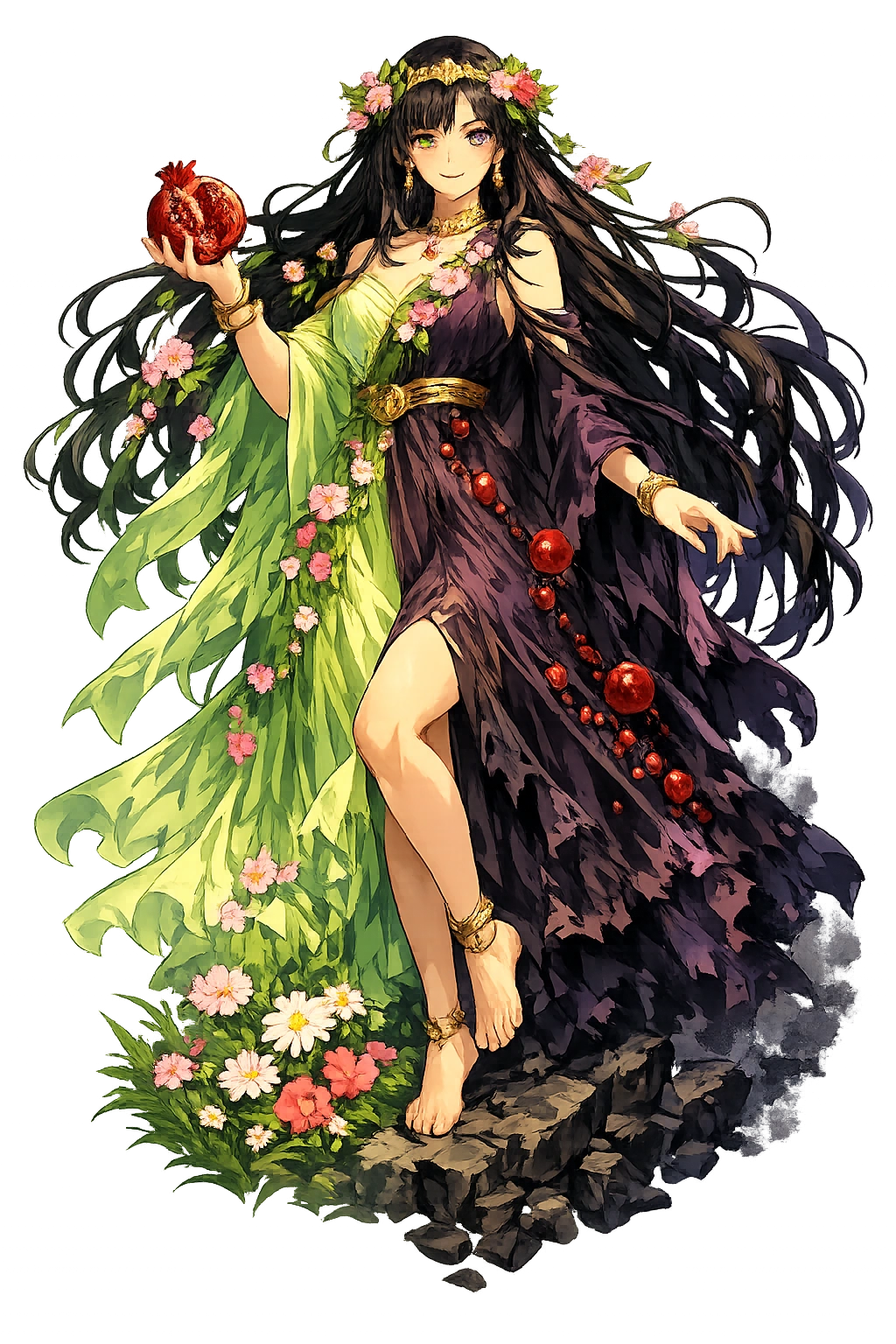
Persephonē is the only Greek deity who is fully at home in two worlds. For half the year she is the maiden Kore, daughter of Dēmētēr and goddess of spring; for the other half she is the dread queen of the dead, Hādēs's wife. Her double life is the Greek explanation for everything that dies and returns.
PuniCodex restores the name as Persephonē and serves its temple at persephonē.com. The original carries both stress and vowel length, and exactly one historically valid Unicode restoration exists, which places the name in Tier 1. The plain ASCII form persephone survives as a modern convenience imposed by the early domain-name system; the restoration, not the fallback, is the form the project defends as philologically complete.
The Name
The name is attested in Greek as Περσεφόνη. Etymologically it means "She who destroys the light (possibly)".
The reconstructed proto-form is per-ʰseh₂- (proto-indo-european, "to emerge, to destroy"). Possibly from πέρθω "to destroy" + φόνος "murder", or pre-Greek. Queen of the Underworld.
The ASCII form persephone survives only because the early domain-name system could not carry diacritics; it is a technological compromise, not an ancient spelling. The Unicode restoration Persephonē recovers the vowel length of the original directly in the address bar. The original carries both stress and vowel length, and exactly one historically valid Unicode restoration exists, which places the name in Tier 1.
The letter-by-letter transformation runs:
- p → P — Pi
- e → e — Short epsilon
- r → r — Rho
- s → s — Sigma
- e → e — Short epsilon
- p → p — Pi
- h → h — Phi
- o → o — Short omicron
- n → n — Nu
- e → ē — Eta: long epsilon
The project holds the domain persephonē.com (xn--persephon-jhb.com) as the canonical home of this name.
Etymology & Roots
The recorded derivation reads: Possibly from πέρθω "to destroy" + φόνος "murder", or pre-Greek. Queen of the Underworld.
The reconstructed proto-form is *per-ʰseh₂- (proto-indo-european), glossed as "to emerge, to destroy".
The reconstruction is classed as disputed.
The Original Script
The name is preserved in Greek as Περσεφόνη — Greek alphabet (Classical / Attic), attested Ancient Greek, c. 8th century BCE – present, in Greece and the Greek-speaking Mediterranean. The script is written left-to-right.
The scholarly transliteration is Persephonē (Greek alphabet with polytonic accents), giving the normalized reading /perseˈpʰonɛː/.
The rendering proceeds step by step:
- The Greek form Περσεφόνη is written in the Classical Greek alphabet.
- Letters with acute, grave, or circumflex accents preserve the pitch accent of Ancient Greek.
- Macrons and omegas (η, ω) mark long vowels, a feature lost in the plain ASCII form.
- The Unicode restoration Persephonē encodes the scholarly spelling as a registrable domain name.
Pronunciation
The reconstructed pronunciation of the name is /per.se.pʰó.nɛː/ — Attic Greek Reconstruction.
Phoneme by phoneme:
- Per- — Pi plus short epsilon and rho — the name begins with a light, searching sound.
- -se- — Sigma-epsilon, the soft transition between worlds.
- -phó- — Aspirated phi with acute on short omicron — the stressed peak, like a cry in the dark.
- -nē — Long eta, the final vowel that opens into the underworld.
For the modern speaker, the closest approximation is: 'per-seh-FOH-nay' — the third syllable carries the pitch, and the final 'nay' is long and solemn.
Kindred and historical forms of the name:
- PIE — per- 'to strike' + -se- + *-phon-? — etymology disputed; the name may be Pre-Greek
- Greek folk etymology — φονεύς (phoneus), 'killer' — ancient speakers sometimes connected her name to death
- Mycenaean — pe-re-se-u-ne / Pe-re-swa, possible Bronze Age precursors
Persephonē is Tier 1 because the Greek Περσεφόνη contains both stress (acute on the short ό) and length (long η in the final syllable). The name's etymology is uncertain, which suits a goddess who moves between the known and hidden worlds.
Mythology
Persephonē's mythology is the Homeric Hymn to Demeter. Every later retelling is a variation on that poem's architecture of loss, grief, negotiation, and return.
The Narcissus and the Void (The Abduction)
In the Homeric Hymn to Demeter (lines 1–89), Persephonē gathers flowers in a meadow near Eleusis when the earth opens and Hādēs carries her away in a golden chariot. Only the helmsman of the sun, Hēlios, sees the abduction. The narcissus she reaches for was planted by Gaia at Zeús's command — a divine trap that makes the earth itself complicit in her descent.
Demeter's Wanderings (The Search)
Dēmētēr searches for her daughter for nine days, bearing torches. Hekátē hears the cry and joins the search; Hēlios finally reveals Hādēs's guilt. Dēmētēr's grief withdraws fertility from the earth, threatening all life. The gods are forced to negotiate because even immortals depend on the grain she withholds.
The Pomegranate Seed (The Compromise)
Hermês retrieves Persephonē, but because she has eaten a pomegranate seed — some say one, some say a few — she must return to Hādēs for part of each year. The number of seeds varies in tradition, but the principle is fixed: any food eaten in the underworld binds the eater there. The seed is the knot of the myth: it makes return possible only by making departure necessary.
Persephonē Koreia (The Queen)
In the underworld Persephonē is not merely a prisoner. She is Haides' basilissa, the queen who shares Hādēs's throne. In Orphic and mystery traditions she becomes a merciful judge of the dead, gentler than her husband. The Spartans called her Persophoneia and honored her as a goddess of childbirth and marriage. Her double nature — maiden and queen, living and dead — made her one of the most theologically complex figures in Greek religion.
Symbols & Iconography
The attributes of Persephonē in art and cult form a coherent cycle — flower, seed, torch, grain — and each is fixed by a specific ancient witness:
- Narcissus — The hundred-bloomed flower Earth grows at Zeús's will "as a snare for the bloom-like girl"; she reaches for it and the plain opens beneath her (Homeric Hymn to Demeter 8–16, 428–429).
- Pomegranate — The seed Hādēs secretly gives her to eat; because she tastes it, she must spend a third part of the year below (Hymn 371–374, 398–400, 411–413).
- Torch — The torches Dēmētēr carries in her nine-day search and Hekátē's torch on the tenth day belong to her story; in cult and art the torch becomes her own attribute as the goddess who ascends (Hymn 47–48, 51–58).
- Sheaf of wheat — Her return restores the grain: reunited with her daughter, Dēmētēr makes the Rharian plain wave with long ears of corn (Hymn 450–456).
- Crown or diadem — As "dread Persephoneia" (epainē) she is queen of the dead, enthroned beside Hādēs in the Odyssey's underworld scenes.
- Black ram — The victim prescribed for her cult below: Kirkē instructs Odysseús to sacrifice a ram and a black ewe toward Erebus while praying to Hādēs and dread Persephoneia (Odyssey 10.521–527).
Three types recur. As Kore she is a draped maiden beside Dēmētēr, distinguished by torch, sheaf of wheat, or pomegranate — the pairing of the Two Goddesses is one of the commonest subjects of Attic votive relief. The abduction scene, Hádēs' chariot wheeling round with the struggling maiden, becomes a set piece of South Italian vase painting. As queen she sits enthroned beside Hádēs in underworld scenes, sceptered and calm, receiving the arriving dead. The Locrian pinakes give her an iconography of her own: Kore with the rooster, the pomegranate, and the bridal torch. Roman sarcophagi developed the type of Proserpina as the mourning or returning figure of the seasonal cycle.
Epithets & Cult Titles
- Κόρη (Kore) — 'the Maiden' — her universal cult name at Eleusis and across the Greek world; 'the Mother and the Maiden' names the Eleusinian pair.
- ἁγνή (hagne) — 'holy, pure' — the recurring address of the Hymn to Demeter and of cult.
- ἐπαινή (epainē) — 'dread, awful' — Homer's fixed formula in Iliad 9 and the Odyssey's underworld scenes: 'dread Persephoneia,' queen of the dead.
- Φερρέφαττα (Pherrephatta) — the Attic name-form (Homer has Phersephoneia), preserved in comedy and inscriptions.
- Δέσποινα (Despoina) — 'the Mistress' — the Arcadian Kore-figure worshipped with Demeter at Lycosura.
- Βριμώ (Brimō) — 'the roaring one' — her invocation in Orphic and magical texts, shared with Hekátē.
The Homeric Hymns
No hymn is addressed to Persephonē alone, but the second Homeric Hymn, to Demeter — the longest and most consequential of the corpus — is her story: the gathering of flowers, the narcissus planted as a snare, the abduction by Hádēs in the golden chariot, Dēmētēr's torch-lit search, and the compromise of the pomegranate seed that divides her year between the living and the dead. The hymn calls her revered (aidoiē) Persephoneia, the slender-ankled daughter whose loss drives the whole narrative. The brief Hymn 13 opens with the paired invocation of Demeter 'and her daughter, most beautiful Persephoneia,' fixing the two as a single cult unit, the Two Goddesses of Eleusis. Later hexameter tradition gave her a hymn of her own: Orphic Hymn 29 addresses Persephone as queen of the dead and source of the year's return.
Oracle Sites & Sanctuaries
Persephonē had no oracle; her worship was mystery and agrarian cult. Eleusis is the center — the Telesterion of the Mysteries celebrated her descent and return, with the 'Mirthless Rock' where the grieving Dēmētēr sat. The Persephoneion of Locri Epizephyrii in south Italy, famous for its thousands of terracotta pinakes showing Kore's marriage and abduction, was the greatest Italic sanctuary of the goddess. Sicily claimed the rape itself: the meadow by Lake Pergusa near Enna was shown as the spot where the earth opened for Hádēs' chariot. In Arcadia, the hilltop sanctuary of Despoina and Demeter at Lycosura honored her local double beside the mother.
Archaeology & Evidence
Her cult landscape is unusually well documented. At Eleusis the Telesterion — the vast roofed hall of the Mysteries with its inner chamber, the Anaktoron — housed the rites of her descent and return; Pausanias places the very spot of the abduction nearby at Erineus on the Cephisus, "where Pluto descended to the lower world after carrying off the Maid," and the "Laughless Rock" on which the grieving Dēmētēr sat was still shown in later antiquity. At Locri Epizephyrii in Calabria, the fifth-century Persephoneion at Mannella yielded thousands of terracotta pinakes — the goddess receiving worshippers, her marriage, her abduction — now in the Museo Archeologico Nazionale of Reggio Calabria. Sicily claimed the rape itself: Cicero describes Lake Pergusa near Enna as the universally known site where Proserpina was carried off, and her image appears on Syracusan coinage and in terracotta votives.
Realm & Domain
Persephonē is the only Greek deity who is fully at home in two worlds. For half the year she is the maiden Kore, daughter of Dēmētēr and goddess of spring; for the other half she is the dread queen of the dead, Hādēs's wife. Her double life is the Greek explanation for everything that dies and returns.
Spring and Return
Her ascent from the underworld brings the grain and flowers of spring; her return is the return of life.
Queen of the Dead
In the underworld she sits beside Hādēs and rules the shades with a power no other Olympian has below.
Vegetation Mysteries
The sprouting seed is her; the buried grain is her; the mystery of Eleusis centers on her journey.
Initiation and Rebirth
Initiates at Eleusis reenact her descent and return, hoping for the same promise in death.
Across Cultures
The Romans identified Persephonē with Proserpina, a goddess whose name may derive from the Latin proserpere, 'to emerge.' The Proserpina myth preserved the same seasonal structure. In later antiquity she was drawn into the orbit of Egyptian Isis as a savior goddess and identified with the moon, whose monthly disappearance and return mirrored her own: Plutarch's treatise on the face of the moon makes Persephone its divine name. The Eleusinian cult spread across the Roman Empire, and emperors including Hadrian were initiated. Christian apologists such as Clement of Alexandria attacked the mysteries in detail, yet the themes of descent and return they condemned passed into Christian imagery of death and rebirth.
Kindred figures in the PuniCodex cross-tradition index include Hádēs, Kānāloa, Kēr, Mōt, and Thánatos, each linked through underworld / death.
Cultural Legacy
Persephonē is the archetype of the goddess who descends and returns: her myth supplied the narrative grammar — descent, disappearance, return — that the mystery cults of the Roman Empire made their own. The Bacchic gold tablets buried with initiates in South Italy and Crete instruct the dead to present themselves before Persephone as queen of the underworld, whose favor sends them to the seats of the blessed; they are the clearest surviving evidence that her worship promised a personal afterlife. English literature meets her most famously in Milton's evocation of "that fair field of Enna, where Proserpin gathering flowers, herself a fairer flower, by gloomy Dis was gathered" (Paradise Lost 4.268–272). In the twentieth century C. Kerényi's essay "Kore," written alongside C. G. Jung, made her the classical model for the psychology of the maiden who must separate from her mother, enter darkness, and return transformed. Restoring Persephonē restores the name of the goddess who makes death temporary.
The Scholarly Record
The account of Persephonē given in this edition rests on the witnesses and reference works listed below. Lexica and etymological dictionaries secure the form and meaning of the name; the literary and religious texts supply the narrative evidence.
- Liddell-Scott-Jones Greek-English Lexicon, 9th ed. with 1996 supplement, 1843. Full text
- Etymological Dictionary of Greek, 2 vols., Brill, 2010. Full text
- Wörterbuch der griechischen Eigennamen, 3rd ed., 1863. Full text
- Homeric Hymn to Demeter.
- Hesiod, Theogony, Loeb Classical Library No. 57, 700 BCE. Full text
- Pausanias, Description of Greece.
- Clinton, Myth and Cult.
A Meditation
Persephonē is the only Greek god who must live in two places. She is not half-dead; she is fully alive in both realms. That is the terror and the promise of her myth: death is not a wall but a season. The grain goes under the earth and comes back; the girl goes under the earth and comes back. The pattern is the same, and the Hymn fixes its arithmetic: two parts of the circling year with her mother and the gods, one part below with her husband.
Modernity has largely lost this cyclical imagination. We treat death as an ending and grief as a pathology. Persephonē offers a different grammar: descent is part of the year. The restoration of her name is a small act of faith that what disappears may also return.
The Unicode Restoration
Persephonē is classified as Tier 1: the original carries both stress and length, and only one valid Unicode restoration exists. The ASCII fallback persephone still resolves everywhere, but it is the restored form that carries the name's full information. Across the 10 characters of the name, the restoration adjusts 1: 1 mark of length (ē). That is the whole thesis of this temple: the marks are the message.
The Domain Name
The restored name is live as a working domain: persephonē.com, which the DNS carries in punycode form as xn--persephon-jhb.com — an ASCII-compatible encoding that lets a non-ASCII name travel the global network without breaking older infrastructure. The visitor sees Persephonē; the machines see the encoding. That duality is the engineering compromise on which the entire restoration rests, and it is why a name written the way its own tradition wrote it in Greek can now be typed into any browser on earth.
Why This Restoration Matters
The marks in Persephonē were never lost; they were only waiting for a carrier that could hold them. Now that the carrier exists, the burden flips: every use of persephone is a choice to leave evidence on the table. The PuniCodex temple keeps the restored form in circulation — as a domain, a dataset entry, and a scholarly argument — so that the choice to use it stays easy. Accent by accent, macron by macron, that is how the original names come back: not with a single grand gesture, but with a spelling that finally works everywhere.
Explore Further
This post is one doorway into the temple. The home page carries the full character breakdown and the ambient canvas; the lore page tells the myths in long form; the Scholarly Edition preserves the sources, pronunciation data, and revision history; and the patron wall supports the restoration directly. For the wider map, browse the Lexicon, explore the Pantheon, or return to the PuniCodex blog.
Related Names
Sources
The full scholarly apparatus — every citation, revision, and review — lives in the Scholarly Edition. Key references for this post:
- Liddell-Scott-Jones Greek-English Lexicon, 9th ed. with 1996 supplement, 1843.
- Etymological Dictionary of Greek, 2 vols., Brill, 2010.
- Wörterbuch der griechischen Eigennamen, 3rd ed., 1863.
- John Milton, Paradise Lost 4.268–272 (1667)./Book_IV)
- Hesiod, Theogony, Loeb Classical Library No. 57, 700 BCE.
- Homeric Hymn to Demeter, lines 8–16, 371–374, 398–400, 411–413, 450–456.
- Homer, Odyssey 10.521–527 (sacrifice to Hades and Persephone); cf. Iliad 9.457.
- Plutarch, De facie in orbe lunae 942D–943E (Persephone as the moon).
- Historia Augusta, Hadrian 13.1 (initiation at Eleusis).
- Lexicon authorities for this entry: LSJ, Pape-Benseler, Beekes.