
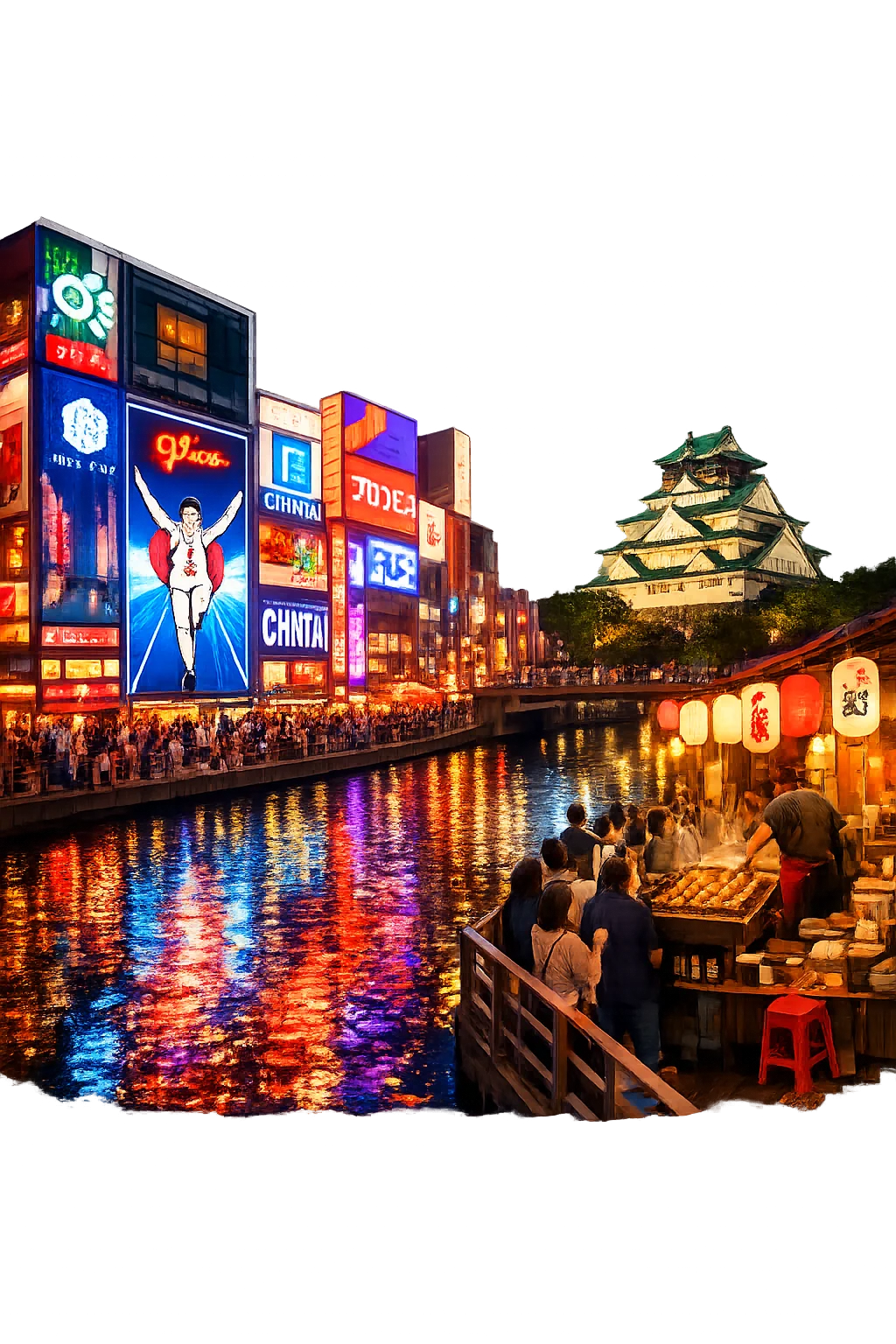
Ōsaka, spelled the way the sources wrote it
Some restorations are cosmetic. Ōsaka is not — the marks in this name are the difference between reading the sources and guessing at them.
Ōsaka began as the ancient port of Naniwa, gateway to the Asian continent and briefly an imperial capital. It later became the merchant city par excellence — the 'kitchen of the nation' — and the fortress from which Toyotomi Hideyoshi sought to rule a unified Japan. Long before it was called Ōsaka, the area was known as Naniwa. The Nihon Shoki records that Emperor Nintoku's great tomb rose on the Osaka plain, and in 645 Emperor Kōtoku moved the capital to Naniwa Nagara Toyosaki-no-miya, making it Japan's first official capital.
That is the figure this file is about — and the temple now standing at its restored name.
At a Glance
- Restored name: Ōsaka
- ASCII form: osaka
- Meaning: "Large hill or slope"
- Domain of influence: Merchant City, Kansai
- Pantheon: Japanese
- Classification: Tier 1
- Original script: 大阪
- Series: The Restoration Files, No. 182 of 271
The Name Before the Marks
The name is attested as 大阪. On the evidence, it means "Large hill or slope".
Strip Ōsaka to osaka and one piece of evidence vanishes:
- o → Ō — Macron: long vowel: the vowel length the ASCII form cannot show.
A reader who knows the marks hears the name correctly on the first try. A reader who never sees them never gets the chance.
The Temple That Stands Now
The restored name is not a plaque; it is an address. The temple of Ōsaka lives at /sites/osaka/, with its mythology in the lore halls, its peer-reviewed record in the Scholarly Edition, and its place in the pattern atlas on the patterns floor.
The restoration preserves more than the ASCII form can say — stress, length, or a letter the Latin keyboard lost — which places it in Tier-1: mechanically verifiable, information-rich.
Every flagship temple is hand-built to the same standard: the original script displayed with its provenance, the pronunciation reconstructed phoneme by phoneme, the sources named — because a restoration you cannot audit is just a spelling with confidence.
The Archetype at Work
A temple is also a reading of what this figure means — and meanings have addresses in the modern world. The pattern atlas maps Ōsaka to the industries its archetype genuinely resonates with, each match argued, weighted, and open to challenge:
- Travel, Tourism & Place Branding — The merchant city; food tourism’s capital.
- Agriculture, Food & Harvest — Historically “the nation’s kitchen”; Japan’s food and merchant capital.
- Finance, Wealth & Commerce — The merchant city; Japan’s historic exchange floor.
The mapping is conservative on purpose: only resonances that can be argued aloud. The rest of the atlas follows the same rule, industry by industry.
In the Sacred Texts
The Japanese tradition is not a vibe; it is a library. The Sacred Texts collection holds Kojiki and Nihon Shoki — the primary sources the temple's scholarship is built on, free to read, cross-linked back to the names they mention. The temple is the argument; the texts are the evidence.
The File Continues
This is one of 271 Restoration Files — a second dispatch from every flagship temple in the fleet. The temple's first dispatch tells the founding story of the name; the blog index holds the whole archive.
Continue the series — previous file: Ọrúnmìlà (read it here) · next file: Ọṣun (read it here).
The Restoration Files are written from the same canonical record as the temples themselves: the lexicon, the lore catalog, the pattern atlas, and the cited scholarly sources. If a file ever disagrees with its temple, the temple is right — tell us, and the file will be corrected.