
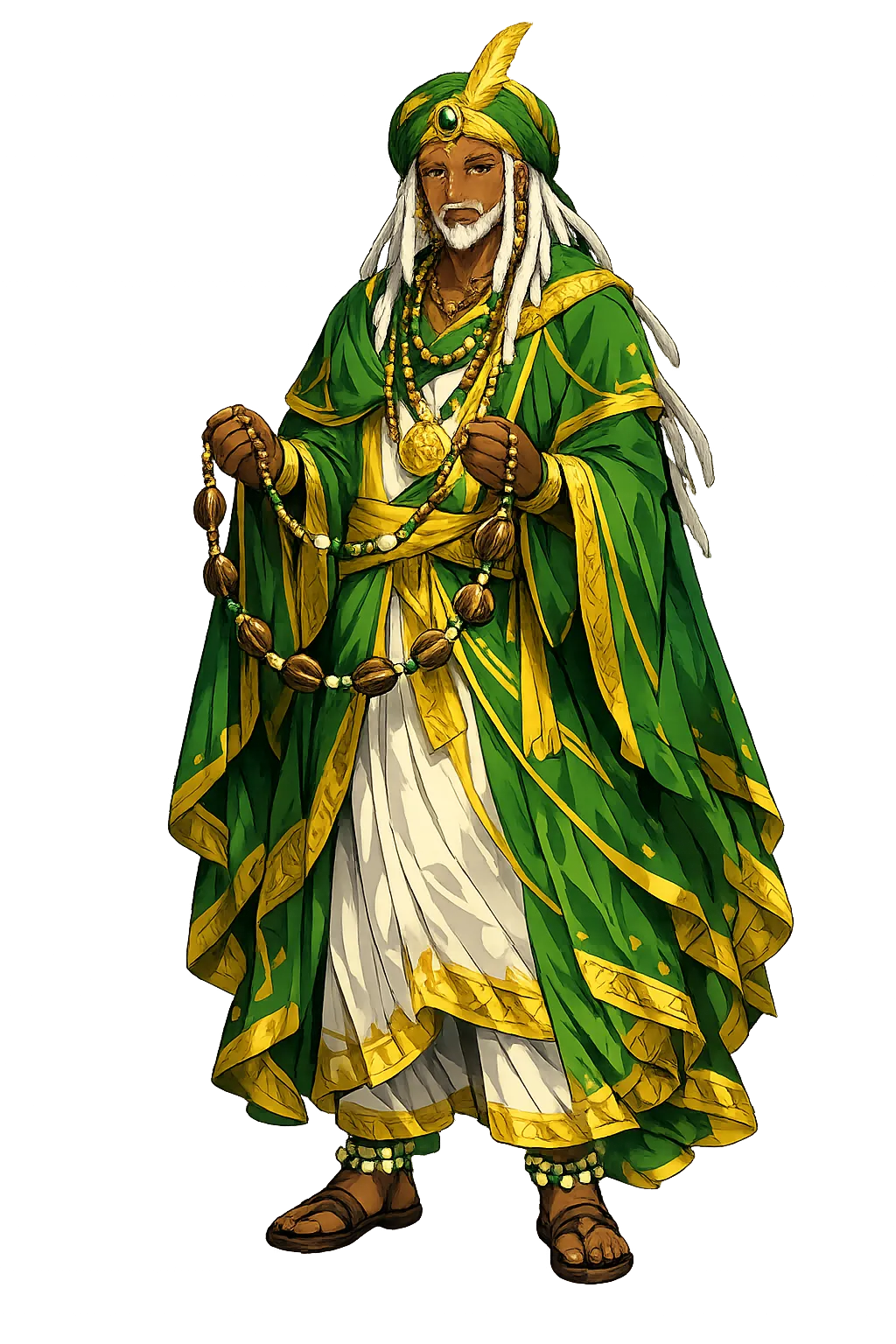
Pronouncing Ọrúnmìlà: a guide for the curious
Saying Ọrúnmìlà aloud is harder than reading it on a screen, and more rewarding. The restored spelling is a compressed pronunciation guide: every accent and macron is an instruction. This post unpacks those instructions — the reconstructed sound, the phoneme-by-phoneme record, the kindred forms in neighboring languages — and then zooms out to the full record around the name: its Yoruba transcription writing, its mythology, its cult, and its modern life as a Unicode domain. Whether you arrive as a linguist, a reader of myth, or a domainer, you will leave able to say the name the way the evidence suggests it was said — and able to type it the way it was written.
At a Glance
- Restored name: Ọrúnmìlà
- ASCII form: orunmila
- Meaning: "Heaven knows who will succeed"
- Domain of influence: Wisdom, Divination, Ifá
- Pantheon: Yoruba
- Classification: Tier 2
- Live domain: ọrunmila.com
Overview
Ọrúnmìlà (orunmila) — Wisdom, Divination, Ifá · Heaven knows who will succeed — belongs to the Yoruba tradition, where it is catalogued under the domain "Wisdom, Divination, Ifá". The name means "Heaven knows who will succeed".
Ọrúnmìlà is the orixá of wisdom and the patron of Ifá, the Yoruba divination system that maps human destiny against the patterns of the cosmos. He was present at creation; he knows the day the world was made and the names that were spoken into it. Kings do not act without consulting him, and no orixá is said to understand the future as he does.
Unlike Ṣàngó or Ọya, he is not a warrior. His power is speech, memory, and the ability to read the signs hidden in the fall of sixteen palm nuts.
PuniCodex restores the name as Ọrúnmìlà and serves its temple at ọrunmila.com. The original preserves one prosodic feature — stress or vowel length — rather than both, which places the name in Tier 2. The plain ASCII form orunmila survives as a modern convenience imposed by the early domain-name system; the restoration, not the fallback, is the form the project defends as philologically complete.
The Name
No indigenous written attestation survives for this name; Ọrúnmìlà is a scholarly transliteration of the reconstructed spoken form. Etymologically the name means "Heaven knows who will succeed".
The ASCII form orunmila survives only because the early domain-name system could not carry diacritics; it is a technological compromise, not an ancient spelling. The Unicode restoration Ọrúnmìlà recovers the stress accent of the original directly in the address bar. The original preserves one prosodic feature — stress or vowel length — rather than both, which places the name in Tier 2.
The letter-by-letter transformation runs:
- o → Ọ — Special character
- r → r — Same
- u → ú — Stress on u
- n → n — Same
- m → m — Same
- i → ì — Stress on i
- l → l — Same
- a → à — Stress on a
The project holds the domain ọrunmila.com (xn--runmila-bx4c.com) as the canonical home of this name.
The Original Script
No indigenous writing system is securely attested for Yoruba before the nineteenth century: the tradition was carried in speech, praise poetry, and the memorised verses of Ifá — a corpus whose custodian is Ọrúnmìlà himself. Muslim Yoruba scholars maintained an Ajami literature in Arabic script, and the modern Latin orthography was developed by Church Missionary Society workers in the 1840s–1850s, codified in Samuel Ajayi Crowther's Yoruba grammar of 1852 and his Bible translation.
The form Ọrúnmìlà is therefore a scholarly transliteration rather than an attested ancient spelling, and no mark in it is decorative. The Ọ carries the dot below distinguishing open /ɔ/ from close /o/, and the accents record the tone contour of the reconstructed /ɔ̀.rú.mì.là/ — low, high, low, low — written in fully toned orthography as Ọ̀rúnmìlà. The name is a sentence-name built on ọ̀rún, 'heaven', which the tradition glosses as 'heaven knows who will succeed', a compressed statement of Ifá's theology of destiny.
Pronunciation
The reconstructed pronunciation of the name is /ɔ̀.rúɱ.mì.là/ — Yoruba Reconstruction.
Phoneme by phoneme:
- Ọ- — Open-mid back rounded vowel [ɔ] with low tone, written with a dot below.
- -rú- — Voiced alveolar tap or trill [r] plus close back rounded vowel [u] with high tone.
- -ɱì- — Voiced labiodental nasal [ɱ] before [m], with close front vowel [i] in low tone.
- -là — Voiced alveolar lateral approximant [l] followed by open [a] with low tone.
For the modern speaker, the closest approximation is: aw-ROON-mee-LAH — low 'aw', high 'ROON', then low 'mee-LAH'.
Kindred and historical forms of the name:
- Yoruba — Ọrúnmìlà, the orixá of wisdom, Ifá divination, and sacred knowledge.
- Ifá corpus — Ọ̀rúnmìlà Èlẹ́gàn, the witness at creation who knows the destinies of all things.
- Brazilian Candomblé — Orunmilá, consulted through Ifá or the simpler merindilogun divination.
Ọrúnmìlà is Tier 2: the acute and grave accents preserve Yoruba tones, but tone is not length. The dot below ọ marks the open [ɔ] vowel.
Mythology
Ọrúnmìlà's mythology is textual as much as narrative: it lives in thousands of Ifá verses (òdù Ifá) that record his journeys, judgments, and interventions.
The Witness at the Foundation of the World (Cosmogony)
According to Ifá tradition, Ọrúnmìlà was the only orixá present when Olódùmarè created the earth. He observed the placement of the rivers, the rising of the mountains, and the distribution of destinies. Because he witnessed the beginning, he can trace any present trouble back to its origin and prescribe the sacrifice that will set it right.
The Sixteen Principals (Odù Ifá)
The Ifá corpus is organised around sixteen principal odù, each with sixteen sub-odù, generating 256 basic combinations. Each odù is a world of stories, proverbs, and medicines. Ọrúnmìlà is not merely the system; he is the living voice that speaks through it when the babalawo casts the chain or nuts.
Ọrúnmìlà and the Choice of Destiny (Legend)
In one widespread Ifá narrative, Ọrúnmìlà advises humans on how to choose their destiny (àyẹ̀wò) before birth. The choice is made in heaven, but once taken it binds the living. Ọrúnmìlà's role is not to change fate but to reveal its contours and the sacrifices that can soften its hardest edges.
Symbols & Iconography
The iconography of Ọrúnmìlà is the toolkit of the babalawo: his attributes are not carried by images of a god but handled daily by the priests who divine in his name.
- Ikin palm nuts — The sixteen sacred nuts of the oil palm used in the full Ifá consultation, struck from one hand to the other so that the remaining count marks the signature of an odù.
- Ọ̀pẹ̀lẹ̀ divination chain — The chain of eight half-nut shells that provides quicker access to Ifá wisdom, cast so that each face lands open or closed.
- Green and yellow beads — His sacred colours, associated with palm leaves, knowledge, and mature wisdom, worn by his priests and initiates.
- Staff of wisdom — The iron staff that grounds his authority and marks the babalawo in ceremony.
Archaeology & Evidence
The material record of Ọrúnmìlà is unusually rich for an orally transmitted cult, because divination is object-centred. Carved wooden divination trays (ọpọ́n Ifá), their rims watched over by the face of Ẹṣù, ivory and wooden tappers (ìrókè Ifá), sacred palm nuts (ikin), and cast chains (ọ̀pẹ̀lẹ̀) entered museum collections from the nineteenth century onward and remain in daily ritual use.
No inscription names him — the Ifá corpus was memorised, not written — yet the tray itself supports a graphic system: the babalawo marks the odù's signature as strokes in the dust of iyẹ̀ròsùn powder spread on the tray's surface, one of Africa's indigenous notations. Diaspora collections hold his green-and-yellow beads, iron staffs, and ritual implements, documenting the cult's continuity from Yorubaland to Cuba and Brazil.
Realm & Domain
Ọrúnmìlà is the orixá of wisdom and the patron of Ifá, the Yoruba divination system that maps human destiny against the patterns of the cosmos. He was present at creation; he knows the day the world was made and the names that were spoken into it. Kings do not act without consulting him, and no orixá is said to understand the future as he does.
Unlike Ṣàngó or Ọya, he is not a warrior. His power is speech, memory, and the ability to read the signs hidden in the fall of sixteen palm nuts.
Ifá Divination
Sixteen palm nuts and the divination chain reveal the odù that governs a situation.
Sacred Knowledge
He remembers the verses, medicines, and sacrifices that restore cosmic balance.
Witness of Creation
Only he saw the world being made; therefore only he can interpret its deepest laws.
Babalawo
The father of secrets — the title of the priests who speak for him in divination.
Across Cultures
Ọrúnmìlà travelled to the Americas as the patron of Ifá and the central figure of Santería's religious hierarchy. In Cuba, babalawos initiate devotees and divine through the dilogún shells or the full Ifá corpus. Catholic syncretism sometimes links him to Saint Francis of Assisi because of the Franciscan association with poverty, humility, and divine knowledge. In Brazil he is Orunmilá, less publicly prominent than in Cuba but still foundational to the Houses of Ifá.
Kindred figures in the PuniCodex cross-tradition index include [[ahuramazda|AhuraMazdā]], [[athena|Athénā]], [[ganesha|Gaṇeśa]], [[odinn|Óðinn]], [[quetzalcoatl|Quetzalcōātl]], and [[thoth|Ḏḥwty]], each linked through wisdom / knowledge.
Cultural Legacy
Ọrúnmìlà's legacy is the Ifá corpus itself — one of the largest bodies of African sacred poetry, recognised by UNESCO as an intangible cultural heritage of humanity. His influence reaches into literature, psychology, and ethics: the idea that wisdom is not possession but practice, that destiny can be read but must be met with sacrifice, and that the future is a conversation rather than a sentence. Contemporary African philosophers and diaspora theologians return to him as a model of disciplined, compassionate knowledge.
UNESCO proclaimed the Ifá divination system a Masterpiece of the Oral and Intangible Heritage of Humanity in 2005 and inscribed it on the Representative List in 2008, describing a corpus of 256 odù subdivided into verses called èsè, interpreted by the babalawo through sacred palm nuts and the divination chain.
The Scholarly Record
The account of Ọrúnmìlà given in this edition rests on the witnesses and reference works listed below; each contributes a distinct stratum of evidence, from the ethnography of divination to the theology of the orishas.
- Bascom, William, Ifa Divination: Communication Between Gods and Men in West Africa (Indiana University Press, 1969). — The foundational ethnography of Ifá: the nuts, the chain, the odù, and the verses, recorded with babalawos in Yorubaland.
- Abimbola, Wande, Ifá: An Exposition of Ifá Literary Corpus (Oxford University Press, 1976). — The standard study of the corpus by a scholar trained in its recitation; source for the praise names Elérìí ìpín and Àgbọnnìrègún.
- Idowu, E. Bolaji, Olódùmarè: God in Yoruba Belief (Longmans, 1962). — Situates Ọrúnmìlà within Yoruba theology as the witness of creation and the deputy of Olódùmarè's knowledge.
- Abraham, R. C., Dictionary of Modern Yoruba (University of London Press, 1958). — Secures the lexical form and the ọ̀rún, 'heaven', element of the name.
- Mason, John, Four New World Yoruba Rituals (Yoruba Theological Archministry, 1985). — Documents the New World liturgy of Ifá.
- Verger, Pierre, Notes sur le Culte des Orisa et Vodun (IFAN, 1957). — Comparative record of the cult in West Africa and Bahia.
A Meditation
Ọrúnmìlà is the god who knows that knowing is not enough. He possesses the memory of creation, yet his work is not to dazzle humans with that memory but to guide them through the small, repeated acts — casting nuts, reciting verses, making sacrifice — that restore alignment.
In an information-saturated age, Ọrúnmìlà offers a different model of wisdom. It is not the accumulation of facts but the patience to hear what a pattern means. The babalawo does not predict the future like a fortune-teller; he reads the shape of a life against the oldest stories and suggests the practical step that will turn the current. To approach Ọrúnmìlà is to admit that you do not know enough to act alone — and that this admission is the beginning of intelligence.
The Unicode Restoration
Ọrúnmìlà is classified as Tier 2: the original preserves at least one philological feature that ASCII cannot encode. The ASCII fallback orunmila still resolves everywhere, but it is the restored form that carries the name's full information. Across the 8 characters of the name, the restoration adjusts 4: 3 marks of stress (ú, ì, à); 1 further adjustment (Ọ). That is the whole thesis of this temple: the marks are the message.
Character by Character
The journey from orunmila to Ọrúnmìlà, one character at a time:
- o → Ọ — Special character
- r → r — Same
- u → ú — Stress on u
- n → n — Same
- m → m — Same
- i → ì — Stress on i
- l → l — Same
- a → à — Stress on a
The Domain Name
The restored name is live as a working domain: ọrunmila.com, which the DNS carries in punycode form as xn--runmila-bx4c.com — an ASCII-compatible encoding that lets a non-ASCII name travel the global network without breaking older infrastructure. The visitor sees Ọrúnmìlà; the machines see the encoding. That duality is the engineering compromise on which the entire restoration rests, and it is why a name written the way its own tradition wrote it in Yoruba transcription can now be typed into any browser on earth.
The Yoruba Pantheon
Ọrúnmìlà is one of 30 entries the PuniCodex lexicon catalogues under the Yoruba pantheon. The Pantheon page gathers the tradition's major figures in one place, and the Lexicon lets you filter all 895 restorations by tradition, tier, or script — the fastest way to see where this name sits among its kin.
Frequently Asked Questions
What does Ọrúnmìlà mean? The traditional gloss is "Heaven knows who will succeed."
Which tradition does Ọrúnmìlà belong to? Ọrúnmìlà is catalogued in the Yoruba pantheon of the PuniCodex lexicon.
Why is Ọrúnmìlà classified as Tier 2? Because the original preserves at least one philological feature that ASCII cannot encode — and the marks in the restored spelling preserve exactly that evidence.
Is Ọrúnmìlà a working domain? Yes — ọrunmila.com resolves today and routes to this temple.
What is the punycode for ọrunmila.com? The DNS encoding is xn--runmila-bx4c.com; browsers perform the translation automatically, so visitors only ever see the restored name.
Typing Ọrúnmìlà
You do not need a special keyboard to use this restoration. The PuniCodex Type Tool converts the ASCII form orunmila into Ọrúnmìlà as you type, and the browser extension offers the same conversion inside any text field. Copy the restored form, paste it into the address bar, and the DNS does the rest.
Sister Temples
Other temples in the Yoruba pantheon include Daramulum, Eingana, and Ẹṣu — each with its own restoration story, its own scholarly record, and its own place in the lexicon.
Why This Restoration Matters
Pronunciation turns out to be the heart of the matter. The marks in Ọrúnmìlà are instructions for the voice, and a web that strips them is a web that mispronounces the past at scale. The restoration hands the instructions back: say it as the evidence suggests, type it as the tradition wrote it, and let the punycode machinery do the quiet translation in between. That is all the PuniCodex project asks of the infrastructure — and everything it asks of you, the reader, is to use the whole name.
Explore Further
This post is one doorway into the temple. The home page carries the full character breakdown and the ambient canvas; the lore page tells the myths in long form; the Scholarly Edition preserves the sources, pronunciation data, and revision history; and the patron wall supports the restoration directly. For the wider map, browse the Lexicon, explore the Pantheon, or return to the PuniCodex blog.
Related Names
Sources
The full scholarly apparatus — every citation, revision, and review — lives in the Scholarly Edition. Key references for this post:
- UNESCO, The Ifa Divination System, Representative List of the Intangible Cultural Heritage of Humanity (proclaimed 2005; inscribed 2008).
- Bascom, Ifa Divination: Communication Between Gods and Men in West Africa.
- Abimbola, Ifá: An Exposition of Ifá Literary Corpus.
- Idowu, Olódùmarè: God in Yoruba Belief.
- Crowther, Samuel Ajayi, A Grammar and Vocabulary of the Yoruba Language (Seeleys, 1852).
- Lexicon authorities for this entry: Bascom, Idowu.