
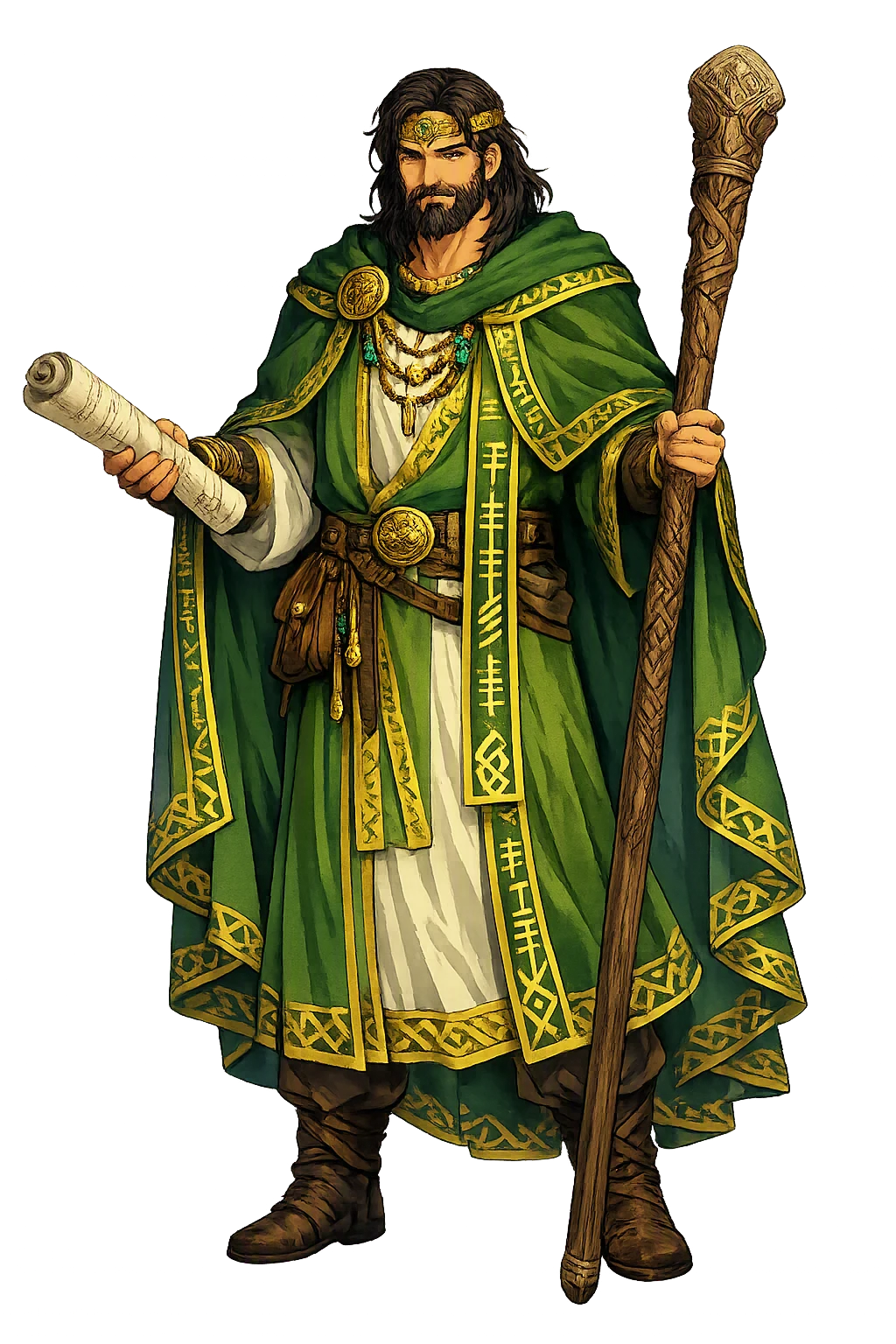
Ogma walks into a defense, military & security firm
Somewhere right now, in a defense, military & security office, someone is doing exactly what the myths describe — and has never heard of Ogma. This file is the introduction.
Before the Office, the Story
The Son of Elatha. The Lebor Gabála Érenn, Ireland's medieval book of invasions, writes Ogma into the divine genealogy: Ogma son of Elatha, of the line of Delbaeth, and brother of the Dagda himself. When the Túatha Dé Danann came to Ireland out of the four northern cities, Ogma came with them as the champion of the race — in trenfer, the strong man, the standing title the texts give him. His place in the pantheon is therefore double from the first mention: the arm of the Túatha Dé Danann, and the brother of their all-father.
The Firewood of the Serf-Years. When the half-Fomorian Bres was made king and laid the Túatha Dé Danann under tribute, the greatest of them were put to work like serfs. The Dagda was set to building raths, and Ogma — the champion of the whole divine race — was set to hauling firewood for the fortress. The tale does not spare him: so weakened was he by hunger that the sea washed over him as he carried the fuel.
At a Glance
- Temple: Ogma
- Pantheon: Celtic
- Domain of influence: Eloquence, Writing
- Pattern seats: 3
- Sectors touched: Commerce & Governance · Culture & Entertainment · Society & Spirit
- Strongest seat: Defense, Military & Security
- Series: The Resonance Files, No. 261 of 397
The Reveal, Seat by Seat
Defense, Military & Security
The honey-tongued champion of the Tuatha Dé Danann — strength and speech in one arm. Nobody in that trade worships at this temple. They just keep its hours.
Writing, Publishing & Media
The inventor of Ogham — the champion who gives Ireland her letters. The match is not poetic license. Strip the trade to its function and the function is the myth.
Education, Research & Knowledge
Now read the why-line with the office in mind: The Ogam tract itself — every scholar who teaches the alphabet stands in his line. The people doing this work did not borrow the archetype. They re-derived it — the way Ogma was always going to be re-derived wherever eloquence, writing matters.
Not the First Rebrand
Ogma has the strongest cross-border witness of any Irish god, and it is a classical author's eyewitness account. Lucian of Samosata, writing in the second century CE, describes a picture the Gauls showed him of their Herakles: not the young Greek athlete but a very old man, bald and wrinkled and sun-dark, drawing after him a great crowd of men — each one fastened by the ears to the god's tongue with slender chains of gold and amber, and following willingly, none struggling. The office is only the latest translation.
The Method, Stated Plainly
Skeptical? Good — the system is built for you. Every seat in this file carries its why-line and its weight, the full derivation is public at the methodology page, and the challenge process is part of the design. Falsifiable is not a posture here; it is the mechanism.
For the Ones Who Work There
For a sponsor in defense, military & security, the fit here is not adjacency — it is inheritance. Your trade already tells this story every working day; the temple simply holds the original. The patron tier and the advertising terms carry the mechanics; the myths above carry the reason.
The File Continues
This is one of 397 Resonance Files — the third dispatch from every flagship temple, where the myths meet the markets. The temple's founding dispatch tells the name's story; its Restoration File tells the spelling's; the blog index holds the whole archive.
Continue the series — previous: Odysseús (read it) · next: Ògún (read it).
The Resonance Files are argued from the same canonical record as the pattern atlas itself: the lexicon, the lore catalog, and the cited sources. Every seat can be challenged at the methodology page — and the challenge is the point.