
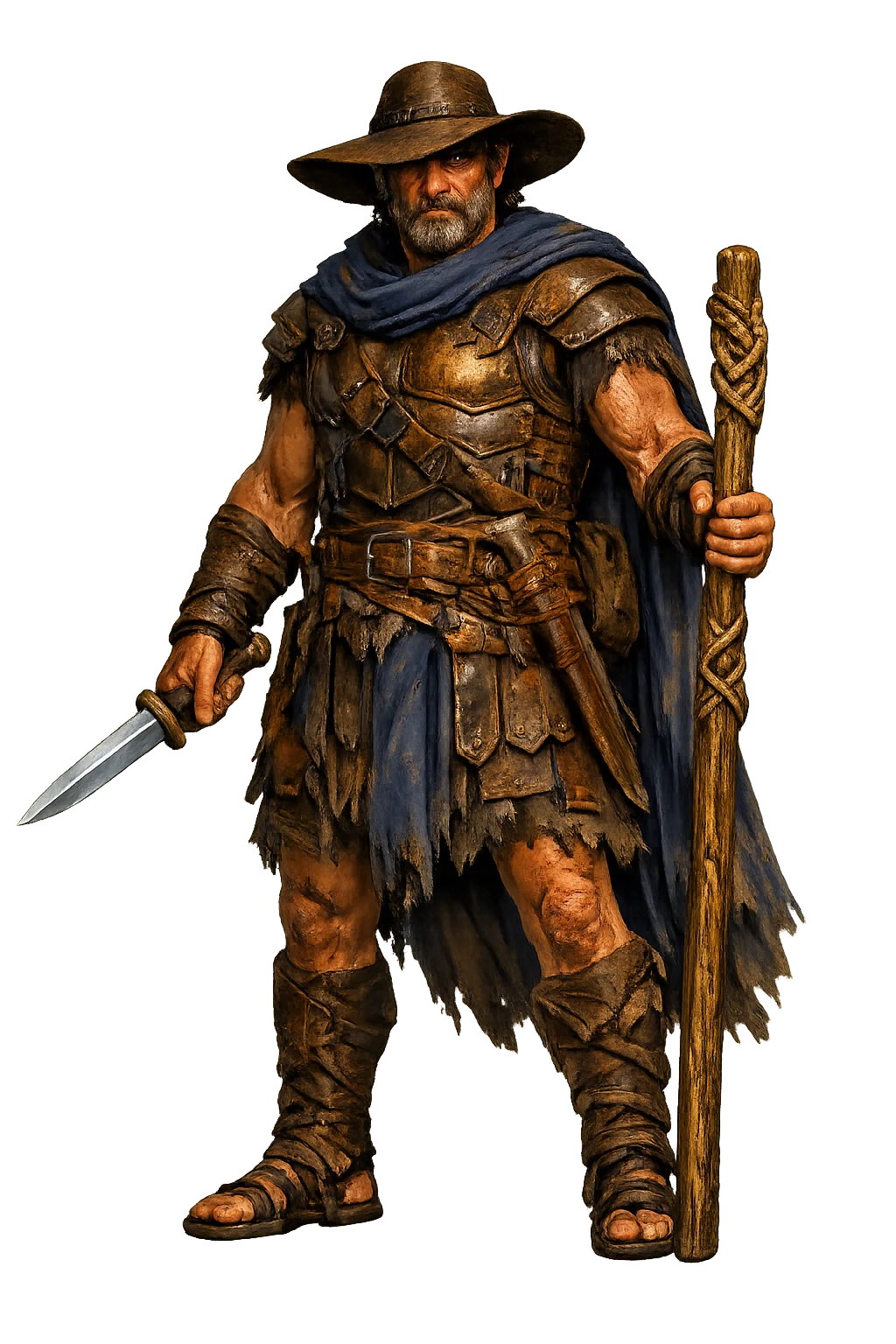
From Greek to Unicode: the journey of Odysseús
Long before it was a domain, this name traveled through scripts. Odysseús begins in Greek, passes through scholarly transliteration, and ends — for now — inside the punycode machinery of the global DNS. Each stage of that journey preserves some information and loses some, and the craft of restoration is knowing exactly which marks matter. This post follows the name stage by stage: the original script, the reconstructed pronunciation, the mythological record, the material evidence, and finally the Unicode form that carries all of it into the address bar. Think of it as a biography of a name, told through its spelling.
At a Glance
- Restored name: Odysseús
- ASCII form: odysseus
- Meaning: "Hated, painful"
- Domain of influence: Cunning, Journey
- Pantheon: Greek
- Classification: Tier 1
- Original script: Ὀδυσσεύς (Greek)
- Live domain: odysseús.com
Overview
Odysseús (odysseus) — The Much-Enduring Wanderer · Master of Cunning Return — belongs to the Greek tradition, where it is catalogued under the domain "Cunning, Journey". The Odyssey's own folk etymology makes the name mean "Hated, painful."
Odysseús is the Greeks' fullest study of intelligence under pressure: the strategist of Troy, the wanderer of ten years, the beggar who comes home to a house full of enemies and wins it back with patience, a bow, and a rooted bed. Homer gives him more words than any other hero — his weapon is speech itself.
PuniCodex restores the name as Odysseús and serves its temple at odysseús.com. The original carries both stress and vowel length, and exactly one historically valid Unicode restoration exists, which places the name in Tier 1. The plain ASCII form odysseus survives as a modern convenience; the restoration, not the fallback, is the form the project defends as philologically complete.
The Name
The name is attested in Greek as Ὀδυσσεύς, a third-declension masculine built on the suffix -εύς — the formative of agents and actors that gives Greek βασιλεύς, 'king', ἱππεύς, 'horseman', and the heroic names Ἀχιλλεύς and Πηλεύς. Homer heard a verb inside it: ὀδύσσομαι, 'to be wroth with, to hate'. In the Odyssey's own telling, the hero's grandfather Autolykos names the newborn: since he had come to Ithaka 'hated by many men and women', the child would be Odysseus — the hated one, the man of pain. Whether or not that is the name's true history, it is the meaning the poem itself teaches its listeners to hear.
Etymology & Roots
The name's family, as the canonical sources give it:
- Greek verb: ὀδύσσομαι, 'to be wroth with, to hate' — the Odyssey's own etymology: his grandfather Autolykos names him 'the hated one' (Od. 19.407)
- Homeric epithets: πολύτροπος 'of many turns', πολύμητις 'of many counsels', πολύτλας 'much-enduring'
- Western Greek: dialectal forms with -l- (Ὀλυσσεύς) stand behind the Latin name
- Latin: Ulixēs, whence English 'Ulysses'
Beekes treats the name as Pre-Greek in formation — older than the Greek language itself, with no Indo-European pedigree — and notes that the folk etymology from ὀδύσσομαι was already at work in Homer. The dialect map tells its own story: the western Greeks said the name with an -l-, and through their colonies in Italy it reached Rome as Ulixēs. One name, two sounds: the hero of patience travels under both, as Odysseus in Greek mouths and Ulysses in Latin ones.
The Original Script
The original is Ὀδυσσεύς: omicron with smooth breathing, delta, upsilon, double sigma, and the diphthong ευ carrying an acute accent before the final sigma. The two marks that matter sit together at the name's end. The acute fixes the stress on the last syllable — o-dys-SEUS — and the ευ is a true diphthong, two vowels sounded as one gliding syllable and counted long by the rules of Greek accent. Stress plus length: both Tier 1 features, both in the final syllable. The standard scholarly transliteration eu keeps the diphthong visible; the restoration Odysseús adds the one thing transliteration conventionally drops — the pitch.
Pronunciation
Odysseús is Tier 1 because the Greek Ὀδυσσεύς contains both stress (the acute on the final syllable) and length (the diphthong ευ). The restoration keeps the acute on ú; the diphthong itself survives in the standard transliteration eu. English 'Odysseus' flattens the pitch that Greek put on the name's last syllable.
The reconstructed Attic sound is /o.dys.seús/ — 'oh-dyss-SEWS', three quick syllables gathering into a long, high final surge, like a wave cresting at the name's end. Three phonemes carry the name:
- O- — short omicron with smooth breathing: the name begins low and unforced.
- -dys- — delta and short upsilon with sigma: the compact middle the poets linked to ὀδύσσομαι, 'to hate'.
- -seús — sigma plus the diphthong ευ under acute pitch: the rising, long final syllable of the agentive -εύς names.
Mythology
The Odyssey is his biography, but his story begins in the Iliad and ends in prophecy. He is the one hero whose full arc — war, wandering, homecoming — the tradition preserves entire.
The Wooden Horse (The Ruse)
Ten years of force had not taken Troy; Odysseús took it in a night by craft. The horse, built by Epeios with Athena's help, carried the pick of the Achaeans within the walls as a pretended offering, and the Odyssey remembers it as his design. The Iliad ends before the fall, but the Odyssey tells the rest: the plan, the peril of Helen's voice at the horse's side, and the sack that followed were all his.
Nobody and the Enchantress (The Wandering)
Blown off course, he meets the story-book of the sea: the Lotus-Eaters; Polyphêmos, outwitted by the name Outis — 'Nobody' — and blinded as he sleeps; Aiolos's bag of winds; the Laistrygonians; Kirke, who turns his crew to swine and then becomes his teacher; the descent to the dead, where Teiresias foretells the road home; the Sirens heard from the mast; Skylla and Charybdis; and Thrinakia, where his last crew eats the Sun's cattle and is lost.
Kalypso and the Raft (The Wrath of the Sea)
For the blinding of his son Polyphêmos, Poseidôn pursues him. Seven years he is kept on Kalypso's island, offered immortality and a goddess's bed — and refuses both for a sight of the smoke of Ithaka. Released by Zeús's command, he builds a raft, is wrecked by the sea-god within sight of Scheria, and comes ashore naked on the Phaiakians' mercy — the low point from which everything turns.
The Bow and the Rooted Bed (The Return)
Landed on Ithaka at last, he enters his hall disguised as a beggar and endures the suitors' insults in silence. Penelope sets the contest of the bow; he alone strings it, and the hall runs with the suitors' blood. Even then she tests him, bidding the bed be moved — and he cries out that it cannot be, for he built it round a rooted olive. Teiresias's prophecy remains: a last journey inland with an oar, until the sea is unknown, and a gentle death in old age.
Symbols & Iconography
The objects the tradition hangs on Odysseús are tokens of identity itself:
- The great bow — the weapon only he could string; the test by which the beggar becomes the king.
- The olive-trunk bed — built into a living, rooted tree; the immovable sign by which Penelope knows her husband.
- The scar — the boar's-tusk wound from Parnassos, by which the old nurse Eurykleia knows him first.
- The oar — carried inland until a wayfarer mistakes it for a winnowing-fan; the prophecy of his peace.
- The ship — the vessel of the much-turned man; he loses every one and still comes home.
The Name in the Poems
The Odyssey puns on its hero's name at the poem's emotional hinges. In the first book, Athena asks Zeus why he is so wroth with the wretched man — τί νύ οἱ τόσον ὠδύσαο, Ζεῦ, 'why did you hate him so, Zeus?' — and the verb rings against the name like a bell. In the nineteenth, the naming itself is staged: old Autolykos, come to Ithaka 'hated by many', gives the child the name that prophecy and poetry will keep. Beekes notes the name is likely Pre-Greek in formation, but the folk etymology was already load-bearing in Homer: to Greek ears, Odysseús always sounded like the man whom heaven hated and the sea pursued.
Archaeology & Evidence
Ithaki, the island that still bears his name, has Mycenaean remains at Pelikata and Aetos, and at Polis Bay a cave sanctuary of the Nymphs whose votive deposits run from the Late Bronze Age to the Roman period — the very cave where later Ithacans placed Odysseús's homecoming, and where a Hellenistic terracotta fragment inscribed ΕΥΧΗΝ ΟΔΥΣΣΕΙ, 'a prayer to Odysseus', attests his hero-cult. The Bronze Age site above Polis Bay, long called the School of Homer, remains conjectural as his palace. Beyond Ithaka his cult is epigraphic and scattered; his truest monument is Homer's text.
Realm & Domain
Odysseús is the Greeks' fullest study of intelligence under pressure: the strategist of Troy, the wanderer of ten years, the beggar who comes home to a house full of enemies and wins it back with patience, a bow, and a rooted bed. Homer gives him more words than any other hero — his weapon is speech itself.
The Strategist
Deviser of the Wooden Horse, and of the name Outis — 'Nobody' — by which he outwitted the Cyclops Polyphêmos.
The Wayfarer
Ten years from Troy to Ithaka: Cyclops, Kirke, the dead, the Sirens, Skylla and Charybdis, Kalypso — the sea's whole syllabus.
The Returned King
Disguised as a beggar in his own hall, he strings the great bow and takes back house, wife, and kingdom from the suitors.
Athena's Favourite
The goddess of counsel delights in him precisely because he is like her: 'among all men you are the best in counsel and speech' (Od. 13).
Across Cultures
The western Greeks pronounced his name with -l-, and through them it reached Italy: Latin Ulixēs, English Ulysses. Rome admired his cunning and distrusted it; Virgil's Aeneid makes him the face of Greek deceit, while the philosophers reclaimed him as the Stoic sage. Dante's Ulisse sails beyond the Pillars of Herakles and drowns for the love of knowledge — the Christian epic's answer to Homer. Long before all this, the Odyssey itself had performed the boldest syncretism: it turned a folktale wanderer into the type of every human journey, so that his name, as the common noun 'odyssey', no longer needs him at all.
Cultural Legacy
He is the most rewritten figure of the ancient world: Sophocles' divided portraits, Euripides' stage villain, Tennyson's aging voyager ('to strive, to seek, to find, and not to yield'), Joyce's Ulysses, in which a Dublin advertisement canvasser lives the whole epic in a day, Kazantzakis's modern sequel, Cavafy's Ithaka — 'wise as you will have become, so full of experience' — and a hundred films and novels. Space probes and wanderers' memoirs borrow the noun he became. Restoring Odysseús keeps the stress Greek put on his last syllable: the name itself rises at the end, like a mast coming over the horizon.
A Meditation
Every other hero of the Trojan cycle is defined by what he can overpower; Odysseús is defined by what he can outlast. The epic tests him with each kind of loss — companions, ships, time, fame, even identity: he survives the Cyclops precisely by becoming Nobody, and he survives Kalypso precisely by refusing to become a god. Between those two refusals lies his whole philosophy. A man is not his name, and yet the name is all that comes home.
The ending refuses triumph. The suitors are dead, the hall is his, and still the wife he won must test him, and the test is not valor but knowledge: only the true husband knows the bed cannot move because it was built on a living root. That rootedness is the answer to all the wandering — the one unmoving thing in a life of motion, grown not made. And beyond even that, Teiresias's oar waits: the promise that he must carry the sea inland until it is no longer recognized. The man of many turns earns his peace only where nobody knows what an oar is — where even his story cannot follow him.
The Unicode Restoration
Odysseús is classified as Tier 1: the original carries both stress and length, and only one valid Unicode restoration exists. The ASCII fallback odysseus still resolves everywhere, but it is the restored form that carries the name's full information. Across the 8 characters of the name, the restoration adjusts 1: 1 mark of stress (ú). That is the whole thesis of this temple: the marks are the message.
Character by Character
The journey from odysseus to Odysseús, one character at a time:
- o → O — O uppercase
- d → d — d same
- y → y — y same
- s → s — s same
- s → s — s same
- e → e — e same
- u → ú — Acute on u
- s → s — s same
The Domain Name
The restored name is live as a working domain: odysseús.com, which the DNS carries in punycode form as xn--odysses-c2a.com — an ASCII-compatible encoding that lets a non-ASCII name travel the global network without breaking older infrastructure. The visitor sees Odysseús; the machines see the encoding. That duality is the engineering compromise on which the entire restoration rests, and it is why a name written the way its own tradition wrote it in Greek can now be typed into any browser on earth.
The Greek Pantheon
Odysseús is one of 266 entries the PuniCodex lexicon catalogues under the Greek pantheon. The Pantheon page gathers the tradition's major figures in one place, and the Lexicon lets you filter all 925 restorations by tradition, tier, or script — the fastest way to see where this name sits among its kin.
Frequently Asked Questions
What does Odysseús mean? The traditional gloss is "Hated, painful."
Which tradition does Odysseús belong to? Odysseús is catalogued in the Greek pantheon of the PuniCodex lexicon.
Why is Odysseús classified as Tier 1? Because the original carries both stress and length, and only one valid Unicode restoration exists — and the marks in the restored spelling preserve exactly that evidence.
Is Odysseús a working domain? Yes — odysseús.com resolves today and routes to this temple.
What is the punycode for odysseús.com? The DNS encoding is xn--odysses-c2a.com; browsers perform the translation automatically, so visitors only ever see the restored name.
Typing Odysseús
You do not need a special keyboard to use this restoration. The PuniCodex Type Tool converts the ASCII form odysseus into Odysseús as you type, and the browser extension offers the same conversion inside any text field. Copy the restored form, paste it into the address bar, and the DNS does the rest.
Sister Temples
Other temples in the Greek pantheon include Iásōn, Iásōn, and Kósmos — each with its own restoration story, its own scholarly record, and its own place in the lexicon.
Why This Restoration Matters
Every stage of the journey from Greek to Unicode was an act of care: the scribe who first wrote the name, the lexicographer who glossed it, the engineer who taught the DNS to carry it. The PuniCodex restoration is the latest stage, not the last word — the Scholarly Edition is revised as the evidence improves. What does not change is the principle: a name deserves to be written the way its own tradition wrote it. Odysseús in the address bar is that principle, made routable.
Explore Further
This post is one doorway into the temple. The home page carries the full character breakdown and the ambient canvas; the lore page tells the myths in long form; the Scholarly Edition preserves the sources, pronunciation data, and revision history; and the patron wall supports the restoration directly. For the wider map, browse the Lexicon, explore the Pantheon, or return to the PuniCodex blog.
Related Names
Sources
The full scholarly apparatus — every citation, revision, and review — lives in the Scholarly Edition. Key references for this post:
- Scholarly reference
- Lexicon authorities for this entry: Homer, Beekes.