
Why Nǚwā belongs in your address bar
Every address bar is a choice. When you type Nǚwā, you are not typing a novelty; you are restoring a name that the early DNS, built for English typewriters, could not carry. The plain ASCII form nuwa is a leftover of that constraint, not the name itself. This post is the long version of the restoration: where the name comes from, how the Chinese characters tradition wrote it, how it is pronounced, what the myths and the material record preserve, and why its Unicode form now lives as a working domain. The claim throughout is simple — the original spelling is not decoration. It is the name.
At a Glance
- Restored name: Nǚwā
- ASCII form: nuwa
- Meaning: "Woman wa"
- Domain of influence: Creation, Mending Heaven
- Pantheon: Chinese
- Classification: Tier 2
- Original script: 女媧 (Chinese characters)
- Live domain: nǚwā.com
Overview
Nǚwā (nuwa) — The Mender of the Sky — belongs to the Chinese tradition, where it is catalogued under the domain "Creation, Mending Heaven". The name means "Woman wa".
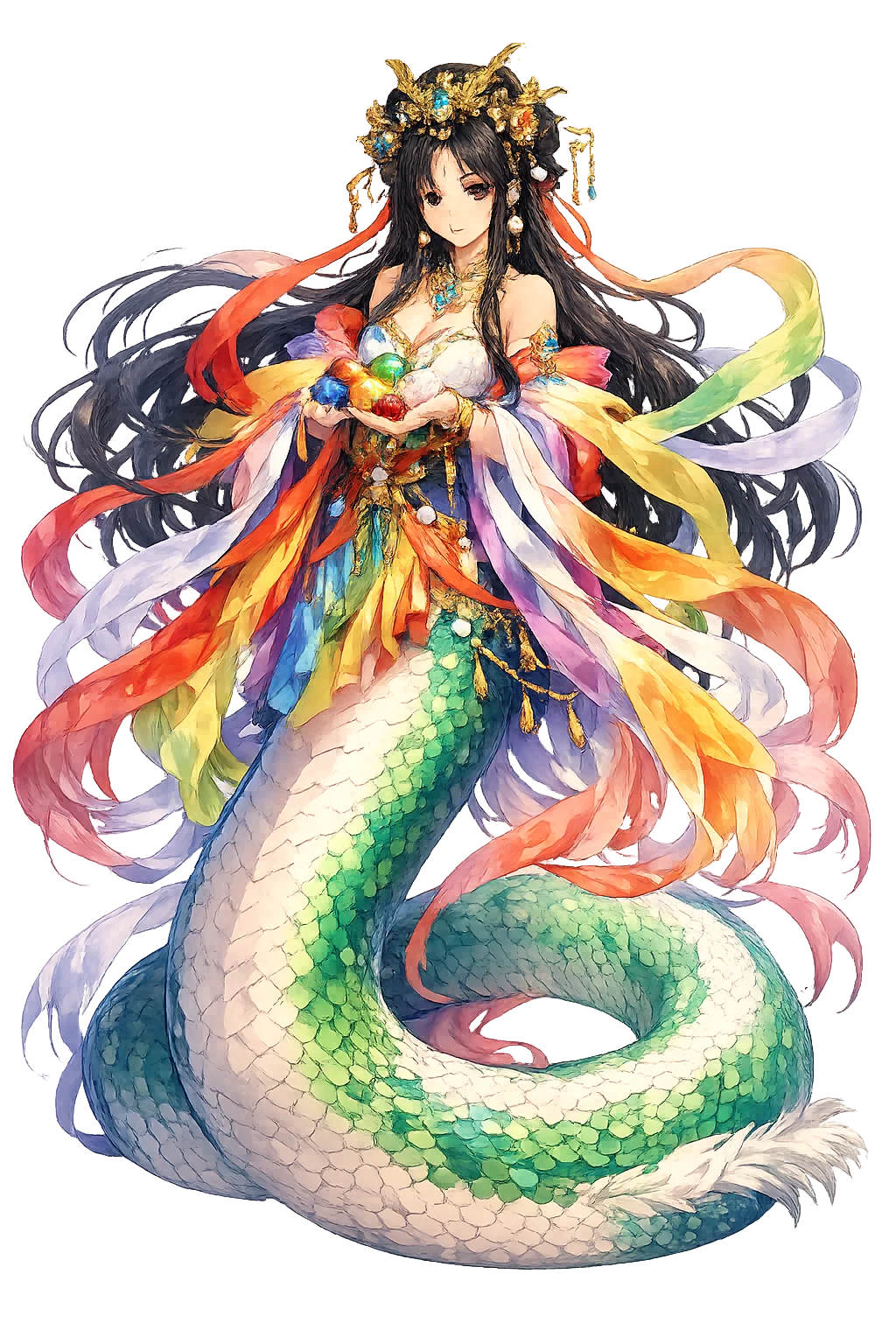
Nǚwā is the great repairer: the goddess who melted five-colored stones to patch the broken sky, cut off the giant turtle's legs to prop the corners of the world, and — on a quieter day — knelt by the Yellow River and made the first human beings out of mud.
PuniCodex restores the name as Nǚwā and serves its temple at nǚwā.com. The original preserves one prosodic feature — stress or vowel length — rather than both, which places the name in Tier 2. The plain ASCII form nuwa survives as a modern convenience imposed by the early domain-name system; the restoration, not the fallback, is the form the project defends as philologically complete.
The Name
The name is attested in Chinese characters as 女媧. Etymologically it means "Woman wa".
The ASCII form nuwa survives only because the early domain-name system could not carry diacritics; it is a technological compromise, not an ancient spelling. The Unicode restoration Nǚwā recovers both the stress accent and the vowel length of the original directly in the address bar. The original preserves one prosodic feature — stress or vowel length — rather than both, which places the name in Tier 2.
The letter-by-letter transformation runs:
- n → N — Same, capitalized
- u → ǚ — Stress on u
- w → w — Same
- a → ā — Long vowel
The project holds the domain nǚwā.com (xn--nw-ela08f.com) as the canonical home of this name.
The Original Script
The name is written in Chinese characters as 女媧. This original script is the form against which the ASCII fallback nuwa and the PuniCodex restoration Nǚwā are measured: the restoration preserves both its pitch accent and its vowel quantity of the written form, so that a reader typing the modern address still speaks the ancient name.
Written 女娲: nǚ (woman) plus wā — a graph so specific to her that dictionaries list almost no other word under it. The ü of the restoration is the sound itself; without it, the name is another word.
Pronunciation
The reconstructed pronunciation of the name is /ny˨˩˦ wa˥/ — Mandarin (Hanyu Pinyin with tones).
For the modern speaker, the closest approximation is: nyoo-wah, low-dipping tone on Nǚ, high level on Wā.
Kindred and historical forms of the name:
- Chinese — 女媧
- Her title — 媧皇 (Wāhuáng)
- Owned form — Nǚwā
Nǚwā 女娲 bears the third tone on nǚ — the vowel ü written with its two dots, which the restoration keeps and plain ASCII drops. Wā is the level-toned archaic graph for this goddess alone: a character invented for her name, used for nothing else in the language. The ü is the front rounded vowel — the sound French writes u — which plain ASCII loses to plain u.
Mythology
Nǚwā's two great myths answer the two great questions: where people came from, and why the sky holds. Both are told in the earliest strata of Chinese myth and never improved upon.
The Mending of the Sky (The Catastrophe)
The Huáinánzǐ tells it: in high antiquity the four pillars snapped, the nine provinces split; fire raged unquenched, waters rose undrained; fierce beasts devoured the people. Nǚwā melted stones of five colors to mend the azure sky, cut the legs of the great turtle to set the four pillars, slew the black dragon to save Jì province, and heaped reed-ashes to dam the flood. Then — and only then — the world was habitable, and the beasts went quiet.
People of Yellow Earth (The Creation)
The later compendia preserve the gentler myth: Nǚwā, walking alone in the empty world, knelt by the river and shaped human beings from yellow clay. The work delighted but wearied her — so she trailed a rope through the mud and flung the drops, which became people too. The handmade figures became the rich and noble; the rope-flung drops, the poor and common — China's oldest reflection on how inequality began.
The First Matchmaker (The Institution)
Having made people singly, she made them continuous: Nǚwā instituted marriage and the go-between, so that humanity could reproduce itself without her kneeling by the river forever. She is therefore prayed to for children and for marriages — the goddess who outsourced creation to love. The tradition names her among the Three August Ones: progenitor, legislator, and engineer in one.
Symbols & Iconography
The iconography associated with Nǚwā concentrates in a small set of recurring attributes, each a compressed statement about the name:
- The five colors — The five phases (wood, fire, earth, metal, water) — the sky rebuilt in cosmic order
- The compass — Her emblem in Han art, paired with Fúxī's square — heaven's measure in her hand
- The turtle's legs — The four pillars she cut and set — sacrifice repurposed as architecture
Archaeology & Evidence
The Wahuang Palace at Shexian — pavilions chained to a cliff above the Zhang River, founded in the Northern Qi dynasty (6th century) — is her principal surviving sanctuary and one of China's architectural marvels. Han pictorial stones pair her with Fúxī from Shandong to Sichuan; the Astana cemetery silk banner carried the image to the Silk Road's far end. Her myth's textual strata are mapped from the Huáinánzǐ (139 BCE) backward into Warring States fragments and forward into the Tang flood-cycle accounts.
The Wahuang Palace at Shexian (Hebei) is her architectural marvel: pavilions chained to the sheer cliff of Phoenix Mountain, founded under the Northern Qi (6th century) and rebuilt across fifteen centuries — the 'hanging temple of Empress Wa,' still crowded at her third-month festival. Tianshui in Gansu claims her birth beside Fúxī's, and the paired shrines of the two serpent-ancestors mark the silk-road towns westward. Han pictorial stones from Shandong's Wu Liang shrine to the Astana cemetery of Xinjiang show her with compass raised beside her brother-husband — the oldest surviving portraits of the mender.
Realm & Domain
Nǚwā is the great repairer: the goddess who melted five-colored stones to patch the broken sky, cut off the giant turtle's legs to prop the corners of the world, and — on a quieter day — knelt by the Yellow River and made the first human beings out of mud.
The Five-Colored Stones
Melted and poured into the sky's wound — the world's first and greatest repair.
The Serpent Body
Her form in Han art: human head, serpent body — earth's maker in earth's image.
The Rope of Mud
The rich she shaped by hand, the poor she flung from a rope — humanity's two fortunes.
The Marriage Rites
She instituted marriage and is prayed to for children — society's first legislator.
Across Cultures
She pairs with Fúxī as sister-wife in the Han synthesis — their intertwined serpent bodies, compass and square in hand, form the canonical image of cosmic order — and she absorbs older creation figures as the myth spread south and north. Modern readers note her kinship with every world-mother from Gaia to the Navajo Changing Woman, but the Chinese tradition keeps her distinct signature: she is not just a mother but a repairer, the goddess of maintenance.
Within the Chinese tradition, closely related names in the corpus include [[bagua|Bāguà]], [[fuxi|Fúxī]], [[guanyin|Guānyīn]], [[long|Lóng]], [[mengpo|Méngpó]], and [[pangu|Pángǔ]].
Cultural Legacy
Her stones became literature: the great novel Dream of the Red Chamber (Hónglóu mèng) opens with the one stone Nǚwā rejected for the sky — the stone that becomes the hero's jade and the book itself. "Nǚwā mends the sky" is the standing idiom for heroic repair; engineers, surgeons, and diplomats are all praised with it. Temples to her survive across North China — Shexian's cliff-hanging Wahuang Palace in Hebei is the grandest — where she is still prayed to for children.
The Scholarly Record
The account of Nǚwā given in this edition rests on the witnesses and reference works listed below. Lexica and etymological dictionaries secure the form and meaning of the name; the literary and religious texts supply the narrative evidence.
- Huainanzi, Liu An; Chinese Text Project, 139 BCE. Full text
- Anne Birrell, Chinese Mythology: An Introduction, Johns Hopkins University Press, 1993.
- Shiji (Records of the Grand Historian), Sima Qian; Chinese Text Project, 91 BCE. Full text
- Shan Hai Jing (Classic of Mountains and Seas), Chinese Text Project, 400 BCE. Full text
- Chinese classical texts, Chinese Text Project, 500 BCE. Full text
- Chinese folklore, Oral and compiled folk tales, various.
A Meditation
Nǚwā is the goddess of the second day — the one after the catastrophe. Creation, in her myth, is not a single word but a continuous mending: sky patched, pillars reset, people shaped and taught. She asks the question every survivor, every parent, every civilization must answer: the world broke once; what, with your own two hands, have you repaired?
The rope and the handmade figures remain the tradition's quiet self-critique: some are shaped with care, some flung from a rope — and the goddess who made both is the one who mends the sky for all of them. Repair is her gospel and her rebuke: the world will break — pillars snap, heavens leak — and the measure of the maker is not the first creation but the mending. She is, for every restorer, nurse, and engineer of last resort, the patron of the second day.
The Unicode Restoration
Nǚwā is classified as Tier 2: the original preserves at least one philological feature that ASCII cannot encode. The ASCII fallback nuwa still resolves everywhere, but it is the restored form that carries the name's full information. Across the 4 characters of the name, the restoration adjusts 2: 1 mark of stress (ǚ); 1 mark of length (ā). That is the whole thesis of this temple: the marks are the message.
Character by Character
The journey from nuwa to Nǚwā, one character at a time:
- n → N — Same, capitalized
- u → ǚ — Stress on u
- w → w — Same
- a → ā — Long vowel
The Domain Name
The restored name is live as a working domain: nǚwā.com, which the DNS carries in punycode form as xn--nw-ela08f.com — an ASCII-compatible encoding that lets a non-ASCII name travel the global network without breaking older infrastructure. The visitor sees Nǚwā; the machines see the encoding. That duality is the engineering compromise on which the entire restoration rests, and it is why a name written the way its own tradition wrote it in Chinese characters can now be typed into any browser on earth.
The Chinese Pantheon
Nǚwā is one of 46 entries the PuniCodex lexicon catalogues under the Chinese pantheon. The Pantheon page gathers the tradition's major figures in one place, and the Lexicon lets you filter all 915 restorations by tradition, tier, or script — the fastest way to see where this name sits among its kin.
Frequently Asked Questions
What does Nǚwā mean? The traditional gloss is "Woman wa."
Which tradition does Nǚwā belong to? Nǚwā is catalogued in the Chinese pantheon of the PuniCodex lexicon.
Why is Nǚwā classified as Tier 2? Because the original preserves at least one philological feature that ASCII cannot encode — and the marks in the restored spelling preserve exactly that evidence.
Is Nǚwā a working domain? Yes — nǚwā.com resolves today and routes to this temple.
What is the punycode for nǚwā.com? The DNS encoding is xn--nw-ela08f.com; browsers perform the translation automatically, so visitors only ever see the restored name.
Typing Nǚwā
You do not need a special keyboard to use this restoration. The PuniCodex Type Tool converts the ASCII form nuwa into Nǚwā as you type, and the browser extension offers the same conversion inside any text field. Copy the restored form, paste it into the address bar, and the DNS does the rest.
Sister Temples
Other temples in the Chinese pantheon include Sānzàng, Shénnóng, and Tàijí — each with its own restoration story, its own scholarly record, and its own place in the lexicon.
Why This Restoration Matters
Restoring Nǚwā is part of a larger effort to make the web multilingual by default. The PuniCodex project does not ask users to learn a new alphabet; it asks the infrastructure to respect the alphabets that already exist. Every section of this post — the script, the sound, the myths, the evidence — converges on the same point: the marks in Nǚwā are information, and information deserves an address of its own. A single Unicode domain is a small proof, but it is a proof that scales: every name restored makes the next one easier, and every visit to nǚwā.com is a vote for the restored form.
Explore Further
This post is one doorway into the temple. The home page carries the full character breakdown and the ambient canvas; the lore page tells the myths in long form; the Scholarly Edition preserves the sources, pronunciation data, and revision history; and the patron wall supports the restoration directly. For the wider map, browse the Lexicon, explore the Pantheon, or return to the PuniCodex blog.
Related Names
Sources
The full scholarly apparatus — every citation, revision, and review — lives in the Scholarly Edition. Key references for this post:
- Huainanzi, Liu An; Chinese Text Project, 139 BCE.
- Shiji (Records of the Grand Historian), Sima Qian; Chinese Text Project, 91 BCE.
- Shan Hai Jing (Classic of Mountains and Seas), Chinese Text Project, 400 BCE.
- Chinese classical texts, Chinese Text Project, 500 BCE.
- Shanhaijing.
- Anne Birrell, Chinese Mythology: An Introduction, Johns Hopkins University Press, 1993.
- The Shexian Wahuang Palace records; Wu Hung, The Wu Liang Shrine.
- Chinese folklore, Oral and compiled folk tales, various.
- Lexicon authorities for this entry: Shan Hai Jing, Chinese classics.