
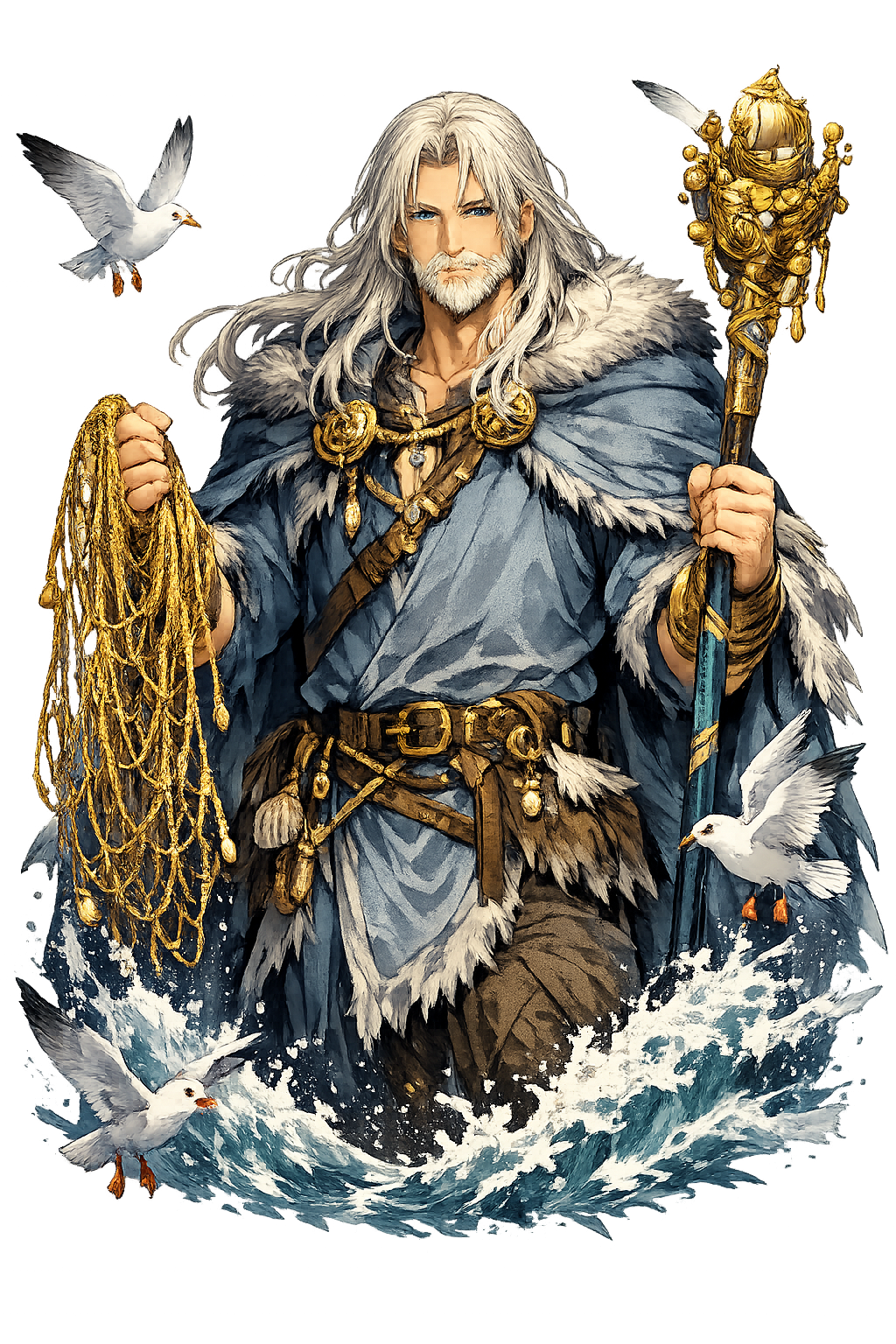
From Younger Futhark to Unicode: the journey of Njǫrðr
Long before it was a domain, this name traveled through scripts. Njǫrðr begins in Younger Futhark, passes through scholarly transliteration, and ends — for now — inside the punycode machinery of the global DNS. Each stage of that journey preserves some information and loses some, and the craft of restoration is knowing exactly which marks matter. This post follows the name stage by stage: the original script, the reconstructed pronunciation, the mythological record, the material evidence, and finally the Unicode form that carries all of it into the address bar. Think of it as a biography of a name, told through its spelling.
At a Glance
- Restored name: Njǫrðr
- ASCII form: njordr
- Meaning: "Vigorous (from *nerþuz)"
- Domain of influence: Sea, Wind, Fishing, Wealth
- Pantheon: Norse
- Classification: Tier 2
- Original script: ᚾᛁᚢᚱᚦᚱ (Younger Futhark)
- Live domain: njǫrðr.com
Overview
Njǫrðr (njordr) — Sea, Wind, Fishing, Wealth · Vigorous (from nerþuz) — belongs to the Norse tradition, where it is catalogued under the domain "Sea, Wind, Fishing, Wealth". The name means "Vigorous (from nerþuz)".
Njǫrðr is the Vanir god who learned to live among the Æsir, a deity of harbors, hauls of fish, and the sudden stillness that falls when a storm turns. He owns Nóatún, the Ships' Haven, and his power reaches into wind, fire, and the silver piled on merchant decks. Where Þórr battles the sea, Njǫrðr negotiates with it.
PuniCodex restores the name as Njǫrðr and serves its temple at njǫrðr.com. The original preserves one prosodic feature — stress or vowel length — rather than both, which places the name in Tier 2. The plain ASCII form njordr survives as a modern convenience imposed by the early domain-name system; the restoration, not the fallback, is the form the project defends as philologically complete.
The Name
The name is rendered in Younger Futhark as ᚾᛁᚢᚱᚦᚱ; the theonym itself is unattested in the runic corpus, so the runic form is a normalized reconstruction.
The name descends from Proto-Germanic \Nerþuz, conventionally glossed 'vigorous, strong' and connected with the Indo-European root seen in Old Irish nert 'strength'. The same name appears in feminine form as Nerthus, the goddess whose procession cult Tacitus describes in Germania 40; the linguistic identity of Nerthus and Njǫrðr* is exact, even though the male Norse sea-god and the continental earth-goddess differ in gender and sphere.
The ASCII form njordr survives only because the early domain-name system could not carry diacritics; it is a technological compromise, not an ancient spelling. The Unicode restoration Njǫrðr recovers the full diacritic detail of the scholarly transliteration directly in the address bar. The original preserves one prosodic feature — stress or vowel length — rather than both, which places the name in Tier 2.
The letter-by-letter transformation runs:
- n → N — Same
- j → j — Same
- o → ǫ — O-hook: short /ɔ/ vowel
- r → r — Same
- d → ð — Eth: voiced dental fricative
- r → r — Same
The project holds the domain njǫrðr.com (xn--njrr-dqa81m.com) as the canonical home of this name.
Etymology & Roots
The recorded derivation reads: Vigorous (from *nerþuz)
The reconstructed proto-form is *nerþuz (proto-indo-european), glossed as "Vigorous".
The reconstruction is classed as attested.
The Original Script
The name is rendered in Younger Futhark as ᚾᛁᚢᚱᚦᚱ — Germanic runic, the epigraphic medium of Viking-Age Scandinavia, c. 800–1100 CE. The script is written left-to-right, top-to-bottom.
The scholarly transliteration is Njǫrðr (normalized Old Norse), giving the normalized reading /ˈnjɔrðr/.
The rendering proceeds step by step:
- The Younger Futhark form ᚾᛁᚢᚱᚦᚱ is a normalized reconstruction; the theonym is unattested in the runic corpus and is known from the 13th-century manuscript tradition (Poetic and Prose Eddas).
- Younger Futhark has only sixteen runes and does not distinguish short/long vowels or voiced/voiceless stops, so the runic skeleton cannot encode the ǫ or the ð.
- The normalized Old Norse form follows the manuscript orthography of the Codex Regius tradition.
- The Unicode restoration Njǫrðr uses the o-hook (ǫ) and the eth (ð), letters registrable in .com, to preserve the medieval phonology.
Old Norse literature was transmitted in medieval Icelandic manuscripts written in the Latin alphabet, but the earlier epigraphic medium was the Younger Futhark. The theonym Njǫrðr is known chiefly from manuscript tradition; a hypothetical runic rendering would approximate ᚾᛁᚢᚱᚦᛦ. The normalized Old Norse form Njǫrðr uses two distinctive letters: ǫ (o with ogonek), representing the short rounded back vowel [ɔ] inherited from Proto-Germanic \Nerþuz*; and ð (eth), the voiced dental fricative [ð]. The PUNICODEX registrable form preserves both characters as a Tier-2 restoration that signals the name's Norse phonology even though it cannot encode manuscript accents or vowel length.
Pronunciation
The reconstructed pronunciation of the name is /ˈnjɔrðr/ — Old Norse Reconstruction.
Phoneme by phoneme:
- Nj- — Palatalized [n] plus [j] glide — the sea-god's name opens like 'ny' with a firm n.
- -ǫ- — Short open-mid back rounded vowel [ɔ], the vowel of *Nerþuz preserved in the Norse ǫ.
- -rðr — Trilled [r], voiced dental fricative [ð] as in English 'father', and a light syllabic final [r].
For the modern speaker, the closest approximation is: "NYORTH" — like 'nyore' with a short o, ending in the 'th-r' sound of 'father' plus a quick rolled r.
Kindred and historical forms of the name:
- Proto-Germanic — *Nerþuz, the pre-form underlying Njǫrðr and the continental goddess Nerthus
- Tacitus, Germania — Nerthus, the Latinized name of a Germanic fertility/sea deity
- Modern Icelandic — Njörður, the living reflex of the Old Norse name
Njǫrðr is Tier 2 because the Unicode restoration preserves the distinctive Norse vowel ǫ and the voiced dental fricative ð, but no length mark or written stress accent. Old Norse stress is initial and strong, yet it is not encoded by an acute; the registrable form Njǫrðr therefore records a single prosodic-orthographic feature.
Mythology
Njǫrðr's myths are stories of arrival and accommodation: the hostage who becomes indispensable, the sea-god who marries the mountain, the father of the two most beloved gods of the Viking Age. His drama is quieter than Óðinn's or Þórr's, but it turns on the same cosmic question — how do unlike powers share one world?
The Calmer of Sea and Flame (Gylfaginning)
Snorri records that Njǫrðr 'rules over the course of the wind and stills sea and fire.' Sailors and fishermen call on him because he can flatten a swell or quiet a blaze. He is fésæll, blessed with property: prosperity follows him like gulls follow a laden hull. In a culture that lived by longships and fish, this was not a minor power; it was survival itself.
Nóatún, the Ships' Haven (Grímnismál)
In the Grímnismál, Óðinn lists the halls of the gods and places Njǫrðr at Nóatún, 'the Enclosure of Ships.' The name imagines a safe anchorage, a god whose house is a harbor. It is the fitting seat for a deity whose realm is not the open ocean's terror but the skilled negotiation of it — the beach, the dock, the wind that fills the sail.
The Hostage of the Vanir (Gylfaginning / Ynglinga saga)
After the catastrophic war between Æsir and Vanir, the two tribes exchanged hostages. The Vanir sent Njǫrðr and his son Freyr to Ásgarðr; the Æsir sent Hœnir and Mímir to Vanaheimr. Njǫrðr did not merely survive the exchange — he became one of the great gods of the north, a bridge between the wild fertility of the Vanir and the ordered sovereignty of the Æsir.
The Feet in the Hall (Skáldskaparmál)
The giantess Skaði came to Ásgarðr seeking weregild for her father Þjazi. As compensation she was allowed to choose a husband from among the gods — but only by his feet. Certain she was selecting the shining Baldr, she picked the cleanest limbs and found herself betrothed to Njǫrðr. The mismatch is comic, but also cosmic: sea married mountain, salt married stone. They tried living in each other's worlds and found both wanting.
The Accusation at Ægir's Feast (Lokasenna)
In Lokasenna, Loki taunts Njǫrðr with his origins: 'you were sent east as a hostage to the gods.' Njǫrðr answers calmly that though he was a hostage, he fathered a son 'whom no one dislikes' — Freyr. The exchange shows both the stigma of the outsider and the dignity with which Njǫrðr carries it.
Symbols & Iconography
The iconography associated with Njǫrðr concentrates in a small set of recurring attributes, each a compressed statement about the god:
- Ship — The longship and the merchant vessel, the vehicles of his domain and his blessing; his hall Nóatún is itself 'the Enclosure of Ships' (Grímnismál 16).
- Fish and net — The daily harvest of the sea and the skill that turns water into food; fishermen are told to call on him (Gylfaginning 23).
- Gull — The cry Skaði hated at Nóatún and the sailor loves, a bird of harbors and hauls.
- Gold and cargo — The wealth that arrives by water, the 'rich god' (fésæll) made tangible.
- Wagon or cart — The continental Nerthus cult's procession vehicle (Tacitus, Germania 40), echoed uncertainly in his older heritage.
Archaeology & Evidence
Direct depictions of Njǫrðr are elusive, but his world is visible in the material record. The Dejbjerg wagons from Iron-Age Denmark — ceremonial carts deposited in a bog — are often interpreted as vehicles of a procession cult like the one Tacitus describes for Nerthus, the strongest continental parallel to the Norse god. Scandinavian place-names such as Njarðarlog in Sweden and Njarðey / Nærøy in Norway preserve his cult on coasts and islands. Wetland boat offerings such as the Nydam ship, and the weapon-furnished boat graves of the Vendel period, testify to a maritime religious economy in which safe passage and full nets were paramount; the later ship finds, including the scuttled Skuldelev fleet, map the seafaring culture whose prosperity he was believed to secure.
Realm & Domain
Njǫrðr is the Vanir god who learned to live among the Æsir, a deity of harbors, hauls of fish, and the sudden stillness that falls when a storm turns. He owns Nóatún, the Ships' Haven, and his power reaches into wind, fire, and the silver piled on merchant decks. Where Þórr battles the sea, Njǫrðr negotiates with it.
Sea & Wind
He 'rules over the course of the wind and stills sea and fire', the divine patron of sailors who read the water rather than fight it.
Fishing & Safe Passage
Fishermen and mariners invoked Njǫrðr for full nets, fair winds, and the calm that lets a hull come home.
Wealth & Abundance
He is so rich and so lucky in wealth (fésæll), Snorri says, 'that he can grant wealth of land or property to those who ask'.
Lord of Nóatún
His hall, the Enclosure of Ships, is the safe anchorage where seafaring and sovereignty meet.
Across Cultures
The strongest comparative case is the deity Nerthus described by Tacitus in Germania 40: a fertility figure drawn in a cart through the Germanic countryside, associated with peace and a hidden lake. The name Nerthus is the Latinized feminine counterpart of Proto-Germanic \Nerþuz, the pre-form of Njǫrðr, and most scholars accept a historical connection. Yet Tacitus's Nerthus is an earth-goddess, while Njǫrðr is a male sea-god. The mismatch may reflect regional variation, a shift from chthonic to maritime spheres, or the fusion of two related cults. Modern scholarship has compared him with Neptune and with maritime Mercury; in medieval Iceland, Christian learned authors euhemerized him as a king of the Vanir. The modern Icelandic name Njörður* preserves the same phonological core.
Kindred figures in the PuniCodex cross-tradition index include [[aseratu|Ašeratu]], [[babaluaye|Ọbalúayé]], [[ea|Ēa]], [[manannan|Manannán]], [[pontos|Póntos]], and [[poseidon|Poseidôn]], each linked through sea / water.
Cultural Legacy
Njǫrðr left his name on the Norwegian coast and in Scandinavian place-names such as Njarðarlog and Njarðey. He survives less visibly in popular culture than Óðinn or Þórr, yet his domain — the sea as livelihood — shaped the Viking world more directly than any battlefield. Modern fishermen, sailors, and coastal communities still sense the old logic: the ocean is not an enemy to be conquered but a power to be propitiated. In contemporary heathenry and Norse-inspired fantasy, Njǫrðr appears as the quiet god of harbors, the father of Freyr and Freyja, and the patient negotiator between land and sea.
The Scholarly Record
The account of Njǫrðr given in this edition rests on the witnesses and reference works listed below. Lexica and etymological dictionaries secure the form and meaning of the name; the literary and religious texts supply the narrative evidence.
- Poetic Edda: Grímnismál (Njǫrðr's hall at Nóatún).
- Poetic Edda: Lokasenna (Njǫrðr's exchange with Loki at Ægir's feast).
- Snorri Sturluson, Prose Edda: Gylfaginning (attributes, marriage, and Vanir hostage exchange).
- Snorri Sturluson, Prose Edda: Skáldskaparmál (kennings and the power over sea, wind, and fire).
- Snorri Sturluson, Heimskringla: Ynglinga saga (Æsir-Vanir war and hostages).
- Tacitus, Germania 40 (Nerthus and the continental Nerþuz cult). Full text
- Cleasby & Vigfusson, An Icelandic-English Dictionary (1874), s.v. Njörðr.
- Zoëga, A Concise Dictionary of Old Icelandic (1910), s.v. Njörðr.
- de Vries, Jan, Altgermanische Religionsgeschichte.
- Simek, Rudolf, Dictionary of Northern Mythology.
- Lindow, John, Norse Mythology: A Guide to the Gods, Heroes, Rituals, and Beliefs.
A Meditation
Njǫrðr is the god of practical peace. Unlike Óðinn, who buys wisdom with violence, or Þórr, who hammers disorder into submission, Njǫrðr prospers by accommodation. He is the hostage who becomes family, the sea-god who learns the mountain's language, the father whose children eclipse him in fame without diminishing his care.
His realm is the shoreline, the most liminal of places: neither land nor sea, yet where both become useful. There is a wisdom in that liminality. To live well is not always to dominate; sometimes it is to read the wind, mend the net, know when the swell will ease, and accept the terms the world offers. Njǫrðr asks no one to hang on a tree or fight a world-serpent. He asks only that the sailor remember which god stills the wave.
The Unicode Restoration
Njǫrðr is classified as Tier 2: the original preserves at least one philological feature that ASCII cannot encode. The ASCII fallback njordr still resolves everywhere, but it is the restored form that carries the name's full information. Across the 6 characters of the name, the restoration adjusts 2: 2 further adjustments (ǫ, ð). That is the whole thesis of this temple: the marks are the message.
Character by Character
The journey from njordr to Njǫrðr, one character at a time:
- n → N — Same
- j → j — Same
- o → ǫ — O-hook: short /ɔ/ vowel
- r → r — Same
- d → ð — Eth: voiced dental fricative
- r → r — Same
The Domain Name
The restored name is live as a working domain: njǫrðr.com, which the DNS carries in punycode form as xn--njrr-dqa81m.com — an ASCII-compatible encoding that lets a non-ASCII name travel the global network without breaking older infrastructure. The visitor sees Njǫrðr; the machines see the encoding. That duality is the engineering compromise on which the entire restoration rests, and it is why a name written the way its own tradition wrote it in Younger Futhark can now be typed into any browser on earth.
The Norse Pantheon
Njǫrðr is one of 86 entries the PuniCodex lexicon catalogues under the Norse pantheon. The Pantheon page gathers the tradition's major figures in one place, and the Lexicon lets you filter all 895 restorations by tradition, tier, or script — the fastest way to see where this name sits among its kin.
Why This Restoration Matters
Every stage of the journey from Younger Futhark to Unicode was an act of care: the scribe who first wrote the name, the lexicographer who glossed it, the engineer who taught the DNS to carry it. The PuniCodex restoration is the latest stage, not the last word — the Scholarly Edition is revised as the evidence improves. What does not change is the principle: a name deserves to be written the way its own tradition wrote it. Njǫrðr in the address bar is that principle, made routable.
Explore Further
This post is one doorway into the temple. The home page carries the full character breakdown and the ambient canvas; the lore page tells the myths in long form; the Scholarly Edition preserves the sources, pronunciation data, and revision history; and the patron wall supports the restoration directly. For the wider map, browse the Lexicon, explore the Pantheon, or return to the PuniCodex blog.
Related Names
Sources
The full scholarly apparatus — every citation, revision, and review — lives in the Scholarly Edition. Key references for this post:
- Tacitus, Germania 40 (the Nerthus procession).
- de Vries, Jan, Altgermanische Religionsgeschichte; Kroonen, Etymological Dictionary of Proto-Germanic (2013), s.v. nerþuz.
- Snorri Sturluson, Prose Edda: Gylfaginning (attributes, marriage, and Vanir hostage exchange).
- Simek, Rudolf, Dictionary of Northern Mythology (1993), s.v. Njǫrðr.
- Barnes, Michael P., Runes: A Handbook (Boydell, 2012).
- Lexicon authorities for this entry: Cleasby-Vigfusson, Zoëga.