
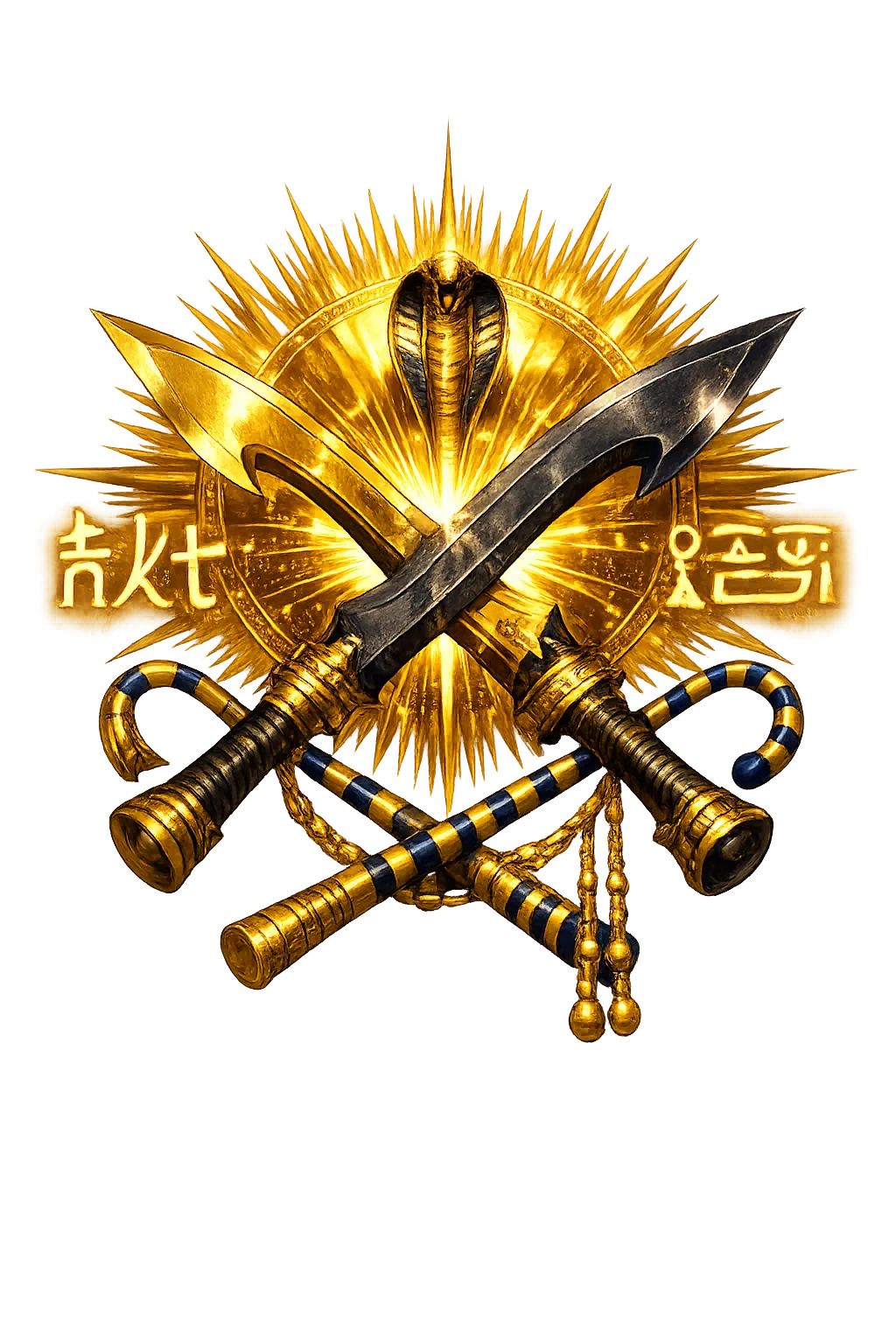
The name Nḫt and the world it opens
A name is a door. Nḫt opens onto an entire world: the domain of strength, victory, a Egyptian tradition, and centuries of storytelling, worship, and scholarship. This post walks through that world room by room — the name and its roots, the original script, the sound of it, the myths, the symbols, the sites, the afterlife across cultures — and ends at the newest room of all: a Unicode domain that makes the whole structure addressable. nekhet gets you to the same building, but only the restored form tells you why it was built.
At a Glance
- Restored name: Nḫt
- ASCII form: nekhet
- Meaning: "Strong, mighty, victorious"
- Domain of influence: Strength, Victory
- Pantheon: Egyptian
- Classification: Tier 2
- Original script: 𓈖𓎛𓏏 (Hieroglyphs)
- Live domain: nḫt.com
Overview
Nḫt (nekhet) — 'strong, mighty, victorious' — is one of the commonest power-words of the Egyptian language and one of the least personified: Egyptian religion knows no god 'Nekhet' with cult, temple, or priesthood, because the word's work is done inside every other god and king. As adjective, noun, and verb it names the quality through which divine rule acts — the arm that bends the bow, breaks the enemy, and raises stone that outlasts the flood. From the Pyramid Texts, where the dead king is made nḫt so that he may ascend, to the battle annals of Thutmose III, where the king campaigns as the strong arm of Amun, the root marks the transfer of strength from god to king and from king to monument.
PuniCodex restores the name as Nḫt and serves its temple at nḫt.com. The restoration preserves the root's defining consonant — the voiceless velar fricative ḫ (h-breve, U+1E2B) — in a registrable Tier 2 form. The ASCII fallback nekhet survives only because the early domain-name system could not carry the diacritic; the restoration, not the fallback, is the philologically complete form.
The Name
The name is attested in Hieroglyphs as 𓈖𓎛𓏏 — the water-line n, the ḫ-sign, and the bread-loaf t, normally closed by the bent-arm determinative that is Egyptian's own picture of strength. The root means 'strong, mighty, victorious' and runs through adjectives ('mighty'), nouns ('strength', 'victory'), and verbs ('to be strong', 'to conquer').
The ASCII form nekhet is a technological compromise imposed by the early domain-name system, which could not carry diacritics; it is not an ancient spelling. The Unicode restoration Nḫt recovers the scholarly transliteration directly in the address bar, preserving the historic velar fricative as a Tier 2 form.
The letter-by-letter transformation runs:
- n → N — Same, capitalized
- e → — — Epenthetic vowel
- k → ḫ — Voiceless velar fricative ḫ
- h → — — Dropped: continuation of ḫ
- e → — — Epenthetic vowel
- t → t — Same
The project holds the domain nḫt.com (xn--nt-bvs.com) as the canonical home of this name.
The Original Script
The name is preserved in Hieroglyphs as 𓈖𓎛𓏏 — Egyptian hieroglyphic, attested from the Old Kingdom to Late Antiquity (c. 2600 BCE – 400 CE) in Egypt; the script runs right-to-left or top-to-bottom.
The scholarly transliteration is Nḫt (Egyptological conventional). Egyptian writing does not record vowels; the original vocalisation is unknown and the conventional reading supplies them, giving an approximate /nəxt/.
The rendering proceeds step by step:
- The Egyptian word is written 𓈖𓎛𓏏 in hieroglyphs.
- Hieroglyphs combine logograms, phonograms, and determinatives; the exact function of each sign depends on context.
- Egyptian writing does not record vowels; the vocalised form is a modern convention reconstructed from Coptic and Greek evidence.
- The Unicode restoration Nḫt uses registrable Egyptological characters; the hieroglyphic form itself lies outside the .com IDN table.
The root is written n-ḫ-t, usually with the bent-arm determinative (Gardiner D40) when the sense is 'strong' or 'victorious'. The ḫ is a voiceless velar fricative, rendered by h-breve (U+1E2B). The vocalisation is reconstructed from Coptic ⲛⲟϭ (nōč), 'great, strong', and from the pattern of Egyptian triliteral nouns. PuniCodex registers Nḫt as a Tier 2 restoration that preserves the historic velar fricative: not the name of an anthropomorphic deity but a divine quality embedded in royal and theological language.
Pronunciation
The reconstructed pronunciation of the name is /ˈnaxt/ — Egyptological Reconstruction.
Phoneme by phoneme:
- N- — Alveolar nasal [n], as in English 'no'.
- -a- — Short open vowel; Egyptian hieroglyphs do not write vowels, so the vowel quality is inferred from Coptic and from Semitic transcriptions.
- -ḫ- — Voiceless velar fricative [x], like the 'ch' in Scottish 'loch'; written with h-breve (U+1E2B).
- -t — Voiceless alveolar stop [t]; the final consonant of the root.
For the modern speaker, the closest approximation is: 'NAKHT' — one syllable, with the 'kh' like Scottish 'loch' (not 'k').
Kindred and historical forms of the name:
- Coptic — ⲛⲟϭ (nōč), 'great, mighty'
- Egyptian root — nḫt, 'strong, mighty, victorious'
- Greek transcription — Ναχτ (Nakht), in some Greek renderings of Egyptian personal names
The hieroglyphs record only the consonants n-ḫ-t; the vocalised form is reconstructed from Coptic ⲛⲟϭ and from the pattern of Egyptian triliteral nouns. In PuniCodex the spelling Nḫt uses the registrable h-breve (U+1E2B) as a Tier 2 restoration; the ASCII fallback is nekhet.
Mythology
Nḫt has no continuous myth of its own; instead, it threads through the myths of others as the strength that makes them possible. It is the unnamed protagonist of Egyptian royal ideology.
The Strength of the King Ascends (Pyramid Texts)
In the Pyramid Texts, the dead king is made nḫt so that he may ascend to the sky, row with the gods, and stride among the stars. Utterances call upon Horus to give the king his arm, Seth to give him his strength, and Thoth to make his limbs mighty. Nḫt is the kinetic energy of resurrection.
The Contendings (Horus and Seth)
The Contendings of Horus and Seth is a contest not only of legitimacy but of nḫt. Each god must prove himself stronger, more cunning, more enduring. Horus's final victory is confirmed when the gods recognize that his arm — his nḫt — is fit to wield the harpoon and rule the Two Lands.
Montu and the Chariot (New Kingdom)
The war-god Montu of Thebes embodies nḫt in battle. Inscriptions of Thutmose III and Ramesses II credit Montu with lending them strength; the king becomes the god's arm, and the god becomes the king's might.
Amun as Nḫt (Theology)
In New Kingdom hymns, Amun is praised as nḫt n rwḏw, 'mighty of strengths,' the hidden source of all power. The abstract noun becomes a divine predicate: to be strong is to participate in Amun.
Symbols & Iconography
The iconography of strength concentrates in a small set of recurring images, each a compressed statement of what nḫt means:
- Bent arm (Gardiner D40) — The flexed forearm that serves the script itself as determinative and ideogram of nḫt: Egyptian writes strength with the picture of a tensed muscle.
- Bow — The weapon drawn by the king's strong arm; Egypt's traditional enemies are enumerated as the Nine Bows, trodden under the pharaoh's feet in temple iconography.
- Mace — The weapon of the smiting scene, in which the king's upraised arm crushes the kneeling foe before the approving god — nḫt frozen as gesture.
- Obelisk — Strength translated into endurance: monolithic stone that carries the royal name unbroken through millennia.
The set is deliberately mixed — two weapons of the hand, one sign of the body, one monument of stone — because nḫt ranges from the muscle of the moment to the permanence of the record.
- Bow — The king's arm made nḫt draws the bow that defeats chaos
Archaeology & Evidence
Because nḫt is a word rather than a person, its archaeology is epigraphic: the root is read, not worshipped. It appears in monumental inscriptions from the Old Kingdom to the Ptolemaic period, above all in royal titularies and war records — the Annals of Thutmose III on the walls of Karnak, where the king campaigns as the strong arm of Amun, and the victory inscriptions of Ramesses II at Abu Simbel. Royal names carry it too: Amenhotep III ruled under the Horus name kꜣ nḫt, 'the victorious bull', and the fixed epithet nḫt-ḫpš, 'strong of arm', recurs across New Kingdom titularies.
In the private sphere the root is everywhere a name-element: tombs, stelae, and papyri, especially at Thebes, preserve generations of men called Nakht, among them the astronomer of Amun buried in TT 52. The bent-arm sign (Gardiner D40) and the arm-with-mace determinative illustrate the word's semantic range across three millennia of Egyptian visual culture.
Realm & Domain
Nḫt is not a god with a temple in every nome; it is a power that runs through every god and every king. The Egyptian root means 'strong,' 'mighty,' 'victorious' — the quality that bends bows, breaks enemies, and endures the weight of stone. Personified, Nḫt is the arm behind the spear, the backbone of the obelisk, the hidden muscle of maat.
From the Pyramid Texts to the battle reliefs of Ramesses, nḫt is the word that turns a mortal into a conqueror and a pharaoh into a force of nature. It belongs to Horus in the contending, to Montu in the chariot, and to Amun when his name itself becomes a weapon.
Mighty of Arm
Royal epithets praise the king as nḫt ḫpš, 'mighty of arm,' the physical guarantee of victory.
Victory in Battle
The root names triumph over Egypt's enemies and the overcoming of chaos.
Enduring Stone
Nḫt describes monuments and laws that outlast generations; might becomes permanence.
Divine Empowerment
Gods grant nḫt to the king through ritual, oracle, and the anointing of power.
Across Cultures
Nḫt is less a figure to be syncretized than a force to be shared. It flows from Montu to the king, from Amun to the cosmos, from Horus to the justified dead. In Greek and Roman eyes, the pharaoh's nḫt was simply the invincible fortune of a god-king; they rendered the concept with words like virtus and dynamis. In biblical Hebrew, the same semantic field is covered by ḥayil and gebûrâ, suggesting that the ancient Near East understood strength as a divine gift rather than a human possession. Nḫt is the Egyptian version of a universal theology: no one is strong alone.
Within the Egyptian tradition, closely related names in the corpus include [[ab|Ꜣb]], [[akh|Ꜣḫ]], [[amun|Ꜣmun]], [[ankh|ꜥnḫ]], [[apep|Ꜥpp]], and [[ba|Bꜣ]].
Cultural Legacy
The root survives most visibly in names. Nakht ('the strong one') was borne by officials of every period; the best-known is the scribe and astronomer of Amun whose painted tomb at Thebes (TT 52, reign of Thutmose IV) remains among the most visited in the necropolis. A general Nakhtmin served at the close of the Eighteenth Dynasty. The name even reached the throne: Egypt's last native dynasts, Nectanebo I and II, ruled under the birth names Nḫt-nb.f ('the strong one of his lord') and Nḫt-ḥr-ḥbt ('strong is Horus of Hebit'), which Greek ears rendered Nektanebōs. The word itself outlived the pharaohs, descending into Coptic as ⲛⲟϭ, 'great, mighty'.
Beyond the lexicon, the bent-arm hieroglyph has become a modern visual shorthand for Egyptian strength in logos and popular art, and in Kemetic reconstruction Nḫt is honoured as the disciplined might that upholds [[maat|Mꜣꜥt]] — not brute domination, but the strength that maintains order against entropy.
The Scholarly Record
The account of Nḫt given in this edition rests on the witnesses and reference works listed below. Lexica and etymological dictionaries secure the form and meaning of the name; the literary and religious texts supply the narrative evidence.
- Allen, Middle Egyptian (2014).
- Faulkner, A Concise Dictionary of Middle Egyptian, s.v. nḫt.
- Wörterbuch der ägyptischen Sprache II, s.v. nḫt.
- Lichtheim, Ancient Egyptian Literature, vol. 2.
- Redford, The Wars in Syria and Palestine of Thutmose III.
- Pyramid Texts, Utterances 273–274.
- The Contendings of Horus and Seth (Papyrus Chester Beatty I).
- Assmann, The Mind of Egypt.
- Gardiner, Egyptian Grammar, 3rd ed. (1957), Sign-list D40.
- Valbelle, Les neufs arcs (1990).
- Davies, The Tomb of Nakht at Thebes (1917).
- von Beckerath, Handbuch der ägyptischen Königsnamen, 2nd ed. (1999).
- Crum, A Coptic Dictionary, s.v. ⲛⲟϭ.
- Hoch, Semitic Words in Egyptian Texts of the New Kingdom and Third Intermediate Period (1994).
A Meditation
Nḫt is the least theatrical of Egypt's powers. It does not roar like Sekhmet or weep like Isis; it simply holds. The arm that draws the bow, the legs that march, the will that keeps building when the flood recedes — this is nḫt. It is strength not as display but as persistence.
In a culture that often mistakes noise for power, Nḫt offers an older definition: the capacity to bear weight without collapsing. To be nḫt is to be the beam in the roof, the oar in the water, the law that outlasts the tyrant. It is not the strength that destroys for sport; it is the strength that keeps the world from falling back into the flood. That kind of might is rarely celebrated, but without it nothing else survives.
The Unicode Restoration
Nḫt is classified as Tier 2: the original preserves at least one philological feature that ASCII cannot encode. The ASCII fallback nekhet still resolves everywhere, but it is the restored form that carries the name's full information. Across the 6 characters of the name, the restoration adjusts 4: 4 further adjustments (e, ḫ, h, e). That is the whole thesis of this temple: the marks are the message.
Character by Character
The journey from nekhet to Nḫt, one character at a time:
- n → N — Same, capitalized
- e → e — Epenthetic vowel
- k → ḫ — Voiceless velar fricative ḫ
- h → h — Dropped: continuation of ḫ
- e → e — Epenthetic vowel
- t → t — Same
The Domain Name
The restored name is live as a working domain: nḫt.com, which the DNS carries in punycode form as xn--nt-bvs.com — an ASCII-compatible encoding that lets a non-ASCII name travel the global network without breaking older infrastructure. The visitor sees Nḫt; the machines see the encoding. That duality is the engineering compromise on which the entire restoration rests, and it is why a name written the way its own tradition wrote it in Hieroglyphs can now be typed into any browser on earth.
The Egyptian Pantheon
Nḫt is one of 66 entries the PuniCodex lexicon catalogues under the Egyptian pantheon. The Pantheon page gathers the tradition's major figures in one place, and the Lexicon lets you filter all 895 restorations by tradition, tier, or script — the fastest way to see where this name sits among its kin.
Frequently Asked Questions
What does Nḫt mean? The traditional gloss is "Strong, mighty, victorious."
Which tradition does Nḫt belong to? Nḫt is catalogued in the Egyptian pantheon of the PuniCodex lexicon.
Why is Nḫt classified as Tier 2? Because the original preserves at least one philological feature that ASCII cannot encode — and the marks in the restored spelling preserve exactly that evidence.
Is Nḫt a working domain? Yes — nḫt.com resolves today and routes to this temple.
What is the punycode for nḫt.com? The DNS encoding is xn--nt-bvs.com; browsers perform the translation automatically, so visitors only ever see the restored name.
Typing Nḫt
You do not need a special keyboard to use this restoration. The PuniCodex Type Tool converts the ASCII form nekhet into Nḫt as you type, and the browser extension offers the same conversion inside any text field. Copy the restored form, paste it into the address bar, and the DNS does the rest.
Why This Restoration Matters
A door only matters if people walk through it. nḫt.com is open, and everything behind it — the myths, the scholarship, the canvas, the patrons — hangs on the restored spelling. The PuniCodex project bets that the web will make room for names as they were actually written, and Nḫt is one of its standing proofs. Visit, share, cite, type it yourself: each use is a small rehearsal for a web where no name has to hide its marks to be found.
Explore Further
This post is one doorway into the temple. The home page carries the full character breakdown and the ambient canvas; the lore page tells the myths in long form; the Scholarly Edition preserves the sources, pronunciation data, and revision history; and the patron wall supports the restoration directly. For the wider map, browse the Lexicon, explore the Pantheon, or return to the PuniCodex blog.
Related Names
Sources
The full scholarly apparatus — every citation, revision, and review — lives in the Scholarly Edition. Key references for this post:
- James P. Allen, Middle Egyptian: An Introduction to the Language and Culture of Hieroglyphs, Cambridge University Press, 2000.
- Faulkner, A Concise Dictionary of Middle Egyptian, s.v. nḫt.
- Redford, The Wars in Syria and Palestine of Thutmose III (2003).
- Allen, Middle Egyptian (2014).
- Crum, A Coptic Dictionary, s.v. ⲛⲟϭ.
- Lexicon authorities for this entry: Faulkner, Wb.