Unicode restoration and ASCII comparison
Myrddin
The name survives in scholarly transliteration. Myrddin is the standard Celtic romanisation, documented in academic sources — “Merlin”. Because the spelling uses only Latin letters, the form is the same in both ASCII and Unicode.
No indigenous writing system is securely attested for individual celtic names. The form shown is a modern scholarly transliteration.
myrddin
The plain myrddin form is identical to the Unicode restoration. Because this name is already written in Latin letters, no diacritics, stress, or script information were lost — only capitalization differs.
Myrddin
The Unicode restoration does not need to recover lost marks for Myrddin. Its value is canonical spelling and consistent cataloguing, not the reconstruction of erased orthography. The domain is readable as-is to both DNS and humanity.
Myrddin.com → myrddin.com
The non-ASCII characters in Myrddin are encoded while the ASCII remains visible. To the DNS, it is Punycode. To humanity, it is Myrddin.
How Myrddin is preserved in writing
No indigenous writing system is securely attested for individual celtic names. The form shown is a modern scholarly transliteration.
Contribute scholarly provenance →Owned, ideal, and ASCII forms of Myrddin
Myrddin
The full Unicode restoration. myrddin.com is not in the PuniCodex collection — it is watched for release; if it drops, this temple upgrades to an owned flagship.
How Myrddin was spoken
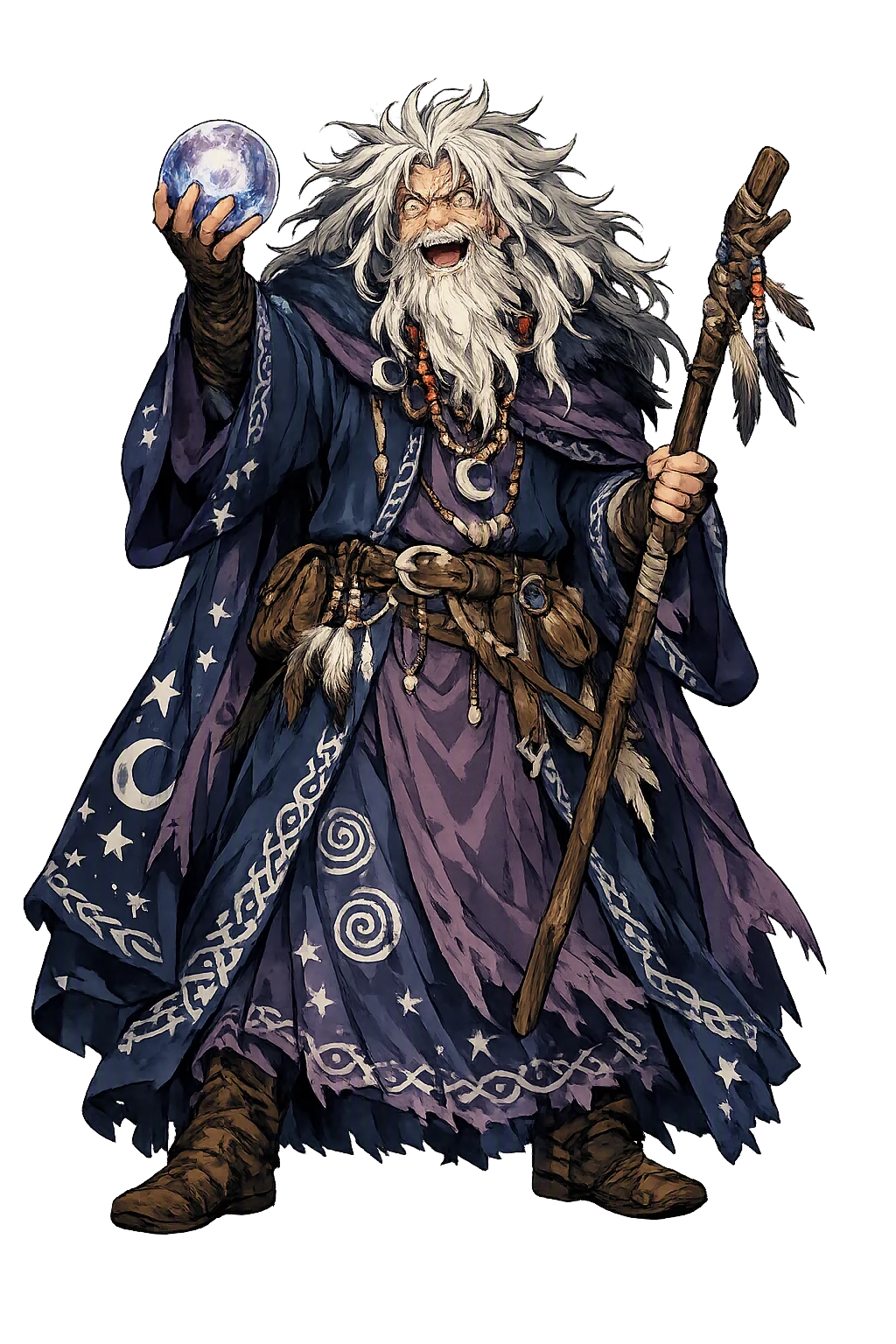
Seer, Wild Man
Myrddin is the original Welsh form of the name the world knows as Merlin: the prophet who went mad at the battle of Arfderydd in 573, fled into the Caledonian forest, and lived there as a wild man — lamenting his dead lord Gwenddolau, sheltering beneath an apple tree, and uttering the prophecies that made him the canonical voice of Welsh vaticination before Geoffrey of Monmouth made him the wizard of the Arthurian world.
The sweet apple tree that shelters Myrddin in the Afallennau — his only house in the forest of Celyddon, addressed like a friend.
The northern battle of 573 where his lord Gwenddolau son of Ceidio fell; grief and slaughter drove Myrddin mad, says the Welsh Triad.
The death Myrddin prophesies in the Vita Merlini — from a rock, in a tree, and in the water — fulfilled to the letter; the wild prophet's own end in the northern tale.
The prophetic poems gathered under his name — the Black Book's Afallennau and Oianau, and Geoffrey's Prophetiae Merlini, the most copied political prophecy of the Middle Ages.
Stories of Myrddin
Myrddin's dossier divides in two, and the tradition itself knew it: the northern prophet who went mad at Arfderydd and fled to Coed Celyddon, preserved in the Welsh Triads, the Annales Cambriae, and the Black Book poems; and Geoffrey of Monmouth's Merlinus, who carried the wild man into Latin and grafted him onto the Arthurian world. Gerald of Wales already separated them in the twelfth century: Merlinus Ambrosius, the boy prophet of Vortigern's tower, and Merlinus Celidonius — Sylvester — the wild man of the Caledonian forest.
The Annales Cambriae enter under the year 573 the battle of Arfderydd, fought in the north between the sons of Eliffer and Gwenddolau son of Ceidio — a historical-seeming conflict of the British Old North. The Welsh Triads count it among the futile battles of the Island of Britain, brought about, in the triad's famous understatement, for a lark's nest; and the triad records the consequence that matters here: Gwenddolau fell, and Myrddin became mad.
From that seed the whole legend grows. Myrddin son of Morfryn, his lord dead and his side defeated, flees the world of the mead-hall into Coed Celyddon, the Caledonian forest, and becomes Myrddin Wyllt — the Wild — living from the forest's gifts and speaking only in verse and prophecy.
The earliest Welsh manuscript, the Black Book of Carmarthen (c. 1250), preserves the poems that give the wild man his own voice. In Yr Afallennau, 'The Apple Trees', Myrddin addresses the sweet apple tree that shelters him: he laments Gwenddolau, slain in the bloodshed of Arfderydd; he grieves that he endures want while once he rode at the head of warriors; he hides from Rhydderch's men; and the refrain returns to the tree, his one companion and hiding-place.
The companion poem, Yr Oianau, keeps the same voice — the outcast prophet calling his mournful 'oian' through the forest, mourning his dead, marked out by madness as the gods' or fate's chosen sufferer. These are not narrative poems but laments with prophecy threaded through them; together they made Myrddin the patron and mouthpiece of the whole Welsh prophetic genre.
The Cyfoesi Myrddin a Gwenddydd ei chwaer — 'The Conversation of Myrddin and His Sister Gwenddydd' — is the tradition's most human document. Gwenddydd, wife of Rhydderch and sister of the wild prophet, questions her brother across the gulf his madness has opened: she mourns the warrior he was, the mead-feasts he no longer honours, the lord they both have lost. Myrddin answers her with prophecy — the fate of Wales, the coming of its deliverers — but the prophecy keeps breaking against grief.
The dialogue fixes what the poems imply: the wild man is not forsaken but watched from the world he left. Gwenddydd survives in Geoffrey of Monmouth's Latin as Ganieda — Rhydderch's queen, Myrddin's sister, and, at the end of the Vita Merlini, his successor in prophecy itself.
Geoffrey of Monmouth's Vita Merlini (c. 1150) is the wild man's fullest biography. Merlinus — poet, prophet, and king in Geoffrey's telling — loses his reason at a battle among the northern princes and flees to the Caledonian wood, where he lives as a silvester homo, a man of the forest, feeding on roots and fruit, snow on his shoulders, unknown to his own court. Rhydderch's men find him and drag him back; at court he laughs at things no one understands, and his laughter is always a prophecy. To a boy he foretells a threefold death: from a rock, in a tree, and in the water — and the boy, falling from a cliff, is caught by a tree with his head in the stream, dying all three deaths at once, as no human prudence could have guarded against.
The poem lets him go home to the forest at last. He appears riding a stag, driving the woodland herds before him like a shepherd of the wild; [[taliesin|Taliesin]] — Telgesinus in the Latin — comes to him, and the two seers discourse at length on the winds, the waters, the fishes, and the making of the world. In the end Merlin gives his observatory to his sister Ganieda, who takes up the prophetic gift, and retires to the forest for good — the mad king become the wise wild man, the only sovereignty he can still keep.
Geoffrey's other Merlin came from another book. The ninth-century Historia Brittonum of Nennius tells of the boy Ambrosius — a child without a father — brought to King Vortigern to be sacrificed so that his collapsing tower at Dinas Emrys might stand; the boy instead reveals the pool beneath the foundations and the two dragons, red and white, whose battle is the prophecy of Britain: the red dragon of the Britons, the white of the Saxons.
Geoffrey took Nennius's boy and gave him Myrddin's name: Merlinus Ambrosius. The graft made one figure of two traditions — the royal prophet of the tower and the mad prophet of the forest — and Gerald of Wales, a generation later, was already insisting they were two. The composite Merlin who results is the one the world inherited: prophet to Vortigern, architect of kings, and, in the romances that followed, counsellor of Arthur himself.
Myrddin is the figure who paid for knowledge with the ordinary world. Every version of him loses something before he sees: a lord, a battle, his reason, his hall. The tradition is strikingly honest about the transaction — the prophecy is real, and so is the madness, and the same event, the slaughter at Arfderydd, gives him both. He is the answer Celtic literature gives to the question of what a seer is: not a priest with a technique but a survivor whom grief has put outside the human settlement, close enough to the trees that the future can get a word in. His sister comes to the edge of the forest to ask what will happen; he tells her, and stays. That is the shape of the gift — the future, at the price of the present.
Enter Extended Lore