
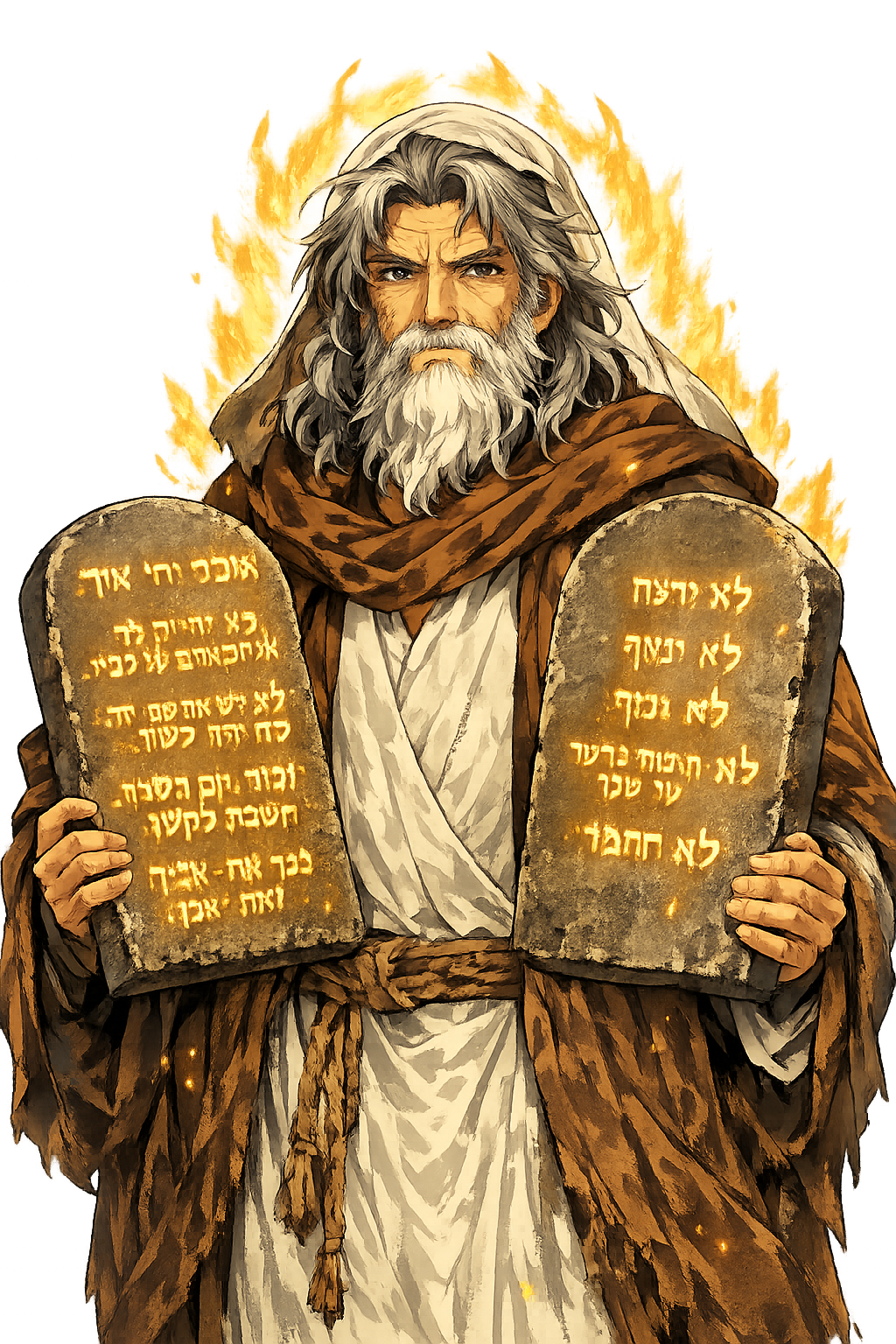
How Mōšeh was rebuilt, mark by mark
From the restoration bench — the working notes on Mōšeh, kept because the process is the proof.
What We Found
The attestation runs through the tradition's own sources: מֹשֶׁה. Meaning: "Hebrew prophet and lawgiver".
The figure behind the name: Moses' story is not a single hero's quest but a forty-year negotiation between a people and their god.
What the Name Carried In
The Child in the Basket. Born under Pharaoh's edict of death, the infant Moses is hidden in a papyrus basket on the Nile and discovered by Pharaoh's daughter. The name Mōšeh is explained as a pun on Hebrew māšâ, 'to draw out,' though Egyptologists also hear in it the common New Kingdom name element -mose, 'born of' (a deity).
The Reluctant Prophet. At Horeb, God speaks from a burning bush and commissions Moses to confront Pharaoh. Moses objects five times: Who am I?
A spelling that has to carry stories like these is not a label. It is equipment.
Where It Stood Before Us
No archaeological find names Moses directly, and the historicity of the Exodus remains debated. The Merneptah Stele (c. 1208 BCE) is the earliest extra-biblical reference to a people called Israel in Canaan. Excavations at Tel el-Dab'a (ancient Avaris) in the eastern Nile Delta reveal a large Semitic settlement during the Second Intermediate Period, though its connection to the Exodus narrative is contested. Proto-Sinaitic inscriptions from Serabit el-Khadim suggest early alphabetic writing in the Sinai mining region, a context compatible with later tradition. The search for Mount Sinai continues at several candidates, including Jebel Musa in the southern Sinai Peninsula and Jebel al-Lawz in northwest Arabia, but no consensus exists. The bench inherits all of it — the web temple is the newest site, not the first.
What We Kept
The evidence, mark by mark — 1 feature the keyboard form moses cannot hold:
- o → ō — Macron: long vowel. Kept.
What We Rejected
moses as the primary form. It survives as the convenience it is; it does not get to lead. The hierarchy is full restoration first, and this name can afford to stand at the top of it.
What We Set Down
Mōšeh — What survives here cannot be shown in ASCII: a feature of the original that the fallback alphabet flattens. That is the Tier-1 test, and this name passes it without argument.
For the voice: 'moh-SHEH' — the first vowel is long and steady like 'mow'; the second syllable is short and crisp, ending in a soft breath.
The temple stands at /sites/moses/ — the notes above are public in its Scholarly Edition, sources and all.
At a Glance
- Restored name: Mōšeh
- ASCII form: moses
- Meaning: "Hebrew prophet and lawgiver"
- Domain of influence: Prophet, Lawgiver
- Pantheon: Canaanite
- Classification: Tier 1
- Original script: מֹשֶׁה
- Series: The Restoration Files, No. 158 of 271
The File Continues
The temple's founding dispatch tells the name's story; its Resonance File reads the myths into the industries; the blog index holds the whole archive.
Continue the series — previous file: Monókerōs (read it here) · next file: Mūt (read it here).
The Restoration Files are written from the same canonical record as the temples themselves: the lexicon, the lore catalog, the pattern atlas, and the cited scholarly sources. If a file ever disagrees with its temple, the temple is right — tell us, and the file will be corrected.