
Pronouncing Móði: a guide for the curious
Saying Móði aloud is harder than reading it on a screen, and more rewarding. The restored spelling is a compressed pronunciation guide: every accent and macron is an instruction. This post unpacks those instructions — the reconstructed sound, the phoneme-by-phoneme record, the kindred forms in neighboring languages — and then zooms out to the full record around the name: its Younger Futhark writing, its mythology, its cult, and its modern life as a Unicode domain. Whether you arrive as a linguist, a reader of myth, or a domainer, you will leave able to say the name the way the evidence suggests it was said — and able to type it the way it was written.
At a Glance
- Restored name: Móði
- ASCII form: modi
- Meaning: "The angry one"
- Domain of influence: Wrath, Son of Thor
- Pantheon: Norse
- Classification: Tier 2
- Original script: ᛘᚢᚦᛁ (Younger Futhark)
- Live domain: móði.com
Overview
Móði (modi) — Wrath, Son of Thor · The angry one — belongs to the Norse tradition, where it is catalogued under the domain "Wrath, Son of Thor". The name is the common noun móðr, 'wrath, courage, passion', made into a person — hence "the angry one".
Móði is the son of Þórr, the personification of wrath and courage. He appears in only a handful of passages, yet his role is consequential: he survives Ragnarök alongside his brother [[magni|Magni]] and inherits their father's hammer [[mjolnir|Mjölnir]]. Where Magni is 'mighty,' Móði is 'fierce' — the emotional force that drives the thunder-god's line forward into the new world.
PuniCodex restores the name as Móði and serves its temple at móði.com. The original preserves one prosodic feature — stress or vowel length — rather than both, which places the name in Tier 2. The plain ASCII form modi survives as a modern convenience imposed by the early domain-name system; the restoration, not the fallback, is the form the project defends as philologically complete.
The Name
The name is attested in Younger Futhark as ᛘᚢᚦᛁ. Etymologically it is the Old Norse common noun móðr, 'wrath, anger, courage, passion', elevated into a personal name — the quality personified as Þórr's son, hence "the angry one".
The ASCII form modi survives only because the early domain-name system could not carry diacritics; it is a technological compromise, not an ancient spelling. The Unicode restoration Móði recovers the stress accent of the original directly in the address bar. The original preserves one prosodic feature — stress or vowel length — rather than both, which places the name in Tier 2.
The letter-by-letter transformation runs:
- m → M — Same, capitalized
- o → ó — Stress on o
- d → ð — Eth: voiced dental fricative
- i → i — Same
The project holds the domain móði.com (xn--mi-wjal.com) as the canonical home of this name. The poetic corpus preserves the name in a single stanza, Vafþrúðnismál 51, where Móði and [[magni|Magni]] are fated to hold Mjǫllnir after Þórr's last battle.
The Original Script
The name is preserved in Younger Futhark as ᛘᚢᚦᛁ.
The scholarly transliteration is muþi.
The rendering proceeds step by step:
- ᛘ (maðr) writes /m/
- ᚢ (úr) writes the rounded back vowels /u, o, ø, ǫ, y/ and /w/ — here the long ó
- ᚦ (þurs) writes both þ and ð; Younger Futhark does not distinguish the voiceless from the voiced dental fricative, so the distinctive ð of Móði has no rune of its own
- ᛁ (ís) writes /i/
- The spelling muþi is a normalized phonetic reconstruction; Younger Futhark does not distinguish voiced/voiceless stops or separate short and long vowels
The acute accent on ó is an editorial convention marking vowel length; it has no runic counterpart. No runic inscription names the god, so the futhark form is a scholarly normalization of the name transmitted by the Eddas rather than an epigraphic attestation.
Pronunciation
The reconstructed pronunciation of the name is /ˈmoːði/ — Old Norse Reconstruction.
Phoneme by phoneme:
- M- — Voiced bilabial nasal [m], the same as English 'm'.
- -ó- — Long open-mid back rounded vowel [oː], marked by the acute accent for stress and length.
- -ði — Voiced dental fricative [ð] (eth) followed by short close front [i].
For the modern speaker, the closest approximation is: 'MOH-thi' — hold the 'o' long like 'mow' without the glide, then say the voiced 'th' of 'father' and end with a short 'ee'.
Kindred and historical forms of the name:
- Old Norse — Móði, 'wrath, courage, mood', the personified quality that gives him his name
- Family — Son of [[thor|Þórr]] and brother of [[magni|Magni]]; his mother is not named in any source — Járnsaxa is named only as Magni's mother, and [[sif|Sif]] is Þórr's wife and mother of Þrúðr
- Modern Icelandic — Móði, the direct descendant
Móði is Tier 2: the acute on ó marks stress and length, while the eth (ð) preserves the Old Norse voiced dental fricative. The name is also the common noun for 'wrath' or 'courage', making the god an embodiment of the quality itself.
Mythology
Móði is not a god of independent myths. His significance lies entirely in his relationship to Þórr and in what he represents for the future after Ragnarök. He is the angry courage that outlives the old gods.
The Sons Who Survive (Vafþrúðnismál)
Móði's sole appearance in the Poetic Edda is Vafþrúðnismál 51. Óðinn asks the giant Vafþrúðnir which gods will survive Surtr's fire; the giant answers that [[vidarr|Víðarr]] and [[vali|Váli]] will dwell in the gods' sanctuaries when the fire is quenched, and that 'Móði and [[magni|Magni]] shall have Mjǫllnir at the end of Þórr's battle' (Vingnis at vígþroti). Völuspá's renewed world adds [[baldr|Baldr]] and [[hodr|Höðr]] but does not name Þórr's sons — the Eddic warrant for Móði's survival is this one stanza.
The Lifting of Hrungnir (Skáldskaparmál)
After Þórr kills the giant Hrungnir, the giant's leg falls across Þórr's neck and pins him to the ground. None of the Æsir can lift it until Magni, Þórr's three-night-old son by the giantess Járnsaxa, arrives and flings the leg aside. Móði does not appear in the scene; the episode belongs to Magni alone and establishes the extraordinary strength of Þórr's giant-born son.
The Children of Thor (Prose Edda genealogy)
Snorri's kenning lists make Þórr 'father of Magni and Móði and Þrúðr', naming the two sons as a pair — might and wrath, the two aspects of the thunder-god's power. Járnsaxa is identified only as Magni's mother in the Hrungnir narrative; Móði's mother is never recorded, and the common assignment of Sif as his mother is a later handbook convention without textual basis. Together the brothers are the legacy Þórr leaves to the post-Ragnarök world.
Symbols & Iconography
No iconographic tradition is attested for Móði: no Viking-Age image can be identified with him, and the texts assign him no attribute of his own. What the sources actually ground is narrower and more telling:
- Mjölnir — The one object linked to him: after Ragnarök he and [[magni|Magni]] inherit their father's hammer, the protective weapon of Miðgarðr
- The noun móðr itself — 'Wrath, courage, passion': his only 'attribute' is a quality, which is why he is best understood as a personification rather than a bearer of objects
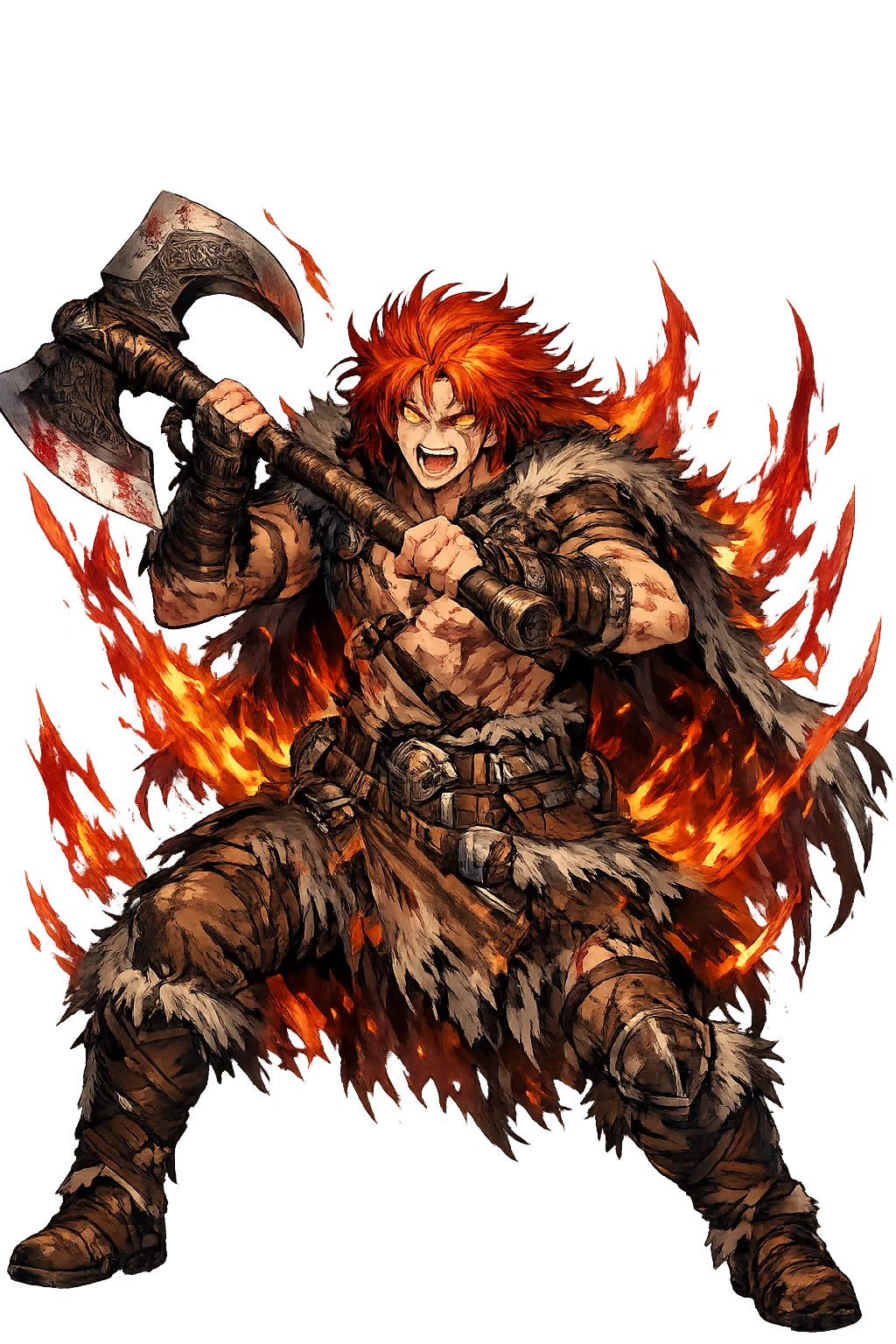
Later artistic and gaming depictions equip him with generic swords, axes, and a reddened, furious face; these are modern inventions without medieval warrant and should not be mistaken for iconography.
- Sword or axe — The weapons of a young warrior-god in a world rebuilt after Ragnarök
- Flame or reddened face — The visible sign of móð, the wrath or courage that gives him his name
- Giant lineage — His mother Járnsaxa marks him as part jotunn, bridging divine and giant blood
Archaeology & Evidence
No archaeological find names Móði, and none is expected: a god attested in a single Eddic stanza and Snorri's prose left no dedications, place-names, or images. His existence depends on the medieval manuscript tradition — the Codex Regius of the Poetic Edda (c. 1270) and the Prose Edda manuscripts. The material record does, however, document the cult of his father: hundreds of Mjöllnir pendants from the tenth and eleventh centuries survive across Scandinavia, and runestones such as Glavendrup (DR 209, Funen) and Sønder Kirkeby (DR 110, Falster) close their inscriptions with the formula 'may Þórr hallow these runes/monuments' (Þórr vígi). That is the material world in which a son of the thunder-god would be imagined inheriting his father's protective role.
Realm & Domain
Móði is the son of Þórr, the personification of wrath and courage. He appears in only a handful of passages, yet his role is consequential: he survives Ragnarök alongside his brother [[magni|Magni]] and inherits their father's hammer [[mjolnir|Mjölnir]]. Where Magni is 'mighty,' Móði is 'fierce' — the emotional force that drives the thunder-god's line forward into the new world.
Personified Wrath
His name is the Old Norse word for fierce courage and battle-fury.
Son of Thor
Named with Magni as Þórr's son in Snorri's kenning lists; the sources never record his mother.
Survivor of Ragnarök
He and Magni live through the twilight to inherit the renewed earth.
Heir of Mjölnir
After Þórr falls to the serpent, Móði and Magni take up the hammer.
Across Cultures
Móði has no clear non-Norse counterpart. His function — the personification of wrath or courage — resembles other Indo-European personified forces, such as the Greek Thumos or the Roman Furor, but he is specifically embedded in the genealogy of Þórr, and no ritual or cultic trace connects him to any wider tradition. His survival after Ragnarök places him in the small company of gods who bridge the old world and the new. In modern retellings he is often overshadowed by his brother [[magni|Magni]] and his father Þórr, but his name preserves an important Norse idea: that wrath, rightly directed, is a form of power.
Within the Norse tradition, closely related names in the corpus include [[alfheimr|Álfheimr]], [[buri|Búri]], [[eggther|Eggþér]], [[helheimr|Helheimr]], [[jormungandr|Jǫrmungandr]], and [[jotunheimr|Jötunheimr]].
Cultural Legacy
Móði's reception is thin by design: a god with one stanza and no myth offers little to retell. Modern handbooks and Heathen literature generally treat him together with [[magni|Magni]] as a paired inheritance — might and wrath — rather than as an independent figure, and he is occasionally invoked as a patron of berserk courage or directed anger. His largest popular exposure is Santa Monica Studio's God of War (2018), where Magni and Modi appear as recurring antagonists hunting the protagonists; the game separates their fates from the Eddic account, having both die before Ragnarök rather than survive it. The deeper legacy is lexical: the noun móðr and its compounds run through Icelandic prose wherever courage or rage is in play, so that the quality the god personifies long outlived the god himself.
The Scholarly Record
The account of Móði given in this edition rests on the witnesses and reference works listed below. Lexica and etymological dictionaries secure the form and meaning of the name; the literary and religious texts supply the narrative evidence.
- Poetic Edda: Vafþrúðnismál 51 (Móði and Magni inherit Mjǫllnir after Ragnarök).
- Snorri Sturluson, Prose Edda: Gylfaginning (genealogy and inheritance of Mjölnir).
- Snorri Sturluson, Prose Edda: Skáldskaparmál (kennings for Þórr's sons).
- Cleasby & Vigfusson, An Icelandic-English Dictionary (1874), s.v. móði.
- Zoëga, A Concise Dictionary of Old Icelandic (1910), s.v. móði.
- Simek, Rudolf, Dictionary of Northern Mythology.
- Lindow, John, Norse Mythology: A Guide to the Gods, Heroes, Rituals, and Beliefs.
A Meditation
Móði is the anger that survives. He does not have his father's epic battles or his brother's astonishing strength; what he has is the fury that keeps going after the world ends. In a pantheon full of larger-than-life actors, he is a small but necessary figure: the emotion that outlives the body.
The survival of Móði and Magni suggests that Þórr's power is not only physical but emotional. Might and wrath together inherit the hammer. The new world will need both: the strength to rebuild and the fire to protect what is rebuilt. Móði is that fire, banked but not extinguished, waiting for the next age.
The Unicode Restoration
Móði is classified as Tier 2: the original preserves at least one philological feature that ASCII cannot encode. The ASCII fallback modi still resolves everywhere, but it is the restored form that carries the name's full information. Across the 4 characters of the name, the restoration adjusts 2: 1 mark of stress (ó); 1 further adjustment (ð). That is the whole thesis of this temple: the marks are the message.
Character by Character
The journey from modi to Móði, one character at a time:
- m → M — Same, capitalized
- o → ó — Stress on o
- d → ð — Eth: voiced dental fricative
- i → i — Same
The Domain Name
The restored name is live as a working domain: móði.com, which the DNS carries in punycode form as xn--mi-wjal.com — an ASCII-compatible encoding that lets a non-ASCII name travel the global network without breaking older infrastructure. The visitor sees Móði; the machines see the encoding. That duality is the engineering compromise on which the entire restoration rests, and it is why a name written the way its own tradition wrote it in Younger Futhark can now be typed into any browser on earth.
The Norse Pantheon
Móði is one of 86 entries the PuniCodex lexicon catalogues under the Norse pantheon. The Pantheon page gathers the tradition's major figures in one place, and the Lexicon lets you filter all 895 restorations by tradition, tier, or script — the fastest way to see where this name sits among its kin.
Frequently Asked Questions
What does Móði mean? The traditional gloss is "The angry one."
Which tradition does Móði belong to? Móði is catalogued in the Norse pantheon of the PuniCodex lexicon.
Why is Móði classified as Tier 2? Because the original preserves at least one philological feature that ASCII cannot encode — and the marks in the restored spelling preserve exactly that evidence.
Is Móði a working domain? Yes — móði.com resolves today and routes to this temple.
What is the punycode for móði.com? The DNS encoding is xn--mi-wjal.com; browsers perform the translation automatically, so visitors only ever see the restored name.
Typing Móði
You do not need a special keyboard to use this restoration. The PuniCodex Type Tool converts the ASCII form modi into Móði as you type, and the browser extension offers the same conversion inside any text field. Copy the restored form, paste it into the address bar, and the DNS does the rest.
Sister Temples
Other temples in the Norse pantheon include Urðr, Valhǫll, and Váli — each with its own restoration story, its own scholarly record, and its own place in the lexicon.
Why This Restoration Matters
Pronunciation turns out to be the heart of the matter. The marks in Móði are instructions for the voice, and a web that strips them is a web that mispronounces the past at scale. The restoration hands the instructions back: say it as the evidence suggests, type it as the tradition wrote it, and let the punycode machinery do the quiet translation in between. That is all the PuniCodex project asks of the infrastructure — and everything it asks of you, the reader, is to use the whole name.
Explore Further
This post is one doorway into the temple. The home page carries the full character breakdown and the ambient canvas; the lore page tells the myths in long form; the Scholarly Edition preserves the sources, pronunciation data, and revision history; and the patron wall supports the restoration directly. For the wider map, browse the Lexicon, explore the Pantheon, or return to the PuniCodex blog.
Related Names
Sources
The full scholarly apparatus — every citation, revision, and review — lives in the Scholarly Edition. Key references for this post:
- Cleasby & Vigfusson, An Icelandic-English Dictionary, 2nd ed. with supplement, 1874.
- Poetic Edda (Eddukvæði), ed. Neckel-Kuhn; trans. Carolyn Larrington, Oxford World's Classics (2014); Codex Regius c. 1270.
- Snorri Sturluson, Prose Edda, trans. Anthony Faulkes, Everyman / Viking Society for Northern Research; composed c. 1220.
- Cleasby & Vigfusson, An Icelandic-English Dictionary (1874), s.v. móði, móðr.
- Poetic Edda: Vafþrúðnismál 51 (Móði and Magni inherit Mjǫllnir after Ragnarök).
- Snorri Sturluson, Prose Edda: Skáldskaparmál (kennings for Þórr's sons).
- Zoëga, A Concise Dictionary of Old Icelandic (1910), s.v. móðr.
- Lexicon authorities for this entry: Poetic Edda, Cleasby-Vigfusson.