
Reading Miðgarðr through the work it rules today
Every age hires the same gods; only the job titles change. Miðgarðr never stopped working.
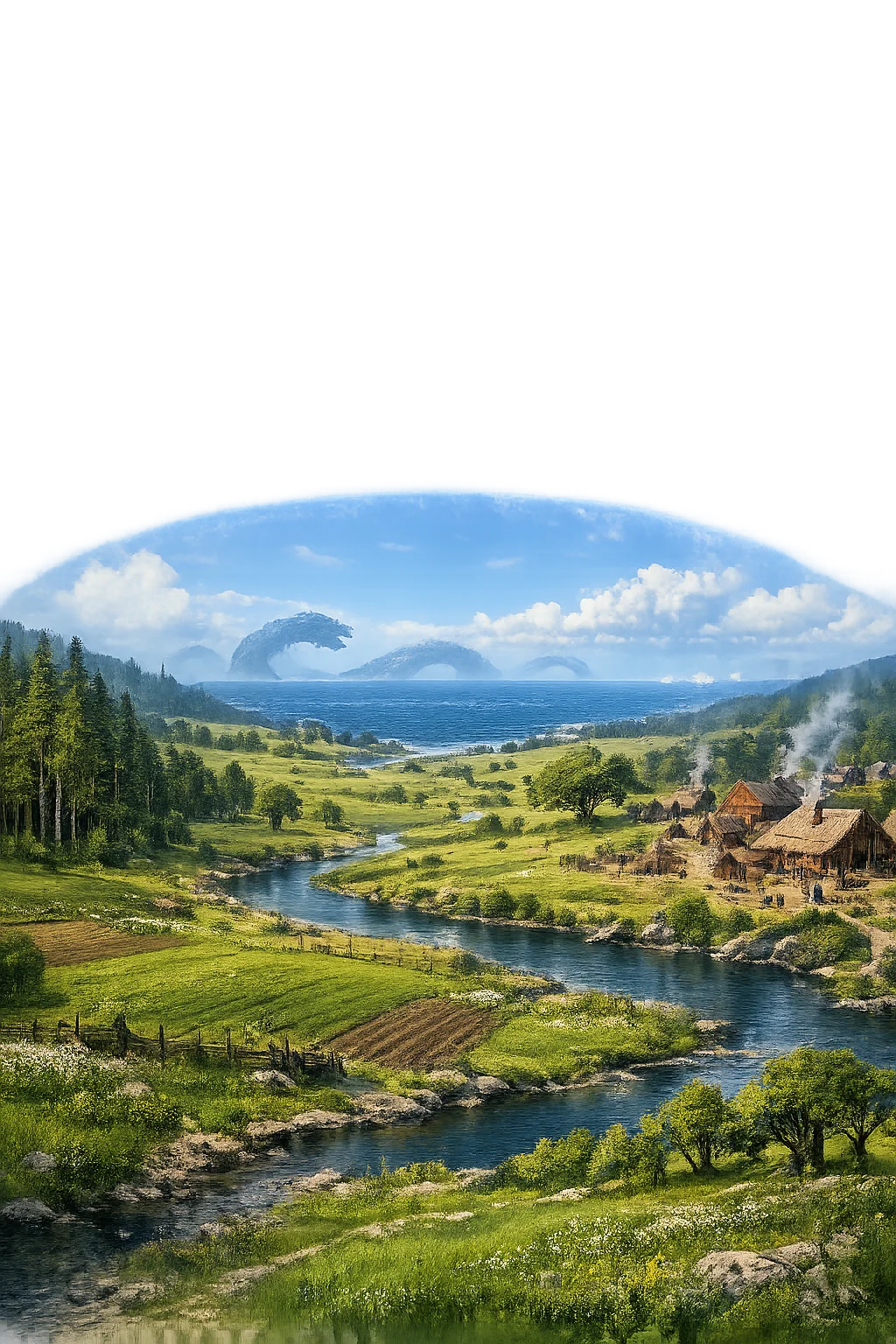
Miðgarðr is the middle enclosure, the world of human beings suspended between the divine realm of Ásgarðr above and the underworlds below. The gods carved it from Ymir's flesh, made its mountains from his bones, its seas from his blood, and set the Miðgarðsormr to encircle all land in the surrounding ocean. A fence of green fortification protects it from the giants, yet it remains permeable: gods cross its boundaries, and at Ragnarǫk those boundaries will fail. Within this ring dwell the races of women and men, placed there by the gods and granted the fields, forests, and shores that make mortal life possible. The very name survives in Old English middangeard and Old High German mittilagart, a shared Germanic image of the human dwelling-place ringed by the unknown. Miðgarðr is protected from the giants by the world-encircling sea and, in some sources, by a fence or the gods' vigilance. Its human inhabitants farm, trade, argue, and bury their dead within this bounded space. The concept gave Norse culture a powerful image of the civilized world as a fragile garden surrounded by wilderness, chaos, and the sea.
The pattern atlas — which maps every flagship temple to the industries its archetype demonstrably resonates with, each match argued and open to challenge — seats this temple in 4 industries. This file reads those seats the way they were earned: through the myths.
At a Glance
- Temple: Miðgarðr
- Pantheon: Norse
- Domain of influence: Middle Enclosure (Earth)
- Pattern seats: 4
- Sectors touched: Energy & Natural World · Culture & Entertainment · Commerce & Governance · Home & Lifestyle
- Strongest seat: Environmental & Climate Services
- Series: The Resonance Files, No. 153 of 271
The Myth at Work
The Making of Miðgarðr. After the sons of Borr slew the primeval giant Ymir, his body became the substance of the world. His flesh was fashioned into earth, his blood into the sea, his bones into mountains, his hair into trees, and his skull into the sky. — hold that image; the industries below are where it goes to work.
Fishing for the World Serpent. Þórr goes fishing with the giant Hymir, using the head of an ox as bait. He hooks none other than the Miðgarðsormr, the serpent that lies in the sea encircling Miðgarðr. — hold that image; the industries below are where it goes to work.
The Seats
Each of these is argued in the atlas with a weight and a why-line. What the atlas cannot fit in one line is the whole myth — so here is each seat with its story restored.
Environmental & Climate Services
Climate science, ecology, and sustainability consulting. (Sector: Energy & Natural World)
The why-line says it in one breath: The inhabited world as a fragile garden ringed by chaos — the sector's founding image. That is not a resemblance; it is the same act, performed in a newer building.
Gaming, Fantasy & Entertainment IP
Video games, streaming franchises, and fantasy worlds. (Sector: Culture & Entertainment)
The why-line says it in one breath: The middle enclosure is gaming’s most visited realm. That is not a resemblance; it is the same act, performed in a newer building.
Disaster Resilience & Recovery
Emergency management, recovery, and business continuity. (Sector: Commerce & Governance)
The why-line says it in one breath: A world whose boundaries hold only by vigilance and fail at Ragnarök; the perimeter problem made myth. That is not a resemblance; it is the same act, performed in a newer building.
Home, Hearth & Real Estate
Property, home goods, and domestic services. (Sector: Home & Lifestyle)
The middle enclosure — garðr is the yard — humanity's first fenced address with the hearth at its center. — the atlas stops there, out of discipline. The myth keeps going: the function Miðgarðr performs in the stories is precisely the function this industry sells.
Read the myth again after the seats and it stops sounding ancient: Miðgarðr is the middle enclosure, the world of human beings suspended between the divine realm of Ásgarðr above and the underworlds below. The age changed. The work did not.
The Method, Stated Plainly
None of this is numerology. A seat exists only where the match can be argued from the deity's documented domains and deeds — weighted, published, and falsifiable. The full derivation, the weights, and the challenge process are public on the methodology page. If a seat in this file reads wrong, the atlas itself tells you how to prove it — and the correction becomes part of the record.
For the Ones Who Work There
If you work in environmental & climate services, gaming, fantasy & entertainment ip, or any trade this temple holds a seat in, this is the honest version of what a placement means: your industry beside the story it has been re-telling all along — on the temple floor itself, before an audience that came specifically to read it. The patron tier and the advertising terms describe the mechanics; the resonance above describes the fit. The story is the pitch; the seats are just where it already works.
The File Continues
This is one of 271 Resonance Files — the third dispatch from every flagship temple, where the myths meet the markets. The temple's founding dispatch tells the name's story; its Restoration File tells the spelling's; the blog index holds the whole archive.
Continue the series — previous: Mídas (read it) · next: Mixcōātl (read it).
The Resonance Files are argued from the same canonical record as the pattern atlas itself: the lexicon, the lore catalog, and the cited sources. Every seat can be challenged at the methodology page — and the challenge is the point.