
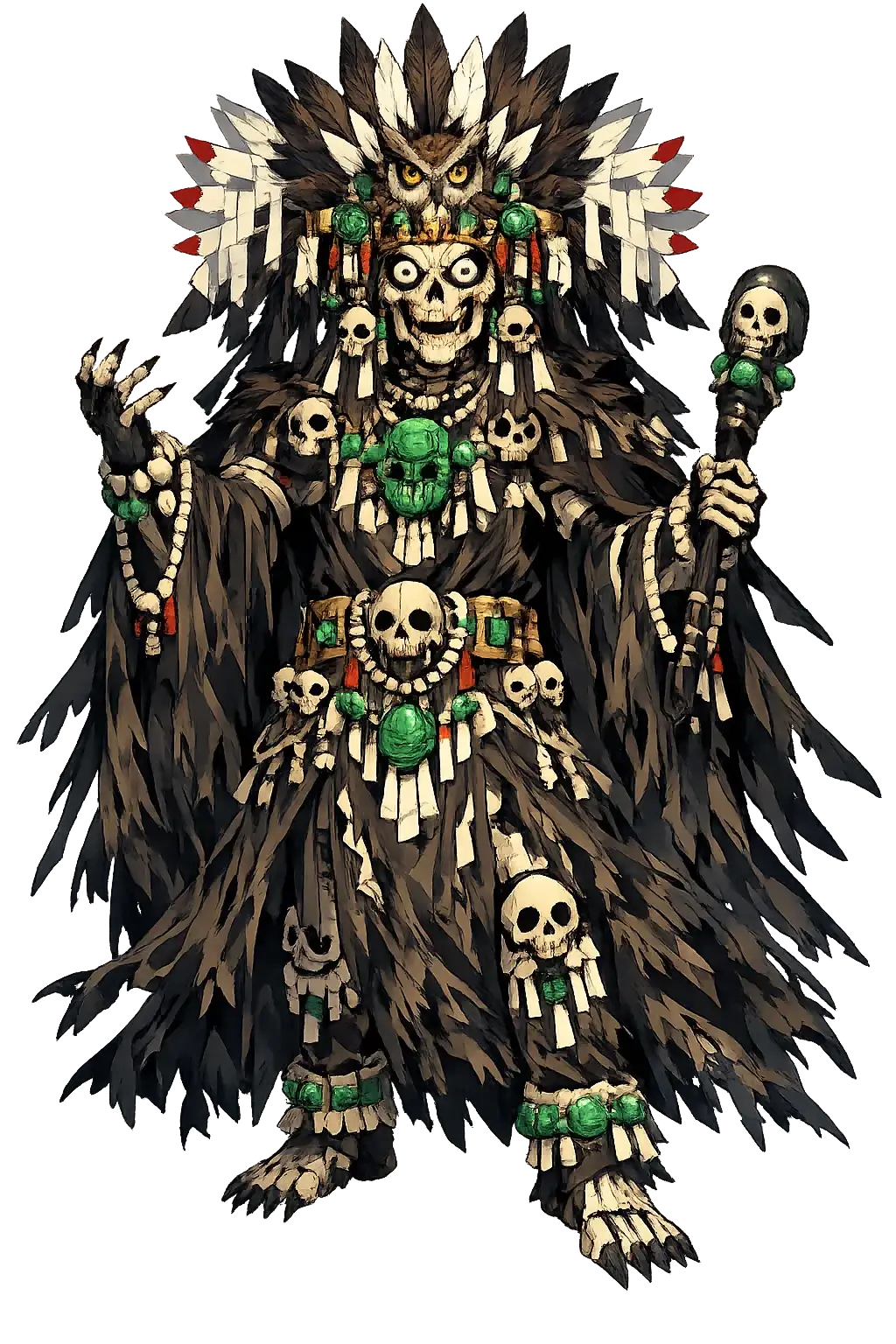
The provenance file on Mictlāntēcutli
The provenance file for Mictlāntēcutli. Nothing here is unsourced; that is what the file is for.
Provenance
1. The attestation. —, from the tradition's own record. On record: Sahagún, Florentine Codex, Leyenda de los Soles, Karttunen, An Analytical Dictionary of Nahuatl, López Austin, The Human Body and Ideology.
2. The preserved evidence. a → ā (Macron: long vowel); e → ē (Macron: long vowel) — absent from the ASCII form mictlantecutli, present in the restoration, verifiable against the sources above.
3. The narrative record. The Bones of the Old Age — After the Fourth Sun perished, Quetzalcōātl descended into Mictlān to retrieve the bones of earlier humans so that the gods could fashion a new race. Mictlāntēcutli agreed, on condition that Quetzalcōātl walk four times around his realm blowing a conch shell that had no holes. The Nine Descents — The dead do not immediately reach rest. For four years they travel downward through Chiconahualópan, 'The Place of the Nine Deserts' or nine hills: winds, mountains, jaguars, icy winds, arrows, stones, water, snakes, and lizards.
4. The current holding. The temple at /sites/mictlantecutli/, classified Tier 1. Tier-1 is not a compliment; it is a measurement. This restoration keeps something the ASCII form provably loses, and the measurement is repeatable.
5. The documented resonances. Funerary & Memorial Services, Music, Arts & Performance, Astrology, Tarot & Esoteric Services — seats argued and weighted in the pattern atlas, read through the myths in this temple's Resonance File.
6. The continuing record. Mictlāntēcutli presides over one of the world's most visually powerful death cults. The great monolith at the Museo Nacional de Antropología, its goggle eyes and fangs still terrifying, has become an emblem of Mexican antiquity.
At a Glance
- Restored name: Mictlāntēcutli
- ASCII form: mictlantecutli
- Meaning: "Lord of the Land of the Dead"
- Domain of influence: Lord of Mictlān, Death, Underworld
- Pantheon: Nahuatl
- Classification: Tier 1
- Original script: —
- Series: The Restoration Files, No. 151 of 271
The Emblems
The name does not travel alone. Skull — The face of the underworld lord and the memento mori carried by priests.; Owl — Night bird and messenger between the living and the dead.; Obsidian blade — The sacrificial knife (tecpatl) that opens the doorway to Mictlān.. Each emblem is filed in the temple's record with its own provenance, the same discipline the spelling gets.
For the Voice
'meek-TLAHN-tay-KOOT-lee' — keep the first 'a' and 'e' long, and release the final -tl as one tongue-flip. The reconstructed line runs `/mik.tlaːn.ˈteː.kutɬi/` — the temple's pronunciation atlas carries the phonemes one by one.
The Discipline It Answers To
This restoration belongs to Nahuatl, a tradition with its own exact discipline. The rules that govern it are not house style; they are the tradition's own scholarship, applied with the same care here as in any edition — and published, with the sources, so the file can be checked the way an edition can be checked. Tier-1 is not a compliment; it is a measurement. This restoration keeps something the ASCII form provably loses, and the measurement is repeatable.
The File Continues
Read the founding dispatch for the name's full story, the Resonance File for the archetype at work — or the whole archive in one sitting.
Continue the series — previous file: Mèngpó (read it here) · next file: Mídas (read it here).
The Restoration Files are written from the same canonical record as the temples themselves: the lexicon, the lore catalog, the pattern atlas, and the cited scholarly sources. If a file ever disagrees with its temple, the temple is right — tell us, and the file will be corrected.