
Mictlāntēcutli in 2026: why scholars still care
In 2026, names are treated as data points. Mictlāntēcutli is a reminder that they are also cultural artifacts — and that the difference matters for search engines, AI training corpora, and anyone who types the name of a Nahuatl figure into a browser. Scholars never stopped caring about the difference between mictlantecutli and Mictlāntēcutli; the web simply made that care actionable. What follows is the full scholarly picture — name, script, sound, myth, cult, and legacy — followed by the engineering compromise that lets a restored spelling live at a real address. The question is not whether the name is old. It is whether the digital world is old enough to hold it.
At a Glance
- Restored name: Mictlāntēcutli
- ASCII form: mictlantecutli
- Meaning: "Lord of the Land of the Dead"
- Domain of influence: Lord of Mictlān, Death, Underworld
- Pantheon: Nahuatl
- Classification: Tier 1
- Live domain: mictlāntēcutli.com
Overview
Mictlāntēcutli (mictlantecutli) — Lord of Mictlān, Death, Underworld · Lord of the Land of the Dead — belongs to the Nahuatl tradition, where it is catalogued under the domain "Lord of Mictlān, Death, Underworld". The name means "Lord of the Land of the Dead".
Mictlāntēcutli is the terrible king of Mictlān, the deepest underworld beneath the earth. He does not judge souls; he receives them. After a long descent through nine perilous levels, the dead arrive at his ash-coloured realm, where life is finally, utterly extinguished.
PuniCodex restores the name as Mictlāntēcutli and serves its temple at mictlāntēcutli.com. The original carries both stress and vowel length, and exactly one historically valid Unicode restoration exists, which places the name in Tier 1. The plain ASCII form mictlantecutli survives as a modern convenience imposed by the early domain-name system; the restoration, not the fallback, is the form the project defends as philologically complete.
The Name
The theonym is attested in colonial-period alphabetic Nahuatl, most prominently in the Florentine Codex, whose scribes wrote Mictlantecutli (also Mictlantecuhtli); no pre-conquest logophonetic spelling of the name survives. Etymologically it is a transparent compound: Mictlān, 'the Place of the Dead' — from mic-, the stem of miqui, 'to die,' plus the locative suffix -tlān — and tēcutli, 'lord, ruler.' The whole means 'Lord of the Land of the Dead.'
The ASCII form mictlantecutli survives only because the early domain-name system could not carry diacritics; it is a technological compromise, not an ancient spelling. The Unicode restoration Mictlāntēcutli marks the two long vowels — ā in the locative, ē in tēcutli — that Classical Nahuatl prosody requires and that colonial orthography never recorded. Because the original carries both stress and vowel length, and exactly one historically valid Unicode restoration exists, the name is classified Tier 1.
The letter-by-letter transformation runs:
- m → M — Same, capitalized
- i → i — Same
- c → c — Same
- t → t — Same
- l → l — Same
- a → ā — Macron: long vowel
- n → n — Same
- t → t — Same
- e → ē — Macron: long vowel
- c → c — Same
- u → u — Same
- t → t — Same
- l → l — Same
- i → i — Same
The project holds the domain mictlāntēcutli.com (xn--mictlntcutli-cnb8w.com) as the canonical home of this name.
The Original Script
Classical Nahuatl names survive in the alphabetic manuscripts of the colonial period, not in a fully deciphered pre-conquest phonetic script; the macron-bearing form shown here is a modern scholarly transliteration of the attested spoken name.
The form Mictlāntēcutli therefore encodes reconstructed pronunciation rather than an attested ancient spelling, and no mark in it is decorative.
The name is Nahuatl: mictlan ('place of the dead') + tēcutli ('lord'). Classical Nahuatl was written in a logophonetic tradition of pictographic glyphs, many of which were burned or lost after the conquest; the name now reaches us through alphabetic transcription in colonial sources such as the Florentine Codex. The macrons mark long vowels reconstructed by linguists; Spanish colonial spellings such as Mictlantecuhtli sometimes omit them.
Pronunciation
The reconstructed pronunciation of the name is /mik.tlaːn.ˈteː.kutɬi/ — Classical Nahuatl Reconstruction.
Phoneme by phoneme:
- mic- — Voiceless alveolar stop [mik], the root of mictli, 'death'.
- -tlān- — Long [aː] followed by lateral [l] and locative suffix -ān: 'place of the dead'.
- -tē- — Long [eː], honorific/intensive vowel in the word for 'lord'.
- -cutli — [ˈkutɬi], 'lord'; final -tl is the lateral affricate [tɬ], a single Nahuatl sound.
For the modern speaker, the closest approximation is: 'meek-TLAHN-tay-KOOT-lee' — keep the first 'a' and 'e' long, and release the final -tl as one tongue-flip.
Kindred and historical forms of the name:
- Nahuatl — Mictlāntēcutli, literally 'Lord of the Place of the Dead'.
- Spanish colonial — Mictlantecuhtli, the spelling used by Sahagún and the Florentine Codex.
- Related figure — Mictecacihuatl, his consort, Lady of the Dead.
The macrons on ā and ē mark reconstructed Classical Nahuatl vowel length, the feature that makes the restoration Tier 1. Final -tl is never pronounced as separate English 't' and 'l'.
Mythology
Mictlāntēcutli's myths are few but pivotal. He guards the bones of the previous creation, and the future of humankind depends on outwitting him.
The Bones of the Old Age (Cosmogony)
After the Fourth Sun perished, Quetzalcōātl descended into Mictlān to retrieve the bones of earlier humans so that the gods could fashion a new race. Mictlāntēcutli agreed, on condition that Quetzalcōātl walk four times around his realm blowing a conch shell that had no holes. Quetzalcōātl summoned worms to bore the shell and bees to make it sound, retrieved the bones, and fled. The lord of death sent a quail to trip him; the bones shattered, becoming the varied sizes of humankind.
The Nine Descents (Eschatology)
The dead do not immediately reach rest. For four years they travel downward through Chiconahualópan, 'The Place of the Nine Deserts' or nine hills: winds, mountains, jaguars, icy winds, arrows, stones, water, snakes, and lizards. Those who died ordinary deaths arrive at last in Mictlān; warriors, women who died in childbirth, and those drowned went instead to sunlit or watery paradises.
The Mockery of the God (Ritual)
During the festival of Tititl, a priest smeared with ashes and wearing the regalia of Mictlāntēcutli was raised on shoulders through the streets. The crowd pelted him with refuse and shouted insults, then lifted him down with offerings. The mockery was not contempt but negotiation: by abusing the image, the people begged death to stay its hand.
Symbols & Iconography
The iconography of Mictlāntēcutli concentrates in a small set of recurring attributes, each a compressed statement about death and its realm:
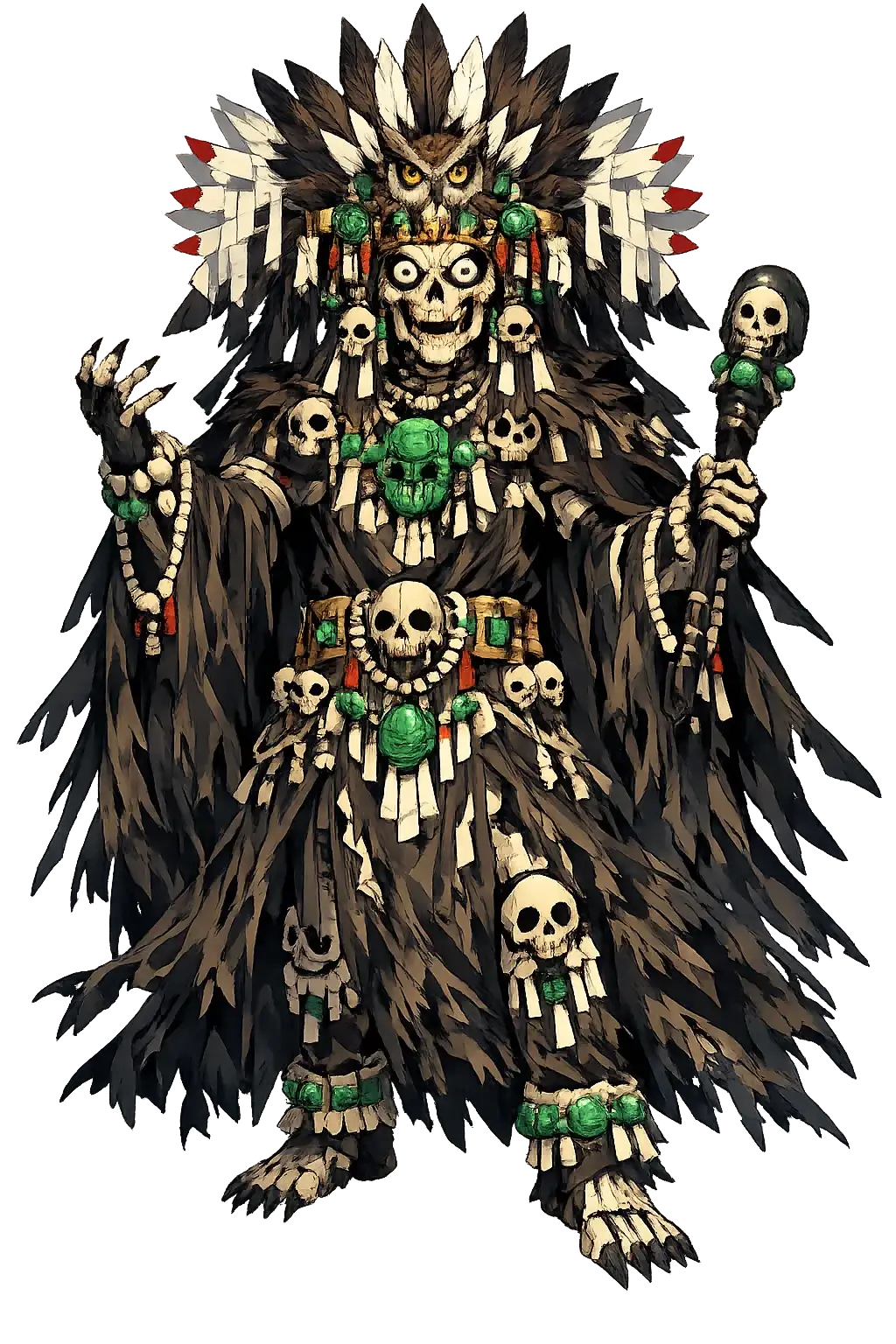
- Skull and skeletal body — The face of the underworld lord, ribs and vertebrae carved or painted in relief; the memento mori carried by his priests and shown by his impersonator at the feast of Tititl.
- Exposed liver — In stone images the god's liver hangs from his open chest; the liver was the seat of the ihiyōtl, the cold animistic breath the Nahua linked to night, fear, and the underworld.
- Owl — The night bird and messenger between the living and the dead, whose cry announced dying.
- Obsidian blade — The sacrificial knife (tecpatl) that opens the doorway to Mictlān.
- Paper banner (amatl) — Ritual paper rosettes and streamers, offerings for the dead, marking the wind that blows through the land of the dead.
- Owl — Night bird and messenger between the living and the dead.
- Paper banner (amate) — Ritual paper streamers marking the wind that blows through the land of the dead.
Archaeology & Evidence
No temple or cult precinct dedicated exclusively to Mictlāntēcutli has been identified, an absence that matches the literary record: the Mexica honoured him within funerary practice rather than with a state shrine on the order of the Templo Mayor. The material record is nonetheless real. Skeletal stone sculptures of the death lord — ribs and vertebrae carved in relief, the liver exposed, the skull framed by a headdress of paper rosettes — survive from Tenochtitlan's sacred precinct and are held in the Museo Nacional de Antropología. The Templo Mayor excavations recovered death imagery at every scale, from the tzompantli (skull rack) platforms of the precinct to the mortuary goods placed in its offerings. Most of what can be said of his cult, however, still comes from the textual testimony gathered in the Scholarly Sources section: the stones confirm the terror, but not the liturgy.
Realm & Domain
Mictlāntēcutli is the terrible king of Mictlān, the deepest underworld beneath the earth. He does not judge souls; he receives them. After a long descent through nine perilous levels, the dead arrive at his ash-coloured realm, where life is finally, utterly extinguished.
Nine Levels
The soul descends four years through wind, mountains, jaguars, and knives before reaching rest.
Lord of Bone
He appears as a flayed or skeletal figure with staring eyes and a jawless skull, adorned with paper banners.
Death as Cycle
Mictlān is not hellish punishment but the necessary destination of most mortals; new life rises from decay.
Impersonator
A living ixiptla wore the god's regalia and was sacrificed at the feast of Tititl.
Across Cultures
Spanish friars quickly identified Mictlāntēcutli with the Christian Devil and Death, and colonial art often shows him with European demonic features. Yet pre-contact Mictlāntēcutli was no tempter; he was an administrator of cosmic necessity. His consort Mictecacihuatl survives in the popular iconography of Día de los Muertos, especially the elegant Catrina, while Mictlāntēcutli himself underlies the skeletal disguises of the festival.
Within the Nahuatl tradition, closely related names in the corpus include [[cihuacoatl|Cihuacōātl]], [[coatlicue|Cōātlīcue]], [[huitzilopochtli|Huitzilopōchtli]], [[itzpapalotl|Itzpapālōtl]], [[quetzalcoatl|Quetzalcōātl]], and [[tlaloc|Tlāloc]].
Cultural Legacy
Mictlāntēcutli presides over the most visible death imagery of the ancient Americas. Skeletal stone figures of the death lord — ribs bared, liver exposed — hold a prominent place in the Mexica hall of Mexico's Museo Nacional de Antropología, and his visual language feeds directly into the modern cult of the dead: the calaveras of José Guadalupe Posada, the elegant Catrina that popular imagination ties to his consort Mictecacihuatl, and the altars of Día de Muertos, whose indigenous roots UNESCO recognized in 2008 by inscribing the 'Indigenous festivity dedicated to the dead' on the Representative List of the Intangible Cultural Heritage of Humanity. Contemporary Mexican and Chicano art returns to him not as a monster but as the dignified keeper of an unavoidable truth: death is the common inheritance of all who live under the Fifth Sun.
The Scholarly Record
No pre-conquest alphabetic hymn or prayer addressed to Mictlāntēcutli survives, and no colonial writer devoted a full treatise to him; the evidence must be assembled from the Florentine Codex's mortuary books, the single great narrative of the Leyenda de los Soles, and the pictorial codices of the Borgia Group, read through modern linguistic and ritual scholarship. The account given in this edition rests on the witnesses and reference works listed below.
- Sahagún, Florentine Codex.
- Leyenda de los Soles.
- Karttunen, An Analytical Dictionary of Nahuatl.
- López Austin, The Human Body and Ideology.
- Carrasco, Religions of Mesoamerica.
A Meditation
Mictlāntēcutli teaches that death is not an interruption but a destination. The four-year descent, the nine deserts, the final ash-coloured stillness: these are not punishments for wrongdoing but the architecture of mortality. In a culture that often hides death behind hospital curtains, Mictlāntēcutli demands visibility.
His realm is also, paradoxically, generative. Quetzalcōātl must steal from him to make humanity; maize grows from the rotting matter he oversees. To look at Mictlāntēcutli is to see that destruction and creation are two faces of the same cycle. The skull is not the end of meaning; it is where meaning begins again.
The Unicode Restoration
Mictlāntēcutli is classified as Tier 1: the original carries both stress and length, and only one valid Unicode restoration exists. The ASCII fallback mictlantecutli still resolves everywhere, but it is the restored form that carries the name's full information. Across the 14 characters of the name, the restoration adjusts 2: 2 marks of length (ā, ē). That is the whole thesis of this temple: the marks are the message.
Name Variations
The lexicon records 1 additional form of the name:
- Mictlantecutli (ascii) — Plain ASCII form
The temple uses Mictlāntēcutli as the primary form: it is the spelling that best balances philological accuracy with the practical limits of DNS.
Character by Character
The journey from mictlantecutli to Mictlāntēcutli, one character at a time:
- m → M — Same, capitalized
- i → i — Same
- c → c — Same
- t → t — Same
- l → l — Same
- a → ā — Macron: long vowel
- n → n — Same
- t → t — Same
- e → ē — Macron: long vowel
- c → c — Same
- u → u — Same
- t → t — Same
- l → l — Same
- i → i — Same
The Domain Name
The restored name is live as a working domain: mictlāntēcutli.com, which the DNS carries in punycode form as xn--mictlntcutli-cnb8w.com — an ASCII-compatible encoding that lets a non-ASCII name travel the global network without breaking older infrastructure. The visitor sees Mictlāntēcutli; the machines see the encoding. That duality is the engineering compromise on which the entire restoration rests, and it is why a name written the way its own tradition wrote it in Nahuatl transcription can now be typed into any browser on earth.
The Nahuatl Pantheon
Mictlāntēcutli is one of 28 entries the PuniCodex lexicon catalogues under the Nahuatl pantheon. The Pantheon page gathers the tradition's major figures in one place, and the Lexicon lets you filter all 895 restorations by tradition, tier, or script — the fastest way to see where this name sits among its kin.
Frequently Asked Questions
What does Mictlāntēcutli mean? The traditional gloss is "Lord of the Land of the Dead."
Which tradition does Mictlāntēcutli belong to? Mictlāntēcutli is catalogued in the Nahuatl pantheon of the PuniCodex lexicon.
Why is Mictlāntēcutli classified as Tier 1? Because the original carries both stress and length, and only one valid Unicode restoration exists — and the marks in the restored spelling preserve exactly that evidence.
Is Mictlāntēcutli a working domain? Yes — mictlāntēcutli.com resolves today and routes to this temple.
What is the punycode for mictlāntēcutli.com? The DNS encoding is xn--mictlntcutli-cnb8w.com; browsers perform the translation automatically, so visitors only ever see the restored name.
Typing Mictlāntēcutli
You do not need a special keyboard to use this restoration. The PuniCodex Type Tool converts the ASCII form mictlantecutli into Mictlāntēcutli as you type, and the browser extension offers the same conversion inside any text field. Copy the restored form, paste it into the address bar, and the DNS does the rest.
Sister Temples
Other temples in the Nahuatl pantheon include Xōlōtl, Cōātlīcue, and Metztli — each with its own restoration story, its own scholarly record, and its own place in the lexicon.
Why This Restoration Matters
In 2026 the stakes are practical. Search indexes, language models, and localization pipelines all inherit whatever spelling the web normalizes — which means every Unicode domain is also a training signal. Mictlāntēcutli teaches the machinery that the restored form exists, that it is used, and that it points to a real place. That is why a project built on philology ends up caring about DNS: the infrastructure decides which names the future sees. This restoration makes sure the future sees the whole name.
Explore Further
This post is one doorway into the temple. The home page carries the full character breakdown and the ambient canvas; the lore page tells the myths in long form; the Scholarly Edition preserves the sources, pronunciation data, and revision history; and the patron wall supports the restoration directly. For the wider map, browse the Lexicon, explore the Pantheon, or return to the PuniCodex blog.
Related Names
Sources
The full scholarly apparatus — every citation, revision, and review — lives in the Scholarly Edition. Key references for this post:
- Sahagún, Florentine Codex.
- Leyenda de los Soles.
- Karttunen, An Analytical Dictionary of Nahuatl.
- López Austin, The Human Body and Ideology: Concepts of the Ancient Nahuas.
- Lexicon authorities for this entry: Karttunen, Sahagún, Florentine Codex.