
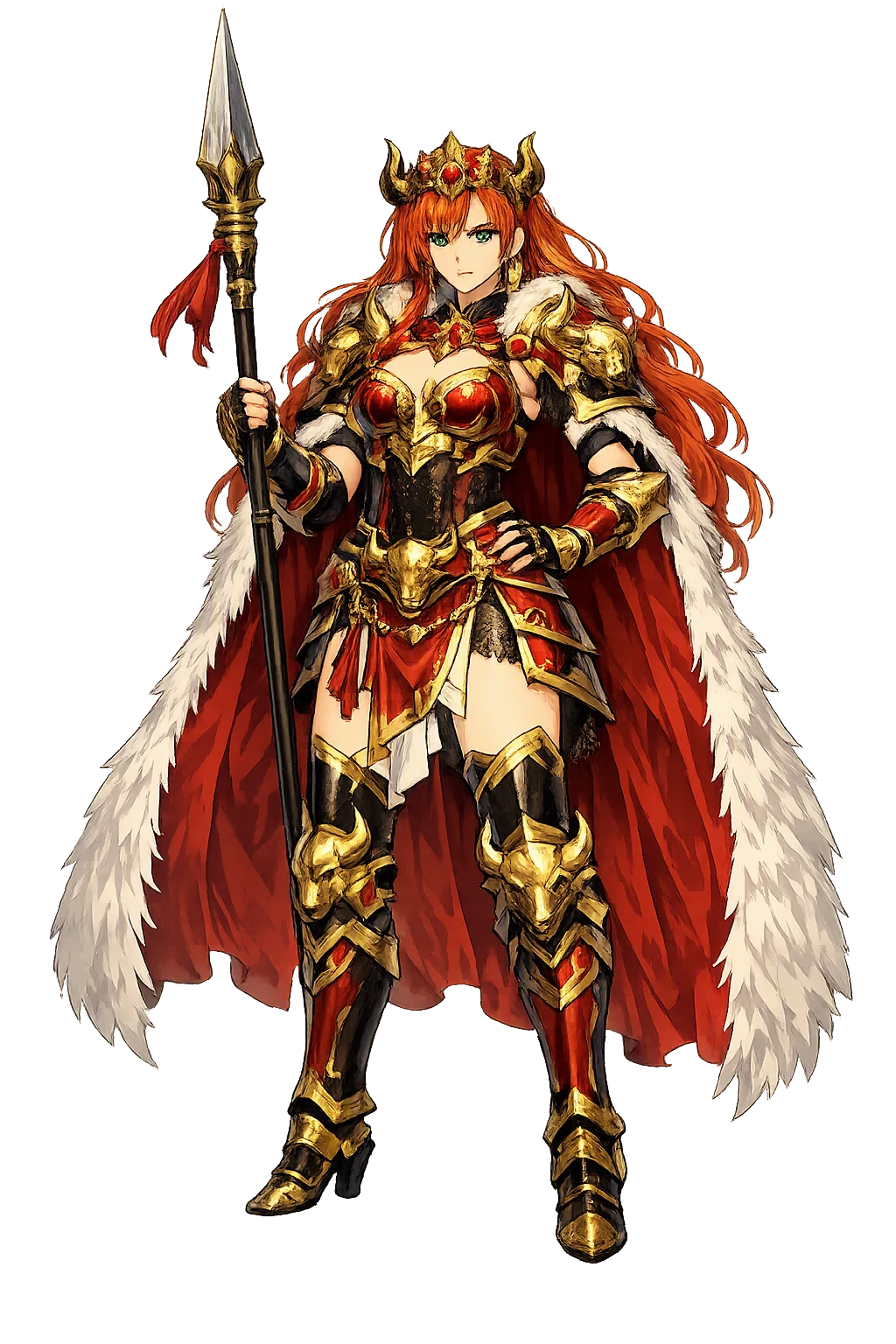
Medb: the stories first, then the spelling
The marks in Medb make the most sense standing next to the myths they have to carry. So the myths come first.
The Stories That Carry the Name
The Pillow-Talk. One night at Crúachan, when the royal bed had been made for Medb and Ailill, they fell into a 'bolster-conversation' — comrac chind cherchailli — and Ailill boasted that the woman married to a wealthy man is well off. Medb answered that she was well off before him: daughter of Eochu Feidlech, high king of Ireland, and the wealthier of the two. To settle it they had every treasure counted — cups, rings, cattle, sheep, horses — and the tally came out exactly even, save one item: the great bull Finnbennach, born in Medb's herd, had scorned to be counted a woman's chattel and walked over into Ailill's, where he stood as the White-Horned of Connacht.
The Bride-Gift Speech. The Táin lets Medb state her own terms, and the speech is the charter of her queenship. Daughter of the high king, wooed by the kings of Ireland, she refused them all, she says, 'for I asked a strange bride-gift such as no woman before me had asked of a man of the men of Ireland — a husband without meanness, without jealousy, without fear. ' If he were mean, their wealth could not sit together, for she is generous in gifts; if jealous, she could not live beside him, 'for I was never without one man in the shadow of another'; if fearful, he would shame her in the front of every fight.
The Debility and the Boy at the Ford. Medb timed the raid for the cess noínden, the pangs of the Ulstermen — the debility laid on the warriors of Ulster by Macha, whom they had forced to race the king's horses when she was great with child. With Ulster's fighting-men abed, Medb marched the hosting of four provinces north — Connacht's own, the Leinster Galeóin, and the exiles of Ulster under Fergus mac Róich, who knew every road and ford of the way and, the tale says plainly, shared the queen's bed with Ailill's leave, for the road could not be found without him. One boy stood against the whole hosting: Cú Chulainn, untouched by the debility, who held the fords in single combat and took the heads of the best of Connacht one by one.
And Here Is What the Spelling Preserves
At a Glance
- Restored name: Medb
- ASCII form: medb
- Meaning: "'The intoxicating one' (Old Irish medb, cognate with 'mead'), Queen of Connacht who drives the cattle raid of the Táin Bó Cúailnge."
- Domain of influence: Sovereignty, War, Intoxication
- Pantheon: Celtic
- Classification: Tier 2
- Original script: —
- Series: The Restoration Files, No. 224 of 397
The Name Travels
The Welsh corpus preserves no Medb — but it preserves her word: Welsh meddw, 'drunk', is the same adjective, and the Mabinogi gives the Brythonic side of the theme she embodies: Rhiannon arriving as a mounted marvel no rider can catch, and the footholder Goewin whose office is bound to Math's life, are the Welsh faces of the kingship-and-goddess complex that Mac Cana traced through Irish literature. Medb's deepest kin are lexical and ritual at once.
The Address It Earned
The temple of Medb stands at /sites/medb/ — lore, scholars, patterns — because a name carrying this much story deserves more than a parking page. The restoration keeps one feature the ASCII form drops. One is enough to matter, and the label says so plainly: Tier-2.
The File Continues
Read the founding dispatch for the name's full story, the Resonance File for the archetype at work — or the whole archive in one sitting.
Continue the series — previous file: Māzǔ (read it here) · next file: Médousa (read it here).
The Restoration Files are written from the same canonical record as the temples themselves: the lexicon, the lore catalog, the pattern atlas, and the cited scholarly sources. If a file ever disagrees with its temple, the temple is right — tell us, and the file will be corrected.